being a teacher, being me

It’s Only Been a Year – Happy Blogday to Me

A year ago, yesterday, I started this blog with a very simple goal in mind; write. On the urgings of my incredible husband who thought I had a story to tell, I ventured into blogging with no plan other than to keep it honest and reflective. Now as my first milestone in the blogging world passed, I am grateful for his insistence. To say that writing this blog has been life changing is not giving it enough credit. Rather than bore you with all of the details of how my life has been changed, I will only highlight a few things. So blogging stopped me from:

Wasting away with my ideas. Who knew there were others out there on a journey similar to mine? For those people who have cheered me on, thank you. And for those people who have questioned, dissed, and torn me apart – thank you as well. Through constant questioning I have been able to refine, reflect, and realize that I am a human being that makes mistakes and sometimes has bad ideas. What a gift that is.

Being dishonest. I couldn’t just write about how I was going to change my teaching and my life, I actually had to do it. Putting my thoughts out in public meant accountability, I want to make sure I actually do all of the things I so proudly exclaim. So if you ever stop by my classroom, yes,it does actually run the way I write about.

Becoming stagnant. If I didn’t change, I wouldn’t have anything to write about, I can just imagine a blog detailing how I am still doing the same thing every day. This has been a journey of teaching and I can see the growth when I reflect.

Being anonymous. It is much easier to hide behind the anonymous label when I reach out but having this blog has offed me a “new” identity and one that I am very proud of. Being an introvert in an extroverts body has certainly led to a lot of awkwardness but I get now how my kids feel when I put them on the spot as well. If we can’t do it comfortably, why should our students?

Quitting teaching. Last year I was ready to quit. I didn’t have my purpose, I didn’t have the drive, and I certainly didn’t feel the passion. Now? I want to change the world, I want to reach all of my students, I want to grown with them and learn from them.

So thank you people, thank you Brandon, thank you to the haters and the believers. Who knows how long my blogging journey will last, but for now I am grateful for the year I have conquered. There have been tears, laugher, many questions and lots of brutal honesty, the next year can only get better (and more honest).
advice, being a teacher, being me, Interview, new teacher

So You Want a Teaching Job – 10 Tips for a Better Interview

10tips
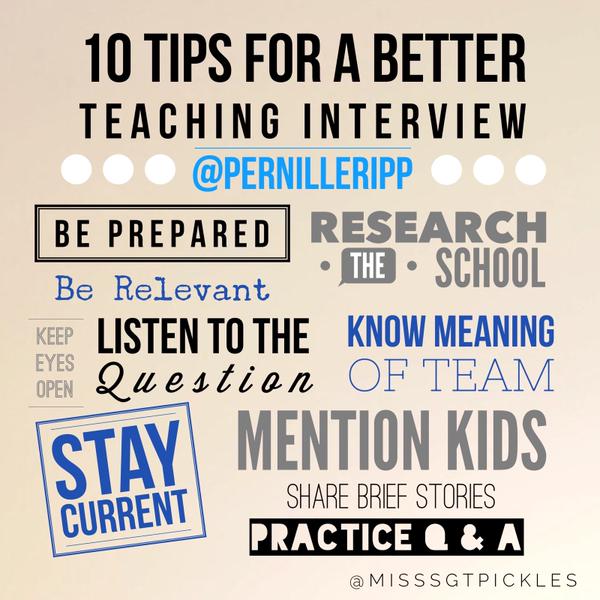
Thank you misssgtpickles for the image!

Every year, even as a rookie teacher, I have had the extreme privilege of sitting in on interviews for both teaching and specialist positions.  Every time I have been amazed at the quality of candidates that are available to us but also stumped once in a while when a candidate just isn’t all that prepared.  So why not offer up some tips for anyone trying to land that sometime elusive teaching job?

  1. Be prepared.  Yes, I know this sounds like an “of course” but there have been times where I have wondered whether the person even knew where they were interviewing or what they were interviewing for.  So prepare for this like you would your first day of teaching.
  2. Be relevant.  Many schools like to see something you have made, whether you bring artifacts, a video, or a link to something.  Make sure that the things you bring to show are current and fit the job.  If the things you bring have nothing to do with the position you are interviewing for, then don’t bring it.  If it fits with the interview bring it up during it, don’t just let it lie in front of you.
  3. Listen to the question.  Teachers tend to like to talk and sometimes we are not the best listeners, this is the time to tune in.  Really listen to the question being asked and then answer it.  This is not the time to stray off topic or think you know what the question is before it has been completed.  You can always ask for them to repeat it.
  4. Stay current.  I was expecting my first child my first year of teaching but that did not stop me from taking classes nor reading books.  There simply is no excuse these days to not participate in professional development,so be active in your professional development.  Take a class, read books, get connected, do something that shows that teaching is passion, not just a job.
  5. Research the school.  Most schools have websites that provide a description for you to read and then use.  We want to know why you want to work for this specific school, not why you want to be a teacher.  Make us feel wanted.
  6. Mention kids.  Another “duh” but there have been interviews where the person never mentioned kids or their desire to work with them, that sends up a major red flag.
  7. Figure out what “team” means.  I have never heard of an job that didn’t require someone to work as part of a team, so come up with a great description of what being a team player means to you and make sure it doesn’t just talk about how much you will bring to the team, what will the team bring to you?
  8. Keep your eyes open.  I know nerves can get in the way  but if you speak with your eyes semi-closed now is the time to open them up and look at people.  This goes for smiling and any other body language that says you are eager, passionate, and with it.
  9. Share stories but keep them brief.  I like hearing about past experiences but only if that story is 100% relevant and brief.  So stay on point and share, but not to every question.
  10. Practice your answers and questions.  If you google “teacher interview questions” you will find enough questions to give you a baseline for what to expect.  Think your answers through and figure out questions  you want to ask as well.  It shows you care, that you are motivated, and that this job matters to you.

Of course, there are experts out there that know way more about this than me but this is what i would tell my friends who are interviewing.  So good luck to all of those seeking jobs.

After some thought it is now time to add the one I forgot:

11.  Google yourself!  If you are a new teacher with an online identity; wahoo!  However, google yourself before the interview to see what a prospective employer might see and then set up some privacy settings if you don’t like what they find.  Results of your awesome blog or schooling is great, pictures of you drinking on Facebook is not.

12.  And finally, be excited, be humble, and have questions that you want to ask at the end.  I have always asked; What are you hoping to find in a candidate?” because ti allows the interview team to tell you their vision.  Remember you are looking for a great fit as well, not just a job.

Enhanced by Zemanta
summer, teachers

You Have the Summer Off, Really?

I know people mean well.  I know they think I am exhausted from dealing with students, demanding tests, and just the overall misery of being a teacher in America.  But they are wrong.  I am not exhausted, I have never just “dealt with” students or misery (dreadful tests – yes).  So when someone tells me that they survived the school year, I cringe, and when someone asks me how excited I am to have the summer “off” I stop and pause.  I am excited to spend more time with my family and do summer things, but excited about having off, no not really.

I don’t have the summer off.  I never have since deciding to be a teacher.  When I was going to college I would work extra hours and take summer classes.  Since getting my teaching job, I have taught summer school, taken classes and just kept my brain engaged.  And while many choices are voluntary, I do it with one big picture in mind; a better educational experience for my students.  This post is not to whine, I make the choices about my time, but it is meant to make people pause before they state that teachers have 3 months off and have it so easy.  So here is what I have been up to:

  • I blog almost daily to keep myself reflective and engaged.
  • I am getting ready to present twice at the Reform Symposium 3.  Once on student blogging and once with my great friend Matt on the connection and collaboration between our very different classrooms.
  • I have finished editing an upcoming article on the Global Read Aloud for ISTE’s magazine “Learning & Leading with Technology” to be published in November.
  • I have written a guest post for VolunteerSpot on what we wish we could tell parents but don’t.
  • I have finished doing a double blind review of a great book to be published by SolutionTree.
  • I have engaged in deep conversation about best practices and student blogging on an almost daily basis with individual educators looking to make a change.
  • I am preparing a weeklong professional development class I am teaching in my district in August on how to integrate technology into your classroom.
  • I have revamped my school’s old website and converted it to a blog.
  • I have changed my own classroom website from Tumblr to Blogger due to security issues.
  • I have worked on revamping the Global Read Aloud website to allow for author collaboration (email me to let me know if you want to be a collaborator).
  • I have cleaned my classroom and sorted all of my 4th grade curriculum to pass on to the new 4th grade teacher.
And that is all in the first week of vacation.  So while bettering myself is a choice and I may do more than other people I fit it into my daughter’s schedule and we make it work.  Next week when I leave for Denmark I have 3 books I am bringing with me all education related since I want to revamp my reading program.  So the next time someone feels the urge to tell teachers how lucky they are to have 3 months off, think about, maybe ask them instead what they plan on doing this summer.  The answer may surprise you.
alfie kohn, behavior, Classroom, punishment, Teacher

So I Gave Up Punishment and the Kids Still Behaved

This year I gave up my inane punishment plans.  Out went the sticks, the cups, the posters, the pointed fingers and definitely the lost recesses.  No more check-marks, or charts to explain what that check-mark meant, no more raised voice telling a child they better behave or else.  Some thought I was crazy, I thought I was crazy, and yet, here I am ready to do it again next year.  So what happened?

Well, a lot of conversations.  If just one child was off that day, disruptive, disrespectful and so on, it was usually handled through a quiet conversation off to the side or in their ear.  Sometimes we went in the hallway.  I tried to limit the times I called out their names and I spoke to them as human beings.  No more teacher from the top, I am going to get you if you don’t listen, but rather, “Do you see what your behavior is doing for your learning?”  Believe it or not, framed in a way where they understood what the loss was = the learning, there was better behavior or at least an attempt to behave.  And that was a central part of my plan; make the learning something they don’t want to miss.  Most kids do not want to miss recess because they have a lot of fun and hang out with their friends, which is why it is such a favored punishment.  Hit them where it hurst kind of thing.  So I decided to make my classroom fun, exciting, and collaborative.  That meant that students actually wanted to participate and not miss out.

Sometimes my whole class was off; jumpy, jiggly, or falling asleep.  In the past I would have yelled, droned on, and probably lectured about the importance of school.  No surprise there that usually didn’t work at all.  So then I would just get mad, tighten the reins and exert my control.  After all, I was the adult here and the one that should decide everything.  Yeah, didn’t work so well.  This year I instead changed my teaching and learning.  While we may have had certain activities planned for that day they would be modified to require movement and discussion or totally changed if I could.  The learning goals usually stayed the same, the method didn’t.  Often this took care of a lot of behavior that would have led to a check-mark before.  And I think that is central to this whole thing; bad behavior often comes from disengagement and boredom.  So when we change our classrooms to give students more outlet for their energy, bad behavior reduces.  My worst days were the days that I hadn’t considered my students needs enough, the days were there was too much sitting down and not enough choice.

In the beginning it was hard.  I so instinctually wanted to say “Move your stick!” that I actually had to grind my teeth.  With time it got easier.  The students knew when they were misbehaving because we discussed it.  If the whole class or a majority of students were off we had a class meeting.  Sounds like a lot of time spent on talking?  Yes, but I would have been spending the same time yelling at the kids and doling out punishment.  The kids got used to it and many of them relished the fact that they were given a voice in their behavior and how to fix it, rather than a dictation from me.  Kids started keeping each other in line as well, asking others to be quiet when need be or to work more focused.  They knew what the expectations were for the different learning settings because we had set them together.  This was our classroom, not mine.

So did it work?  Absolutely, I would never go back.  I didn’t take away recess but had it reserved to work with the kids that needed it, I made fewer phone calls home, and I sent a kid to the office twice the whole year for recess related stuff.  I am sure there are tougher classes out there than mine, but this was your every day average American elementary class.  We had the talkers, the interrupters, the disrespectful, the fighters, and the sleepers.  And it worked for them as well.  The kids felt part of something, something big, and they let me know on the last day of school just how much it meant to them.  They relished the voice they had, even when it came to their own consequences.  They relished that rewards were no longer personal but rather classroom-wide whenever I felt like it.  Kids were not singled out for horrible behavior and so I didn’t have “that kid” that everyone knew would get in trouble.  Instead we were all there as learners being rewarded through our community rather than punished.  Yesterday while preparing form y switch from 4th to 5th, I put my old punishment cups to move your stick in into the lounge.  I hope no one picks them up.

Enhanced by Zemanta
being a teacher, choices, Student-centered, trust

5 + 1 Things I Learned This Year

I was recently asked what would be my top 5 things I have learned this past year in my journey to radically change my classroom.  So after some deep pondering and gut checks, here are the lessons I have learned, or the top 5 + 1.

  1. Give them choice (and a voice).  The number one thing my students said they loved was the fact that they had a choice and a voice.  As teachers we are taught that we are the only experts but this is so far from the truth.  My students have a lot of background knowledge and a lot of enthusiasm so letting them choose the type of project they wanted to create or how they wanted to learn something meant there was buy in.   No longer was learning mandated, there was actual buy-in from everyone.
  2. Trust your students.  I was not sure that my students could handle all of the responsibility I was giving them but throughout the year I was proven wrong again and again.  In fact, my students could probably have handled even more.  Trust also means that if they tell you something not so nice, you should celebrate it, not get upset.  The fact that my students trusted me enough to tell me something was boring is something that I relish and then learned from.  
  3. Trust yourself.  I knew I had to make big changes in my room and yet I questioned myself throughout the year.  was not giving them a letter grade really benefitting them?  Was not having punishment in my classroom better for all of us?  Were we accomplishing as much as we should have?  My gut told me I was doing the right thing and yet doubt snuck in sometimes, in the end, do what you believe in and then stand behind it.  There is a reason your common sense is telling you something is amiss and needs to be fixed, so fix it to suit you.
  4. Ask yourself the tough questions.  I asked myself whether I would be a student in my own classroom.  Before this year, the answer would have been a resounding no.  Now that answer has changed.  In fact, I love being in my classroom as much as my students do.  School should be about learning, yes, but that doesn’t mean it can’t be engaging and enticing at the same time.
  5. Give yourself a break.  There were days were I sucked as a teacher.   Days were I pined for inane punishment just to make them behave or were I raised my voice.  There were days were I didn’t feel like giving feedback or having lengthy conversations about projects.  Some days I just wanted to lecture and be done with it.  Thankfully my students snapped me out of that really quickly.  You are not perfect, you never will be, and that is ok.  Trust the direction you are taking and make adjustments as you see fit.  
  6. Be Quiet!  Teaching should not be about teachers pouring information into the heads of students, but rather teachers as a guide letting students explore, create, and make connections.  When we let the students own the classroom and the discussion they also take ownership of the learning, and that is a beautiful thing indeed.  So get off the stage but set it up for them to learn and then stop talking.  Much like we ask our parents to not help with homework, we should also ask ourselves to not take away the pleasure of learning.  

So there they are; my biggest lessons this year.  I am already excitedly planning for my transition to 5th grade next year and reevaluating what worked, what sucked, and what will I definitely do differently.  A new year brings new challenges and for that I am thankful.

Enhanced by Zemanta
being a teacher, Dream

Allow Yourself to Dream

Cross posted from the fantastic Cooperative Catalyst


I do my best teaching while I dream.  Far away from my own cowardice that tells me to stick within the lines, follow the lesson plan, and to not deviate off the trodden path.  I do my best teaching right before sleep comes and envelopes me, right before the stress of the day falls away, leaving only time to think of what can be done.  That is when I think of how I will reach all of my students.  This is where the labels are cast aside and only ability and tenacity shine the brightest.  This is when I fully believe that they can all achieve everything.
In college, I was taught not to dream.  Dreams were for people without teaching degrees, people that might make a warm and fuzzy teacher, a softie,  but certainly not someone who made their students achieve.  Instead I was told to plan, plan, and plan some more.  Read the standards, correlate them, and throw in some spice for those students with minor special needs that may pop up in your classroom.  English language learners?  No problemo; just throw in some pre-teaching of the vocabulary and off they will go. I was ready to teach them all that school was fun and useful.  And then reality struck and I looked at the list of my not so minor disabled students, my english language learners that did not just need vocabulary, and even that one child that was just so angry at the world.  And so I planned some more.
After a year or two with glazed eyes and long, drawn out speeches about how important it all was, I dreamed a little.  I dreamt of a classroom that students wanted to come to.  A room where learning was loud, excited and maybe not always practical.  And so when I was dozing every night, I would think that maybe I could try one little thing, maybe that would not hurt my plans so much if instead of planning every minute of the lesson, I asked the students what they wanted to do instead.  Maybe they could dream along with me?
So I have become a dreamer, one who believes that children have a valid voice in their own education.  One that believes that parents should be involved in the school, one that believes we must drop the labels and see our children for what they are; dreamers just like us.  They do not dream of a school that talks at them, but one where there is engaging conversation.  They do not dream of being drones chained to desks being stuffed with information, but rather really learning through experimentation, thinking, and yes even dreaming.  So let them dream, or even more importantly, let yourself dream.  For it is in these dream that we realize just how powerful our classroom can be.  It is in these dreams that we shape the future and the future shapes us.  We are a world of dreamers, if only we choose to be.


Enhanced by Zemanta