advice, aha moment, Be the change, being a teacher, creativity, students

How to Unleash the Uncreative Children

image from icanread

I was a dreadfully uncreative child.  Sure, I would draw trees, flowers, animals, but whenever someone told me to unleash my creativity, my heart sank and my page usually stayed empty.  Writing was slightly better, but I tended to stay on tangents so much that even I couldn’t tell my stories apart after awhile.  And singing?  While I loved to sing, I couldn’t just create something out of thin air no matter how hard I wanted to.  No, I would never be a jazz singer.

When I look back on my childhood I see that I was probably not alone.  Many of my friends weren’t explosively creative either and while these days when we have uncreative children we tend to blame our school system, I think it was just the way we were.  We didn’t know how to be creative so we weren’t.

I see this play out in my classroom as well.  I ask students to come up with whatever type of project they want and they go into a slight panic, not quite sure where to go with that much choice.  Or tell them to write a story about anything they want and some of them are so stuck in a writers block that they actually sit there frozen, never even lifting their pencils.  So what can be done with those kids that are stuck in a panic battled with creativity?  How can we unleash their potential?

  • Give them limited choice.  I think choice is one of the biggest gifts we can give to students, however, to some the  thought of free choice limits their imagination rather than urging them to create.  So give them some choices and then urge them forward.
  • Give them examples.  I know this sounds counter-intuitive to spark creativity but often some students simple need to see what is possible before they venture out on their own.  Sure, they may borrow ideas from what we show but in the end they still create.
  • Check in often.  While we tend to think of creativity as an adult-less venture, those kids that struggle with the process need check-ins and reassurance letting them know they are on the right track and help getting unstuck.
  • Celebrate the small risks.  We tend to look for the impressive but when it comes to some students, we need to celebrate even the little ventures into creativity.  Boost their self-esteem and let them know that what they are doing is right.
  • Praise, praise, praise.  As an uncreative child I always thought I was doing it wrong, if someone had told me I was doing it right, I would have had more faith in myself.  Often lack of creativity comes from the same place as lack of self-confidence.  Make sure it is not empty praise but rather specific and to the point.
  • Give options to collaborate.  I almost always give students the choice to have partners in projects simply because they spur each other on.
  • Break the mold of creativity.  We tend to only allow for creativity within certain subjects but why not open up all of our subjects to creative thought and exploration?  Some students will do better unleashing their genius within math than literacy.  Make room for them as well.
  • Be persistent.  I was almost allowed allowed to give up on projects as a child whenever they failed rather than see them through, and while we should know it is ok to abandon something, as teachers we should also encourage our reluctant students to push forward.  While it may not be the best creation, it is something, and that is always worth celebrating.
  • Highlight everyone.  Part of not being creative was that I knew who was considered creative in my class.  Those kids were given special attention every time.  I was never in the group therefore I quickly deduced that I was not creative.  Be careful that we don’t let our labels of students stymie them.

I am a passionate (female) 5th grade teacher in Wisconsin, USA, proud techy geek, and mass consumer of incredible books. Creator of the Global Read Aloud Project, Co-founder of EdCamp MadWI, and believer in all children. I have no awards or accolades except for the lightbulbs that go off in my students’ heads every day.  First book “Passionate Learners – Giving Our Classroom Back to Our Students Starting Today” will be released this March from Powerful Learning Press.   Follow me on Twitter @PernilleRipp.

advice, Be the change, being a teacher, education reform, new year

Who Is to Blame? Who Cares…

image from icanread

In the ever expanding debate on the state of education, it seems a lot of blame is passed around.  Teachers blame parents, parents blame teachers, public schools blame society, charter schools blame public schools, and politicians, well they seem to blame everybody.  Not a day goes by without another blaring headline of one side versus the other and frankly I am sick of it.  I know there is blame to be passed, I know there is blame to be had, but in the end, who really cares?

Blame doesn’t do us any good.  Blame doesn’t fix the problem.  Yes, I can lament the fact that not all of my students have the same socioeconomic background, the same level of parent commitment, heck, I can get upset about their varying degrees of pre-school involvement, but at the end of my teaching day, none of it matters.  What matters is what I do now.  What matters is how I work with the students, with all of their background, and how we keep them successful from there.  Blame is great to discuss, it can get us all riled up, it can get us more invested in the debate, but really it takes our focus off of where it should be – what we can do in education with the students we have.

So this year, I am going to try to step out of the blame game.  Yes, I know there are many ills in our public schools and society in general.  Yes, I know poverty is a major factor in many students’ lives.  Yes, I know that I cannot control what happens outside of school or what happened before they became my students but I can control the now.  I can play a part in what happens starting September 4th and for a whole school year within the walls of our classroom.  I can focus on the students as I have them, rather than the blame I would like to assign.  I am going to take my energy off of blaming and place it back with my students.  I will continue to work and fight for change.  I will continue to be a voice in the debate.  But I will not continue to just pass the blame and do nothing.  Are you with me?

advice, being me, new year

Take Your Moment

image from icanread

Tonight I had to get out of the house.  Leave with no children needing things.  Just me, alone, caring for my own whims, doing nothing and everything, whatever I needed right at that moment.  Being a new mom of 18 day old twins and a very active 3 year old, I am not surprised that I hit this point, indeed, it was nothing dramatic, just a realization that a break was needed so that I could continue to function optimally.  And so I left when the opportunity arose, went to the mall of all places, to surf from store to store, aimlessly, yet breathing and thinking of nothing except for putting one foot infront of the other.

This has happened to me as a teacher as well, that moment snuck up on me on an ordinary day where things just were not working and I knew a break was needed.  For me, for the students, for the room to clear the air so we could all start over again.  How many of us haven’t had that time where our tricks didn’t work?  Where our glorious lesson fall apart?  Where there is nothing going right and we know we either start to get angry with the students or we just take a moment.  A moment to breathe, a moment to step out if possible, a moment is all we need.

So this school year, I will take those moments if needed.  I have found that with the way I teach they are very far and few in between, however, now with the addition of sleep deprivation who knows what will happen.  I hope you allow yourself to take those moments as well, to realize that you are human, that you cannot solve, soothe, or fix everything all by yourself.  That it is ok to call in the troops, that it is ok to step away.  As long as you return, after all, it should just be a moment you need.

advice, assumptions, Dream, students

A Child Reveals His Ambition and I Snort

Basketball
Basketball (Photo credit: mvongrue)

“…Awe but Mrs. Ripp, I won’t need to know how to do this because I am going to be a famous basketball player…”

I hold back a snort.  Really?  A famous basketball player?  In my head, the statistics of this ever coming true run through at lightning speed, I am about to say something, and then I stop.  Who am I to squash a dream, even if in my eyes it is an unrealistic one?

So I take a different approach.  “Did you know that even famous basketball players have to go to high school, have to learn, have to go to college?”  The boy stares at me.  “Did you know that this will directly lead into more math that we are going to do and I have a feeling you are going think it is really fun?  Did you know that to be a true role model you shouldn’t just be great at basketball but you should also show the world just how smart you are?”  The boy nods, still unsure of what I am saying, but I walk away, dreams still in place, not squashed by this teacher.

As a teacher, I used to be the biggest realist I knew.  I was quick to tell students what they could or could not do, the odds of something happening to them.  I felt it was part of my job to set them up for “real life” with real expectations and real failure coming their way.  Now I know better, there is no sense in destroying dreams, even if we know it may not happen.  There is no sense in taking hope away from children.  What we can do, though, is to show them everything else that is important; how an education fits into their dreams.  How an education may be the ticket to get them where they need to be.    Hoa an education is not a waste of their time, so don’t make it a waste of their time.  Make it something they want to have, make school a place they want to go to.  A lofty goal perhaps, but a necessary one.

advice, being a teacher, being me, Interview, new teacher

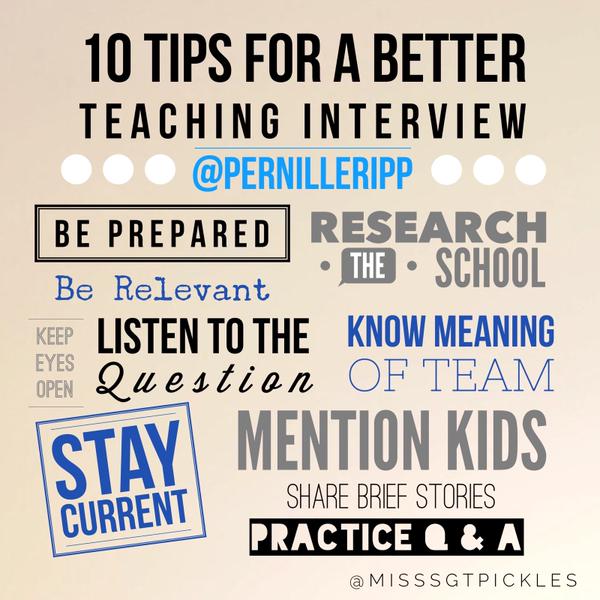
So You Want a Teaching Job – 10 Tips for a Better Interview

10tips
Thank you misssgtpickles for the image!

Every year, even as a rookie teacher, I have had the extreme privilege of sitting in on interviews for both teaching and specialist positions.  Every time I have been amazed at the quality of candidates that are available to us but also stumped once in a while when a candidate just isn’t all that prepared.  So why not offer up some tips for anyone trying to land that sometime elusive teaching job?

  1. Be prepared.  Yes, I know this sounds like an “of course” but there have been times where I have wondered whether the person even knew where they were interviewing or what they were interviewing for.  So prepare for this like you would your first day of teaching.
  2. Be relevant.  Many schools like to see something you have made, whether you bring artifacts, a video, or a link to something.  Make sure that the things you bring to show are current and fit the job.  If the things you bring have nothing to do with the position you are interviewing for, then don’t bring it.  If it fits with the interview bring it up during it, don’t just let it lie in front of you.
  3. Listen to the question.  Teachers tend to like to talk and sometimes we are not the best listeners, this is the time to tune in.  Really listen to the question being asked and then answer it.  This is not the time to stray off topic or think you know what the question is before it has been completed.  You can always ask for them to repeat it.
  4. Stay current.  I was expecting my first child my first year of teaching but that did not stop me from taking classes nor reading books.  There simply is no excuse these days to not participate in professional development,so be active in your professional development.  Take a class, read books, get connected, do something that shows that teaching is passion, not just a job.
  5. Research the school.  Most schools have websites that provide a description for you to read and then use.  We want to know why you want to work for this specific school, not why you want to be a teacher.  Make us feel wanted.
  6. Mention kids.  Another “duh” but there have been interviews where the person never mentioned kids or their desire to work with them, that sends up a major red flag.
  7. Figure out what “team” means.  I have never heard of an job that didn’t require someone to work as part of a team, so come up with a great description of what being a team player means to you and make sure it doesn’t just talk about how much you will bring to the team, what will the team bring to you?
  8. Keep your eyes open.  I know nerves can get in the way  but if you speak with your eyes semi-closed now is the time to open them up and look at people.  This goes for smiling and any other body language that says you are eager, passionate, and with it.
  9. Share stories but keep them brief.  I like hearing about past experiences but only if that story is 100% relevant and brief.  So stay on point and share, but not to every question.
  10. Practice your answers and questions.  If you google “teacher interview questions” you will find enough questions to give you a baseline for what to expect.  Think your answers through and figure out questions  you want to ask as well.  It shows you care, that you are motivated, and that this job matters to you.

Of course, there are experts out there that know way more about this than me but this is what i would tell my friends who are interviewing.  So good luck to all of those seeking jobs.

After some thought it is now time to add the one I forgot:

11.  Google yourself!  If you are a new teacher with an online identity; wahoo!  However, google yourself before the interview to see what a prospective employer might see and then set up some privacy settings if you don’t like what they find.  Results of your awesome blog or schooling is great, pictures of you drinking on Facebook is not.

12.  And finally, be excited, be humble, and have questions that you want to ask at the end.  I have always asked; What are you hoping to find in a candidate?” because ti allows the interview team to tell you their vision.  Remember you are looking for a great fit as well, not just a job.

Enhanced by Zemanta
advice, alfie kohn, assumptions, being a teacher, classroom setup, community, educators, elementary, new teacher, new year

Declutter I say! Or Why Motivational Posters Demotivate

Life is full of choices, so choose carefully! How can anyone love you if you do not love yourself? And my favorite: failure is never an option! All sayings found on various motivational posters sold to teachers that mean well and boy, do they sell. Anyone who has ever been in a teacher store those last couple of weeks before school start will see the poster wheels spinning frantically as the just right poster is sought. Ok, I admit I, I was one of those teachers, however, I thought I was clever and that I had it all figured out. You see, I had edited my pre-packaged collection and therefore only had select few displayed. Thus, my students knew that these were the sayings they had to focus on. I remember one was a cute little frog hanging on to a tree branch and something about sticking with it. Oh, day in and day out that little frog inspired my students to never give up! Right? Well, not exactly. My students didn’t care. I am sure they thought they were cute and one or two of them used them for inspiration for their own doodles in their journals but did it ignite their passion for learning? Hardly, in fact, I would like to argue quite the opposite. You see, my students were overloaded with messages. Walk into almost any elementary classroom and you will be bombarded with motivational posters, hand-made posters, student work, rules, classroom jobs and anything else that deserves a special place on the wall. And we don’t just tack it to the all, we put up back posters and fancy boarders o that it gets really colorful and pops! In fact, bare walls are taunted and laughed at, seen as someone being unprepared or dare I say dispassionate about their room, their job, their kids!

And so the pressure on new teachers in particular is immense. You may be new but your room should still look inviting, educationally functional and also be a representation of you as a teacher. That last week before my first week of school ever, I was waking up in cold sweat wondering whether the kids would get “me” in the room? And then school happened and I realized little by little that even though I had labored intensely over my handmade sign with the great Shakespeare quote “Do Not be Afraid of Greatness” my students had never read it or noticed it really. How do I know? My principal asked them about it when I was observed the first time. But surely they had noticed all of the signs? Not so much, even if I had pored over each placement of every poster so much that my walls had holes in them from my tearing off the gorilla tape (note to self: don’t ever use gorilla tape again.) I had created rules – keep them simple but firm, and a little flexible. Classroom jobs – instill responsibility but make the chart so fun that the kids cannot wait to see what job they will do. And maps – I had maps all over my room. Why maps? Well, I really like maps and they filled all that dreaded empty wall space. I would have continued to cover and decorate had it not been for a pesky thing called the firecode. It stopped me at 20%.

So what changed? One day I realized that it wasn’t my room that represented me, but myself that represented me. In fact, I got sick of re-taping posters that kept falling down, or moving them when I actually needed the space for learning and so little by little down they came. The ultimate clean up came when I had to move rooms this year. I sorted, evaluated and donated. Now I chuckle when I see my “old” posters hanging somewhere else. Don’t they realize why I got rid of them? I also thought about my students more and how they reacted to the environment I created. Too much of it was about me, and how I wanted the room to be. They didn’t feel welcome or that the space was theirs, but merely as guests passing through borrowing the space. Another consideration was that I have students that get over-stimulated quite easily. Being a clutter freak myself I start to get clammy when I stay in these rooms too long so imagine if you are a student trying to focus on whatever is going on on the whiteboard. Where do you look? To the poster telling you to keep focusing or on to the actual board? So is my room bare walls? Nah, but what is up there is important. In fact, the kids have noticed what is posted. Quotes form the Little Prince, from the “I Have a Dream” Speech, and student introductions in Wordles. We have some literary elements as reminders and even a couple of pictures. The students know how obsessed I am with zombies so they draw me pictures of flesh eaters. No rules, no motivational posters, just us. Our space, our room. And most importantly, room to grow into a community. Into making the space our own. They own the room as much as I do and that is more important that sticking to it or never giving up!