being a teacher, history

Let Them Learn about War

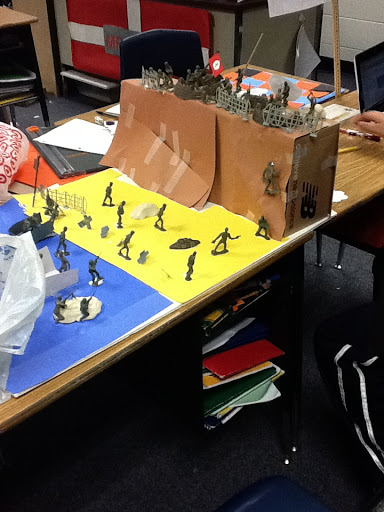
“Oh, you let them build a war model?” another adult is scanning our products from  our Innovation Day.  “I don’t think I would let them do that…” and so begins my train of thought.  Did I do something wrong by allowing Jack to build a model of D-Day?  Should I have steered him toward something kinder, more 4th gradeish, should learning about war be a one time occurrence?

I guess I hadn’t even thought about it.  After all, I asked the kids to do something they were passionate about, something that would keep them focused an entire day, something that we had perhaps not covered. Jack loves the history of wars.  He is good at it too.  All year whenever we came close to a war in social studies, and there are many of them, he is the one that adds the facts that I would never remember, the facts that bring the other kids in, the facts that put the human face on war.  His passion is contagious too and other kids have checked war books out from the library because of him.  Should I have stopped them?
I realize that I teach 9 and 10 year olds who are not ready to know the true devastation and horror of war, and yet, the sheltering that occurs in America of our students, the rewriting of history so to say, is taking on epic proportions.  You don’t need to look further than the recent rewrite of Huckleberry Finn for proof.  Yet we have to realize that our history is not made up of unicorns and rainbows, or even peace and understanding.  Our history is one of a cycle of violence, people who fight for change, and in that fight, there are battles.  If we do not teach our students about the fight, then how will they ever appreciate the outcome?  I don’t go into horrific details about the injuries or torture or anything of that sort, but we learn about it so that we can understand our world a little bit better.  
It happens again; a child wonders whether he is allowed to add a sword fight in his fairy tale.  Perplexed I ask him why he is even asking, after all, there are many battles or fights in fairy tales.  He tells me that some teachers don’t allow it.  Again, I wasn’t aware that this would be a problem.  Of course, there are battles in stories, particularly in the stories written by my boys.  And that’s it isn’t it?  Is it because we as female teachers prefer stories about love, compassion, and friendship?  Is it because we do not relate to the need for action, for fights, for valor and bravery?  I have never had a female student write a battle story and yet I think some day I will.  So I want to keep the option open.  I want my students to feel that they can write whatever they please as long as it fits within the requirements we have determined.  I want my students to know that this world is a messed up place that we are continually trying to enhance and we can only do that by learning from our previous mistakes.  We have to stop the sanitization of our history, in essence, we have to bring back the violence, the grittiness, the not so perfect human side, that makes us all human.
So let’s stop the unnecessary fixing of our curriculum.  We have to give time to the battles and wars so that all of our students can learn from them.  We have to stop skipping the “bad” parts and only focusing on the good.   We have to embrace the interests of our boys and cater to them as well.  They are equal partners in learning and deserve their chance to express themselves creatively.  
being a teacher, smartboards, Student-centered

The Sheer Genius of SmartBoards

Image taken from here

I am not a believer in SmartBoards, there I said it.  Sure, they are a nice tech tool to have but honestly, for that amount of money, I could think of about a thousand other things I would rather have in my classroom.  In fact, Bill Ferriter at the Tempered Radical agrees with me, which partly prompted this post.  And yet, I have to applaud what the makers of SmartBoards have done to our school districts.  Think about it, a smart board.  So if you have it then you must be smart for making the investment and if you don’t, well, then you are not.

Sometimes it is all in a name.  After all, that is why companies spend money trying to come up with the best marketing they can.  So when someone came up with the name SmartBoard you know high fives went around the room.  How about the Interactive Whiteboard?  Teachers love to speak of how interactive their SmartBoards really are.  And where does that notion come from? Their name.  I do nto for one minute believe that soemone went up to that board and thought indepedently of how interactive they are for students, maybe for the teacher, but not for others.  It really should just be called a touch and response board but that just doesn’t seem to have the same kind of connotation.  So when you call something interactive well, then, think of how much easier you can sell it.

So really who is the board interactive for?  The teacher who gets to touch it as the lesson moves on or the selected student who gets to come up and move a word around.  Ooooh, now that is engaged learning.  I don’t dismiss interactive whiteboards as classroom tools altogether but I do dismiss the notion that they are the ticket to reform our classrooms, to re-engage our learners, and teach our children.  Instead they lead themselves to more “sage on the stage” type of teaching where the teacher is in control of all of the learning and the students just get to participate.  That is not what school should be.  So laud your interactive whiteboards as much as you want, but keep in mind just how they were sold to you.  I think it is time we see them for they really are; tools, not solutions, not magic pills, just another tool and one that comes with a steep pricetag and a much too deep learning curve.  This should not be the future of our classrooms. 

being a teacher, grades, label, rank, students

Some Questions on Labels

Those struggling learners, the reluctant readers, the underachievers. All labels heard in schools on a daily basis. The tired ones, the creative types, the giften, the talented, the fidgeters, the lazy students. We label and label in order to define them all, to fit them all into a box under the pretense of being better teachers, of making our jobs easier, more manageable, more suited for differentiation. After all, if we don’t label then how will we know who needs which services? If we do not label then who will we teach at what time? How will class lists be made up to ensure balanced needs? We may not be tracking our atudents openly but the labels keep on coming.

I often ponder labels and what effect they have had on my own life. Some teachers labeled me gifted, I was not, only gifted through circumstance. Others labeled me underachieving, where rather it was in response to the teaching method. I was labeled opinionated in history, that one stuck, outspoken in English, talentless in math, and relentless in my pursuit of academic excellence in college. Labels shaped my education whether I agreed with them or not, yet how often were they shared with me? How often was I aware of what category I was placed in? And worse, how often when I was aware did it become my definition?

Some will inevitably argue that if we do not label our students whether through tests or grades then how will we rank them? How will we teach them best? If we don’t know who our strugglers are then how will we reach them? I don’t know. But what happens when those labels become all we see? What happens when the labels end up defining the student rather than the student defining the label. What happens when one teacher’s comment becomes the mold we force the student into? Can we label our students without actually harming them and impeding their learning? Can we genuinely categorize students as struggling when they are perhaps just learning at a different pace?

I hope someone has the answer.

being a teacher, students

We End the Year

As students count down and yet feel so guilty for wishing for the summer sun, we push on, aware that every moment is one moment less that we get to be this group.  That we get to have this experience.  That this moment is done now too.  And we celebrate, and we reminisce, and then we worry because what comes next?  Will these students be ok in the next year?  Did I teach them everything I wanted to?  Did they understand my words?  Our goals?  Did they make this their own?

We end the year the way it began; eager, anxious, pondering what comes next?  We end the year the way it began; wondering where to now, what challenges shall we undertake, who will be our friends?  A year has passed, the goals been met – or have they – and constantly we ask ourselves; now what, now what, now what?

being a teacher, edcamp

So I Survived My First EdCamp

There I sat in the corner, carefully checking my Twitter, had I been discovered?  Was I going to speak to anyone or just spend the day lurking in the corners, learning and tweeting away but with no human contact, shouldn’t be so hard.  This was already looking like any other conference I have ever been to; I would learn by myself and then go home and blog about it.  And then something happened; after about 1 minute of sitting there,  I get a message from Josh @Stumpteacher asking me if I am sitting in the corner.  Two minutes pass and a woman comes up and asks me if I am 4thgrdteach, yes…  Turns out to be my friend Katie @TheTeachingGame who I give an impromptu hug to.  Now I am a hugger, but I have never hugged someone who should be a stranger before and yet with Katie I was like a reunion.  Welcome to EdCamp Chicago, my very first unconference and my first conference after getting on Twitter.

What followed was a day of stimulating conversation, a lot of laughs, and a lot of connections.  So what were my biggest take away’s?  Well, the connections were incredible. Every day I pour my heart on on this blog and on Twitter, so to have people come up and tell me that they know who I am and like what I write, really was mind-blowing for this small town girl.  Also, to get a chance to sit down and speak to some of the educators I learn from myself was incredible.  The different experiences, stories, and perspectives really offered me a jolt of knowledge.

I also learned a lot about myself.  I can speak in front of peers that I respect even if I have not met them before.  I can also voice my opinion without being too bullheaded about it.  I learned that somehow I am making meaningful connections with people that I have met through Twitter.  It was also amazing to hear other non-present people’s names being brought into the conversation and others recognizing the names.  It truly showed just how connected one can be on Twitter.

And finally, the idea of regular people setting the agenda, offering choice, and impromptu conversations, really played into my belief that we must offer our students choice.  I chose to leave one session because I was not adding anything useful to it, instead we created a smack down which was incredible.  I chose to be part of a session on grading, because it is something I am passionate about.  I chose what I wanted to learn, how I wanted to be challenged, so my stake was personal and I was more engaged.  That is what we should offer our students as well.

So did I get inspired, sure, but mostly I had my spirit renewed.  There are passionate educators out there who have no problem with spending an entire Saturday discussing how we best can reach students.  That is incredible.  There are people out there who have no qualms of telling you exactly how they feel even if they disagree with you, but also this sense of not being alone.  I often reach to Twitter to be inspired, but I often walk away with new energy and new passion.  EdCampChicago did that for me as well.  I am sad that I will not be at ISTE this year, but hopeful that next year will be my year for truly making the face-to-face connections.  I will be there in spirit.