being a teacher, being me

In These Divided Times

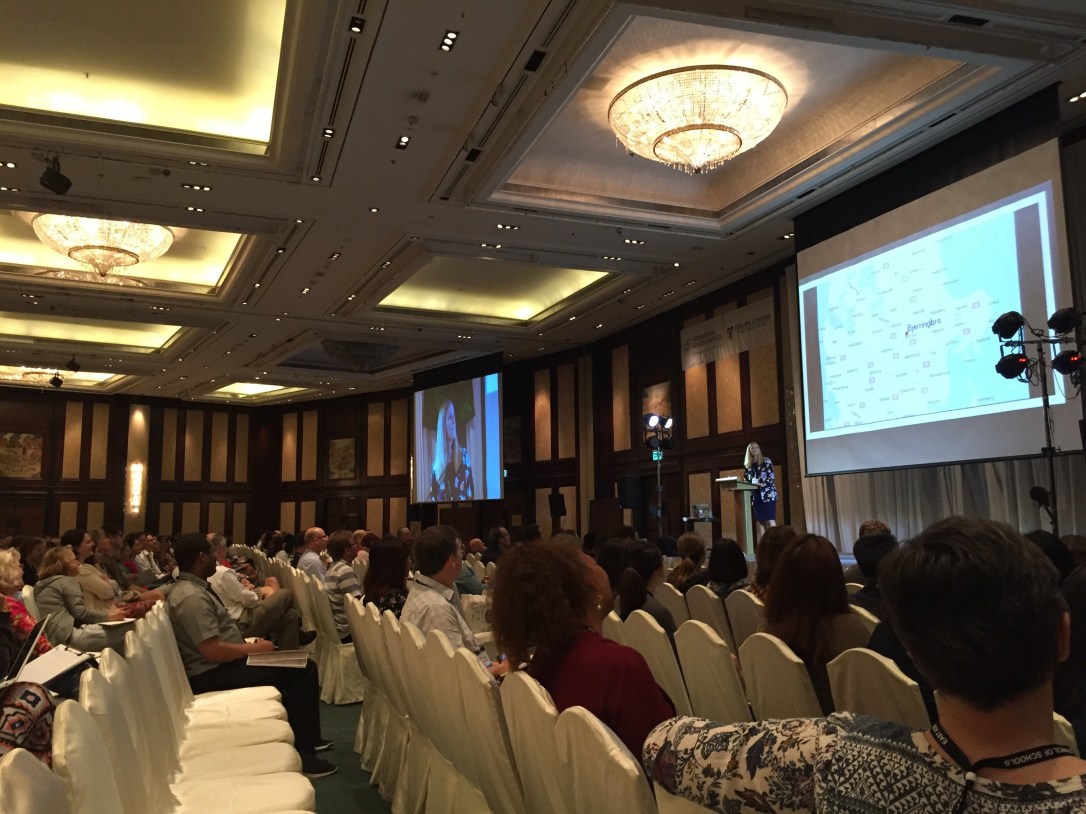
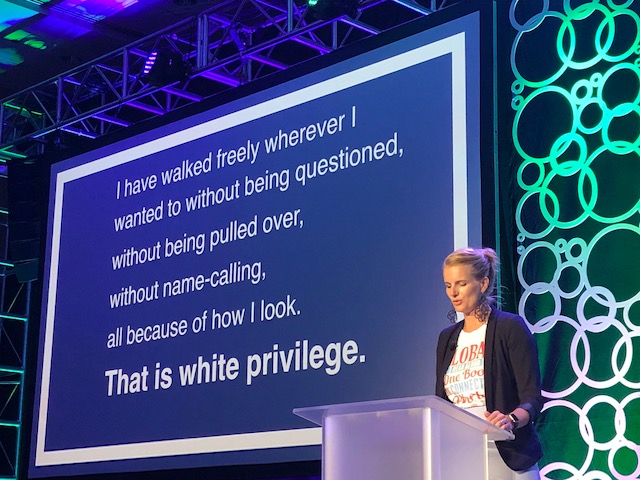
Yesterday, I was given the opportunity to speak for 5 minutes on the ISTE small stage.  I was given five minutes to share something I am passionate about.  Something I care about.  I knew I wanted to discuss technology.  I knew I wanted to discuss division,  I thought I would discuss the Global Read Aloud, and yet as I started writing I realized the inherent opportunity I had been given to speak about something I am still learning about and growing within.  Something I have spoken about before but not at ISTE, not in a tech space.  So yesterday, I delivered the following Ignite to a full room.  I don’t know if my words will matter, I never do, but I was nervous and proud to speak from the heart.  Hopefully, I didn’t screw it up too much.  And while some told me it was a brave speech, I am not so sure about that, after all, I am pretty protected within my privileged place.   It was truly the least I could do as we continue to work toward a better world for all, not just those of us with privilege. 

PS:  Some of the words were repeated from my NCTE speech but they fit here as well.  I also think a video will be made available at some point and will add a link here.  For now, here is a Periscope version of it.


I was clutching the steering wheel.  The red and blue lights behind me flashing.  My heart in my throat. In my head, I kept wondering what I had done.  I knew I had followed the speed limit, used my blinkers. And yet, I was getting pulled over and I was frozen.

As the police officer walked up, I was scared.  Not for fear of a ticket, but because I didn’t have my green card on me.  That little card that grants me the permission to be here as a lawful immigrant.  That little card that I am supposed to carry on me at all times, in case the police, or ICE agents, or even strangers ever question whether I have the right to be in the US.

I didn’t have it.  It was at home. She came up to my window.  “License, registration please, do you know why I’m pulling you over?” My brake light was out.  That was it. Get it fixed or get a ticket – not questioning, not deportation. She thanked me for my time.  And then she walked away.

She never asked about my green card.  She never asked if I was here legally.  She never even thought to ask.

I was raised in Bjerringbro, Denmark, but my mother had a wandering heart and at the age of six, she moved us to inner-city San Francisco.  I navigated not understanding what someone said to me when they spoke. Figuring out how to find the bathroom when you don’t know how to ask to leave, how to make friends when you don’t speak the same language, how to show I was smart even if I couldn’t communicate it.  

And just when I felt like I had mastered this new culture, this new language, this new me,  we went home. Becoming Danish once again, rather than a kid from a foreign country. But when you see me;  Do you see a woman whose first language is not English? Or do you just see my white skin? Hear my American English and assume the rest?  

When I was 18, we moved again.  July 1998, I walked up to the counter in Logan Airport and declared myself an immigrant.  Alone and clutching my sealed papers, the officer took the papers and led me to a small room.  After what felt like forever, he finally handed them back, said; “Welcome to America” as he led me out into what felt like a whole new world.  

For 20 years no one has ever asked me for my papers again.   I have walked freely wherever I wanted to without being questioned, without being asked where I am from, without anyone asking me where I was born, all because of how I look.  That is white privilege,

When I wrote about how I am never assumed to be an immigrant, someone replied; “Well, that is easy to understand, after all, you look like an American.”

Let’s think about that for a moment.  How can I look like an American when I do not have a single drop of American blood in me? How can I look like an American when my first language is Danish and not English? How can this Danish girl be handed so much privilege – my skin of course.

You see, my family and I are so white we are like a caricature of whiteness, blonde, blue-eyed and tall.  I was born white, it is who I am, but I am on a journey to use my innate privilege to be something more. Not just an ally, but a fighter, and technology is my weapon.

My students and I have taken the curriculum that the world has handed us and tried to figure out where we fit into the world.  We have used books and computers to connect to the world. Web cameras, videos, and apps to not just share our work but to learn more.  

Yet when a student asked what does refugee mean and another child answered, it means the enemy, it was a stark reminder of the work that still needs to be done.    On the urgent need to use technology so that we can make our own decisions based on actual experience and not just hearsay and biased opinions. Use it so that those of us, who live with privilege,  can be a part of the fight for a more just world.

Because let’s face it, I am privileged because I get to be afraid of the type of reaction my teaching may cause if I continue to teach about inequity. If I continue to teach what it means to be privileged.  I get to be afraid for my job and I get to choose whether to have these hard conversations or not. But the truth is, there should be no choice. We, as teachers, are on the front lines of writing the future narrative of this country.  Of this world. Ugliness and all. We are the gatekeepers of truth, so what truth are we bringing into our classrooms?

Where is our courage when it comes to being a part of dismantling the fears that drive us apart because It is not enough to bring in devices, the latest gadgets, without using them to learn about others.  To understand others. To have the tools to dismantle our prejudiced world but then choose to do nothing to change the world that we live in.

We, as people with privilege, must use technology to create more opportunities for the students to do the hard work.   To create an environment where they can discover their own opinion. Where they can explore the world, even when it is ugly so that they can decide which side of history they want to fall on.

So look at the power of the tools you have at your disposal.  Look at what you can do with a camera. With a computer. With your voice and your connections.  Look at whose voices are missing in your classroom. Look at who your students need to meet so that they can change their ideas of others.   

We say we teach all children, but do we teach all stories?  Do we teach the whole truth, and nothing but the truth, or just the sanitized version that will not ruffle any feathers?  I can choose to bring others into our classrooms so that their stories are told by them. I can choose to model what it means to question my own assumptions and correct my own wrongs.

What if the next time a child made a statement that divided rather than united, instead of scolding them, we used a camera, a microphone, and others as a way to start a conversation.  What kind of world could we be? What kind of history would we write?
 

IMG_4855.JPG

Be the change, being a teacher, being me

Lessons From Ten Years of Trying….

first year.jpg
The night before my very first day as a teacher.  This is what terrified looks like.

Ten years ago, I said thank you to my very first class of 4th graders.  Thank you for their dedication.  Thank you for their persistence.  Thank you for their love.  I know I cried as I hugged each and every one of them, thanking them for our year.

Today, I will hug as many 7th graders as I can.  I will thank them for a year filled with laughs.  With challenges.  With growth.  With love.  Teaching is by far the best thing I can do with my professional time.  When I look back on ten years of teaching, I cannot help but think of all the things I have learned.  Of how I have grown.  Of how I am still growing.  There is so much to learn, still.

But ten years has also taught me a lot about what it means to be a teacher.  What it means to get up every morning and do this job.  Not just because you have to, but because you can.  And as always, the kids I have had the privilege of teaching are the ones who have taught me the biggest lessons.  The ones who have made me who I am today.  They taught me…

That’s it’s not about me.  That the needs of the students should always be my focus.  That when I am wondering what I need to change, they are where I start.  That my assumptions, while sometimes on point, will never be as accurate as what they will actually tell me.  That their advice, if we only take it, will transform our teaching for the better.

…but sometimes it is.  Sometimes I am the problem.  Sometimes I am the reason a child hates school.  Sometimes my decisions, even if made with the best of intentions, will harm rather than build.  It is my job to make sure that I know that.  That I realize the immense power that we have over the future of the very children we teach.  That I ask the hard questions in order for me to grow and to create an experience that works for every child as much as humanly possible.

They have taught me…

That a smile will always go further than a well-developed lesson plan.  That my attitude when it comes to the very kids I get to teach is a choice.  That saying hello, that smiling, that telling them how much I love this job, how much I love them, will make a difference.  Even to those who push the hardest.

….but sometimes a well-developed lesson plan can move mountains.  When students plan lessons with us, offer up their ideas, and invest their energy, we are already further than we could be without them.  That lessons need choice, relevance, and challenge.  That every child deserves to be held to high expectations, and every child needs a second chance when something doesn’t work.

That those who push you the hardest, leave the biggest marks.  That often those kids who see no value in school, no value in you, are the ones you will fight the hardest for.  That it is not your job to save them from their lives, themselves, or their circumstances, but that you are there to love, to offer up ways to navigate their lives, and to remind them that they have worth.  That in this world, they matter.

…but sometimes they don’t want you to be in their corner.  And that’s ok, too.  We can try to connect with every child we teach, knowing that for some we may be exactly the type of teacher they do not want.  The biggest gift we then can offer up is, besides not giving up, to help them forger connections with others.  To help them have someone they connect with, so they know that they are not alone.

They have taught me…

That I don’t know it all.  Especially the more I teach, I realize how little I know.  Ten years ago I didn’t think about my privilege.  I didn’t think about how marginalization hurt the very kids I taught.  How inequitable our school system is.  How white skewed my classroom library was.  How I didn’t know everything.  But I grew, and I will continue to grow.  I will continue to admit when I screw up, and it happens a lot, and I will continue to apologize, to use the power I have been given to fight for others and with others.

…but I do know some things.  I know that love matters.  That research matters.  That conviction matters.  That sometimes being the sole voice for change is scary, but necessary.  That we grow best through kindness, but sometimes kindness will not tear down walls.  That what we believe in directly influences how we teach, but that our bigger job is not to give students our opinion, but instead make space for them to develop their own.  That every day I get to work with kids is a better day.  That there is hope.  That this new generation of kids we are raising are changing the world.  That I would rather be a part of the fight, then safe on the sidelines.

I became a teacher because I hoped to make a difference.  I hoped to create a classroom where every child felt safe, where every child felt loved.  I don’t know if I have succeeded, but I do know that teaching has changed me.  That I would not be the person I am without the influence of the many incredible children I have taught and who have taught me.

I came into this profession to make a difference but in the end, it was the kids that made the biggest difference to me.

If you like what you read here, consider reading my newest book, Passionate Readers – The Art of Reaching and Engaging Every Child  Also consider joining our book club study of it, kicking off June 17th.  This book focuses on the five keys we can implement into any reading community to strengthen student reading experiences, even within the 45 minute English block.  If you are looking for solutions and ideas for how to re-engage all of your students consider reading my very first book  Passionate Learners – How to Engage and Empower Your Students.      Also, if you are wondering where I will be in the coming year or would like to have me speak, please see this page.


being a teacher, being me

What We Could Have Done, Perhaps

I am not sure why I am writing this.  Perhaps it is simply to get it out of my brain, if even for a few minutes, perhaps it is to not feel so alone.  Perhaps it is because someone, somewhere, out there will have some sort of magical answer that will somehow make all of this better.

The very harsh reality that we now face as a family is that our oldest daughter started this school year as a fairly well-adjusted eight-year-old who liked school, was nervous about making friends as the new kid, but was known as being kind, helpful and as a hard worker despite the obstacles she faced.

And then the school year happened.  And the bullying happened.  And life seemingly turned upside down from what we knew or at the very least thought we knew.

We now end the year with a kid who is angry a lot, sad a lot, who hates school, begs us not to send her, and worries that she will never be liked by her peers. Who snaps for little reason, has insomnia, and has continued to face learning obstacles that we have not been able to address because her mental health comes first before we think about reading intervention.

We now end the year with a kid that can go from being happy one moment to completely devasted the next.  Who yells so much, I sometimes forget what it sounds like to have a normal conversation with her.  Who asks for our protection and we know there is only so much we can do.  And yes, we have her seeing someone both in and out of school, but it does not seem to be enough.  Nothing seems to be enough.

While the rational part of me knows that there is not much more we could have done to protect her, I cannot help but feel like we did this somehow. Like we somehow failed to equip her with the tools she needed to survive this school year.  That perhaps if we had raised our voices sooner.  If we had yelled louder.  If we had seen the signs.  If we had taught her how to change her personality.  If we had not moved to our new house.  If we had not switched schools.  If only…

If only…

As parents, we pick up the pieces of our children every day.  We marvel at times over the miracles they are, over how they grow.  Over how they seemingly become this incredible person we always knew they would be.

But sometimes the pieces seem to no longer fit.  We wonder where this child came from and how we need to parent now.  We love, even when they yell.  We hug, even when they say they don’t need it.  And we keep telling them that they are beautiful.  That they are smart.  That they have worth.  Even when they don’t believe us because the words of other children now speak louder than whatever we could say.

This year, we count down the days until school’s out in this house, something we have never done. (17 days tomorrow).   We tell her just one more day, tell your teacher if you need to, look for a friend, hold your head up high.  And we hold our breath for the bus to bring her home, waiting to see what will be unleashed as she walks through our door.

I can’t help but think of how I somehow failed as a parent.  Failed to protect.  Failed to guard.  Failed to fix.  But perhaps it was never that simple?


being a teacher, being me

On the Road Again

White, Black, Yellow, Red,  Free Image

As summer beckons in just a few weeks, I have the honor of traveling to learn and teach with passionate educators around the country.  I often get asked where I will be, and while this page is almost always up to date, I thought it would be nice to have a visual of where I will be this summer in case I am close to where you are, especially since most of these are open to the public.  If you would like to have me come to your event, please see this page, it is not too late to book for the summer. I hope our paths cross!

May:

May 19th, Morning workshop, Passionate Readers, Waukesha, WI

June:

June 9th, 2018 – Speaker, Indiana State Book Festival, Muncie, IN

June 21st, 2018 – Scholastic Reading Summit, Chicago, IL

June 24th – 26th, 2018 – ISTE, Chicago, IL

June 28th – July 4th, 2018 – Barcelona, Spain

July:

July 9th – 10th, 2018 – NerdCamp, Parma, MI

July 12th, 2018 – Scholastic Reading Summit, Raleigh/Durham, NC

July 17th, 2018 – Scholastic Reading Summit, Los Angeles, CA

July 21st – 28th, 2018 – Hanging out around Carolina Beach, NC

August:

August 2nd, 2018 – Workshop, RRVEC, Grand Forks, ND

August 8th, 2018 – Workshop, WSRA, Stevens Point, WI

August 14th, 2018 – Goosecreek, Texas

August 15th, 2018 – League City, Texas

August 24th, 2018 – District PD, Calexico, CA

being a teacher, being me

Who Keeps You In Line?

On Friday, I stood on the stage at EARCOS in front of hundreds of passionate educators from all over Asia and told them my story of change.  The story of how my students have changed me. It was met with applause, with careful words shared after about how they felt inspired, moved, how what I had said mattered and how they wish more educators had been there to hear this powerful message.  I felt on top of the world.  As if I mattered, as if the words I spoke mattered, as if I had made a difference.  Like I had it all figured out.

IMG_3184.JPG

Today, some of my students reminded me that our class is boring, that what we are doing doesn’t matter much, and that no, they were not happy to be back after spring break, thank you very much.  Ah, the life of teaching 7th grade.

So much changes in a few days.; from high praise, hugs, and admiration from fellow educators to sometimes harsh words served up frankly from the very students I serve.

It seems that I am not the perfect teacher after all, but I knew that already, even before today, because I teach students who speak up.  Who sometimes forget to say the nice before they get straight to the point.  Who have no problem pointing out what they dislike, but still are working on how we can make things better together.  Who, yes, sometimes like our class, but often push me to be better, to try harder, to keep thinking.

I wouldn’t have it any other way.

In fact, if it weren’t for my own students, I wonder how much of the hype I would end up believing.  Probably all of it.  After all, it is hard not to believe someone when they tell you just how much you matter and how great of a teacher you seem.  And yet, it is easy to say someone is a great teacher, coach, administrator, fill in the blank, when you are not in their classroom or schools.

And so I wonder what happens when we don’t have the presence of those we serve to put us straight.  When we leave the classroom, or the school, or the job and no longer are in touch with those who our words affect the most.  When we only hear the good but don’t get a lot of bad?

What happens when our great ideas no longer really have to stand the test of time?  When our great ideas and “just do’s” don’t actually have to face the test of our own classrooms?

How do we keep ourselves in check if all we get is admiration?  Who brings us back down to Earth to remind us of how teaching continues to be a challenge, even when we think we have it all figured out.

I see it play out in social media all of the time.  From the inspirational tweets that seem more quippy the older I get.  From the followers that rush in to excuse any old statement someone makes because surely they didn’t mean to sound like an idiot, or condescending, or like a know it all.  To how we end up equating followers and likes with quality, with actual work, with some being “rockstars” or somehow better than “just” the regular educators.  How we constantly seek inspiration to be just like those who forget to share their failures, who somehow appear more than the rest of us.

I think it is a dangerous thing.  I think it is too easy to take oneself too seriously.  I think it is easy to write about only the good and not share the bad.  I think it is really easy to compose posts, tweets, or pictures that only tell half the story.  Yet, showing off flaws, off failures, off the not so great is what makes us all human.  Is what makes us actually relatable as educators.  I have never claimed to be a perfect teacher, nor will I ever, my students would tell you that there are great moments, and then there are boring ones, just like in most classroom.

And so for that, I am grateful.  For their honesty, I am thankful.  Because if it weren’t for my students, it would be easy to think that I was more than I am; just a teacher still trying to figure out how to become better.  Not someone who already knows it all.

So who keeps you in line?  And how do you grow from their words?

If you like what you read here, consider reading my newest book, Passionate Readers – The Art of Reaching and Engaging Every Child, out August 2017.  This book focuses on the five keys we can implement into any reading community to strengthen student reading experiences, even within the 45 minute English block.  If you are looking for solutions and ideas for how to re-engage all of your students consider reading my very first book  Passionate Learners – How to Engage and Empower Your Students.      Also, if you are wondering where I will be in the coming year or would like to have me speak, please see this page.

Be the change, being a teacher, being me

It’s All in the Small

She tells me, “You know, Mrs. Ripp, I really learned a lot in 7th grade…”

I grin, and ask whether she is sure, that I often wonder if anything we do really helps them learn.

She says, “What helped me the most were all of those little things you would teach, the easier ways to do things.  I use those now…”

The bell rings, my sub time is over in 8th grade, I tell her to see me for a book, and she is off to see her friends.

I am reminded in these moments that as an educator I need to see the small steps.  That I need to count the little moments that really are the big wins in the bigger picture.  That it is easy to see that one child who all of a sudden becomes a reader, or a  science lover, or a coder, or a successful student.  But that when I only look for those big moments, I miss all of the small ones that are equally important.  I miss the moments that show signs of important growth, that may not be as obvious as that big aha moment.

Like the child who independently abandoned his book and then immediately went to the bookshelf to grab another one.

Like the former student who told me he didn’t have a book and then actually came and book shopped and found one.

Like the student who told me that he thought it was pretty cool that he doesn’t hate reading now, but doesn’t mind it as much anymore.

Like the child who trusts me enough to tell me that she is lost and needs help.

Like the child who only takes two reminders to settle in rather than five.

If we only measure education in the big successes, we may lose faith in our ability to actually create change.  For our students to actually grow.

Because those changes happen so gradually that they are easy to miss.

Because those changes often happen after they have left us.

Because those changes aren’t always shared in an outward way.

Because those changes often get overlooked when we compare students to each other and then wonder why they are not all acting the same way.

So if March is bringing you down.

If you are having a hard time remembering why being teacher is the very best job in the world.

If you are wondering if you are making a difference.

If you are wondering if your students are learning and growing.

Look for the little change.

Really remember how they came to us.

See how far they have come.

And if you are not sure, ask them.  Do they know how far they have come?

Count the small steps and then count yourself lucky that you get to be a part of this incredibly complex process we call school.

If you like what you read here, consider reading my newest book, Passionate Readers – The Art of Reaching and Engaging Every Child, out August 2017.  This book focuses on the five keys we can implement into any reading community to strengthen student reading experiences, even within the 45 minute English block.  If you are looking for solutions and ideas for how to re-engage all of your students consider reading my very first book  Passionate Learners – How to Engage and Empower Your Students.      Also, if you are wondering where I will be in the coming year or would like to have me speak, please see this page.