I find myself at a point in time where it apparently bears repeating that some of our priorities in education seem a little misplaced. After all, I don’t know how many more discussions I can bear witness to that centers around which expensive curriculum to purchase when our librarians are being forced out of their jobs. How many more giveaway prizes are needed rather than actual books? How many more paras we need to help the students, rather than certified staff?
If our priority is to create education that actually works for all kids and not just the ones who are easy to teach, then we need to discuss what our priorities should be.
Our priority should not be how to punish the kids that misbehave but rather how we help them remain in our classrooms instead.
Our priority should not be for how we can force kids into our rigid systems but instead how we can make our systems more flexible.
Our priority should not be how many skills a program will teach if we don’t have the foundational knowledge to understand why these skills are needed.
So can we instead decide that it only makes perfect sense to…
Invest in certified staff, particularly in areas that have the biggest impact such as special education, the arts or the library.
Invest in books before basals. Books before programs. Books before computer programs that teach basic reading skills.
Invest in raising student’s voice, rather than finding ways to quash it.
Invest in mental health services, in counseling, in smaller class sizes so we can truly connect with all of the students we teach rather than in more security and locks.
Invest in the staff we have, in order to retain an experienced staff, rather than always focusing on how to recruit the new?
Invest in community.
Invest in access for all kids.
Invest in hugs.
In smiles.
In high expectations for all.
In challenging all.
In equity and in hard conversations that uncover our own areas of weakness.
In the basic components of education that may not garner news headlines but that we know works, respect, credibility, training, reflection, and yes, love.
Can we please make it an expectation that if you teach kids you have to actually like kids. After all, it doesn’t feel like too much to ask.
Perhaps if we straightened out our priorities and went back to common sense, we wouldn’t be having so many of the same conversations again and again.
Perhaps…
If you like what you read here, consider reading my newest book, Passionate Readers – The Art of Reaching and Engaging Every Child, out August 2017. This book focuses on the five keys we can implement into any reading community to strengthen student reading experiences, even within the 45 minute English block. If you are looking for solutions and ideas for how to re-engage all of your students consider reading my very first book Passionate Learners – How to Engage and Empower Your Students. Also, if you are wondering where I will be in the coming year or would like to have me speak, please see this page.
Today, as too many times before, I walked into our classroom and tried to figure out what we could use to protect ourselves, what we could use to barricade the door, what I would need to help my students escape through our second story window. How we would survive in the case of an active shooter.
As colleagues drifted in we discussed the news; another school shooter, more lives lost, more teachers portrayed as heroes as they shielded students with the only thing they had; their bodies. And we looked around our rooms and we shuddered at the realization that really the only thing we can hope for is a lucky break if someone decides that our school is the next target. That the only thing we can cling our hope on is that if a shooter was to enter through the front entry, then we perhaps would have enough time to get out simply because of our location in our school.
And as I watched students come to class, ready for another day to learn, I was surprised at their lack of talk about it. One child finally brought it up, telling me she had seen the videos recorded from Snapchat. How it was hard to watch and I wondered; have our students become used to this new reality where we don’t do just fire drills but also active shooter drills? Where my 5-year-old kids come home to tell me how they sat really quiet in the corner so that the bad man wouldn’t hear them. How is this our nation?
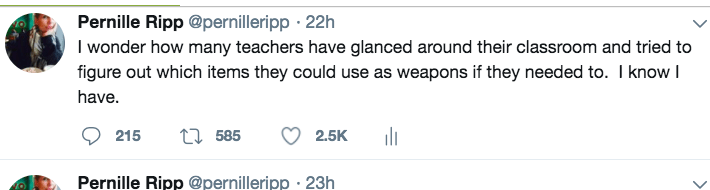
Last night I sent out the following tweet and all day today the replies have poured in. Comments from fellow teachers telling me what they have for weapons in the classroom (nuts and bolt, fire extinguishers, bats, golf clubs or anything else they can get their hands on), how they plan on getting out, what they plan to use to barricade the door. How their doors lock from the outside, how their kids won’t know how to stay quiet and hide. How they know as special ed teachers that they more than likely will have to shield their kids because they may not be able to get out. How they are training their students to run around the gunman in case they are taken out. How they cannot fathom how this is our reality in the United States, because, guess what, it is not the reality for teachers anywhere else in the world, not at this scale.
My husband told me he would be purchasing a rope ladder and window hammer for me to keep in my classroom. That he would think of something to send in with me in case I needed to defend myself but I couldn’t help but think; what good will a bat do against an AR-15?
We are working in a public school system where our funding is being depleted and our class sizes are going up, leaving us less time to connect with each child, leaving us less time to really get to know the kids we have in our care. We live in a country where mental health services are being slashed and those who desperately need more care, cannot get it. We are living in a country where protecting gun rights is more important than protecting human lives. And we are told to not make this political but how can we not when it seems the only response we have in America is to send thoughts and prayers?
And so this morning, as I entered our classroom, I realized, again, that as much as I want to live to be old, I would also shield my students with my body if I had to. That I would stand in the line of fire if I need to because that is now also a part of my responsibility. That my students lives matter more than my own.
So today I put on a brave face in front of my students, even if every little out-of-the-ordinary noise made me flinch. Even if I thought about every student I have ever taught and whether I did enough for them to make sure they felt known, like they mattered, and not like they should come back for revenge. And I was scared.
I am scared.
Because I don’t want to be a hero.
I want to be alive.
I want to see my own children grow up.
I want to see them graduate.
Fall in love.
I want to be a grandmother some day.
Be called mormor and tell stories of back in the day.
I want to retire and hold hands with my husband by the ocean someday while the world passes us slowly by.
To take my last breath surrounded by my family, not in my classroom.
But I may not get that dream if we don’t change the way our laws work.
How many more children will have to die for us to do something?
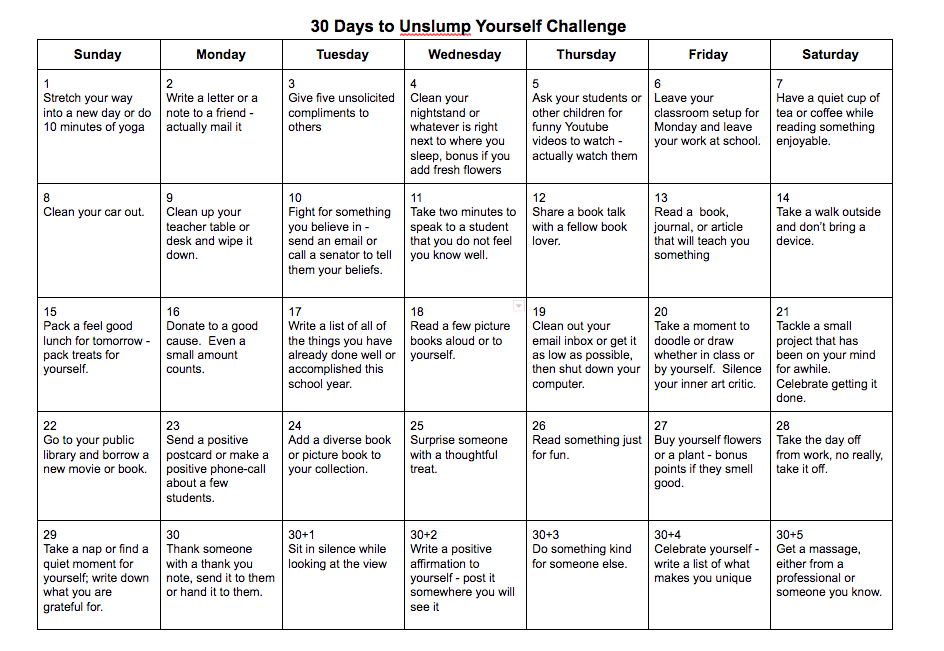
If you are like me, January brings excitement, positivity but also exhaustion. This quiet month is one where I sometimes find my energy running low, my creativity running out, and rather than take the time to take care of myself I barrel on as if that will do the trick. So this year, I realized I needed to challenge myself. Challenge me to take better care of myself. Challenge me to slow down. Challenge me to focus more on meaningful interactions, rather than hurried conversations. And yet I know that as soon as I say I will do it, I just don’t. Such is life. Such is so many of our realities.
So I created a 30-day challenge to unslump myself. To remember to take care of me. You are more than welcome to join me or create your own. My challenge starts on Monday. I cannot wait. To see the challenge document, go here.
If you like what you read here, consider reading my newest book, Passionate Readers – The Art of Reaching and Engaging Every Child, out August 2017. This book focuses on the five keys we can implement into any reading community to strengthen student reading experiences, even within the 45 minute English block. If you are looking for solutions and ideas for how to re-engage all of your students consider reading my very first book Passionate Learners – How to Engage and Empower Your Students. Also, if you are wondering where I will be in the coming year or would like to have me speak, please see this page.
I often get asked how I started writing, where this blog came from. My answer has always been the same; this blog should b called Pernille’s Random Thoughts. Pernille’s thoughts that keep me up at night. Pernille’s reflections that I need to to make so that I can grow from them. While I know others now read it, this was never my intention, it still isn’t.
I write for myself.
For the words that otherwise haunt me.
For the experiences, I have to process.
Sometimes I write to share ideas because I am so proud of something that worked.
Sometimes I write to share failures so that others can learn alongside me.
Sometimes I write simply to think out loud, to hold myself accountable, to set my thoughts out in the world so that I can be reminded of what I believe in to my core.
On Sunday, 8 AM, at NCTE, I was part of a session with 6 powerful women. That morning Jess Lifshitz, Katie Muhtaris, Kathleen Sokolowski, Sara Ahmed, Katherine Hale, Donalyn Miller and I got the chance to share a personal story to help others reflect on their identity and our society. The invitation was wide open for me to share whatever I felt like. I knew that this was an opportunity for me to take the privilege that I have been handed because of my skin color, my socioeconomic status, my resources and so many other things and shine a light on it.
And yet, I was scared. My hands shook. Not because my risks are great; what’s the worst that can happen?! (Although I sometimes do forget that things can happen that would greatly affect my family) But because I was afraid of not saying it right. Of muddling my words. Of unintended consequences. But the words came out and so did the tears. So for all of you who were not in our little session at NCTE, here is the story I chose to share, some pieces already shared on this blog, and others not.
I remember clenching the steering wheel. The red and blue lights behind me flashing. My heart in my throat. My breathing fast. In my head, I kept wondering what I had done. I knew I had followed the speed limit. I knew I had used my blinkers. I knew my registration was up to date.
And yet, I was getting pulled over and all of my kids were in the kid yelling at me about the police car behind us. As the police officer walked up, I was scared. After all, I didn’t have my Green Card on me. That little card that grants me the permission to be in the United States as a lawful immigrant. That little card that tells authority that I am legal. That little card that I am supposed to carry on me at all times, in case anyone ever needs to see it. In case the police, or ICE agents, or any other authority ever decides to question whether I have the right to be in the United States of America.
I didn’t have it. It was at home. And then the police officer came up to my window.
I rolled down the window, ready to ask if I could please go home and get it, ready to make promises to always carry it with me in the future. I still had no idea why I was being pulled over.
She asked me for my license and I held my breath as I handed it over and she began to speak.
My brake light was out. That was it. A brake light. I had seven days to get it fixed or else but my “or else” was a ticket, not questioning, not deportation.
She thanked me for my time. And then she walked away.
She never asked about my green card. She never asked if I was an American. She never even thought to ask.
I almost cried as I pulled my car out into traffic and went home.
I was raised in Bjerringbro, Denmark, a small town of about 8,000 people. My mother moved my siblings and me there, I was 6 months old when she found the courage to look for a better life. My mother was a strong single mother, who also had a wandering heart and so when I was six years old, she moved us to America so that she could write a book at Berkeley. I was six years old the first time I spoke a word of English taught to me in an inner city classroom in San Francisco. For seven months I navigated this foreign tongue, I navigated not understanding what someone said to me when they spoke. I navigated trying to find the bathroom when you don’t know how to ask to leave or even how to say “Bathroom.” I navigated how to make friends when you don’t speak the same language, how to show I was smart even if I didn’t know what I was supposed to be doing. And just when I felt like I had mastered this new language, this new culture, this new me, we went home. Back to Denmark where we resumed the life we had left behind. Becoming Danish once again, rather than a kid who doesn’t have English as their first language.
So when you see me; do you see a woman whose first language is not English? Do you see the ESL student I was? Or do you just see my white skin? Hear my American English?
When I was 18, my mother decided it was time to move again and she asked me once more if I would come. “Stay for a year and if you don’t like it, I will buy your ticket home.” In July of 1998, I walked up to the counter in Logan Airport and declared myself an immigrant. I was alone, traveling by myself, and clutching my sealed papers as tightly as I could. The immigration official, a surly man, pulled me into a small room, took my papers and then opened them without a word. I stood there silent, afraid that I somehow would make the wrong move or say the wrong thing. Afraid that at any moment the uniformed man, this stranger, would decide that I was not going to America and just like that I would be sent back home to a country where my family no longer was. After questioning, he stamped my passport, handed it back and simply said; “Welcome to America” as he led me out into what felt like a whole new world.
Newly moved to Wisconsin, in my 18 year old glory
For 19 years no one has ever asked me for my papers again. I have walked freely wherever I wanted to without being questioned, without being pulled over, without name-calling, all because of how I look. That is white privilege,
When I wrote about how I am never assumed to be an immigrant, someone replied; “Well, that is easy to understand, after all, you look like an American.”
Let’s think about that for a moment. How can I look like an American when I do not have a single drop of American blood in me? How can I look like an American when I can trace my Danish roots back more than a thousand years? How can I look like an American when my first language is Danish and not English?
Take Martha, our nanny. She is a full-blooded American and yet she gets pulled over regularly for as she calls it “Driving while Mexican.” She is questioned about her heritage, asked where she is really from, whether her parents came here illegally. When we go out together, she is automatically viewed as the immigrant and I am not. Our assumptions about what makes someone American follows her everywhere she goes. She shrugs it off like it is no big deal, says that’s just the way it is, but I am not okay with that, we shouldn’t be okay with that.
And I get it, I am so white I am like a caricature of whiteness. You see me coming; blonde, blue eyes, tall, my Viking heritage directly responsible for the four blonde children that cruise around with me in our mini-van while we bungle the words to Despacito. I was born white, it is who I am, but I am on a journey to use my innate privilege to be something more. Not just an ally, but a fighter. Someone who doesn’t just shut the door when the going gets tough but leaves it wide open.
My children go to a school that does not mirror us. It is through circumstance we came to it but by choice that we stayed. Learning among other cultures, races and identities have brought many questions to our dining room table. Questions that were hard for us to navigate with our young children, questions who pushed our own thinking. I shudder to think whether these questions would have been posed by my children if they did not go to the school they do. And so I think of the choices we, as white people, make as a privileged society to keep our lives homogenous. How we live in neighborhoods where people look like us, we send our kids to schools where they float in a sea of whiteness, we not only elect people whose values mirror our own but so do their faces. I can choose to step away from racism. I can choose to step away from inequity discussions. I can choose to step away from anything that may be upsetting, dangerous, or demoralizing.
I am privileged because I get to be afraid of the type of reaction my teaching may cause if I continue to discuss inequity. If I continue to discuss racism. If I continue to discuss what it means to be privileged in my classroom. I get to be afraid for my job and I get to choose whether to have these hard conversations or not. But the truth is, there should be no choice. We, as teachers, are on the front lines of changing the future narrative of this country. Ugliness and all. We are the bastions of truth, so what truth are we bringing into our classrooms?
Where is our courage when it comes to being a part of dismantling a racist and prejudiced system? It is not enough to have diverse books in our classrooms if we are too afraid to discuss diversity and what the lack of humanity for others does to our democracy. It is not enough to say “You matter” and then do nothing to change the world that we live in. Or to celebrate diversity and then not accept a child for who they truly are, differences and all. It is not enough to say we are an ally if our actions don’t match our words. I don’t need 100 clones of me, I need to create more opportunities for the students to do the hard work. To offer them an opportunity to decide. To create an environment where they can discover their own opinion. Where they can explore the world, even when it is ugly so that they can decide which side of history they want to fall on.
So this year I am planning for even harder conversations. I am planning on being an ally, for being a fighter, even when I get scared. We say we teach all children, but do we teach all stories? Do we teach the whole truth, and nothing but the truth, or just the sanitized version that will not ruffle any feathers? Do we give the students time to discuss, to formulate their own opinions, to evaluate the society that they live in and reach their own conclusions?
I am so white, I am like a caricature of whiteness, but perhaps even this white person can make a difference by not being so afraid. By listening, by asking questions, and by doing more than just saying that this world is filled with wrongness.
I am no longer just an immigrant, this summer I became a United States Citizen. I no longer have to fear being deported and separated from my children, but then again; did I ever really have to fear that? Or did my white skin shield me from what it truly means to be an immigrant to this country? Did it give me the cover of assumptions when I am assumed to be American? And so I wonder; what assumptions do you make about those that you teach?
My beautiful friend, Jess Lifshitz’ also shared her story, please go read it, it took my breath away.
On the morning of the kickoff to the largest Global Read Aloud yet. On the morning of what should have been a happy Monday, One where more than 2 million students would connect through the invisible threads of a read aloud. One where a global project kicked off that is focused on perspective, understanding, acceptance, kindness, empathy, and everything that is good about our world, we are instead faced with the news of another mass shooting.
Once again the largest in newer US history. And I spend my day in front of my computer not checking in on the Global Read Aloud, but instead seeing the death toll rise higher, the injured numbers climb, and the desperate pleas for someone to do something.
And we do; we send our thoughts and prayers, We donate our blood, and then we say to not make it political. That now is not the time for action out of respect for the tragedy.
And yet, tomorrow I will send my children to school knowing that they have to do active shooter drills in their classrooms so that they can be prepared for the worst.
And yet, I will ask my son about these drills and he will tell me that he did a great job being quiet mom, so the “bad guy can’t get me…” And I will smile and tell him good job but inside I will rage and tremble. This is my child, these are my most precious, and they are being taught to sit silently, hoping to not become victims.
And yet, I will go through training in my own district for what I can do to try to protect the very kids I teach. I will be told I have an option to fight or to hide, and that no one will fault me for making the wrong decision.
And I will tell my friends, who sit in my home nation of Denmark, that I am afraid again. That I am not sure this country is really sane anymore. That I am not sure I am really able to protect anyone because all it takes is one person with a weapon.
And yet, this is not the time to be political. So when is it? Because I am ready, because I am afraid, and I don’t want my children to have to wonder what will happen when they go to school, or a movie theater, or a mall, or a concert, or on a plane, or walk down the street.
Today you told me you were stupid. That you couldn’t even read the stupid test. That you knew you failed and so you gave up. That you will never be a reader. Again.
And I looked at you and I asked if you needed a hug. As you crept into my arms, there was so much I wanted to tell you and like your bumbling mother I tried.
I told you to remember that you are not a stupid test.
That you are not a correct answer. Or an incorrect one for that matter.
That you are not just a level, a piece of data, an insignificant number determined by a profit-making entity. You will never be just a J.
That you are not stupid.
That you are not failing.
But that you are smart.
That you are brave.
That you are a reader.
Because what the test didn’t care about is that we see you read. We see you listen. We see you choose a book and make your way through the pages, even when the words don’t make sense.
We see you ask to go to the library and please can I have one more book?
We see you read to your siblings, to ask for just one more page, to tell me everything that has happened in the Lightning Thief since I last drove the car.
We see you try, We see you fight for the words at times, and other times, they come so easily.
What the test doesn’t care about is how far you have come. How you know all of the strategies but when you know you are getting the answers wrong it doesn’t matter what you were taught because all you can think about is how you know you are wrong and now the rest of the world knows it too. How does anyone face that as a child?
What the test doesn’t care about is how much you love reading. How much your teachers work hard to protect it. How much being a reader, one that reads chapter books, means to you. Which is why you keep trying every single day, every single time.
So when we look at the data, dear Thea, I wish it told the full story. That it actually showed us what we needed to know. Not just a level. Not just a score. Not just the incorrect or the time spent struggling. Not just the suggested lessons or the gaps in your skills.
I wish it knew you. No test ever will. That is why we are so thankful for your teachers.
But I can tell you now, and you have to believe this loudly. You have to believe this proudly. You have always been a reader. You will always be a reader. Nothing will change that if you don’t let it. So don’t let it.



 Pernille Ripp