classroom management, hidden rules, Student-centered

How We Became that Room

“…And if you walk into our room you may be surprised at the noise and the mess, but to me that means the students are engaged.”  So ended an elementary teacher’s presentation to my class on classroom management and I was horrified.  Noise?  Mess?  Not this teacher!  I was going to run my classroom like a machine.  Those kids would know routines for everything, even down to when they could sharpen their pencil, and they would love me for it because that was part of my expectations as well.  Equipped with all of my Harry Wong ideas, I was ready to whip these kids into shape and they would be so thankful.  After all, how could anyone possibly learn in noise or out of their desks?  

Now some years later I look around our room and we are that classroom.  The one you can hear coming down the hallway, the one where students are splayed out on the floor, discussing, laughing and gosh golly sharpening their pencils whenever they like.  There are no laminated rule posters hanging on our walls, there are no reminders of how to get their stuff or how to come into the classroom.  There are no sticks to move or stars to give.  Just a classroom being run with the students and by the students.  To the untrained eye it may seem chaotic.  After all students crave routines, even in their classrooms.  But if you look closer, you will notice they are there.  Students get to work and stay focused, they treat each other with respect.  They tell me in the morning when they forgot to do their homework and they ask to work on it during recess or to get it to me the next day.  They have their things organized, they know when I need their attention, and they know how to treat each other.  Behold, the managed classroom without the overt rules.  

I did not start this way, in fact, I am not sure any new teacher should.  As a new teacher it is so important that you discover who you are as a teacher, that you discover your own best practices and then start to question them.  Question the ideas you are taught and see how they fit into your vision.  I was taught that I should post the rules of my classroom so that the students would be continually reminded of what the expectations were.  Except I like clean walls, and I don’t think students need constant reminders.  Down came the posters and my room somehow got uncluttered.  I was taught that I had to be the ultimate authority in the classroom or it would turn into Lord of the Flies, except I found out that by sharing the authority I created autonomous learners that were much more engaged.  I was taught that students would learn better if they were rewarded with stickers or A + but found that we didn’t need the extrinsic motivation if the learning was worth it.  How did I learn all of this?  By watching my students and questioning my own practices and then trying it.  I was terrified the first year I threw out the rules.  When I told my students there would be no rewards and no punishment I thought I would have a riot on my hands, kids who refused to work, homework that would be weeks late, and instead?  No change.   In fact, the kids shrugged, no big deal, they knew they had to get to work.  
So this year I did the unthinkable; I didn’t tell the kids the rules.  I instead asked them what the routines should be and what type of classroom they envisioned.  They discussed without much of my input and that was it.  We didn’t make a poster, we didn’t all pledge to follow the rules, we moved on to more exciting things.  Now students live up  to the they expectations set and they help each other work well in the classroom.  If a day is louder than normal, then I know we need to get out of our desks and I adapt our learning to their moods.  By being clued in to what their behavior is telling me, we have a lot smoother days because I am not trying to squeeze them into my box of expectations.  They are in the truest sense of the word active learning and teaching participants.
So how can you make this work for you?  Start to question what you have been taught.  Question those tips and tricks you were given that didn’t seem natural to you.  Ask yourself how do you learn best and then ask everyone else you meet.  The answers may surprise you.  Ask the students; their voice is the most important one in the room.  Yes, that’s right; their voice, not yours.  Create a space where the students feel comfortable, welcome, and have ownership.  Show them you trust them to make great decisions and then give them an opportunity to do so.  Change your curriculum to fit their needs and get them moving; long periods of stationary work lead to restless bodies which means their minds have long since wandered off.  Have i fit their age; I teach 5th graders so I can expect a lot more autonomy than I can from a roomful of kindergartners, but even our youngest students can own the room.  And most importantly; believe in your students.  Believe that they have buy-in in the room, believe that they care about it, and then give them a learning experience that they actually do want to care about.  Tear down the authority between you and them and give them a chance to prove you wrong.  Give them a chance to show that they can work without the overt rules, that they can set the expectations, that they can rise to the occasion.

balance, change, classroom management

The Dangerous Weapons in School, Or When You Remove the Permanent Markers……

Recently, and no I am not making this up, we were asked kindly to confiscate all permanent markers from the students.  It wasn’t that there had been a huge problem with students using these to write on things, but there had been a couple of incidents and it was therefore deemed necessary to ban permanent markers in the 5th grade totally.  After all, it is much easier for us to ban things rather than teach appropriate usage.  To say I was perplexed at the approach is an understatement.

So this got me thinking, if we remove the permanent markers, what else should we remove from the students?

  • Paper – not only can this create dangerous paper cuts but it can also be used to communicate secret messages or ideas.  Highly subversive stuff if left in the wrong hands, and let’s face it, all students hands are wrong.
  • Pencils – this master weapon can be used to write these aforementioned dangerous messages, and also if you sharpen it really really well it is a dangerous weapon in itself.  (For more bad usage of pencils duo check out #pencilchat on Twitter – there is some scary stuff there)
  • Rulers – ever see a kid spin a ruler on their pencil – ’nuff said.
  • Compass – sharp points and the ability to poke things, no more of these.
  • Scissors – who allowed this stabbing and scratching tools into the classroom in the first place?  Gigantic bad idea.
  • Erasers – these things can be thrown at other people and also used to erase things we want to see such as notes being passed and wrong answers.
  • Textbooks – these mammoths of knowledge create backaches for kids, they can be torn apart by devious students and dropped on someone’s foot.

The more I think about this more I see the problem here.  These kids are not equipped to handle any of these tools maturely and I am sure there are more out there that need to be banned.  Think of how wonderful this will be; then all the students will have to do in a classroom is listen tot he teacher filling them with knowledge.  Win!

classroom management, classroom setup

10 Ways to Make it "Their" Room

  1. Visualize a flow – do you see students moving around a lot, or will they be more sequestered?  Either way, make sure people can get by each other without any issues arising.
  2. Create different spots – I learn best sitting in a comfy chair or sprawled out, as do many of my students.  Some though prefer the rigidity of a desk.  Offer options within your classroom to fit all of their movement needs, which leads me to the next point.
  3. Let them use your classroom in whichever manner they see fit, as long as it is within safe reason.  My students don’t ask whether they can move, they know that they can, as long as it is not disruptive or unsafe.  I love that they feel like it is their room.
  4. Talk about it as our room not your room.  Language matters and how you label the classroom is huge.  Do you have a sign that says welcome to “my” room?  That sends a message.  I still catch myself saying “my” even though I know it is ours.  
  5. Have them set the expectations.  We all work better when we decide our working conditions.  I have the students discuss routines and expectations for the year and then we adjust them as necessary.  Again, this is their room, not my room.
  6. Un-clutter.  At the elementary level there seems to be a need to cram as much stuff on our walls as possible to help the kids or inspire them.  I chose instead to give them room to create and to only put up things that are vital for our learning at that time.  Our room is by no means bare but it does reflect what we are working on and then provides calm.
  7. Get rid of your desk.  I cannot tell you how the energy of my room changed when I did.  I still have a table for my computer and planner but it is against a wall.  The students use when I don’t and they also use the computer.  I was worried I wouldn’t have a place to put all of my stuff and it turns out I have had to get a lot more organized because of this.
  8. Give them space.  Make sure the students feel they have enough room for their things, we just have bins and cubbies but it works for us.  The kids spread out more when they need to but they also clean up after themselves.  I had to let go a bit of how clean the classroom is but have noticed that the kids now take more pride in the room.
  9. Stop managing and controlling them. You control animals and manage tasks, not children.  How about guiding or leading them instead? Language matters because it changes your own mindset.  I don’t do classroom management, we instead have classroom routines and expectations.  The power of words is immense.
  10. Believe in it and prove it.  You cannot talk about their room but then act like you are the queen bee.  It just doesn’t work.  So if you truly want students to take ownership of their learning and their room, get out of the way.  Let them experiment with how the tables are set up or where they gather for a lesson.  Let them figure out how it works best for them.  You can direct obviously but have them discuss and try.  

    being a teacher, classroom expectations, classroom management, student driven, Student-centered

    This is My Room – How Controlling Ones Classroom Can Send the Wrong Message

    I used to be the ruler of my universe; my classroom, the queen of the systems.  You need to sharpen your pencil?  There’s a system for that.  You need to leave the classroom?  Here is the system for that.  How we walk down the hallway, how we get our jackets and backpacks.  How we act when others come into the classroom, how we borrow books from the library, how we borrow supplies.  Don’t answer the phone, don’t sit in my chair, don’t eat your food now, don’t, don’t don’t…Everything had a protocol, rules to be followed, always designated by me, and I was exhausted.  I was so busy keeping track of all my check out sheets and reminders that I forgot to just enjoy what I was doing with the students.  I was so wrapped up in managing my space that I lost focus on what was important and instead wasted time getting upset when my system wasn’t followed.  It was time-consuming, overcomplicated, and downright ridiculous.

    Yet I feared what I knew had to be the opposite of my contrived systems; chaos.  I feared what would happen if I just let a kid check out a book without having them sign it out and leave it in their desk at the end of the day.  I feared what would happen if I didn’t know who had which manipulative, or how many pencils someone had borrowed from me.  Add that fear drove those systems forward until they got me so lost that I didn’t know the teacher I was anymore.

    So I stopped the endless control.  I “let” students borrow books from my library and take them home.  After all, the worst that could happen if a book was lost was that another child might read it.  I showed the students where I kept all of the supplies and let them grab what they wanted.  I had them unpack and come in from the hallway in the way that suited them best; some need one trip, some need more.  I stopped obsessing over our systems and gave the room to the students instead.

    And the result?  Not chaos as I had feared, but ownership.  It turned out that these students knew exactly how to take care of our space and actually were a lot more invested when they felt it was theirs.  They no longer come into my room, but into our room.  They no longer ask permission to use a stapler or use some tape, they just do it.  They fight me over my chair, and take pencils when they need.  They now welcome others to our room, answer the phone with their name, and take over the space every day.  I don’t manage them, but instead focus on our learning.   Giving back the classroom to my students righted a wrong I didn’t know I had committed; I had taken their space from them.  I often remind myself that teaching is not about me but all about them, and now our room reflects that.  Does yours?

    being a teacher, classroom management, Student-centered

    What Happens to the Doodlers?

    Recently Richard Byrne shared the fantastic short TED video by Sunni Brown called “Doodlers Unite.”  (Shown below).  Being a lifelong doodler myself, and also one that has realized how much my students do it, I was eager to share the video with the rest of my school and see how they reacted.  So imagine my delight, when my principal emailed me the following story today:

    The framed pencil sketch of “Mr. Rykal’s class” on my wall is from my first classic doodler. When he was in 4th grade, I went to him, ripped a doodle page from his notebook, and then stapled it to my bulletin board. I told him if I couldn’t stop him from doodling, I was going to be the first person to own his original work. The result was the portrait.

    Later, when he graduated from HS, he sent me a note, thanking me for recognizing that he had to doodle.

    He is now an artist who illustrates children’s books. I purchased one for our library, and a couple years ago emailed him a picture of the portrait on my wall.


    As a new teacher, I was always the one that would try to “catch” students not paying attention and doodling was definitely one of my many “clues” as to who was aptly listening and who wasn’t.  I assumed that if they were busy with their hands there was no way my fascinating lecture could be captivating them as well.  Often, my doodlers would be embarrassed by being called out in front of the class like that and their  doodling would disappear.  I wanted control so badly of my room that I confused it with controlling my students’ every move as well.

    It wasn’t until two years ago, when I realized that some people focus much better when they doodle and perhaps I had just given doodling a bad name.  What was an annoying habit that I needed to get rid of, was something I myself do when I sit in meetings.  Oops.  Big learning moment when I realized that.   And now I wonder how many students grow into be artists when we let them doodle?  How many students discover their love of using tools to create when they doodle?  How many students focus more aptly because their hands are busy?  I now encourage doodling in my classroom as we work and have had students share their doodles as well.

    So there we have it – Doodling isn’t wasteful, it is an art-form, something that helps students focus.  Rejoice and celebrate the doodling.

    classroom management, first day, hidden rules, new teacher

    Do We Need to Set the Rules? Or Do Kids Already Know Them?

    Photo Courtesy of Bloggertone

    Yesterday was my very first day with my 24 new 5th graders.  I don’t know who was more nervous; me or them.  As we got settled into our new tables, 23 sets of eyes on me  (one child is still on vacation) eagerly awaiting what this teacher would share with them I asked; what is the first thing teachers usually talk about on the first day of school?  Hands shot up and one child blurted out “Rules!”

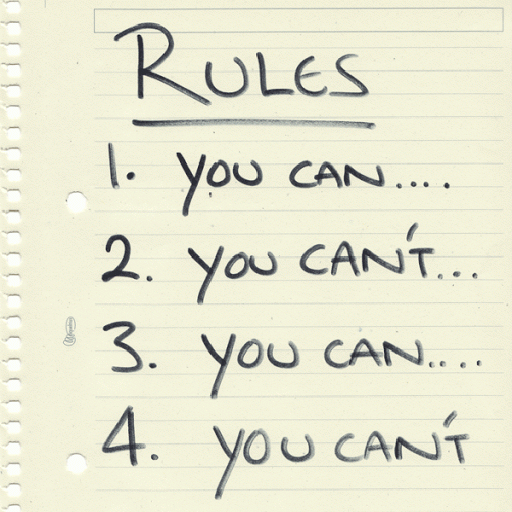
    It’s true, isn’t it?  One of the first things we welcome students into our rooms with is indeed the discussion of rules.  Walk into almost any classroom on the first day of school and somewhere on the agenda is a discussion of rules or an explanation of the rule poster that is already on the wall.  As some of you may know, there are no rules posted in my room.  And yet the kids knew that rules had to be discussed.  They knew it was important, they knew that in fact it is one of the first things we choose to welcome students with.

    The room got really quiet, the kids were waiting for me to list the rules but I didn’t.  Instead I asked them whether they knew the rules?  A couple of kids nodded.  “Again, don’t you already know the rules of a classroom?”  More nods.  “Isn’t this your 6th year in school?”  All nodded and starting to wake up a little.  “Do you need me to explain the rules or can you tell me what they are?”  With this, the buzzing started.  That little bit of chatter that kids get involved in when they start to see the light.  “We know the rules, I know how to act, we can set the rules….”

    So I told them to discuss rules at their tables; what works for a classroom, what type of environment do we need to learn in, what do you need, and the kids took it from there.  They all brainstormed and then shared their ideas and guess what; they knew it all.  How to respect, how to work, how to be a community.  We discussed fidgeting which in my book just means the teacher is boring or you need to get out of your seat.  We discussed interruptions and blurting out, how to be safe, how to be nice (You don’t have to be friends with everyone, but you do have to be nice to them).  And then we decided that we didn’t need to discuss anymore because we all knew what the expectations were.  In fact, they decided we didn’t need to post our discussion because our rules are going to change and that maybe they shouldn’t be called rules but rather just expectations.  And with that our expectations were set and for now I don’t need to spend anymore time discussing them.

    I gave my students a voice and let them lead and they showed me they already know.  I am so excited for the rest of the year.