being a teacher, new teacher, students

Getting Ready to Student Teach; Just a Little Advice

Wordle: student teacher
I am one of the lucky few that got a job at the school I student-taught at, something that I had hoped and wished for over several years.  My desire to be at this school was multi-faceted; excellent staff, a dedicated district, and a diverse student population.  So the day I received the phone call that, indeed, a 4th grade job was mine, I was over the moon.  And yet, this didn’t just happen purely because I was lucky, I had put in a lot of work to put myself in this dream position so I want to share a bit of advice for those new student teachers or those soon to be.

  • Research your school.  The school you student-teach at should be a school that you would like to work at.   Do you homework, meet the teachers and figure out the school’s presence in the community.  I had known for several years that West Middleton was where I really wanted to be so I also did practicums here, thus establishing a relationship 2 years before student-teaching started.  It was through the relationships that I found my mentor teacher and classroom I would be in for 6 months.
  • Get to know your teacher before you start.  I met with my incredible mentor, Kathy, before my placement was settled to make sure we would mesh.  I wanted to really be in a community of learning that I would grow and be challenged in and also with someone who I would form a relationship with.  While you certainly don’t have to be become life-long friends, you do have to like each other otherwise the kids will notice and learning will be disrupted.
  • Treat it with respect.  The first time I met Kathy I called her Ms. Hiteman; we were not friends and I did not feel that I had earned the right to call her by her first name.  This means something, so even if your initial contact is through email, use their last name and title, then when they tell you to use your first name you know they feel ok with that.  This goes for anyone you meet, take a cue from those around you and treat them with respect.  You never know who will be your next boss, interviewer or team mate.
  • Be passionate.  Being a student-teacher is hard work but you have to be excited.  These are the big leagues; you finally get to do what you have been training for and hopefully in a setting that suits you.  Be excited to come to school and it spreads to others, trust me people notice when you bring passion to the table and even new ideas.
  • Clear your schedule as much as possible.  Student-teaching needs to be your job, and yes this is coming from someone who worked full-time with an 18 credit load through college.  I still worked during student-teaching but it was on the weekends.  You may not be getting paid to student-teach but you should treat it like a job; this is an investment in your future and you need to be available for all of the extra work that teachers do even during summer if you student-teach in the fall.
  • Have a personality but don’t let it overtake you.  Don’t be bland, be nice, speak your mind, but do it with respect.  You do not know the school as well those who work here so bring your personality in but know when to put a lid on it.
  • Be invested.  Take the time to get to know the students, treat them like they are yours, because they are, and grow with them.  The mark of a great teacher is someone who forms a connection, so be great.  And this isn’t limited to just the students; get to know everyone, they will also be the ones deciding whether or not you fit into their school and believe me , word travels fast.
  • Reach out to others.  You may just be with one teacher through your whole process but establish relationships with others in the building, ask  them if you can go to their room to observe, volunteer for committees, and establish a relationship with the principal.  I was able to get a written recommendation form mine because I reached out and asked him to observe me.
  • Take initiative.  When I student-taught I took initiative to create new math reviews, graph data for assessment purposes and learn more abut the math resource position.  All of this ultimately led me to land a maternity leave position as a math resource teacher which then led me to my classroom job.  Had I been a wallflower and not done these extra things none of that would have happened.
  • Be yourself.  While this is a long job interview you cannot fake your personality.  Stay out of drama, again be nice to everyone, and be deeply interested in the school.  If your personality does not fit with the school culture at least now you know.  Be critical of what you bring to the table and know when to look inward rather than out.
  • Listen to the advice you are given and then actually use it.  I was not a great teacher when I student-taught and I knew it.  Be humble and take the advice that others so diligently give you; this is your chance to really grow.  Know when to ask for help and know when to change something.  Listen when someone speaks and know that it is not easy for them to point out flaws, but this is how you will  grow.  Ultimately knowing how to listen and take criticism is a life-skill you will need the rest of your career as well.

being a teacher, choices, new teacher

Some Questions to Ask Yourself as You Prep for the Week Ahead…

Ah the weekend, and for most educators that means lots of prep getting ready for the week ahead.  As I prep this weekend, these are the questions I ask myself…
  • What is the goal of the lesson?
    • This essential question was one I learned the hard way when I student-taught.  My principal observed a lesson that just fell apart, a big horrendous mess, something that could not be salvaged.  After the lesson he asked me what the goal was for that hour?  Met with a blank stare and no answer, I swore I would always know what the goal was of something I subjected my students to.  We owe it to them.
  • How will the kids be involved?
    • I moved from sage on the stage to student-driven last year so this question is huge in my prep.  In fact, I often ponder assignments for a while before I write anything down just so I can figure out what my students’ roles are in it.
  • How much talking will I do?
    • We know there is essential information in each lesson that needs to be communicated but do I have to be the one communicating it or can it be discovered or explored?  This changes widely from the concept being taught, but I do try to limit my lecturing as much as possible. Teacher talk goes down = student engagement goes up.
  • How will I change it up?
    • I need change as much as my students, so how can I make this concept fresh again. The students have been taught many of these concepts before (we work a lot on a spiral) so how will it look and feel different this time?  This questions also leads to how many different activities can we do within the time?  
  • What will they work on?
    • What will the students be doing during this lesson?  Are they note-taking, creating something, researching etc?  What supplies do I need and how much time do they need to be successful?
  • Will there be a product?
    • Does this tie in with something they are creating?  Is this a longer-term thing or very short?  I realized this week with the Hour of Wonder that students do not need that much time to create something meaningful, what they do need is for the teacher to stop talking and let them explore.
  • Where can the students decide?
    • This questions drives all of my instruction decisions.  How can the students take ownership of whatever we are doing?  After all, I already have a successful education, now it is their turn; school has to be about the students and not about the teacher.   Often they have better ideas than I do!

A peak into the mind of Pernille as I prepare for next week’s lessons.  What types of questions do you ask yourself as you prepare?

classroom management, first day, hidden rules, new teacher

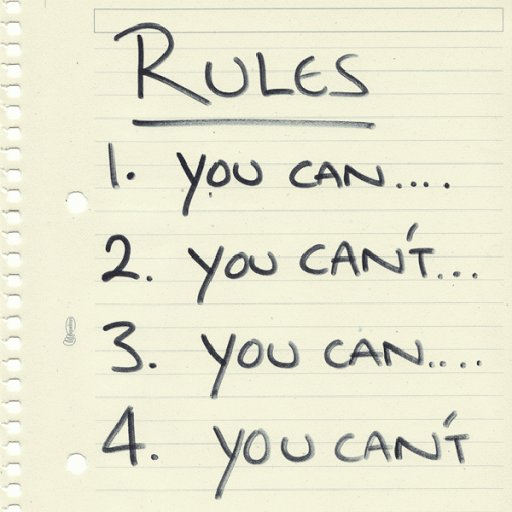
Do We Need to Set the Rules? Or Do Kids Already Know Them?

Photo Courtesy of Bloggertone

Yesterday was my very first day with my 24 new 5th graders.  I don’t know who was more nervous; me or them.  As we got settled into our new tables, 23 sets of eyes on me  (one child is still on vacation) eagerly awaiting what this teacher would share with them I asked; what is the first thing teachers usually talk about on the first day of school?  Hands shot up and one child blurted out “Rules!”

It’s true, isn’t it?  One of the first things we welcome students into our rooms with is indeed the discussion of rules.  Walk into almost any classroom on the first day of school and somewhere on the agenda is a discussion of rules or an explanation of the rule poster that is already on the wall.  As some of you may know, there are no rules posted in my room.  And yet the kids knew that rules had to be discussed.  They knew it was important, they knew that in fact it is one of the first things we choose to welcome students with.

The room got really quiet, the kids were waiting for me to list the rules but I didn’t.  Instead I asked them whether they knew the rules?  A couple of kids nodded.  “Again, don’t you already know the rules of a classroom?”  More nods.  “Isn’t this your 6th year in school?”  All nodded and starting to wake up a little.  “Do you need me to explain the rules or can you tell me what they are?”  With this, the buzzing started.  That little bit of chatter that kids get involved in when they start to see the light.  “We know the rules, I know how to act, we can set the rules….”

So I told them to discuss rules at their tables; what works for a classroom, what type of environment do we need to learn in, what do you need, and the kids took it from there.  They all brainstormed and then shared their ideas and guess what; they knew it all.  How to respect, how to work, how to be a community.  We discussed fidgeting which in my book just means the teacher is boring or you need to get out of your seat.  We discussed interruptions and blurting out, how to be safe, how to be nice (You don’t have to be friends with everyone, but you do have to be nice to them).  And then we decided that we didn’t need to discuss anymore because we all knew what the expectations were.  In fact, they decided we didn’t need to post our discussion because our rules are going to change and that maybe they shouldn’t be called rules but rather just expectations.  And with that our expectations were set and for now I don’t need to spend anymore time discussing them.

I gave my students a voice and let them lead and they showed me they already know.  I am so excited for the rest of the year.

being a teacher, new teacher

The Things I Said – Cringeworthy Statements From a New Teacher

This summer the memories of my first year of teaching comes floating back and more specifically the insane things you would have heard me say.  So had you been a fly on my wall, here are some of most cringe-worthy….

Put your name on the board!

One more check mark and we are calling your parents.

You will have to stay in for recess since you did not return your test.

I am sorry your mother did not sign it, you will lose a recess and bring it back tomorrow.

I do not think he deserves to be in the talent show since he does not do his homework.

What do you mean you didn’t have time?  It was homework!

Sit in your chair and listen.

Wake up!

Put that chair down.  Put that table down.  DO NOT SLAM MY DOOR!

Stop sharpening that pencil.

Don’t you have your own school supplies?

Do you see these zeroes?  That means you are failing 4th grade.

I am doing this for your own good.

The goal?  Well for you to do this assignment.

Ah yes, the plight of a first year teacher.  I barely recognize myself in them and yet I know who that person was because if I didn’t then I wouldn’t know who this teacher is today.  We all have our journeys as teachers, mine took me far away from this, and for that I am thankful.  Where does your journey lead you?

advice, being a teacher, being me, Interview, new teacher

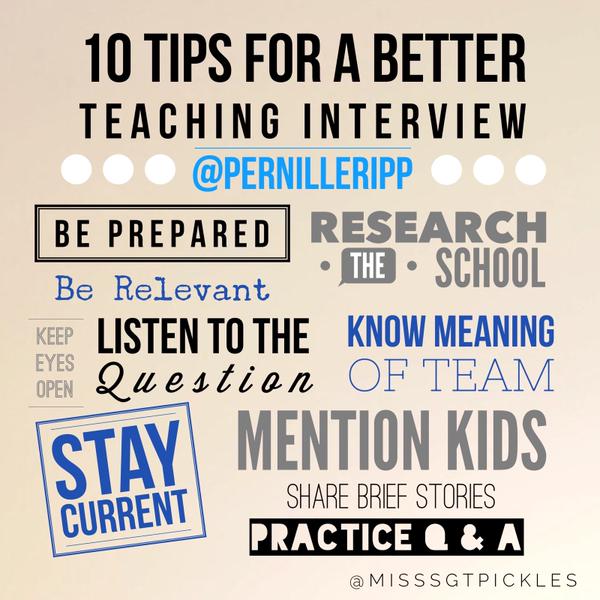
So You Want a Teaching Job – 10 Tips for a Better Interview

10tips
Thank you misssgtpickles for the image!

Every year, even as a rookie teacher, I have had the extreme privilege of sitting in on interviews for both teaching and specialist positions.  Every time I have been amazed at the quality of candidates that are available to us but also stumped once in a while when a candidate just isn’t all that prepared.  So why not offer up some tips for anyone trying to land that sometime elusive teaching job?

  1. Be prepared.  Yes, I know this sounds like an “of course” but there have been times where I have wondered whether the person even knew where they were interviewing or what they were interviewing for.  So prepare for this like you would your first day of teaching.
  2. Be relevant.  Many schools like to see something you have made, whether you bring artifacts, a video, or a link to something.  Make sure that the things you bring to show are current and fit the job.  If the things you bring have nothing to do with the position you are interviewing for, then don’t bring it.  If it fits with the interview bring it up during it, don’t just let it lie in front of you.
  3. Listen to the question.  Teachers tend to like to talk and sometimes we are not the best listeners, this is the time to tune in.  Really listen to the question being asked and then answer it.  This is not the time to stray off topic or think you know what the question is before it has been completed.  You can always ask for them to repeat it.
  4. Stay current.  I was expecting my first child my first year of teaching but that did not stop me from taking classes nor reading books.  There simply is no excuse these days to not participate in professional development,so be active in your professional development.  Take a class, read books, get connected, do something that shows that teaching is passion, not just a job.
  5. Research the school.  Most schools have websites that provide a description for you to read and then use.  We want to know why you want to work for this specific school, not why you want to be a teacher.  Make us feel wanted.
  6. Mention kids.  Another “duh” but there have been interviews where the person never mentioned kids or their desire to work with them, that sends up a major red flag.
  7. Figure out what “team” means.  I have never heard of an job that didn’t require someone to work as part of a team, so come up with a great description of what being a team player means to you and make sure it doesn’t just talk about how much you will bring to the team, what will the team bring to you?
  8. Keep your eyes open.  I know nerves can get in the way  but if you speak with your eyes semi-closed now is the time to open them up and look at people.  This goes for smiling and any other body language that says you are eager, passionate, and with it.
  9. Share stories but keep them brief.  I like hearing about past experiences but only if that story is 100% relevant and brief.  So stay on point and share, but not to every question.
  10. Practice your answers and questions.  If you google “teacher interview questions” you will find enough questions to give you a baseline for what to expect.  Think your answers through and figure out questions  you want to ask as well.  It shows you care, that you are motivated, and that this job matters to you.

Of course, there are experts out there that know way more about this than me but this is what i would tell my friends who are interviewing.  So good luck to all of those seeking jobs.

After some thought it is now time to add the one I forgot:

11.  Google yourself!  If you are a new teacher with an online identity; wahoo!  However, google yourself before the interview to see what a prospective employer might see and then set up some privacy settings if you don’t like what they find.  Results of your awesome blog or schooling is great, pictures of you drinking on Facebook is not.

12.  And finally, be excited, be humble, and have questions that you want to ask at the end.  I have always asked; What are you hoping to find in a candidate?” because ti allows the interview team to tell you their vision.  Remember you are looking for a great fit as well, not just a job.

Enhanced by Zemanta
attention, being a teacher, new teacher, Student-centered, talking

Your Lips May be Moving But I Stopped Listening a Long Time Ago

A question I kept asking myself last summer was, “Would I like being my own student?”  Beside bringing back a flood of unfortunate memories of my own schooling, it also stopped me in my prep tracks.  The answer was a resounding “No.”  I would have been that kid rolling their eyes at the teacher (yes, that happened daily), groaning every time a new group project was introduced (I hated group work),  and refusing to do homework out of sheer principle of boredom (and then argue with the teacher as to why it was pointless). Yikes, I am still that kid.  And so when a tweet by Jeremy MacDonald asked

“How do we get teachers past the teacher-centric use of tech? Modeling? Should I make them let me teach 30 mins in their classroom?” 

my mind started to spin.  Would simply asking teachers to sit through their own type of teaching, stop them in their tracks?  Or would the response be a more nuanced reflection discussing the need for various learning styles and types?  Or would we hear the stagnant adult claiming that, “they went through it so that is just how things are and to suck it up?”  I love that “suck it up” like school is just meant to be survived and not lived.

So how do we get teachers to rethink the traditional classroom setting?  Why is it we tend to forget our own school experience and then repeat it as teachers?  Why do most teachers come to teach prepared to speak most of the time?  I have been actively trying to stop talking and let me tell you, it is hard! Our curriculum is not set up for a lot of exploration, but rather mini activities packaged with a lot of careful monologue.  What is it about our way of educating that makes question-answer seem like the best fit?

So I start my own quiet revolution, using less words and still getting to the point.  Using less teacher-focused and more student-directed learning.  I even started thinking about it all as a learning process rather than how I am going to teach something.  In the end, we have to realize that if we want just test-taking students, then yes, talking at students will get us there.  If we want independent thinkers who are also creative and confident, then we have to stop talking.  So how do we stop talking?