blogging, challenge, kidblog, writing

Student Blogging Challenges – A List of Ideas

One of the things that my students love the most on our KidBlog are our weekly blog challenges.  And while these challenges are in sense homework, they always have the opportunity to do them at school, and get enough time to do it without being a hassle.  Over the past two years we have had quite a lot of fun with these, so why not share for all you blogging with your students.  Feel free to borrow or change to suit your kids.

I have broken these into categories for easier reading.

All About You

  • Imagine you have been given $100 to donate to someone or something like a charity or even to start a charitable business.   The challenge is to make your money grow whether through product or some other form.  So you need to blog about what you will do with the money, how it will grow and how much you can make it grow even more.  Your money will have 3 months to grow.
  • If you could go anywhere in time once round-trip, where would you go and why?  What would you see there?  What would you do?  Would you bring anything back or try to change the past?
  • If you could go anywhere in time once round-trip, where would you go and why?  What would you see there?  What would you do?  Would you bring anything back or try to change the past? 
  • If you could eat only one meal the next year, what would it be? 
  • If you could do one good thing this Holiday season to make others happy, what would it be?
  •  Tell me about the great traditions you have in your family. 
  •  What makes you the happiest in your life and even better how do you show how thankful you are? 
  • This week I would like to challenge you to write about about a place, from the past or the present, where you would like to live or go for a holiday or vacation.

Wacky Challenges

All About School

  • Which school rule you would change, how you would change it and why?
  • How is the year going so far?  What are you excited about?  What works for you?  What doesn’t? How can we make 5th grade better?  What should I change?
  • What would you change about school so that you would love being there?
  • Tell me what was the best, the worst, the most fun, the most boring things of the trimester?  
  • So, if you could decide what we had to learn about, what would it be?  What would our goals be? How would we learn about it? And how would we pass that learning on? 
  • What does a principal do all day?  What qualities does a principal have and what do they do in the summer?
  • You are the teacher; which class would you add to school curriculum that we don’t already have?  When would the class meet, what would the students do?  What would it look like, feel like, sound like?  And what would the students produce to show their learning?

 
Your Thoughts on Education and School

  • What is the true purpose of education?  Why do you go to school?  Why do you learn what you have to learn?
  • Is teaching and learning the same thing or not?
  • Should education be fun?
  • Give me your thoughts on tests!  Do you think they help or hurt your learning?  What do you suggest to teachers about tests?

Academic Related and Story Writing

  • You need to write to other teachers and tell them about the Global Read Aloud.
  • I want you to tell the world about Innovation Day!
  • Tell everyone about the simulation in social studies 
  • Keep a science diary of our experiments and answer any questions people may leave in the comments.
  • Write a book review of the book you are currently reading.
  • Explain what the author study is, who you chose to study and why.
  • Finish the story, “The crash came from around the corner…”
  • Finish the sentences:  Being a good teacher means…. Being a good student means… 
  • What do you love when teachers do in their classrooms?  What do you wish I did as a teacher? If you were a teacher how would you run your classroom?

Challenges from Students:

  • If you were to go inside of a book, what book would you go inside of, and what would you do?
  • Create a blogging challenge for other students to do.
  • If you could create your own country, what would it be called, where would it be, and what language would the residents speak?

All About Blogging

  • Should we continue to blog or not, convince me!
  • So how has blogging helped you as a writer?  What do you like about blogging?  What do you not like?  What would you change?  Would you continue blogging next year if you could?
  • What are the rules for blogging, how do you stay safe?
  •  Now that you have tried it, what would you tell other kids and teachers about blogging?  What should they know before they start?  What should they be careful with?  How can they get people to comment?  Any advice for people who want to blog but don’t know how?
  • Pick one student from another blog and introduce yourself properly 
assessment, being a teacher, discussion, grades, writing

Gender Bias in Assessment – Even Students Do It, Do You?

“…But Mrs. Ripp, it is sloppy so they cannot get a 4…”
“… We can hardly read their explanation so we gave it a lower grade… “

All comments that made me think in today’s math class as students were assessing work samples to get them ready to assess their own work.  Their open response work involved multiple steps, illustrations and explaining their work. They were therefore provided what we as teachers are provided; student sample work to figure out what the work was worth based on a 4-0 rubric.  After partner discussions, students shared their rankings of the problems and the most common discussion point was the sloppiness of the writing, not the math presented, not the explantion, not whether they followed directions; instead a laser-like focus on handwriting neatness and presentation.

I kept my mouth shut and handed them all a post-it note, asked them to copy a sentence off the board and write their name lightly on the back of the post-it.  I didn’t ask them to take special care with their note, just write it down.  They handed them in and one-by-one I asked them to decide whether a note was sloppy or not as shown under the document camera.  I didn’t know the names of the note writers but sure enough all the notes that were deemed neat and not sloppy were those written by girls.  Not a single boy post-it note was in the pile.  My students sat quietly as I gave them some think time.  Then I said; “If you were a boy and I assessed your work based on your handwriting presentation you would not be able to get a full score.  You would never be able to acheive what a girl can achieve in this class.”  Silence and crazy stares. 

When teachers base part of their grade on handwriting and neatness, particularly at the elementary level, we forget one important thing; handwriting is often determined more by our fine motor skill development and not the effort placed in the work.  Neat handwriting does not mean a fuller understanding or a better writer, it does not mean more care was taken with the work, or that more effort was put in.  Neat handwriting means just that; neat handwriting.  So unless that is what we are specifically assessing it should not be part of our assessment, even if our inner voice screams at us to include it.

Try the same experiment with your students, see if you get similar results and then watch them discuss it.  Watch them realize how their knowledge is judged based on their handwriting.  Watch them gain a deeper understanding of all of the inner voices they carry telling them what makes work quality or not.  It is quite a realization for teachers and students alike.

being a teacher, writing

But We Get So Excited….

We are in the middle of writing boot camp, that back to basics training that my 5th graders all need.  They have these incredible ideas just bursting onto their blogs, their journals and anywhere else they write, but they lack the basics.  The organization, capitalization, and other things that make readers stumble and lose interest.

So as we go through another lesson on paragraphs and the students correctly put all of the pieces together, I ask them, “Do you all know this?”  A resounding “Yes!” greets me.  “Well, then why don’t you use it in your writing?”  Silence and then this answer, “Well, we just forget because we get so excited…”  I smile and move on.

I wonder how many times students don’t show their best work because they are so excited…

Diary of, video, writing

Diary of Project

For the past two years, my phenomenal tech teacher, Myrna Heilman, has spearheaded the Diary of project in the 4th grade. The students get to research an animal of their choosing, write down 10 facts at least and then create a movie pretending to be their animal. This is based on the books in the “Diary of a Fly” series and this lesson plan.

This lesson not only lets students incorporate tech in a meaningful way, not just for tech’s sake, but lets them truly adapt a different voice and unique perspective. While most of my students’ work can be found here, below is just a sample of the finished product.

action, word choice, writing

A Lesson in Action and Word Choice

My students are developing their choice in words and in particular how to create a more exciting story.  I often find that students are tired of writing by the time they reach the exciting bits and so it ends up being shortened and not fully developed.  This action word lesson sprung from this problem.

Day 1:

  • I read them “Crazy Hair” by Neil Gaiman and asked them to take note of any “delicious” words that he used.  Whenever students submitted a delicious word, we discussed what other words he could have chosen and why we thought he didn’t.
  • We then return to our prior knowledge of the 6 + 1 Traits of Writing, which ones have we discussed more (organization, voice) and which ones do we need to explore; word choice.
  • This always lead to a discussion of why word choice is so important, where the students take ownership of making their writing better. 
  • I also introduce the “circle it” strategy here for spelling words: don’t skip a word just because you cannot spell it, spell it as best as you can, circle it and come back to it when you edit.  This eliminates kids stopping and losing their momentum in their writing.
  • Then they need to spice up some boring sentences to get their creative juices flowing, my list of boring sentences can be found here.  I only gave them 4 to work on in a small group and they had about 5 min. to improve.  Then present to the class and the students compliment each others sentences.
  • I do a teaser for the next day about how excited I am to introduce their writing project etc.

Day 2:

  • Write the word “ACTION” on the white board.  Let students guess for a minute why.  Then refresh their memory about the lesson from day 1.   What does action have to do with word choice?
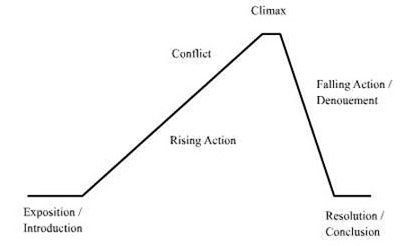
  • After discussion of this we speak about the climax of a story.  My students already know about the parts of a story so they recognize the diagram I draw on the board.  I circle the middle part because this is where the focus needs to be.
  • We discuss how movies are filled with action and then how would you write a scene from a movie?  I offer them my example. We discuss why it works as an action sequence.
  • Then it is their turn.  In small groups, they are to brainstorm using our huge whiteboards (24″ x 32″) and then write our a short action sequence using the most exciting word choices they can come up with. I project their brainstorm help questions to save paper.
  • I have them write in small groups as a guided writing step, some students would be capable of writing their own example right away but this way they help each other gain strength.  I gave my students 30 min to brainstorm and write.  They all finished just in time.
  • Share the stories and compliment what can be complimented.
  • Then I reveal the final project: their own short story, starting at the beginning of the action and ending at the end of the action.  No set up, no explanation, no denouement, just pure action.

Day 3:

  • Brainstorm using these sheets from http://www.writingfix.com.  This fit our purpose of using transtion words to shift from place to place as well as keeping the focus on the action.
  • Students will spend a lesson brainstorming and meeting with peers to help each other out.

Day 4:

  • Meet with me to discuss their idea and then begin the actual writing process.

Days spent on this lesson will depend on progress of students.  I envision about 2 weeks with a comic like illustration to go along with their action sequence.

being a teacher, elementary, kidblog, Student-centered, writing

If You Give a Classroom Videos

If you give a classroom videos to watch, they may just ask for more.  And then when you play another one, they may start to discuss if it is true what the video purports.

As they discuss the message they ask to write that day’s Op.Ed. on the topic and groan when you only give them 15 minutes to write.

When they start to write, you will notice there is furious scribbling and lots of staring.  Then you ask why they are staring and they tell you that they are thinking.  As they think, they come up with even better reasons for why there should be fun in education.

When the time is up, the most reluctant of writers eagerly raise their hand.  As they share, you notice, that other students are nodding in approval.  As they nod in approval, you see the speakers smile.

As the speakers smile, you notice the mood getting lifted and more students raise their hand to share.  As they continue to share, you realize just how much thought went into their writing and you get very, very proud.

When you realize how proud you are, you know this has to be shared with others, so you ask the students to please publish it in their kidblog.

The students cheer as they love to blog and as the cheers settle, one student raises their hand eager to ask a question.

If you let that student ask their question, they will ask if they may watch another video.  And if you let them watch another video, chances are they will want to watch another one after that.