blogging, kidblog, student blogging, writing

6 Steps to Better Student Blogging

image from icanread

When I started blogging with my students, I had no idea what I was doing.  I knew I wanted them to write, I knew I wanted them to connect, and I knew I wanted them to reflect openly on many issues and not just blog their writing assignments.  Sometimes their blogs blew me away and other times I wanted to encourage them to hit delete rather than publish.  Over the years as I have seen our blogging reach a wider audience, we have fine-tuned what it means to blog and it is something that I continue to work on with every batch of new students.  So how can you take your blogging from just writing to actual global collaboration and reflection, well, these tips may help.

  1. Be a blogger yourself!  I show this blog to my students and we discuss what I do to keep an ongoing dialogue going.  We discuss what my writing looks like and who I am writing for.  The students notice the care I take with my posts and also that I (usually) comment back.  Because I am dedicated to my own blog, I know how much work it is and also how fulfilling it is.  Why would you ever ask students to bare their souls if you haven’t bared your own?
  2. Make it authentic.  Yes, I have students write about curriculum once in a while, but rarely is just a typed up version of something they already wrote.  So if you want them to blog about an in-class topic such as science, how about making them keep a science inquiry diary where they discuss and reflect on their discoveries and answer questions from others?  
  3. Discuss the difference.  We tend to assume that students know the difference between blogging and writing but they usually don’t.  So make a chart, a list, a poster, something and use the students’ own language to discuss the similarities and differences.  Post it and bring it up again, particularly if you see students’ writing not developing the way it should.
  4. Create expectations.  Again, ask the students; what should a great blog post look like?  Then hold them to it.  I have certain requirements the students have to follow and they also add their own to them, after all, this is being published to the world.  While I would not have my students write a rough draft and then type that up, I believe we can hold them to a certain standard when it comes to their blogging.  It should be punctuated correctly, spelled mostly correctly, and it should be a blog post, not just a couple of lines.
  5. Make the time for it.  And keep it!  I have an urge to blog most days and I do wait until inspiration strikes, however, that takes training in a sense.  I love to blog and I love the conversations that follow blog posts, but this is something I have grown accustomed to.  I didn’t start out that way and neither do most of my students.  So dedicate class time to blog, discuss their blogs, and celebrate the comments the students get.  Make it a big deal because it is!  When we grow complacent about our student blogs, they lose their deeper meaning and students can take the global connections aspect for granted.  The blog then becomes just another forced writing assignment.  So make them a big deal and keep them that way.
  6. Prepare, Discuss, and Reflect.  Before you start blogging, do all of the necessary preparation.  Then while you blog discuss how it is going, fine-tune the expectations, and maintain a blogging presence in the classroom.  Reflect once in a while; how is the blogging going?  Should we take a break?  Have students run the discussion, it is there hearts and minds on the line, not yours.

If you need more help, please visit my blogging resource page.  I even have a letter for parents on blogs that you can get here.  But in the end, if you do student blogging right, it may just turn into one of the most rewarding experiences for the students and for you.  And even if you don’t do it right, it is never too late to fix it.  Happy blogging!

being a teacher, classroom management, discipline, punishment

Red Cup, Green Cup, I Even Had a Blue Cup – Why I Threw Out My Sticks in A Cup

image from icanread

I remember the first time I displayed my classroom management cups; I was so proud.  Although the idea was not my own, far from it, I felt that here was something I could embrace, here was something I could stand behind and really make my own.  My old system of putting names on the board had proven to be too complicated, I had given up on it and so had searched for something new.  Inspiration struck in another classroom and I too had gone to Target and purchased my cups; big fancy tropical drink cups.

The system was so easy; a stick with your name on it starts out in green, when you misbehave you move it to yellow – warning! – and then when you disobey again you move into red.  But that wasn’t enough, oh no, I needed another level of bad, another level of punishment; enter the blue cup!  The blue cup was an immediate phone call home to parents.  It didn’t matter what we were doing,  blue infractions meant stop the class and make that phone call in front of all of the class to tell your parents just why you were calling home.  Proponents of in-class embarrassment can clap their hands with glee here.  It was great!  Not only did I get to call students out in front of their classmates to move their stick,  I also got to have the cloud of warning hanging over them all day, and that stick of theirs could never move backwards in a day, only forward so the whole class knew exactly who had been bad that day with absolutely no chance to redeem themselves, power to the teacher!

With some kids the system was great, they misbehaved so often I didn’t even have to speak the words, we had a hand motion and a certain look that told them exactly what they needed to do.  Move that stick or else!  Or else… or else I publicly humiliate you in front of your peers, or else I make sure that if your day didn’t start out poor it is now guaranteed to be.  Or else I call you out for any little thing because I am so focused on you now with that stick in the yellow cup.  Those cups were central to the power in the room.  Their placement was at the front of the class right by the white board where everybody could see them.  No slinking to the back to move your stick, oh no, get up here and do it.

So what were these stick moving infractions because they must have been bad, right?  Well, to the teacher I was then, where it all had to do with keeping the control, they were definite deal breakers.  They were kids speaking out of turn, blurting out, or not paying attention.  Kids coming in late from recess or not having their supplies ready after they had been asked.  How about leaving your homework at home and then forgetting to come in during recess to do it.  Or if I was in a bad mood it might be a snarky comment or the attempt at a joke; move your stick!  You see, there was no rhyme or reason, some days it was easy to move your stick, other days I let things slide because I was in a better mood.  And yes, some kids moved their sticks more than others because they just couldn’t sit still, because they just couldn’t get it together, because they were that kid that just keeps getting in trouble because we are so focused on them and their misbehavior.  Poor kids.

So  I stopped when I realized, too late, how much damage this system had created.  Students had relinquished the power to me, sure, but it was because of fear not out of  respect.  They knew I was the boss because I made sure they were at the edge of their seats hoping to not be called to the front.  I had created the type of classroom I swore I would never teach in and it had all been so easy.  I knew I had to change when I saw their self-esteem suffer.  I knew I had to change when it was the same kid day in and day out moving that stick.  I knew I had to change when those parents didn’t answer the phone call because they knew it was not good news.  I knew I had to change when I couldn’t recognize the teacher I saw in the mirror.  So I threw out the cups, threw out the sticks, took a deep breath and swore off all systems.  No more sticks, no more calling out, no more cups.  And guess what…the kids behaved.  The kids started to have more fun, to show respect, to pay attention.  Was it perfect?  Of course not, this is real life not a movie.  But by throwing out the cups we shifted the power to be more balanced.  The room became theirs again and I got to fulfill the role as teacher, not just punisher.  I got to show the kids that I loved my job and more importantly that I loved having them in my life and that will always be more important that a cup and a stick.   I have never looked back.

global, global read aloud, tools

5 Reasons I Love Using Edmodo in the Classroom

Image representing Edmodo as depicted in Crunc...
Image via CrunchBase

I have long been a fan of Edmodo after it was introduced to me as tool in the Global Read Aloud.  This free social network specifically aimed at students and teachers is a fabulous way to integrate social media into your classroom, as well as setting up ways to collaborate with other classrooms.

While there are many great tutorials on how to use Edmodo such as this one by Jason Bedell, it is really one of those sites that needs very little how-to explanation, which makes it ideal for any techie newbie out there.  So here is my top 5 reasons for using this social network

  • Global collaboration made easy such as for the Global Read Aloud.  We have different groups set up for teachers and small student groups.  We love how easy it is for people to find each other, share resources, and even branch off on their own.  This is our fastest growing site used in the GRA and parents can even be invited in to see everything we do.
  • It is free!  Teachers love free things and particularly ones that are really well made.  Edmodo is easy to use, easy to facilitate, and does not charge us a dime.  
  • It is a great introduction to Facebook.  I know this may sound strange but I love how closely Edmodo resembles Facebook without it being Facebook.  Being a 5th grade teacher where students are legally not allowed to be on Facebook, Edmodo provides them with an opportunity to dabble in social media and getting used to using it well.
  • It is private!  I love the ability to set up different groups and the ability to add students to them.  I also love that this is something only teachers or administrators can do and not just anyone.  I also love how we have control over who joins the group, connects with us, and how we communicate.  You cannot find someone on Edmodo outside of it and yet it provides enough flexibility within its privacy that students can create meaningful collaboration.
  • It provides a direct pipeline to the teacher.  I love that students can use Edmodo for informal as well as formal classroom work.  My students often use it to ask for homework help, clarification, or just to boast of their latest achievement.  They also use it to reach out to me privately with questions or concerns and I love this capability.  Some students simply do not feel comfortable speaking to you about private things out in the open but this way they can contact me directly without anyone knowing.

Of course there are many more reasons, such as how easy it is to share resources, how it allows students to communicate with other classrooms and create polls, how parents can get a window into the classroom, and how I could use it to post and gather homework assignments.  So this top 5 is just that; my top 5.  Why do you love Edmodo?

community, first week, new year

Hold Off on that Curriculum – Slowing Down Now Speeds You Up Later

image from icanread

You feel the sense of urgency as you enter, the hallways are buzzing with sounds, and everywhere you look teachers and students are engaged in activities; welcome to the first few days of school.  And while we all feel the curriculum rushing up on us, here is why taking your time with your students those first few days will be the ultimate payoff for the rest of the year.

  • We are all brand new to each other.  Yes, you may have had their sister, or you may have started a relationship with them in an earlier grade but let’s face it; they are a brand new kid who just wants to be liked by their teacher.  How will you ever find common ground if you don’t find the time to actually hear about their lives?
  • We are cementing our routines.  I am not always a fan of prescriptive programs but there are certain routines that the students have to master for our days to get started quickly and for us to work more effectively.  Those routines will not be secured if we don’t take the time not just to practice them, but also to discover and discuss the need for them.  I don’t set the rules but I do show routines.
  • We are discovering our rules.  As I said, I don’t set the rules, my students do, so to do that we have to take the time to discuss what we want our year to look like, feel like, sound like.  What do we want to leave 5th grade with?  So we create a vision video for our room on Animoto and we talk a lot about what we need in order to be successful learners.  We do not write the rules down but bring them up throughout the year.  This takes time and that time needs to be given at the start of the year, later on it is too late.
  • The curriculum will mean nothing if we don’t get excited.  School has been done for too many years to students so I would rather see students get excited about what this coming year of learning will mean for them.  To do that you have to invest time in exploring just what the year will look like.  We pull our curriculum a little bit apart just so we know where we are headed and all of the things we have to look forward to.  It is wonderful to see a child get excited about something they will explore in February already.
  • We relish our freedom.  We sometimes have to unteach certain behaviors because we work a little bit differently in our room.  So instead of always raising our hand to answer, we figure out  how to do “adult” discussions.  We figure out how to work independently, what our help resources are, as well as how to take control of our misguided attempts or abject failures and figure out where to go from there.  Students tend to think at first that I am trying to trick them into misbehaving, they have to see that it isn’t a trick.  This takes time but is so important to the rest of the year.
  • We have to build trust.  Without trust our blogging does not work, and neither do many of the other learning activities we do.  I don’t demand their trust, I earn it just as they have to earn mine. Respect and representing ourselves well is something I hold very dear and I try to pass on those values to my students.  If we don’t trust each other to learn together then we cannot overcome all of the challenges we need to conquer.  Trust is a main tenet of our room.

Being on maternity leave doesn’t mean that I won’t have a first day of school, it jst means that it comes a little bit later and there may be changes for the students.  When I go back, I know that i will have to invest the time to start our relationships.  Right now, my 5th graders are not my kids, they belong to my sub, so to become mine, we have to build our relationship.  So yes, I will be taking the time to do so even if that means the curriculum has to wait a little.

Some of the activities I plan on using such as the human treasure hunt, our time capsule, as well as the letter to me can be found as a printable packet on Teachers Pay Teachers with 13 pages of ideas.

Uncategorized

To Be Successful Sometimes We Have to Let Go

image from icanread

5 hours into a marathon feeding session and I am practically in tears; how will I ever satisfy this child with what I have?  Oskar and I have been at it since 10 PM and the clock ticks dangerously close to 3 AM and yet he won’t sleep, all he wants to do is eat and be held, and this parent of 3 is at her breaking point.   As I feel the panic rise within me I realize that this is exactly why there is formula, why we have an alternative when we feed our babies, and so I calm myself down, take a deep breath and try to push the guilt away.  Sure, this is not ideal, it certainly is not the natural parenting I had envisioned, but right now Oskar is screaming bloody murder and I need to stop the guilt, get with the program and get over myself.  Having twins means making a lot of changes, and sometimes realizing that my idea is not what is best at that time.

As teachers, we need to sometimes let go of our own ideas as well.  We need to realize that the program we have envisioned, trained for, and perhaps even used before, may not be the program that will work this year. The program that we have so loved, eagerly anticipated, may just not work with this group of kids.  So letting go of our own foolish pride becomes priority number one.  Letting go of what we thought would be the right thing to do becomes of utmost importance.  Once we have let go, we can start to work on acceptance and figuring out where to go from here.

Sometimes our plans and our desires don’t work the way we want them to.  Sometimes we have to let go of what we thought would work, we have to let go of what we envisioned.  That doesn’t mean we are sacrificing ourselves or our ideals, but rather that we are working with the kids instead of forcing them into our idea of them.  In the end, that is what great teaching is all about; working with the students you are given and not the students you had envisioned.  So hey, it’s ok to let go.

Related articles

Be the change, being a teacher, choices

Find Your Change

image from Case&Co

I write a lot about change, after all, in education how can you not?  Change does appear to be the constant every year and this year is no different.  However, the change I love to focus on is the personal change; the one where we know that something has to be different for us to keep on going.  The change that tells us that we will burn out in teaching if we don’t act now.  So the one question I seem to get the most is; how do you change?

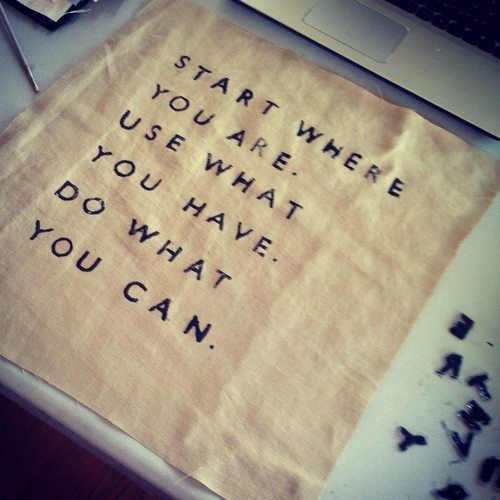
The answer for me is; start where you are.  Take stock of what it is that makes you tick and what makes you stop.  What burns you out and what do you have power over?  There are many things that wear my soul down that I cannot control so I try to focus on those that I can; homework, grades, punishment, ways I present information, community, and so on.  And then I focus in on a few that I need to change right now.  I do not marry an idea, I date i,t and year after year it may get transformed – the change may change, and I am at peace with that.

I also don’t buy into a lot of programs.  I already have enough to memorize with the curriculum I have to teach so I look for natural changes; those that speak to me, that I know are authentic to me, nor purchased and packaged in a sleek form.  I have tried to implement many programs in my classroom, Tribes anyone, only to watch them disappear because I don’t remember what the main components are.  So my change is my program and therefore not prescriptive, it works for me in that moment, in that year, and I believe those are the best types of changes.

So this year, as I sit on maternity leave and wait for the calendar to show November 5th, I think of changes I may implement this year.  There are many I can think of but none that I know for sure, after all, how can I know what to change when I don’t know what will work with this amazing group of students?  And yet, the need for change is there, I can’t wait to blog about it.