
first day, hopes, new year

A Hope for the First Day of School

In the movies they often speak about that one day that changes everything.  The moment in which the world stood still or tilted on its side or whatever cosmic thing that can happen, happened.  That day that changed someone forever.  And as much as I love the movies, I don’t think our lives can depend on just one day.  I think it can depend on many “one day’s,” a collection of big days that compounds us and define us, creating the person we want to be.

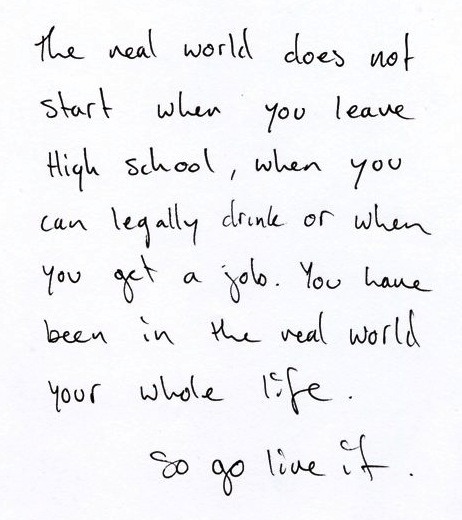
One of those days is the first day of school.  The real first day, not the ones where parents show up and you wear your finest clothes and you smile and socialize and talk and try to not show how insanely nervous you are.  No, the one after that.  The one where the students show up after the bell rings and try to remember where their desks are, try to remember your name, try to remember what was all said the day before.  That day can change everything.
We worry about the impression we make on parents, did we get our message across?  Did we plant the seed of relationship?  Do they really trust us as professionals?  But do we worry enough about the impression we make on our students?  Has that seed of trust been planted or is it simply taken for granted?
So on that first day of school, that real first day, I want to reach out and connect.  I want to laugh a lot.  I want to excite, I want to work, and I want to bare myself.  I want to invest, to relish, and to trust my students.  I want them to feel they are at home, that our room is safe, and that 5th grade will be just as magical as they hoped it would.  I want to make a day that changes their lives, I want to be part of their collection of “one day’s.”  I hope it is not asking too much.    
Uncategorized

15 Lessons That Are Taught in Schools, Even if They Are Not on Our Syllabus

image from icanread

I don’t get offended easily, after all, being an outspoken feminist liberal means you just have to be a little tough.  And yet, when I came across the post “15 Life Lessons They Don’t Teach You in School” my hair stood on end just a little bit.  Besides the obvious referral to “They” which I absolutely can’t stand, I couldn’t believe what the author thought we didn’t cover in school.  SO while the lessons are sound, the assertion that these are not taught in school is simply false, read on for my counter arguments.

1.  Author states:  “Don’t sweat the small stuff.” 
School is one big exercise in not sweating the small stuff, we teach kids to deal with day-to-day bumps in the road whether deliberately or not.  Your pencils are all missing; here is a new one.  You dropped your milk in your backpack; let’s clean it up.  So and so aren’t talking to you; let’s figure this out together.

2.  Author states:  “Life can be unpredictable and throw you some curves.” 
Anyone who has ever taught a day in their life have to laugh a little bit at this statement.  Most of our day is spent dealing with curveballs and so is that of the students.  No matter how much planning we do, how well crafted our intentions are, something usually goes amiss.  Presentation tools don’t work (ask my 5th graders about that one), a child flips a chair in anger, or your friend throws up all over your project, oh yes, my kids know how to deal with curves; suck it up and make the best of it.

3.  Author states:  “The most boring word in any language is “I.”
I would love to know which school this author went to where students didn’t have to interact and work together throughout the day because I don’t think it exists in the USA.  School is not about being self-centered but being a team player that creates a community of learners.  Of course, we have to teach self-reliance and self-esteem but even that is done as a team.

4.  Author states:  “People are more important than things.”
Need I refer back to how much time we spend building community in our classrooms and schools?  Enough said.

5.  Author states:  “Nobody else can make you happy.” 
I know we frequently discuss this in our classroom, how you are responsible for your own school experience and whether it is a good one or not.  By providing opportunities to discuss ownership of state of mind we are exactly teaching this lesson.

6.  Author states:  “Character and integrity count.”
I had a child plagiarize not once but twice in a year.  His biggest take away wasn’t the punishment aspect of the ordeal but what it made him look like; how it affected his character.  This major teaching point of school is something we deal with on a day-to-day basis by setting ourselves up as role models and pointing out model behavior.

7.  Author states:  Forgive yourself, your friends, and your enemies.”
Another major component of lesson taught in school.  As a 5th grade teacher this is a regular conversation after recess incidents and friendship issues.

8.  Author states:  ” A good joke can be better than any pill”
My main goal of teaching is to make sure students still love school when I am done with them.  This is accomplished through a lot of laughter and personality.  By building a sincere community founded on happiness and showing students that school is indeed fun we maintain kids that love to learn.

9.  Author states:  “There are no substitutes for exercise, eating well, and fresh air and sunshine.”
Which is why we fight to keep PE in our schools and teachers take their kids outside as much as possible.  I teach most days with the lights off to allow the natural light to dominate and any chance we can get to move a lesson outside we take.

10.  Author states:  “Persistence will eventually get you almost anything.”  
While I love the sentiment of this statement I don’t believe it.  Even if I persisted at doing gymnastics I would never make the olympic team or many other things.  However, I do believe we teach our children to not give up and try again every day.  In fact, many of us celebrate all of the times something did not work and the lesson learned from that.

11.  Author states:  “Television probably ruins more minds than drugs.”
What is this, a 1980’s PSA?  Of course mindless channel surfing limits intellectual stimulation; how many TV’s running incessantly has the author seen in our nation’s schools?

12.  Author states:  “It’s ok to fail.”
Yes!  And this is stated almost daily in our classroom.  Failure is embraced as a natural part of life and celebrated as the opportunity for exploration it is.  I don’t believe in a school where failure is not allowed if that failure is viewed as a learning opportunity rather than a detriment.

13.  Author states:  Learn from the mistakes of others.”
This is called classroom discussion, an integral part of any good lesson.

14.  Author states:  “Don’t be afraid to show and tell others you love them.”
Love is one of the key tenets of a classroom; love for your job, love for your students, and love for yourself.  Without love in a classroom it becomes a factory model of fact churning, not a rich learning environment.  You must invest yourself for the students to invest themselves.  You want love?  Come to an elementary school on the last day of school and see the tears, the hugs, the smiles.

15.  Author states:  “Live so that there is only standing room at your funeral.”  
Be the best friend you can be, be the best you you can be.  You matter indeed.  All words uttered in may classrooms around the nation.  Lifelong relationships start before we enter school and only progress from there.  Of course, school is one of the key places you meet all of those people that one day may be at your funeral, why wouldn’t it be?

So there you have it, nice sentimental sentiments that would be a cute article if it wasn’t for the assumption that none of this is taught in schools.  Who said being a teacher was only about the curriculum?  And if you don’t believe me, drop on in to room 111 any day, I will prove it you and so will my students.
new teacher, new year, preparation

So You Got the Teaching Job – Now What?

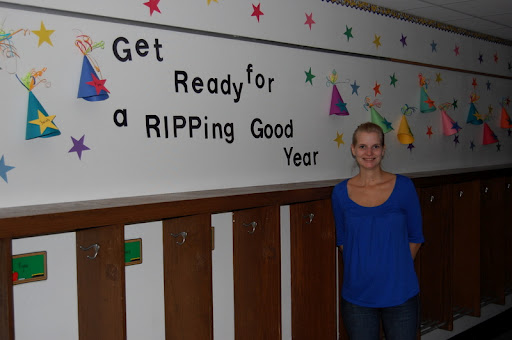
Me in front of my very first welcome wall

As summer continues to lull us into long days filled with ice cream, books for fun, and nights spent on a porch, I can’t help but think back to the first summer as a teacher.  That summer when I had made it through those grueling interviews, where I had finally landed my dream job and I now stood facing an empty classroom, slightly panicked, but oh so very excited.  I remember the joy.  I remember the delight.  And boy, do I remember thinking, “Now what?”

Don’t get me wrong, I had read Harry Wong’s book, I had substituted, I had even taught summer school, and yet, it just wasn’t enough.  I had no idea where to go from there, so to all those new teachers, with all those new jobs, I offer you my advice.

  • Reach out!  Remember that interview team you sat across trying to connect with, well, now is the time to make the actual connection.  So email them, find them on Twitter, Google them, but do something and reach out.  Set up a time to meet whether formally or informally.  Don’t wait until the first day of school there will be so many others to connect with then.
  • Ask questions.  When you reach out, ask questions about curriculum, ask questions about school quirks.  Truly there is no such thing as a dumb question in this matter.  I still remember my long list and just how gracious my team members were to me.
  • Ask for resources.  Don’t re-invent the wheel with every single piece of paper.  I created so much on my own that first summer until I found out how much of this stuff my team already had made that was much better than my stuff.  Bring your ideas to the table but also ask to use some of theirs.  There will plenty of stuff to do on your own.
  • Do your homework.  However, do figure out what you can on your own too.  Things like math curriculum and other major district decisions can probably be discovered through a quick website search.  That way you can get to those things that are a little more complicated then that.
  • Start dreaming about your room.  Your room is really important, it signals to the world what type of teacher you are and what your educational philosophy is.  Where do the desks face?  Do you have a desk yourself?  Are there posters or will you have students take over the walls?  All of these seemingly innocent room questions are actually pretty major things to consider.
  • Take classes.  Again, this may be something a teammate tells you, but see if there are classes you need to take.  This year my district is implementing the writing workshop and we are all encouraged to take a 2 day class on it, my new team mate knows this because I told him.
  • Reflect.  Now that you have the job; what is your primary goal for your first year (and please don’t say survive – teaching shouldn’t be about survival but about thriving)?  What do you hope to pass on to all of those kids, your teammates, your school and yourself?  Where do you want to see yourself next year?
  • Stop with the prep work.  I made so many copies and spent so much time laminating my first year, why?  I am not sure.  It seemed like a full-time job some times but I was so sure that everything needed to be protected and copied, crazy really.  So figure out what is important to you, take stock of what you will be doing in your prep time, and ask yourself this; “Does it really need to be laminated?”
  • Enjoy!  There is no time like the one you are in, all fresh and ready for those first students.  So get yourself psyched up, because it is truly a memorable experience.  Allow yourself to trust yourself.  Allow yourself to feel like you have something valuable to add.  And finally, allow yourself to be just a little bit freaked out.  You cannot prepare for everything but you got the job because you are capable, so trust that.

classroom setup, new year

The Secrets of Your Classroom – What Your Set Up Says About You

image from icanread

I finally made it into school today and saw to my amazement that all of my furniture had been moved back in, the floors were waxed, and now all of those boxes were ready to be unpacked.   I couldn’t help but be excited, and then I realized that I am hugely pregnant, and didn’t even know if I could stand up for the time it would take me to set it up.  So what is a girl to do?  Try anyway.  As I unpacked, arranged, and dreamt a little of the new year, I realized once again how much the way we set up our classroom reflects our educational philosophy.  How much those seemingly innocent decisions of table placement, wall decorations and so on really reveal to the world.  So these are the questions I asked myself

  • To desk or not to desk?  I was offered the granddaddy of desks this year; huge, sleek, brand new and I turned it down gladly.  last year I decided to go deskless and I have never looked back.  Instead I have a table for my computer and planner, one where I can meet with kids but it is tucked into the corner, somewhere where I don’t get drawn behind, isolating myself from the kids.
  • Tables or desks?  I used to have small desks that we would scoot together to create pods, now I am fortunate enough to just have big tables for the kids to use.  They move their chairs as they see fit to work with the lesson and I don’t ask questions when they do.  They just pick up their pencil can and go.
  • What’s on your walls?  I used to have all of those awesome posters with the animals saying cute motivational things plastered all over my walls.  That way wherever you looked you would be motivated to hang in there, work hard, and make great decisions.  I took them down two years ago and now have three posters hanging; a world map to push pin our connections, a top ten of my room created by former students, and a calendar.  Everything else we add as we go.  
  • Are you in the room?  Those kids become part of my family so I have framed pictures in my room of newspaper articles from former years, all of the kids I have ever taught, two fantastic student art pieces that still choke me up and two quotes from the Little Prince.  These mean more to me than motivational poster ever will and show the kids who I am, that is so important.
  • Which way do your desks face?  My former students told me they didn’t want to face the Smartboard but rather the whiteboard because we used that much more.  So this year that is exactly how they face.  However, once again, the students can move about as they like so in all honesty I am not too bothered how they face.  I don’t need to be the center of attention so the desks don’t need to face me so I can lecture.
  • Other areas?  Are there places for the students to work that doesn’t include their desks?  I used to have cushy bean bags and comfy chairs but lost them all to fire code.  Now we have carpet squares, random chairs from my house, a big reading carpet, two stand up desks and lap desks that the students can use whenever they want.  I don’t ask questions, if they need them, they use them.
  • Sign in and out.  Some teachers ask students to sign out when they go to the bathroom etc.  I don’t, instead they put the pass on their desk so in case of a fire drill I know where they are.
  • Can they get what they need?  I used to hide all of my extra supplies and would get really upset if students dared ask for a pencil.  Now, I have bins of stuff they may need which they can grab and they know to just ask if they need something that isn’t out.  My goodness, who hasn’t ever needed an eraser?
  • Where are those rules?  Anyone who walks in will notice there is no class constitution, no rules, no what happens when… posters in our room.  Expectations are discussed by the students and changed as needed.  With only 20% of the walls up for use due to fire code I am not wasting that space on rules.
  • Where’s the tech?  I am fortunate to have a 4-in-1 computer set up for students, but we also have some flip video cameras, headphones, microphones, and camera for them to use.  Do you hide it or can students just use it?  What is your level of trust with technology and putting it in the hands of students?

By no means a final list but things that flashed through my head today as I unpacked.  What did I miss?

assessment, feedback, No grades, Student-centered

How Do You Assess Without Grades? 5 Tips to Ease the Transition

Two great questions came my way yesterday in regard to assessing without grades and then communicating that information.  We are so used to the ease of a letter grade that gets recorded in a book, averaged out and then translated into a letter, that moving away from that can be daunting and just a bit overwhelming.  So two years into my process I thought I would share some tips I learned the hard way.

  1. Discover your goal.
  2.  Whether they are based on district standards, common core, school outcomes, or even those listed in the curriculum, figure out what the goal is for each thing you teach.  These can be large or small (don’t do too many small ones though, trust me) and then figure out what the outcome should be.  Everything you do should have a learning goal because without that there is no point to the lesson.

  3. Determine the product.  What does it look like when students have accomplished the goal?  What is finished?  What is just another stepping stone?  How will students show that they have mastered the goal?  I love to have this discussion with my students, they have amazing ideas for this.
  4. Determine assessment.  Will it be written feedback?  Will it be a rubric?  Will it be a conversation – great tip; record these with a Livescribe pen and you have it for later!  Once again, ask the students, what type of assessment will help them?  How do they learn best?
  5. Keep a record.  This has been my biggest hurdle.  I have had charts, Google Docs, grade book notes, relied on my faulty brain, and yikes.  This year I am bringing my iPad in and using Evernote to keep track of it all.  Students will each have a portfolio in Evernote with conversations, pictures of work, links to blog posts, as well as videotaped events.  This way, everything will be at my fingertips when needed.  
  6. Communicate!  Assessment is not helpful if kept to yourself so have the conversations with students, take the time, write things down, communicate with parents.  All of these things need to be taken care of for this to work.  The allure of letter grades is just that; the ease of communication, nevermind that they can mean a million different things.  So when you step away from those make sure you replace that with communication.  Give students ownership of their goals and have them write a status report home, send an email, make a phone call.  Something.  Everybody should know where they are at and where they are headed throughout the year.

My 5 biggest tips for today and something I continue to work on.  Whatever your system is, take the time to reflect upon it, refine it, and make it work for you.  Ultimately stepping away from letter grades should lead to a deeper form of assessment, not a larger headache, but for that you have to have systems in place.