So You Want to Quit Letter Grades – A Practical Guide From Someone Who’s Done It and Survived
- Do your research. I knew that to do this right I had to have my philosophy and facts straight so I read Alfie Kohn’s work, as well as the numerous blogs, articles, and reflections on it available through a Google search. This strengthened my stance and gave me practical know-how.
- Think it through. This is a bucking-the-system type of decision so you need to be clear on why you are doing this. Providing students with more meaningful feedback: yes. Less work and more free time: no.
- Now think it through practically. What is this going to look like in your room? How will you take notes? How will you assess their learning? And then how will you compile that all into feedback, progress reports, and perhaps even a dictated grade on a district report card? This was my biggest hurdle this year and something that I need to refine next year.
- Create your goals. All lessons have to have goals, otherwise you will have nothing to assess. Sometimes we are not totally sure of that what those goals are since a curriculum has been prescribed to us. Dig through it and find them or create your own within your standards and then make a list or some sort of report. I was able to quickly assess through verbal Q&A whether a student was secure in something or not and then check off that goal, moving that student on to something else.
- Involve the higher ups. I didn’t have to alert my principal to what I was planning on doing but it made my life a lot easier when I did. Some districts will not support this without a proper discussion and it is important to have allies if someone questions your program or philosophy.
- Explain it to your families, and particularly your students. The first few weeks we discussed what proper feedback was, what we could use it for, and how the feedback was just another step in our journey. This made my students start to focus on the feedback rather than pine for a grade to be done with it. Deadlines became more flexible and a product was seldom “done” but always a work in progress.
- Involve your students. I had to still give letter grades on our report cards so I discussed with students what their grade should be. More time consuming, absolutely, but it was wonderful to see their knowledge of the subject and understanding of what they should know. Most of the time, their grades and mine lined up perfectly and in rare occasions were they much harder on themselves than I was. Either way we figured it out together, through conversation and reflection, and they started to own their learning more.
- Plan for it. Meaningful assessment does not just happen, it is planned and somehow noted. If you think you are just going to remember, you are not. So every day I had my trusty clipboard that I took notes on, checked off progress and goals accomplished on, and added anything else useful to. This became my “grade book” and the days I didn’t use it, all of that information was lost.
- Take Your Time. Letter grades will always be easier to do because they most often are compiled from a piece of paper or a one-time presentation. Deep feedback is not. This happens through conversations, assignments, and lots and lots of formative assessment. Give yourself time to take it all in, take your most important goals and give them enough time to be accomplished by your students, and then give yourself enough time to have the conversations. The conversations are the most important tool here.
- Allow Yourself to Change. This means both allowing yourself to try out not giving letter grades and then figuring out if it works for you. This also means allowing yourself to know that this is a work in progress. There were absolutely missed opportunities in my room this year concerning feedback, but I know what to work on now. I also know what my goals are, how to engage students in meaningful conversation regarding their work, and also how to give better feedback. Just like our students, we too, are learning.
- Most Importantly: Reach Out. Through my PLN I was able to engage in meaningful conversations and iron out hurdles with the help of Joe Bower, Jeremy MacDonald, and Chris Wejr. I even reached out to Alfie Kohn. There are people who have done this before you, there are people who have gone through it before you, use them, ask them questions, and know that you are not alone. I am always available to discuss this with anyone so reach out to me as well.
No Longer Mine
These children are given to me on loan and it is my job to make sure they still love school when I am done with them. It is my job to ensure that they still love learning when this year is over and that they, in fact, have grown not just academically but personally as well. I am passionate about them because they are the reason why teaching is the best job in the world and also the most heartbreaking.
We invest our hearts every year. Our dreams, our hopes, our ideas. And we hope to plant a tiny seed within our students knowing that they matter, that we care, that their sheer presence makes a difference for us and everyone else. That passion consumes me. When the end of the year arrives, I know I have to let go. I know they are no longer ming but someone else’s. It is someone else’s turn to become passionate about these kids and I get new ones to focus on. Yet my heart grows wider after the sadness leaves and I know that these students will in some way always be mine, or at least their 4th grade version will be.
They Are Ready to Leave
I started this year with a vision and ended it with a new belief. I started this year by throwing it almost all out, scrappng what I thought were “have to’s” in the classroom, discarding rhetoric survived from college, raising my own expectation for eagerness, excitement, genuine learning rather than memorization. I started this year with many ideas. Not my students. They started this year being excited about being 4th graders, bummed about losing their third recess, but pumped that the chairs and desks were bigger. Some were even interested in what we would learn in 4th grade, but none of them knew what to expect. Neither did I to tell you the truth.
So these kids that have been my partners in learning, these kids that have believed in our journey together are now ready to leave me. They are ready for new challenges, new jokes, new routines and expectations. They are ready to decompress, breathe a little bit, and just be kids in the summer heat. I pretend to be ready to let them go, I know it is their time, but it is still hard to lose the label of “my kids.” The journey we have been on has been so incredible, so beyond expectations, that I wonder if this is it? Is this the year I will always try to emulate? Or did I really stumble upon something within myself? Did I create a new teacher where then old me once stood? Will my vision survive the next year?
I started this year with a vision and I was lucky enough to have kids that believed in it too. Now they get to leave with our vision of what learning should feel like, and I am left behind, alone, but so, so proud. These kids – they will change the world some day.
How to Use Kidblog – A Video
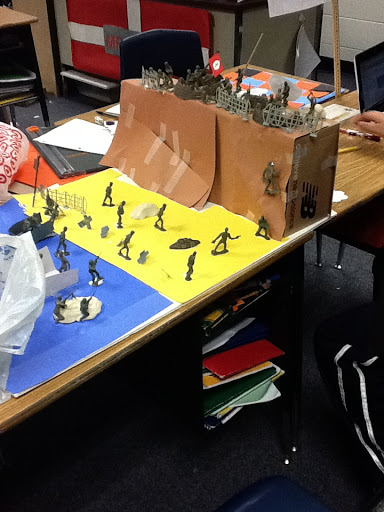
Let Them Learn about War
“Oh, you let them build a war model?” another adult is scanning our products from our Innovation Day. “I don’t think I would let them do that…” and so begins my train of thought. Did I do something wrong by allowing Jack to build a model of D-Day? Should I have steered him toward something kinder, more 4th gradeish, should learning about war be a one time occurrence?