being a teacher, boring, inspiration, Lesson Planning, lessons learned

Today I was Boring

I love Mondays.  They are loud, a little bit crazy, and always exciting.  My students are tapping their feet, their are sharpening their pencils and asking a million questions about what we are doing this week and when are we going to get to do this really cool thing?  The noise can be kind of intimidating to cut through but then you realize that it is excitement, not just chatter, and it becomes a different beast to maneuver altogether.

Today, I was boring, though.  I had my lessons planned, even with discussion questions, extra surprises and movie clips.  And yet, I fell flat.  During social studies, where I was teaching the writing of the Constitution, I yawned.  And you know if the teacher is bored, then imagine what the students feel.  So I stopped.  I put the book down that I was reading aloud and then asked them what questions they had.  A little bit of perking up.  Then I asked them to write on the board everything they knew about the office of the president, some motion and activity.  Then I started to drone on again – moment lost.

I don’t know what it was today.  I had a long night with my daughter with croup, my mind is heavy with the scary legislation vote looming over us, and I didn’t take the time to think this morning.  I have a pretty set morning routine where I get in 1 hour and 15 min early, turn on my music, jam to that while I clean, pull out, discuss, give hugs to colleagues and just focus.  Today I had no music, ran around, got visited by students early, stopped by a great Valentines Day breakfast and just spoke a lot of politics  By the time the bell rang, I was ready physically not mentally.

And what a difference that makes!  All day I played catch up, tried to find my brain – it must be around somewhere – and just made it through.  That is not what teaching is supposed to be like; surviving.  So I wonder; what do others do when the lesson isn’t working?  Do you throw it out?  Stop and do something else entirely or just lumber through it?  I felt I robbed a great moment in history from my students today, something that I cannot get back.  So when your brain disappears and the day just seems to happen to you, what do you do to put it back on track?

I, for one, am going to bed early, charging my Ipod, getting my red shirt ready (all union workers are wearing red to show unity this week) and packing chocolate in my lunch tomorrow.  I will not let my students down like this again.

being a teacher, education reform, government

Dear Scott Walker

I can’t afford to be a teacher anymore, at least not if what is proposed here in Wisconsin gets passed.  Don’t get me wrong, I am not a teacher because of the money, I am not a fool after all, but if I lose 17% of my already insanely low salary, I cannot afford to remain a teacher.

I cringe at saying those words aloud, but the facts remain, if I want my child to go to daycare so that my husband and I can work to pay for our bills, then teaching does not let me do that.  We speak of wanting another child, yet know that on my salary today, it would be a far stretch with extra hours picked up wherever possible.  If my salary is cut, there will be no second child, no house mortgage and certainly nothing extra.

So the debate within me begins; can I give up what I so passionately believe that I was meant to do?  Do I even have a choice anymore if my salary is reduced and frozen?  I have been willing to sacrifice almost all of my social life to dedicate myself to the craft of teaching, but at some point, the realization hits that it will not just be time I am sacrificing but the ability to pay our bills.

So dear governor of Wisconsin, you may think that you are solving the problems, but who will you get to teach the children?  Who will have the luxury of being a teacher when they cannot afford to anymore? You speak of us as if we are using the system, stealing money from children who need health insurance, while you cut taxes for businesses.  Who will educate the future workers of Wisconsin?  Who will buy the goods of all those companies you lure to our state at the promise of less money taken from them?  Who will want to raise their children here when we slash funding and stifle the voice of teachers.  We do not have a lot, but what we have, you want to take away.

So that is where I stand.  Blamed for the deficit, blamed for why we cannot beat China in test scores, and blamed for why America is slipping in its world rankings.  One teacher with all the blame at her feet.  I wonder what will happen when the teachers cannot be blamed anymore, who will be next?

being a teacher, believe, making a difference

How Do You Know You Made a Difference?

How do you know you made a difference? Is it the test scores? The grades? The parent approval? Or your principal giving you a thumbs up? Is it the highlights? The low moments? The tears? Or the smiles? Maybe it’s the hugs? Or the excitement? The introductions and the goodbyes?

Or perhaps, just perhaps, it is the people. The kids, the conversations, the handwritten cards. Your self-satisfaction from knowing you tried your hardest. The tiredness that comes from focusing on something you know is important. Perhaps it is the kind words sent your way, a friendly gesture, or a friendly hello. Maybe a plea for help or an offer of assistance shows you made a difference. Maybe someone letting you try that new thing or even that old tried and true thing. Maybe somebody simply believing in you or letting you try again after you failed. Maybe that means you made a difference. Or maybe, just maybe, believing you are making a difference is all that it takes to make it come true. Maybe if you believe in yourself enough you will know that it matter, that it all counts, and that the kids are noticing. Maybe then you will know you are making a diffence.

being a teacher, college, education

What I Didn’t Learn in College

I was an adult student, attending college in all of my seriousness, so eager to learn everything there was to know on how to be a teacher. I wanted to be good, great even, and I studied, and I planned, and I reflected my little heart out. And then I graduated, got my first teaching job and realized that I had very little idea of what it meant to really be a teacher.

So what I didn’t learn in college is really quite a lot. I didn’t learn how to gain my students’ trust, interest or even attention. Instead I learned systems of control, of management, of planning that would force students to listen. I didn’t learn how to teach a child that consistently gets 5 hours of sleep every night because of parent job situation and therefore puts his head down on his desk every day. I learned that that child better pay attention to me because that is what children are spposed to do.

I didn’t learn how to care about my students, this was meant to be a given, and not taken for granted. I didn’t learn how to strip away all the layers and show the true meaning of the lessons being taught. I didn’t learn to adapt at the start of a tantrum or the twist of an interesting conversation. I didn’t learn to love them all, no matter their roughness or demeanor.

I didn’t learn to change myself, to be humble, and to realize that this journey is not about my teaching but the students’ learning. I didn’t learn that there are at least five different ways to explain something, or in my case, at least twenty, because every student explains it their own perfect way. I didn’t learn that often the simplest idea, lesson, or decision can make for the most meaningful moments.

I didn’t learn how to be great, or even how to be good. I learned how to save paper, be efficient, and to plan, plan, and plan some more. I learned how to find sources, and ask for help, but not who to ask it of. I learned how to plan for the fictitious child with special needs, the unplannable, or even the out there. And so there are many things I didn’t learn in college but I am not so sure you can. Teaching has to be experienced to be learned, not just read about, discussed and debated.

A great teacher is not something you are just taught to be in college, pushed to be through test scores, or coached to become through observations, it is something you become through your experience, reflection, and everyday life. I wish, I had been taught that in college.

action, word choice, writing

A Lesson in Action and Word Choice

My students are developing their choice in words and in particular how to create a more exciting story.  I often find that students are tired of writing by the time they reach the exciting bits and so it ends up being shortened and not fully developed.  This action word lesson sprung from this problem.

Day 1:

  • I read them “Crazy Hair” by Neil Gaiman and asked them to take note of any “delicious” words that he used.  Whenever students submitted a delicious word, we discussed what other words he could have chosen and why we thought he didn’t.
  • We then return to our prior knowledge of the 6 + 1 Traits of Writing, which ones have we discussed more (organization, voice) and which ones do we need to explore; word choice.
  • This always lead to a discussion of why word choice is so important, where the students take ownership of making their writing better. 
  • I also introduce the “circle it” strategy here for spelling words: don’t skip a word just because you cannot spell it, spell it as best as you can, circle it and come back to it when you edit.  This eliminates kids stopping and losing their momentum in their writing.
  • Then they need to spice up some boring sentences to get their creative juices flowing, my list of boring sentences can be found here.  I only gave them 4 to work on in a small group and they had about 5 min. to improve.  Then present to the class and the students compliment each others sentences.
  • I do a teaser for the next day about how excited I am to introduce their writing project etc.

Day 2:

  • Write the word “ACTION” on the white board.  Let students guess for a minute why.  Then refresh their memory about the lesson from day 1.   What does action have to do with word choice?
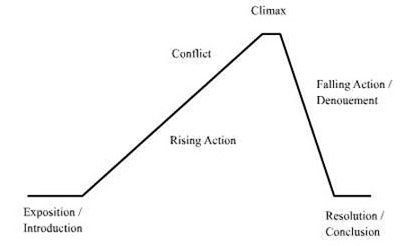
  • After discussion of this we speak about the climax of a story.  My students already know about the parts of a story so they recognize the diagram I draw on the board.  I circle the middle part because this is where the focus needs to be.
  • We discuss how movies are filled with action and then how would you write a scene from a movie?  I offer them my example. We discuss why it works as an action sequence.
  • Then it is their turn.  In small groups, they are to brainstorm using our huge whiteboards (24″ x 32″) and then write our a short action sequence using the most exciting word choices they can come up with. I project their brainstorm help questions to save paper.
  • I have them write in small groups as a guided writing step, some students would be capable of writing their own example right away but this way they help each other gain strength.  I gave my students 30 min to brainstorm and write.  They all finished just in time.
  • Share the stories and compliment what can be complimented.
  • Then I reveal the final project: their own short story, starting at the beginning of the action and ending at the end of the action.  No set up, no explanation, no denouement, just pure action.

Day 3:

  • Brainstorm using these sheets from http://www.writingfix.com.  This fit our purpose of using transtion words to shift from place to place as well as keeping the focus on the action.
  • Students will spend a lesson brainstorming and meeting with peers to help each other out.

Day 4:

  • Meet with me to discuss their idea and then begin the actual writing process.

Days spent on this lesson will depend on progress of students.  I envision about 2 weeks with a comic like illustration to go along with their action sequence.

being a teacher, being me, Lesson Planning, Student-centered, teaching

Simplify

As I prep for the upcoming week of lessons, I find myself cutting ideas out and slimming things down.  I am simplifying my lessons.  And not because I am “dumbing” them down, not at all, instead I am offering my students the luxury of only having to focus on key concepts rather than overwhelming them with all the bells and whistles.

In order for my students to take ownership of the learning they have to understand what they are owning.  They have to be able to take an idea, make it their own and then push it through.  if I add too many components to something, they will end up confused, bogged down, or just plain bored.

In college I was taught to make it exciting, to add visuals, support, brainstorming sheets and even hand signals.  I now rebel against that notion of having to add more every time. Perhaps that is why I am no longer a supporter of IWB’s in every classroom.  I don’t need to be more interactive, my students do.

So this week, I am cutting back all the extras.  I am focusing on what the goal is and letting students add their distinctive spins on it.  I will have supports ready if needed but I will not assume they need them.  I will speak less and engage more.  Simplify my teaching = expand their learning.  I am excited.

This post was partially inspired by this excellent post written Josh Stumpenhorst @stumpteacher.