aha moment, MIEExpert15, principals, student voice

Why I Asked My Principal to Observe My Craziest Class

I gave up putting on a dog and pony show for my observations several years ago.  I had reached the pinnacle of coaching, asking my students to please be on their best behavior as I was being observed, bribing them with treats if they would just be great when my principal walked in.  After that observation, where I received nothing but accolades for my classroom management – yeah for bribing – I realized that I had to change.  My attitude had to change, at least when it came to being observed.

Yesterday, I invited my phenomenal principal into my craziest class.  Not as a stop by visit, but as my second official observation for the craziness that is Educator Effectiveness, or the way my teaching quality will be known here in Wisconsin.  I invited her in to see how I am trying to harness the energy of these students, how I am trying to wok with their behaviors, tap into their quirks, rather than smother them by yelling.  And yet, I wanted throw up before she came into the room.

Even after 7 years and some months of teaching, having a principal in my room makes me so nervous.  I thought of calling in sick.  I thought of changing the time of the observation so she would see that one class where all of the kids need little direction, that one class where every plan always works out.  That class that makes you look like an incredible teacher even though you know that it is not really because of what you are doing but because the kids are so well-behaved.  That’s the class I would have been observed in a few years ago.  And I know exactly how that observation would have gone; great praise, little feedback on what to work on because everything was so wonderful, meaning no growth for me.

But I didn’t, I forced myself to follow through with my plan, hoping that things would work out alright.  Hoping that my students would at least attempt what we were doing not just give up, settle in after only about 5 minutes, and perhaps even have a great discussion.  I held my breath the entire time.  Yet, as I sat teaching the mini-lesson, noticing how a kid that should have been writing was instead tapping his pencil playing songs, another kid had their head down, and another kid would not stop talking, inwardly cringing as I saw my principal noticing too.  I realized something; all the other students were working.  The 5 that sat in front me coming up with such great ideas.  The 2 that sat and whispered together pointing to their paper.  The kid with the pencil listening in to what I said in my mini-lesson and yelling out “Now I get it!” and then started to write.  I noticed those moments too.  I noticed our classroom functioning in its typical way, and I noticed that for those kids, the tapping, the whispering, the staring blankly; it works.

So the next time I am observed, I will invite once again to the class that hangs by a thread.  To the class that I know pushes me the hardest.  To the class that keeps me up at night.  My principal is here to support me, to guide me on my journey, not to just clap her hands and tell me “Great job!”  If I don’t invite her into the class where I need her ideas, then I will not grow, and growing is what we all need to do every day, every opportunity. Never will I go back to bribing a class.  Never will I prep a class beforehand.  Never will I ask a class to please behave because I am getting observed.  I will instead teach my heart out and wait for the feedback, hoping that among the chaos,  my principal sees the greatness that I see, and can help me further my teaching.  Will you?

PS:  I was worried my students thought they had to put on a show until a kid asked me if he could please continue to work on the science project he had been working on instead of reading.  Nope!  They hadn’t changed even though the principal was there.

I am a passionate teacher in Oregon, Wisconsin, USA but originally from Denmark,  who has taught 4th, 5th, and 7th grade.  Proud techy geek, and mass consumer of incredible books. Creator of the Global Read Aloud Project, Co-founder of EdCamp MadWI, and believer in all children. I have no awards or accolades except for the lightbulbs that go off in my students’ heads every day.  The second edition of my first book “Passionate Learners – Giving Our Classrooms Back to Our Students” will be published by Routledge in the fall.   Second book“Empowered Schools, Empowered Students – Creating Connected and Invested Learners” is out now from Corwin Press.  Join our Passionate Learners community on Facebook and follow me on Twitter @PernilleRipp.
being a teacher, education reform, MIEExpert15, no homework, student voice, students choice

Before You Assign That Homework – What Students Wish You Knew

FullSizeRender

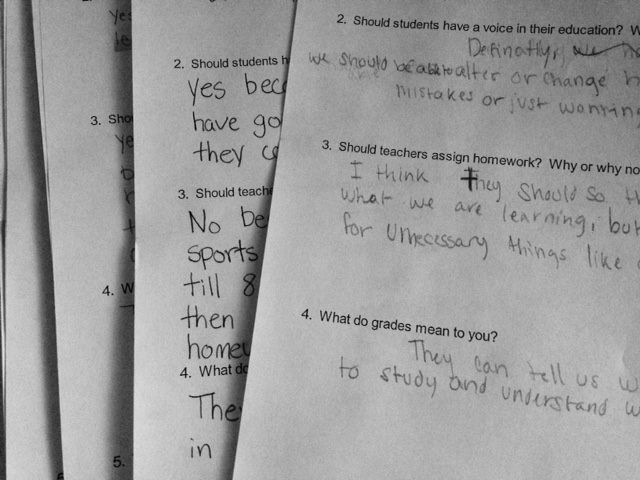
“Should teachers assign homework?” was the question I asked my students today.  I thought I knew the answer, a resounding no I was sure, and yet, once again my 7th graders surprised me.

While some pleaded for no more homework, many said they understood the purpose of it, that it was a necessary component of school and then wrote a paragraph asking for change.  Asking for their thoughts to be considered.  Asking for teachers to think before they assign.  So what my students wish teachers knew before homework is assigned is now written here for the world to see.

They wish teachers knew just how busy they are.  That we ask them to live balanced lives that involve sports, family, friends, and sleeping, yet assign hours of work that pushes their bedtime later and later.  They cannot fit everything in, even though they try.

They wish teachers knew just how stressed they are.  That they feel like our expectations are through the roof at all times, but sometimes they are bound to mess up, and can we make that okay as well?  Can it be okay to forget once in a while or to not get it all right?

They wish teachers knew that they don’t always need the practice.  That homework should be for those kids that don’t quite get it, not assume a need for everyone, and that those that really don’t get it won’t get it after they do the homework.  That they need help in school instead.

They wish teachers knew how much we all assign.  That we spoke to one another more so that we see that our class may not assign a lot but when you add each class together, it is now hours of work, not just a little bit of time.

They wish teachers knew that they have worked really hard in school and wish they could have a break.  That homework on some days is okay but it doesn’t need to be every day. Nor does it need to be over the holidays.  That tehy get we have a lot to cover but can they promise us to work hard in school in exchange for time off from school?

Finally, they wish teachers actually did their own homework.  That they tried the assignments so they could see how difficult or confusing they may be.  That they worked through it with kids, not in a pretend way, but really, and then shared their own learning with students.  That teachers truly felt what it means to live the life of a student, along with the pressure of homework,  to understand why homework continues to be a problem for some.

Once again, my students thoughts push my own thinking.  I quit assigning homework years ago but still run into my old ways once in a while; there always seems to be so much to cover, so much to do.  Now, I only assign reading every night, but even that adds up with everything else.  So I wonder; if we all asked our students, what would they say about homework?  And what would we do about it?  How would their answers change education?

I am a passionate teacher in Oregon, Wisconsin, USA but originally from Denmark,  who has taught 4th, 5th, and 7th grade.  Proud techy geek, and mass consumer of incredible books. Creator of the Global Read Aloud Project, Co-founder of EdCamp MadWI, and believer in all children. I have no awards or accolades except for the lightbulbs that go off in my students’ heads every day.  The second edition of my first book “Passionate Learners – Giving Our Classrooms Back to Our Students” will be published by Routledge in the fall.   Second book“Empowered Schools, Empowered Students – Creating Connected and Invested Learners” is out now from Corwin Press.  Join our Passionate Learners community on Facebook and follow me on Twitter @PernilleRipp.

Uncategorized

Creating Passionate Writers – Some Ideas to Start With

The strange quiet that envelops my classroom is astounding today.  The normal whispers, hustle and bustle, shifts and blank stares have been replaced.  Silence, concentrated, thick silence fills my ears, so absolute you can almost touch it; my students are in the writing zone.  I want to run around the room and high five them all.

I wish this was my doing. I wish this awesome moment was because of some grand writing prompt or assignment I had dreamed up, but the truth is; its because of the students and their honest conversation.  This moment was made because of the students and their audacity to share everything they hate about writing.  Everything that has made them dislike something that they will need as a skill for the rest of their lives.

What they hate should not come as a surprise; being told what to write, being told to share with other peers, being told to present it to the class, being told how much to write in a day, and being told how to write it.  All things I have done to students, all things that I still have to do to students to follow my curriculum.  Yet, their honest answers made me think too.  How could writing be given back to them as a process they have control over?  How could we fit our standards around re-igniting a love of writing?  What could I do to change this dire situation?  Behold a few ideas currently working in my 7th grade classroom.

Know your purpose.  While the purpose of writing is often something that is beyond our control because of predetermined curriculum, in this case, I was able to challenge the students to master a standard rather than master a writing task.  The students have been asked to master writing a narrative using vivid word choice and strong organization.  Think of all the possibilities that opens up for students!  So if you have an opportunity to just have students write, embrace it.  Challenge them to show you mastery in a way that works for them.  They get that they have to learn how to write a variety of ways, but we have to take care of their inner writer as well.  Dont let that get lost in our eagerness to create stronger writers.

Give them control of the product.  The final product needs to be their best work to show that they have mastered the standard but what they create it up to them.  It has to be complete, it has to have a beginning, middle, and end and it has to be their best work.  I have students working on any type of standard story imaginable, but I also have students writing a collection of short stories, a story told in verse, several graphic novels, fan fiction, and even students extending books they have read.  The point is; having full choice within the narrative genre is inspiring my students to write, even getting some excited to come to class.  This is the first time I have had kids being upset that the bell rang because writing was over.

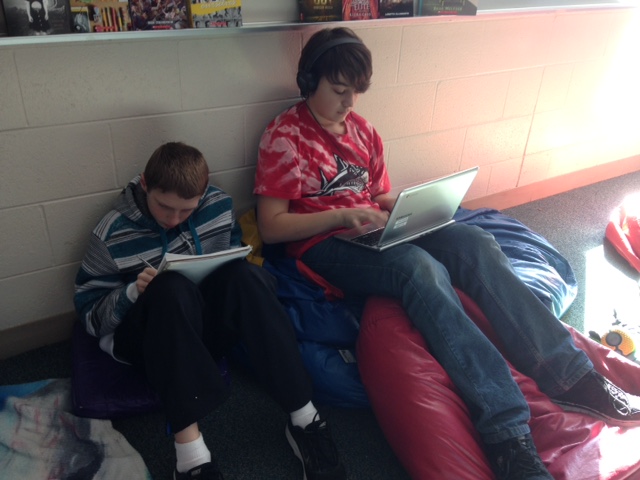
Give them control of how.  Some students are natural pencil writers, while other prefer a computer.  I even have a student typing their story on their phone because that is what they prefer.  When possible, allow students to choose how they write.  We sometimes get so caught up in thinking we know how to best write that we forget that even professional writers all draft in different ways.  If we want students to be writers then they need an opportunity to discover their own method.

Give them uninterrupted time.  I had been giving my students some time a few times a week to just free write, but they expressed their frustration with having to constantly shift focus.  Thursdays are now designated our write-in days and they get at least 40 minutes to just write.  Not listen to me.  Not do an exercise, just write.  We cover everything else we have to cover Monday through Wednesday.  Friday is reserved for reading.

Make the mini-lesson truly mini.  If the whole class does need a lesson, keep it under 5 minutes; short and to the point.  Otherwise reserve longer lessons for a mini-group since chances are that most students don’t need all of that support any way.  Ẃalk around your room and observe, assess while you speak and make groups in your head as you move.  If 5 kids need help with something, pull them together and get to the point.  What do you see that needs work and how can they fix it.  Then let them get back to writing, check in the next day if needed.

Allow for talk.  It was incredible to see the writing community that has been popping up with students sharing ideas, asking for comments, and also just writing side by side.  Students knew to keep voices to a whisper to not disturb the hush, I didn’t have to be the only sounding board.

IMG_0501

Allow for thinking.  My own hatred of writing came from being asked to write on demand.  I needed time to find inspiration, time to think.  So allow time for just staring into space and daydreaming, check in with students, help them brainstorm if they want your help, but give them time for their imagination to take over.  We are always in such a rush; most of us would not  write well under the same conditions we tend to impose on our students.

Set up appointments to ask what they need.  I plan on pulling students for mini one-on-one conferences starting next week and I can’t wait.  This will be my chance to ask them what they think they need, not what I think they need.  This is to help students take control over their own writing journey, not just be led by me.

Finally, allow for space.  Many of my students prefer to sit at a desk when they write but others like laying on the floor, sitting in corners, or even in the window perch.  Again, we are trying to cultivate actual writers in here, they should be comfortable.

IMG_0500

If you are wondering how you can create passionate writers; ask your students.  What would they need to re-ignite or maintain their love of writing?  What can be changed?  Find out what you have control over, take some time to have the conversation, and then plan for the future.  Please share your ideas.

I am a passionate teacher in Oregon, Wisconsin, USA but originally from Denmark,  who has taught 4th, 5th, and 7th grade.  Proud techy geek, and mass consumer of incredible books. Creator of the Global Read Aloud Project, Co-founder of EdCamp MadWI, and believer in all children. I have no awards or accolades except for the lightbulbs that go off in my students’ heads every day.  The second edition of my first book “Passionate Learners – Giving Our Classrooms Back to Our Students” will be published by Routledge in the fall.   Second book“Empowered Schools, Empowered Students – Creating Connected and Invested Learners” is out now from Corwin Press.  Join our Passionate Learners community on Facebook and follow me on Twitter @PernilleRipp.
being me, education, lessons learned, Personalized Learning, students

I Want to Be the Kind of Teacher

I have failed as a teacher many times, mostly in small ways, but there have been epic ones as well.  I think so many of us have had them.  Yet, what we do with our failures is also what defines us and today, after two weeks of rotations that simply were not working, I was reminded again of what kind of teacher I want to be.

I want to be the kind of teacher that doesn’t give up.  The kind that finds a new solution even when it seems like I could just stay on a path because it would be so much easier.  That knows when to hold them, when to fold them, and yes, even when to walk away.

I want to be the kind of teacher that keeps the students in mind at every moment and with every decision I make, even the ones where my own pride may suffer.  The one that problem-solves rather than rants.  The one that fixes rather than breaks.

I want to be the kind of teacher that realizes when something is not working and has the common sense to stop it.  That tries an idea with all of their heart and then makes it better when it doesn’t quite work.

The kind of teacher that dreams.  The kind of teacher that listens.  The kind of teacher that has students who are willing to speak up even if they know the message may cause temporary hurt, but in the long run will create a path toward a solution.

I want to be the kind of teacher that sees the learning in every problem.  That sees what can be salvaged rather than throws everything out.  The kind that can see the good in something or someone even in the bleakest of moments.

Today, when I realized that my dream for epic discussions had failed, I wanted to throw it all out, but my students once again reminded me that there were good moments too, things that worked that deserved protection and resurrection in a new format.  So instead of ranting.  Instead of raving about all of the hard work lost, how I now had to start over, I reflected, re-imagined and am ready to go for tomorrow.

I want to be the kind of teacher that never forgets their own vulnerability but sees it as a strength rather than a weakness.  That isn’t afraid to show the world failure to inspire others to grow.  That remembers that not everything is bad, not everything is broken even if it seems so at the moment.  That’s the kind of teacher I want to be.  One day I’ll get there.

I am a passionate teacher in Oregon, Wisconsin, USA but originally from Denmark,  who has taught 4th, 5th, and 7th grade.  Proud techy geek, and mass consumer of incredible books. Creator of the Global Read Aloud Project, Co-founder of EdCamp MadWI, and believer in all children. I have no awards or accolades except for the lightbulbs that go off in my students’ heads every day.  The second edition of my first book “Passionate Learners – Giving Our Classrooms Back to Our Students” will be published by Routledge in the fall.   Second book“Empowered Schools, Empowered Students – Creating Connected and Invested Learners” is out now from Corwin Press.  Join our Passionate Learners community on Facebook and follow me on Twitter @PernilleRipp.

aha moment, being a teacher, books, Passion

Got a Minute? One Sure Fire Way to Get Students to Read

For the past 3 years I have avidly shared my reading life.  Students always know the book I am reading, they know the titles I am excited about it, I have shown them pictures of my ever growing TBR (to be read) pile at my house and every week I am lucky enough to bring in new books for my students.  I place them on the shelves, the ledges, the window sill.  I place them on their desks and I place them into their hands.  And yet, something was definitely missing.  Students were reading sure, I see them with the books in their hands, but for some reason my excitement was not carrying over.  Those books I had loved that were given 5 stars on my “Read” poster were still staring at me from the shelves.  Enter Nancy Atwell and her idea that is so simple, yet I had forgotten to do, the idea that has changed the way my students are finding books, the idea that has taken 1 minute to implement in every class.  Yup a minute.

Got a minute?  Do a book talk.  Seriously.  Grab a book and plan one right now.  

For a little more than a week, I have started every class with a book talk.  A one minute recap of why a book was amazing and deserves to be read.  Sometimes I have expanded it to 4 minutes as I have read the first few pages of a book when I don’t feel the back page gave it enough selling power.  Then I have put it down where the students can see it and then started to teach class.  Easy to prep, easy to do, doesn’t take much time out of our precious 45 minutes.

The result has been palpable.  Almost every single book I have book talked has left the room.  Almost every book has found a new reader right after the talk.  That is why I talk up a different book to each class, so they all get a chance at something amazing.

The best part though is that a book talk doesn’t just end with the one reader that gets the book.  Once a child loves a book, they pass on that love to another friend,  and that friend passes it on.  A whole chain of book love going on all because you took one minute to talk up a book.  I should have done this from the start.  Thank you Nancy Atwell for reminding me.

I am a passionate teacher in Oregon, Wisconsin, USA but originally from Denmark,  who has taught 4th, 5th, and 7th grade.  Proud techy geek, and mass consumer of incredible books. Creator of the Global Read Aloud Project, Co-founder of EdCamp MadWI, and believer in all children. I have no awards or accolades except for the lightbulbs that go off in my students’ heads every day.  First book “Passionate Learners – Giving Our Classrooms Back to Our Students” can be purchased now.   Second book“Empowered Schools, Empowered Students – Creating Connected and Invested Learners” is out now from Corwin Press.  Join our Passionate Learners community on Facebook and follow me on Twitter @PernilleRipp.

aha moment, being a teacher, education reform, Passion, student voice

Want More Student Understanding? Try This.

I don’t know when my classroom first got so quiet, but I remember the moment when I realized that it shouldn’t always be.  I remember looking around at the students, some working through the task at a steady pace, others with their hand up waiting for me, and some staring into space completely lost.  There were no words spoken.  My shushes and teacher looks had effectively taken care of that.  So those kids with their hand up waited until I could get to them while I tried to get those who stared into space started.  The time wasted for all was significant; not much had been gained by the silence other than compliance and loss of learning time, but at least they were silent.

It seems an epidemic of silence has been harming our schools for many years.  That we long for silent hallways, which also mean quiet classrooms, as we tour schools.  That we often equate silence with good learning and noise with bad.  Teachers are evaluated on how quickly they can get students to settle in and listen, not how quickly they can get them talking.  

I knew then that this was not the type of classroom I wanted to be a part of; one where students were so well-trained in being quiet that they didn’t even dare advocate for themselves anymore.  Where students waited patiently at a time when they should have been figuring out how to access the information they needed without the teacher.  The quiet, the shushes, yes they still had a place but it could not be for everything.  It should not be the golden standard with which we held our learning too.

So I changed the way I taught, in fact, it was quite easy to do.  I started to plan for when they students should speak.  Rather than plan for silent engagement at all times, I plan for discussion, for deeper learning to occur because more than one person (IE the teacher) has shared their thoughts, doubts, or wonderment.  When I teach, I seek out moments for students to talk.  They turn and talk or discuss with their groups before we discuss as a whole group.  Even before an assessment, I ask the students to discuss for a few minutes to help them sort through their thoughts, to gain confidence in their beliefs, and to get mentally started with the task ahead.  I can still assess their thinking just fine, in fact, I think theirs has gotten stronger simply by allowing them a few more minutes to process in a different way.

I am not saying that all noise, all the time, is what we should strive for but there should be more.  Students should leave every single classroom having used their voice to further the learning.  Students should feel that their voice mattered, that they were heard, that those questions they carried, those ideas they had were brought into the world and at the very least touched upon.

So as you plan ahead for the week today, ask yourself; when are the students speaking?  When are they a part of the teaching going on?  My students will discuss every single class, every single day this week, much like they have in the weeks past. They will grow their listening skills by speaking.  They will grow their ideas by sharing them.

Our classrooms should not be judged on how quiet they are but instead on the type of noise they create.  Please allow the students to speak, teach them how to use their voices for good, for learning.  Let our classrooms be about the students speaking and not just their listening.

I am a passionate teacher in Oregon, Wisconsin, USA but originally from Denmark,  who has taught 4th, 5th, and 7th grade.  Proud techy geek, and mass consumer of incredible books. Creator of the Global Read Aloud Project, Co-founder of EdCamp MadWI, and believer in all children. I have no awards or accolades except for the lightbulbs that go off in my students’ heads every day.  First book “Passionate Learners – Giving Our Classrooms Back to Our Students” can be purchased now.   Second book“Empowered Schools, Empowered Students – Creating Connected and Invested Learners” is out now from Corwin Press.  Join our Passionate Learners community on Facebook and follow me on Twitter @PernilleRipp.