Be the change, being me, happiness, reflection, Student-centered

How I Brought Back Joy in My Classroom

DSC_0176

I continue to ponder the concept of joy in schools and more so the seeming lack of it.  Yet, I look at my own classroom and I know that we have a lot of joy.  Not all the time, not in everything we do, but there is a lot of joy in what we do.  It wasn’t always like that, when I taught traditionally, joy was not on my priority list when I planned.  If something happened to be fun I felt rather guilty since it probably meant I wasn’t getting the educational value across to my students.  Now I know better.

Joy is something I try to create, as funny as that sounds.  Yet by now I know what makes my students happy and I try to incorporate it as much as possible.  So what are some of the things that bring us joy?

  • Picture books.  Many 5th graders think picture books are for little kids but not in this room.  We cherish the arrival of new ones and laugh outloud whenever we can.  Taking 5 minutes to share a great one can boost us all.
  • Making mistakes.  I make the stupidest mistakes at times but I laugh outloud about it too and make sure the kids know.  We have to be able to giggle about ourselves for others to realize it is okay to laugh with us.
  • Challenges.  I try to concoct bi-weekly challenges for my students that focus on community and perseverance.  Often they are inane and I make them hard, not to test my kids but to push them further.  Our latest boat challenge was a blast and I am already rummaging through my closets trying to think up the next one.
  • Meditation.  After being inspired to bring back more mindfulness we have been doing 3 minute meditation sessions after math to center us for the rest of the day.  I know it is supposed to be quiet breathing but we have hard time not cracking up at some of the instructions.  Why shush them when laughter also centers them?
  • Dance breaks.  Singing and dancing are something I relish as an adult so if we are feeling down or extra restless I know what we need.

These things may seem like extra things and you are right, what about my core instruction, what’s so joyful about that?

The one thing that has brought more joy into our classroom is simply giving shared control to the students.  These few changes have had an incredible impact in our room:

  • Student voice.  Meaning that students have the right to an opinion in everything we do.
  • Student choice.  Whether it is what they are creating, how they are creating it, or who they are creating it with – student choice is essential in my room.
  • No punishment.  My students don’t get punished, I tend not to take things away such as recess, field trips or special moments.  It’s not that they are angels, we just figure out a way to work through bad moments.
  • No grades.  My students don’t work for grades, they work for understanding.  There is a big difference and it is something we cultivate throughout the year.
  • Lack of knowledge.  I don’t know everything and I tell my students that so we have to figure it out together.
  • Curiosity.  I am very curios as are my students so we have to take time to explore some of the things we are curious about.  Whether it is through genius hour, project time or simply stopping what we are doing to veer off the path, we allow it and we embrace it.
  • Global connections.  My students reaching out to teach others or ask others is a big part of our room and something that brings us happiness.  We try to incorporate some sort of global connection in most things we do, as long as it makes sense.

Yet I am not there yet.  There are still moments of dreadfulness in my classroom.  Spelling used to be one of them,  and because of that I have completely revamped the program starting Monday, I will let you know if it makes a difference.  So while not everything is joyful yet, I feel like we are on the right path.  Are you?  Is there room for joy in your classroom?  How do you teach for it?
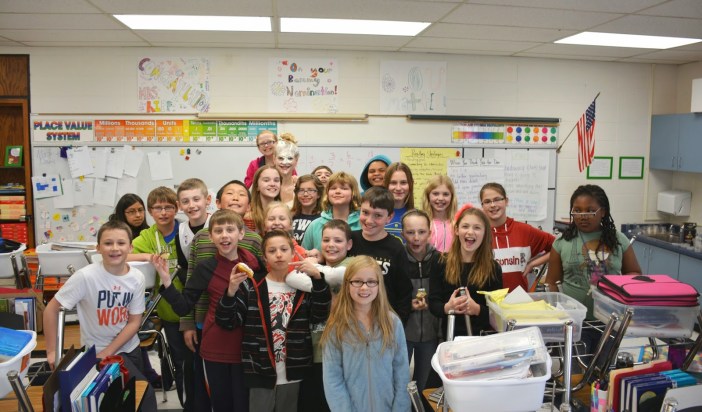
The student who memorized the most numbers of pi got to throw a pie in my face on my birthday

I am a passionate (female) 5th grade teacher in Wisconsin, USA, proud techy geek, and mass consumer of incredible books. Creator of the Global Read Aloud Project, Co-founder of EdCamp MadWI, and believer in all children. I have no awards or accolades except for the lightbulbs that go off in my students’ heads every day.  First book “Passionate Learners – Giving Our Classroom Back to Our Students Starting Today” can be pre-bought now from Powerful Learning Press.   Follow me on Twitter @PernilleRipp.

Be the change, happiness, reflection, Student-centered

Are You a Joy Remover?

image from icanread

Dean Shareski asked me (and many others) yesterday, “Whatever happened to joy?”   A simple question really that should be easy to answer if you are a teacher – it’s right in our classrooms – but then again, one that requires more thought.  Is joy really prevalent in our classrooms?  Or is it reserved for special occasions or for those students who earn it?

Joy is often associated with special events in a classroom.  We earn our joy and happiness through parties.  When I gave up punishment and rewards, I didn’t get rid of joy, I just tried to make sure it was always present rather than something we marked on the calendar.  And yet, in today’s learning environment we seem to reserve joy not just to special occasions but also to those who we find deserving of it.  If a child is behind academically, joy is often one of the things we unintentionally remove from their day.  We pull them out of specials for interventions.  We take away their independent reading time to give more instruction.  We take away recess and field trips due to poor behavior or more instruction.  We have them work on missed homework rather than the challenge the other students are doing.  Their joy in the classroom deemed unnecessary because joy does not lead to academic achievement.

And yet, these kids that struggle are exactly the kids that need more joy in school.  They are the ones that we need to stay invested and engaged, not just the kid that is already mastering everything we present them with.  They are the ones that need to realize the worth of school, that need to believe that school is worth their time and effort, and that they will get to do the exact same things as everyone else around them.  That they will not be singled out once again for their supposed shortcomings, but rather treated as an equal that deserves to have as much fun learning as everyone else.

We know that students who struggle often act out to hide their deficit, so why is it we continue to punish rather than help?  Why is it we continue to believe that if we just give them stricter consequences we will finally break their will and they will work better, hand in their homework, or try harder?  These kids are the ones that need to find the joy in school, these kids are the ones who need it the most.  So what are we doing to provide it?

I am a passionate (female) 5th grade teacher in Wisconsin, USA, proud techy geek, and mass consumer of incredible books. Creator of the Global Read Aloud Project, Co-founder of EdCamp MadWI, and believer in all children. I have no awards or accolades except for the lightbulbs that go off in my students’ heads every day.  First book “Passionate Learners – Giving Our Classroom Back to Our Students Starting Today” will be released April 23rd from Powerful Learning Press.   Follow me on Twitter @PernilleRipp.
 

Be the change, reflection, Student-centered

We Must Create Room for Failure and Mean It

image from icanread

“…I failed…” the disappointment leaks from my student as he looks at his contraption.

I am stopped by his words because it is March and we have been trying to embrace failure since September.  Failure is our friend, failure is something we learn from.  Failure is not the “f” word.  Not in this room.

And yet, here he sits, so upset with himself that I am not even sure I have the words to fix it.

I am reminded that embracing failure is not just a line we say to our students.  We must fully live it out in our rooms.  We must admit our own failures, I know I do, and then celebrate the learning that happens from them.  But more importantly we must assess students not just on how successful they were with something but also their persistence in trying.  We must move away from the thinking that to succeed means that the project or product is correct and adopt the notion that success can take on many shapes.  That perhaps success to one child is that they didn’t give up.  To another that they attempted in the first place.

This is not to say that students should not be pushed to succeed.  Of course they should.  All students need success in order to continue learning.  But it is to say that we need to assess students on more than their successes.  That we need a whole child approach that celebrates all of the steps in the journey without reducing them to just a little number.  Grades or numbers can never do that for us but our words can.

It took me a few seconds but I finally found the words to say.  “You didn’t fail, you tried and it didn’t work.  There is a big difference.  Now what can we do to make it better?” I walk away and give him time to think.

At the end of the day he comes up, says “I am taking it home to show my brother, I think I found a way to fix it.”  He smiles and leaves.

Failure is not something we should just pretend to accept – our actions, our words, our assessments must embrace it to.  We must celebrate the failures and give students time to learn from them.  We must discuss the growth, the trial, and the ideas.  We must be more than a motivational poster.

ideas, students

After Spring Break Some New Ideas to Try

image from icanread

There is something almost palpable in the air in a 5th grade classroom after spring break.  It is as if the students were replaced by 6th graders so suddenly that it never ceases to startle me.  Where did my 5th graders go and who are these new kids?  I used to fear spring break and the change it seemed to signal.  I used to dread it, wondering how on earth  I would get through all we have to get through while not shouting at the top of my lungs for their attention.  Now I relish the challenge, the chance to start fresh with a “new” set of kids, the chance to push them harder in our final home stretch.

So when my students come back there will be new things to try:

  • A new spelling approach based on root words, their meaning, their origin and whether they can come up with an example of a word.  And not just for my advanced spellers but for everybody.  Spelling practice seems to never transfer so I hope this new word study will give my students more knowledge rather than just more practice memorizing words they never end up using.  We will use buddy chats, acting out, and simple word plays to hopefully get the students to learn.
  • A tweaked resource time rotation modified by my students.  I will be looking at doing more mini lessons with my book club groups too, maximizing every minute I get with them.
  • A service learning project.  With the push for common core implementation comes more research papers so this is not the first time my students will spend time researching.  I therefore need a hook to increases engagement so it is time to give back.  Students will be presented with an opportunity to research any need either in our school, our community, or the world.  They choose the direction but must come up with a way to help the problem and not just in theory either, they have to actually help.  I cannot wait to see how they will change the world.
  • A new math approach.  After my latest post on math, my team and I decided to change our program again.  We will continue to share kids, but with a bigger focus on math stations trying to hit the needs of every kid, pushing those students that need to be pushed, and trying to fill in some of the math holes in others.
  • More hands on social studies.  My students have been knocking their colony prezis out of the park and I want to keep the momentum going.  So while we continue to lean on the text book as our base knowledge (through summary not reading it) we will continue to connect our knowledge, bringing back genius hour, simulations, as well as creating new problem solving tasks for the kids such as figuring out what would have happened if the US lost the Revolutionary War.

My mind will continue to spin during spring break hoping to come up with even more.  All I know is that I get two more months with these incredible kids and we need to make it memorable.  I know they are up for the challenge.

Student-centered

Project Time and How My Students Made It Theirs

In our classroom we have been big fans of genius hour and Innovation Day.  yet when I realized that my 30 minute block of resource time ( a block meant for remediation/intervention and enrichment) wasn’t being used to its fullest, I knew I had a chance to change things.  So during a creative burst, our new resource time rotation schedule was born and within came something new – project time, or just time to learn.

photo

I love genius hour, I love Innovation Day, I love the idea of learning and creating something.  But I felt we were starting to focus too much on the creation part rather than just the learning part.  That too much time was spent creating the imagery of their learning rather than the learning itself.  So instead I asked the kids to do what we have called project time, 30 minutes once a week where they just get to learn.  Sure, they can create, sure they can make things, but they can also use the entire time to just read, study, ask questions, whatever they want to do.  I decided on a big category to help them  focus their curiosity, geography,  and with held breath I sat back.

The last two weeks have been incredible.  Students have read library books on countries, they have studied maps, they have created impromptu map quizzes, and yes, they have even created presentations.  The learning that has happened has been tangible as kids ask questions about the broader world, about their place in it.  When I asked them what they thought, the response was overwhelming; “We love it, Mrs. Ripp.  Please don’t change it.  What will we focus on next?”  (History for those who wonder).

So project time is here to stay, with a few tweaks requested by the kids.  More resources, computers if they are available, and study hall rather than dedicated spelling time.  It is a thing of wonder to see 26 students working on what they need to be working on without me standing over their shoulder.  Once again, my students are examples of what can happen when we trust kids  to take control of their learning, when we give them freedom to learn.  We should have more school like this.  I cannot wait to see what else they learn.


being me, reflection, Student-centered, students

Is it Okay That 5% Don’t Get It?

image from icanread

“…I wish I could do 5th grade over again…” the student looks at me sadness in his eyes.

“Why?” I ask.

“Because then maybe I would have a chance at getting it.”

My heart breaks.  This kid has tried so hard but the holes in knowledge just seem to grow as our curriculum picks up speed and we are asking them to do more, figure out more, understand deeper.  The math test he holds in his hands with all of the circled problems, asking to be fixed, seems to be insurmountable at the moment.  So I rack my brain, what else can we do?  My team and I try so hard to reach every kid, to fill in the holes, to help them understand not just regurgitate and yet it is not enough.  Some of our kids still don’t get math, some of our kids still don’t grow in areas where we have tried so hard.

And this isn’t the first year, every year we have these kids.  These kids that show up with gaps already.  These kids that work hard, even if they get a bit distracted, and yet what we are doing is simply not enough.  The language we speak in math is above them and no matter how much we try with smaller groups and remediation it doesn’t catch them up.  So we keep on pushing, hoping that something clicks and then pass them on to the next year’s teachers hoping that perhaps they have the solution.

We tend to feel successful in our math instruction because most of our kids get it.  Most of our kids do well on tests.  Most of our kids grow a lot.  But is “most” enough anymore?  Can we really say we are successful if all the kids are not getting it?  Is it okay to base success on the 95% that do and just live with the 5% that don’t.  I don’t think it is anymore, but I don’t know how to help them. Yet.  How do we reach those kids with their gaping holes in a day that is already chock full of new?  How do we build up their confidence?  How do we make the curriculum accessible?

I hope you have some ideas to share.


So we can do two things.  We can say that is just how it is.  That every year some kids will not grow as much as they should.  That we tried our hardest  and hopefully some of it stuck even though we know it was not enough.  After all, most of our kids do just fine with the curriculum, so what are a few loses?  Or we can do as my team does.  Get to gether and try to come up with a new plan.  Try again.  Try to reach every kid.