Reading, Student-centered

For the Love of Book Clubs – Creating Meaningful Conversations

“….I think you are right because…”

“…on page he said…”

“…I really connected with…”

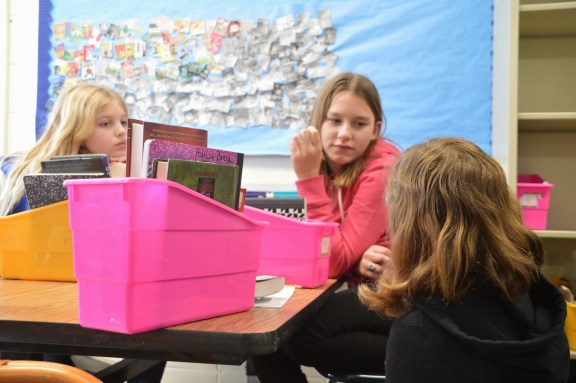
I am drifting around my classroom listening in on the book club conversations happening during reading.  Some times I stop and guide, other times I just listen, smile and move on.  What a glorious sight indeed, 26 students discussing their books.

It wasn’t always this way in my room.  I remember the days of guided reading, teacher front and center, and the students skimming the surface of their books waiting for their turn to read aloud.  I remember the times when 2 children dominated every conversation and others just watched.  Or the time when I thought book clubs meant I had to have all of the questions prepared in all of the books.  Gone are those days and thank goodness they are.  So how did we get to this stage, because I can tell you it didn’t just happen by magic!

  1. We started the first day of school.  The very first thing I did in my classroom was read aloud a book and ask my students to discuss it.  Everything we have built off started that day.
  2. We set the goal beyond school.  I don’t want my students to have deep conversations to get a good reading grade,  I want them to be able to have meaningful conversations about anything in life.  The goal is bigger than 5th grade and the students get that.
  3. I gave them a timeline.  I told the students that later in the year we would be in book clubs and so everything we were practicing in reading led up to this; real “adult” conversations about books.
  4. We practiced.  Deep conversations don’t just happen so we practiced with every read aloud.  That way the students had a shared experience to discuss without it taking up much time.  Practice wasn’t just out loud, students would also write down what their response would be on post-its, thus allowing everyone a chance to be a part of the conversation.
  5. We built off each other.  Younger readers tend to state their opinion without really listening  to what has been said before them.  I modeled how to build off what has just been said and students then practiced every chance we got.
  6. We did it across subjects.  Creating great discussions isn’t contained to just reading but is something we need in all subjects because it is a life skill.  We have many discussions across the board and they all practice the same skills with the goal of pushing our thoughts deeper.
  7. We created cheat sheets.  Students don’t always know what questions to ask to push a conversation so we created cheat cards together; little note cards with printed questions that they could refer to anytime they want.
  8. I stopped talking.  Rather than lead the conversation, I am now on the side coaching in and helping when needed.  I also have a designated weekly time set aside for each book club so that I can really see how it is going and help as needed.  It has been wonderful to see the clubs grow.
  9. They picked the book.  And abandoned the book if needed.  Just as every book doesn’t work as a read aloud, every bookd doesn’t work as a book club book either.  Students had about 12 different books to choose between and gave me a top 4.  Each group knows they can abandon the book if it does not live up to their expectations but that it needs to be a shared experience.
  10. They set the expectations and the pace.  Before we started reading, all groups met to create the expectations within their group.  They discussed what they should look like, sound like, and feel like and then created a poster.  All the posters are different based on the group.  The groups also decide how many pages they are going to read every day, leading to 100% completion and buy-in.

My students know that book clubs are their chance to show off everything they have learned in reading, but also that it is bigger than that.  Book clubs are not just reading and discussing a shared book, it is about growing as a person.  I am so proud of my students and what they are accomplishing.

photo 3
Book Club Expectations

photo 1

photo 2
Book Club Expectations

reflection, students

There Should Be No Invisible Children

Sometimes the heart sees what is invisible to the eyes H. Jackson Brown 5:22-23 PRINT

I didn’t know what I would read.  I didn’t know what they would say.  I only knew we needed to have this conversation.

They gathered on the carpet, waiting for the usual routine to start, but instead I started to read “The Invisible Boy.”   They grew silent and then were sucked in, they have become such focused listeners.  I closed the book.  Told them to grab their thoughtful logs and answer the questions posted.  Are there any invisible children in our class?

They wrote, took their time.  I read and my heart sank.  It was what I feared.  Even within our incredible community of learners there were children that felt invisible.  Children that felt they had few friends, few who cared.  Who felt that they were a part of school simply because they showed up but not a part of something bigger than that.

We gathered back on the carpet and I told them the story of how I moved so many times as a child I never felt I belonged anywhere.  That I often tried to reinvent myself when I was the new kid but inevitably ended up being me again.  The only person I really knew how to be.  I then told them that many of them had said there were no invisible children in our classroom but that was not true.  That several kids had been brave enough to share that they felt invisible.  That they felt they had no friends.  And it was our job to change that.

I didn’t share the names.  I didn’t tell them how to fix it, but I told them to really start to notice each other.  To not take each child for granted.  To not just live by the school rules but to be kinder, to be more caring, to take the time to reach out and start new conversations.  That this is not just about finding the new kid and making them feel welcome but reaching out to every child, even the one you think is just fine, the one who you think may have plenty of friends.  To really see who is in their class and make sure no one feels invisible.

I don’t know if it made a difference today.  I can only hope.  There should be no invisible children.  Not in our room.

assessment, grades, students

Why Do I Ask My Students to Grade Themselves?

Keep Learning, Keep Growing- 11x17 typography print, inspirational quote, teacher gift, university, dorm decor, modern wall decor, christmas
image from etsy

I first gave up on percentages the day I found myself overriding a student’s average and changing their grade to something else.  Mind you that average was calculated by me on worksheets I had assigned.  I remember erasing the letter I had written, so meticulously calculated, and then arguing with myself over whether I had the right to do so.  Would anyone know that I had changed the grade to more accurately reflect what they knew and that it was no longer based on an average?  Would I get busted for this?  I felt like such  a fraud.

Today I asked my students to once again assess themselves.  Assign 4 through 1 to their learning in all subjects and then hand it in to me.  The numbers are not my invention but rather my district’s take on standards based grading and so that portion is out of my hands, it is the end of the trimester so report cards must be written.  I gave them their previous report card, also filled out by them.  I gave them an explanation of what the categories meant and then I gave them time to evaluate.  They thought, they asked questions. and then they handed them in.  Yet some people may wonder why I bother?

I don’t have them write their own grades because I’m lazy.  It is not because I don’t know how I would assess them.  It is not to give them a fake sense of control.  Or a fake sense of ownership.

I do it so it is their voice that is heard when they are judged.  So that their input determines where they are and where they need to go.  I do it because every time there is a surprise.   A child always evaluates themselves differently than I would, and it is in that difference that some of our most revealing discussions take place.   This is where a child reveals their broken self esteem, this is where a child reveals their confusion, their lack of belief in their own capabilities.  This is where a child shows that they perhaps are less clued in then they have led me to believe.  Or where they prove to me how much they know but were too afraid to share.  It is within these conversations that my students truly take control of their learning journey and set the goals.  It is where they find their mistakes and take ownership.  It is where they realize what they have mastered, how far they have grown.  It is where we celebrate their successes and think about our failures.

I may not be a believer in grades, but I will always believe in the power of a good conversation.  These conversations shape the next trimester, the next month, the next day.  These shape the journey my students continue to take.  My students know that I am not the only one assessing them, they have someone else that is much tougher than me; themselves.  And they don’t want to let that person down.

being me, reflection

To the Kid Who Walked Through My Door Last Night

image from icanread
image from icanread

Dear Kid ,

There you were, shuffling your feet, looking at the floor, cautiously approaching me as I sat on my computer after an afternoon of conferences.  “Hey Mrs. Ripp – do you still teach math?”  I turned around, surprised to see you.  “Of course…” I say.  You look up, smile, “I think I need some help…middle school is kind of hard.”

But the truth is you didn’t come to me last night for math help.  You came to tell me about how you are trying your best but the teachers don’t see it.  How it is hard to stay awake some times.  How it is hard to not laugh when your best friend does that funny thing again.  How the teachers don’t get you even though 2 weeks ago you decided to really try your best but now you think your best will never be good enough for those teachers.  They already give you that look, they have already given up.

My heart sank a little.  I heard what you said but also thought about the teachers, thought about what it must feel like from their side.  Thought about the disruptions, the laughter, the trying to reach you but you’re not listening.  Thought about how even though we try to start each day with a fresh new chance for each student that sometimes students push us so far that it gets harder and harder to forget.  That we try to see the good every day but that we are human too and sometimes our emotions get involved.

So I told you to prove them wrong.  To not fall into your old self, to not let your silliness, your anger, get the better of you.  To buckle down not for the sake of the teachers but for yourself.  For your future.  Yeah, middle school grades may not determine your future but they set the habits that will.   To show them what we saw last year.  That kid with the infectious smile.  That kid that got so excited when something went right.  That kid with dreams and plans that were bigger than where they came from or what others believed they could do.

It was time for me to leave.  To go home to my own kids that need me.  I told you to stop by anytime.  That even if I’m teaching my door is always open.  That I miss you and I believe in you.  You finally smiled, started to turn away then came back and said, “You know, we were your family.  We were like your kids last year.  We felt that.  Are we still?”

I had to take a deep breath, I get emotional really easily right now, “Yes, you are.  All my kids are.  Doesn’t matter how old you get or what you do.  You are still my kids even when you’re not kids anymore.”

He left, waved.  I gathered my things and drove home.

I know now that I can’t quit teaching.  That is why I do it.  For those kids that need us so ferociously to believe in them even when they screw up.  For those kids to feel part of our family.  For those kids to always stay our kids no matter how old they get.  That’s what I teach.  That’s why I’m a teacher.

Thank you for coming to my room.  Thank you for walking through my door.

Love,

Mrs. Ripp

punishment

How Do I Punish My Students? Umm, I Try Not To

When I moved my blog from Blogger to WordPress last summer I mistakenly assumed that all posts would seamlessly transfer.  I have since found the error in my thinking and have decided to re-post some of my more discussed posts that didn’t survive the move.  This is one of those posts.

Recently a comment on my post “If We Would Just Stop Talking, We Might Learn Something” has made me think quite a bit.  Short and simple, it asked, “Do you have your non-punishment strategies written down?  Could you please share it?”  And I went hmmm, non-punishment strategies sounds much more fancy than what I have.  The truth is, I don’t have any strategies; I simply do not punish kids.  In fact, even the word punish is such a heavily loaded word that I cringe at the sound of it.  It brings to mind canning or  publicly embarrassing children, simply not my thing.  So instead I handle situations as they arise, mostly with common sense.  Let me explain by taking some every day situations in a classroom…

  • A student keeps blurting out.  Sense of humor works for me here most of the time and I tend to look at it through a positive lens; wow, that kid can’t wait to share the answer because they are having so much fun!  Strategies used to curb or direct it has been to give them dry-erase boards to write down their answers and then flash them to me or have them tell it to a partner.  If the blurting is more like an epidemic I place a blank post-it on their desk and have them make a tally every time they blurt out.  This is used for self-awareness not as a way to reward or punish and I have seen it help kids realize the extent of their blurting who were otherwise unaware.
  • Homework is not handed in.  Even in a classroom where I try to stay homework-free, some students do not use their time as effectively as others and may have a page or two to do at the end of the day, mostly math.  So the first thing we speak about is time management; what could they be doing differently in class to curtail taking work home?  Then we also discuss taking responsibility for not having their work; if a child tells me in the morning that they did not do their homework and have a strategy for getting it done such as bringing it tomorrow or spending some time during recess, then I am fine with that plan.  The point to the conversation is; I don’t want to be the one that has to come up with the plan or have to find out that they didn’t do their work.  They need to come to me, take responsibility for it and then fix it.  Just like we do as adults.
  • And yet, the homework continues to not get done.  This does not happen a lot in my room because we just don’t have the homework.  And yet it does happen once in a blue moon. Besides a conversation with the student where we discuss things they have tried to fix it, we often do a quick phone call home to discuss strategy with parents.  This is not a punishing phone call but instead a “heads-up” we need to give a little more support here both at school and from home because the work is disappearing.  Often I find the root of this to be disorganization rather than laziness, so my number one point is; ask what happened!
  • Students goof off and generally not paying attention.  This is a huge flashing sign to me that what I am doing is not engaging and that the kids need a break.  So unless I for some extreme reason cannot stop what I am doing, I do just that; stop and switch gears.  Whether it just entails giving them a body break or asking them how they would like to learn about this concept something needs to change.  I have also had them do partner share, journaling, or whatever pops into my head to make sure they stay engaged.  Sometimes a lesson is continued but in a different format, sometimes we scrap it for the day.
  • Students are staring into space, reading a book or doing other work.  For anyone who has ever been absorbed in a great book, we know how hard it is to stop reading, so I always smile a little when I see a student reading under the table.  And yet, students do need to be doing whatever it is we are doing at the moment.  Often a quick tap on the shoulder or even just silence and waiting for them to join the rest of us works.  It is not a big deal, nor do I make it into one.

Yes, I have had students throw chairs and tables in my room, yes I have had students hit each other, and yes, I have had to send students to the office because they needed a cool down moment.  And still, even during those more extreme situations, I always try to keep in mind that there is a cause to this behavior and it is my job to figure it out.  So I do not punish my students.  I do not take away their privileges to coerce them to behave.  I do not threaten, I do not dangle things in front of their nose.  Instead I start out the year by inviting them to create the rules of the classroom and then asking them to responsibility for it.  We help each other out, we steer each other as we do, and we take the time to talk.

So although I may claim to not have any strategies, the one I might have is to listen with not just my ear,s but also my eyes.  Listen to what their behavior tells me, listen to what they tell me, and then listen to my own reflection on how to create better situations.  And that’s how I don’t punish my students.

Be the change, rewards

My Barren Wasteland – A Room Without Rewards

When I moved my blog from Blogger to WordPress last summer I mistakenly assumed that all posts would seamlessly transfer.  I have since found the error in my thinking and have decided to re-post some of my more discussed posts that didn’t survive the move.  This is one of those posts.

A barren wasteland with no smiling allowed.  A silent classroom with a teacher standing sternly at the front slapping a ruler against their palm waiting for the next kid that dares to actually have a good time.  These are all images people tend to get when I say I do not believe in rewards.

Recently I wrote a post detailing how I reward my students through time rather than extrinsic motivators.  One comment I received asked me whether I believed in whole classroom rewards or not, which is a question I often get.  The answer is no.  I don’t believe in the idea of rewards and agree with Alfie Kohn when he states that “Rewards and punishment  are ways of manipulating behavior that destroy the potential for real learning.”

I believe that rewards twist the focus of the classroom and provides students with a false reason to want to engage.  I believe that rewards always end up benefiting the same students and some are always left out.  I know some will say that classroom rewards are the answer to that inequity, but ask yourself; how often have you taken away classroom points or not given marbles based on the actions of one kid or just a couple?  I know I used to even though it did not reflect the behavior of the whole classroom.  So you still produce an inequity because the other kids certainly know who it is that makes them lose points and believe me that plays into social situations sooner or later.

The bottom line for me is when we perpetually stick a carrot in front of students faces whether it be through points, letters, or marbles, we are teaching them that they should not do anything without a reward.  So while in the short term it may work to have kids get points to earn something as a classroom, in the long run it is not shaping their behavior to want to behave simply for the greater good.  I need kids that want to be in my classroom and I expect kids to take responsibility for their behaviors.  So I do not make kids “earn” anything in the reward sense, and I do not single out kids.  Instead we celebrate class-wide whenever an occasion arises.   Celebrations are given not earned and they can be based on whether we have achieved something or it is a certain time of year.  Often students and I discuss how we should celebrate something and it is never ever taken away from them.    I never use it is a way to manipulate their behavior or to point out anything.  We simply celebrate, and there is always a lot to celebrate!

So while classroom rewards may seem harmless, think of what it projects.  Think of what message it really is sending the students.  Are we trying to tell them that we do not expect them to behave without some sort of reward?  Are we trying to tell them that society will always reward them extrinsically whenever they do what is expected of them, because if we are, those kids will be mightily disappointed in adult life.