books

These 5th Graders Recommend

In our classroom we have a running list of book recommendations we thought we would share with the world.

The Invention of Hugo Cabret by Brian Selznick
Eragon series by Christopher Paolini
The Schwa Was Here by Neal Shusterman
Number the Stars by Lois Lowry
The Alchemyst by Michael Scott
13 Gifts by Wendy Mass
Little House on the Prairie by Laura Ingalls Wilder
Spiderwick Chronicles by Holly Black
Camp Confidential by Melissa J. Morgan
Soulsurfer by Bethany Hamilton
Amulet Series by Kazu Kibuishi
The Secret of Platform 13 by Eva Ibbotson
The Lost Children by Carolyn Cohagan
Ghosts in the Fog by Samantha Seiple
Tuck Everlasting by Natalie Babbitt
Rules by Cynthia Lord
The Miraculous Journey of Edward Tulane by Kate DiCamillo
The Lightning Thief Series by Rick Riordan
being a teacher, students

Ability Grouping Versus Tracking – What’s in a Name?

For a while now I have been wondering about the language we use as we group our students.  Not so much the labels we use but the method of grouping used.  For guided reading, you are supposed to group students at their reading level, which then in turn creates ability groups.  This is considered a great thing for teaching students at their targeted levels.  And I tend to agree, I do some whole class book discussions but for deeper teaching of reading strategies I like to meet with smaller groups to discuss pertinent strategies with books they can understand.  And that according the guided reading is what I should be doing; placing students with similar leveled students or similar skilled students so that they can work at the same task.

For math you can do flex grouping, also based somewhat on ability as determined through pre-tests and personalties, and this too is totally permissible.  It allows for smaller groups and different pacing of curriculum, as well as remediation and enrichment.

Yet, if you take away the gentler names and introduce the word “tracking”, then both of these scenarios lose their luster.  So I wonder, out loud as usual, is ability grouping really just tracking with a kinder name?

If we ability group in elementary are we setting students on their path for the rest of their academic career or are we indeed teaching them within their zone of proximal development and then spurring further growth?  Are we able to group students in such a way that all are challenged at their level without breaking them apart?  Can we effectively meet every single child’s needs within in a classroom setting during our instruction time without identifying which skill they specifically need to work on and them grouping them to work on them?

I would love your thoughts on this.

being a teacher, classroom setup, Student-centered

Theirs

As I look around the classroom I see the piles, the papers, the snack wrappers.  I see the posters in progress, some ideas scribbled out, doodles and even a wayward shoe.   Computers that have been left on, carpet squares haphazardly stacked, and pencils on the floor.  When I started teaching this would have stressed me out.  I would have spent a half an hour or more straightening, re-hanging those posters and throwing out whatever I saw fit.  I would have wiped, sanitized, and organized.  Perhaps I would even have labeled and checked my supplies that nothing was missing.  I would have made a note to myself to talk to the kids about how they needed to clean more, how we need a clean and organized classroom to function well.  How their stuff shouldn’t be messed in with my stuff.

Now I organize myself, leave their piles, smile as I shut off the lights and think, “This is their room now.”

being me, education reform, occupyedu

We Did It to Ourselves

Play nice, don’t fight, don’t whisper and give compliments.  Share, take interest and never, ever be critical.  Highlight others before yourself, don’t ask for special treatment, share your voice but take turns.  Rules we teach our kids?  Sure, but also rules that we teachers are expected to follow.  So when we look around and wonder how we as a group get such little respect by some politicians, by some media, even by some parents, administrators, and fellow teachers, the truth is; we did it to ourselves.

Teachers are their own worst enemy it seems.  We are not expected to share our successes in case someone gets offended that they are not being highlighted.  We are not expected to shine a light on the things we do well in our jobs, and there are many, because someone may get jealous.  We shouldn’t draw attention, rather pass it to our kids.  We shouldn’t tell people our pay, or how many hours we put in but rather stand as saints hoping someone might notice.  Indeed we are expected to stand up for our students, but not for ourselves because it is just so uncouth.  We are supposed to be selfless, with no wants besides the basics; food, shelter, and maybe some respect.  We are not supposed to say that we would like better pay for the incredible amount of work we do.  We are not supposed to say; look at me, look at what I do, and give me some respect.  (Which yes, can be done in a nice manner, that then can be easily dismissed).

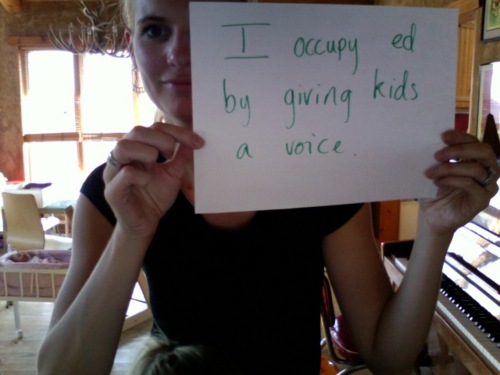
Teachers should play nice, like we tell our students.  Don’t cause too many waves because it is unbecoming of our profession.  Don’t raise your voice too much because you may offend.  Whatever happens to us, happens, because we choose to not raise our voice, to not band together, and instead waste our time fighting amongst ourselves.  It is time to rise up, it is time to raise our voice, to occupy our classrooms and stand tall.  To highlight the incredible work we do, to get the respect we deserve.  To be treated like we treat our students.  So as I give my students  a voice, I allow myself to speak as well. We are the 99% and together our whispers will become a roar.

connections, global, student blogging, Student-centered, technology

Why Students Should Blog – My Top 10

Image: Kristina B

I have written about it before, I will write about it again I am sure, so here is why students should blog:

  1. They have an actual audience to write for.  The writing is no longer just for me but the whole world. When we write science diaries, we have scientists write back to us and push their questioning skills.  When students write about a book they are reading, other students ask them questions and give them more recommendations.  When students go on vacations they write to us to tell us all about it.  You get the idea.
  2. You can track their writing progress.  I have always had them keep track of their writing in their binders but invariable papers got lost.  Here I can see their growth, print it out and hand it to them.  I can have them focus on specific skills, just like regular writing, but they can go in and edit on their own time.  They can see their growth and the electronic version seems to appeal to them more.
  3. It opens a dialogue.  Students have a direct line to their teacher and to anyone else they are connected with.  Blogging helps us write back to each other, but great blogging is like a conversation with questions and critique.  My students are learning how to engage in written dialogue with topics they care about. 
  4. It establishes their internet identity in safe manner.  Students are getting on the internet earlier and earlier so as teachers it is vital we embrace this opportunity to teach them safety.  My students know the safety rules by heart and help each other follow them.  By being on the internet and establishing a presence they are actively practicing staying safe rather than just talking about it.
  5. They teach each other.  Numerous times my students have corrected misconceptions or created new awareness of concepts being taught within our room.  They become teachers rather than just students in our classroom and blogging allows them to continue that outside our classroom walls.
  6. They are global citizens and global collaborators.  We speak of creating global citizens but then forget to actually connect kids with kids.  My students know where places in the world are because they speak to kids from those places.  We have connections around the world that we can use when we study other places and this year my students will even be working on a project together with another classroom.
  7. Transparency.  Too often teachers shut their doors to the world rather than sharing the amazing things we concoct along with or students.  Blogging opens up that door and shows the whole world what is happening.  My students have more than once inspired other teachers to try a project.
  8. They become aware of themselves as writers.  Students start to create their own essence as a writer first playing around with fonts but then creating tag lines for their blogs and deciding how they want to present themselves to the world as writers.  This is powerful at the elementary age.
  9. I can easily check in on their learning.  When my students blog about a concept I can quickly see whether they are understanding the essential concepts or need another learning opportunity.  
  10. You give them a voice.  Students need a way to express themselves to take ownership of their learning, so through our blog students tell the world their thoughts on education, their learning and their needs.  I am a better teacher because of their blogging.

I could keep going but I hope that this inspires you to try it.  Reach out, connect, I will gladly help anyone that wants to try blogging with their students.  My students tell me now that blogging is one of the best things that has ever happened to them.  To see their work and their thoughts visit them here

For more reasons why students should blog, check out this post: