For a week the students worked on building their 3-d models becoming designers and builders. Here is the finished product.
Author: Pernille Schmidt Ripp
Since 2010, I have lived my teaching life outloud, writing, speaking, and sharing the great, the okay, and the sometimes not so great. Starting as a 4th grade teacher in Middleton, Wisconsin, then heading to the middle school for many years, in 2022 I moved back home to Denmark to try teaching primary grades. Because why not?
But I also started the Global Read Aloud in 2010, a global literacy project that has connected millions of children across the world. I also write books trying to help others co-create sustainable student-centered learning spaces, and I share my life on Instagram, in both English and Danish.
I Am Committed
We all struggle with decisions, every day, every minute. Some decisions become easier as we get more set in our ways, language we use, motions we go through, and yet some never lose their unfamiliarity, their newness, their rawness. As a teacher I cannot begin to count how many decisions I make in a day; language choice, assignments, what I bring into my room and what I take out. TO teach does not just mean to guide the learning, I am also there to make decisions.
So I wish for this for the coming week, month, and year; that whatever decisions I make, I make them fully. That once I commit myself to something, I commit the entire me. Not just a tentative part, but the whole thing. That once my thinking is through and outcomes have been weighed that I then trust myself. That I trust myself to know I made the right decision, that I trust myself enough to agree with my choice, and to perhaps even revel in it. Trust myself to fully commit. Give myself the gift of believing that I made the right decision, perhaps then I can give myself a break. Do you need to commit?
Solidarity, Protest and Tractors – Pictures from the protest
These are pictures taken at the union solidarity protest in my town of Madison, Wisconsin March 12, 2011
Don’t Worry – There’s a Routine for That
 |
| Image taken from ronnestam.com |
Routines, one of the big words in “teacher school” as we call it in my classroom. You must set up routines, you must establish them, practice them, train them and share your expectations. We have routines for everything, and it seems the younger the students are – the more routines we have. So if you need to go to the bathroom, there’s a routine for that, how to hand in homework, there’s a routine for that, how to answer a question – you guessed it, there’s a routine for that. And yet as I struggle with keeping track of all of my routines, I wonder; when do the routines become suffocating?
I agree that routines must be in place for the students to know the shared expectations. After all, accountability is one of the great skills we teach along with math, reading, writing. Students learn to follow routines because it provides familiarity and safety. It simply makes school and a classroom more manageable, and more effective. And yet we can over-routine. We can ponder and prepare routines for almost everything. My first year, I spent a whole day preparing a sign for my students, very artistic indeed, writing out routines for what to do when you needed to sharpen your pencil or leave the classroom. I don’t think any student ever read the poster, let alone memorized it.
So I realized that perhaps routines were needed for the really big things, like morning routine, how to go to specials or lunch routines, and general classroom behavior routine. But beyond that, I am done. I am done routining my students to death. After all, they are equipped with common sense. I do not think me writing out how and when they should sharpen their pencils is worthy of their memorization or the title of “routine.” I think I am going to stop “ruling” them to pieces and let them develop their inner sense of proper behavior. Do we trust our students enough to pull back some of our rules masqueraded as routines? I do.
So What Does a B+ Mean to You – Quitting Grades Does Not Mean You are Lazy
Quitting grades to some means to quit expectations. I used to think that if I didn’t meticulously grade everything, I was inefficient, ineffective, and certainly lazy. And yet I have come to happily realize that quitting grades as much as I am allowed to do has become one of the great liberations of my young teaching experience. By quitting grades, I simply become able to better evaluate work, to in the end better “grade” my students.
When I quit putting letter grades on my papers, I did not lower my expectations for an excellent product, in fact quite the opposite happened. By removing letter grades from the final product it ceased being exactly that; final. When my students hand in an assignment now, they know it is is not done. No longer just an end product, but instead another stepping stone in our learning journey. If a test is mediocre, then they get a chance to fix it. As simple as that seems, I cannot tell you how many times I have witnessed a student say “oh” only to then erase the incorrect answer and provide the right one.
So quitting letter grades did not make me weak, simpler or even more “granola.” I didn’t quit letter grades because I wanted to shelter all of my students from the “real” world. I quit letter grades on assignment because they did not work. A letter grade only ever sparked a discussion when it was below what a student or parent thought was deserved. If an A- was given, a student did not take the opportunity to ask what could be better or ask what was great about it in the first place. Instead the grade was received, glanced at and the product filed away, perhaps to be shared with a parent, at some point to be shared with a recycling bin. So I didn’t start to wear patchouli or run chants in my classroom, I didn’t let my students academics slide to fit in with my new philosophy. Instead I challenged myself to provide better feedback, a better pathway for my students to follow to academic success.
Giving letter grades would be less time consuming then the feedback I provide now. Sometimes on busy days I even yearn for those days of easy calculations, slap on of a grade, and done with it all. Now instead I ponder, I chart, I reflect back upon previous work and then I try to write meaningful, relatable feedback that is relevant to that student. No more “Nice try” comments, but instead “You are secure in paragraph setup but still developing in sentence fluency.” And that’s only after all of my students actually know what a paragraph and sentence fluency is. So call me weak, call me a rebel, but don’t call me a softie. Letter grades for my students has meant more work, more thought, and more academic challenge than ever before. And boy do I love my new, hippidippy ways.
Build a 3-D City – a math project for scale, area, and perimeter
This week we started our much anticipated week-long project with the goal of designing and building a 3-d city. I searched the internet for plans to modify but did not come across any, so please feel free to use or modify this as you see fit.


In Everyday Math, unit 8 in 4th grade is all about area and perimeter. The unit is very short and I therefore saw a need for concrete practice with calculations. My husband, who happens to be a house designer and builder, agreed to co-teach this with me.
Length of project: 5 days
Materials used:
- 4’x8′ plywood, this is the base of our city. (This is not necessary but we chose to use it to elevate the project off the floor)
- Lots and lots of cardboard in various colors
- Thick cardboard cut into the lot sizes specified, they will serve as base for the students to build on.
- White paper for sketching
- Notebook
- Imagination!
- Hand outs for students:
Advance preparation:
- We wrapped the plywood in gray paper for roads and drew in all of the lots and roads. (We placed the wrapped plywood in the classroom a day in advance to build anticipation, it was great fun!)
- Copies for each person as needed
- Poster hung for Building Process
- Lottery lot numbers made and cut out, one for each student to draw. I worte on them lot # and what type of building.
Requirements:
- Scale decided upon: 10 feet = 1 inch
- Height of each story = 10 feet
- There must be 10% green space left on lot
- Single family homes must have at least 20% garage of house square footage
- Shopping malls etc. must have 40% of square footage be parking
Day 1:
- My husband used this presentation to reveal what the project would be, the video was stopped when “Kelly” was introduced.
- Then he showed a slide show of different types of houses to show the students what houses could look like, again sparking that creativity.
- We would stop and let kids get excited with each other for a couple of minutes.
- We made a list of math we would need to use: Scale, area, perimeter, fractions, decimals, percentages. There may even be more, only time will tell.
- Then time to sketch. Some students work in teams (if they are designing/building a large building) while others work by themselves. This is their time to try out several ideas that will fit with their requirements.
- The rest of the class time was used on sketching, answering questions and just checking in with students.
Day 2:
- Start out by answering any questions students may have.
- Discuss math conversions needed by using this prezi
- I would also sketch out at some point what it means to draw a detailed dimension plan.
- Meet with students to see if they have everything figured out and give them architectural approval.
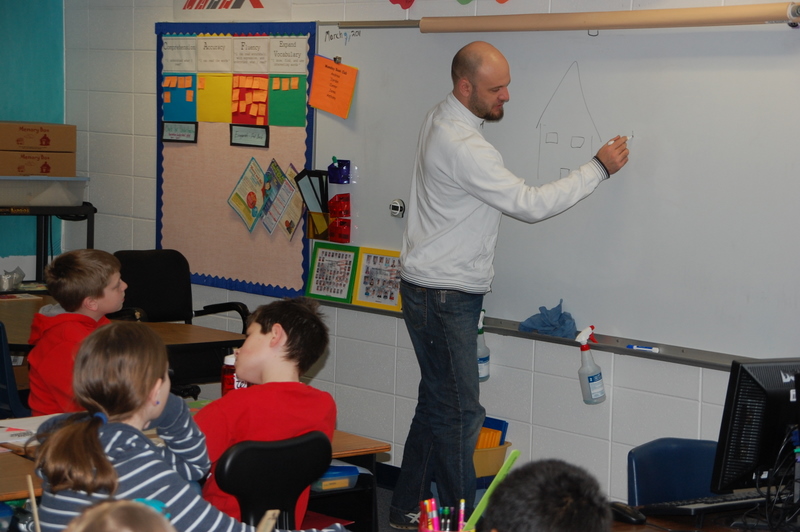

Days 3-5:
- Students design, draw, and meet to get their building permits.
- The process is as follows: Concept design, architectural control, permit checklist, detailed plans, building permit, build your house.
- This is where the support will happen as students try to do the math needed for the project.
- Obviously different levels of support are needed for this for each student, modify as you go.
Coming soon: pictures, video and progress reports.

