action, word choice, writing

A Lesson in Action and Word Choice

My students are developing their choice in words and in particular how to create a more exciting story.  I often find that students are tired of writing by the time they reach the exciting bits and so it ends up being shortened and not fully developed.  This action word lesson sprung from this problem.

Day 1:

  • I read them “Crazy Hair” by Neil Gaiman and asked them to take note of any “delicious” words that he used.  Whenever students submitted a delicious word, we discussed what other words he could have chosen and why we thought he didn’t.
  • We then return to our prior knowledge of the 6 + 1 Traits of Writing, which ones have we discussed more (organization, voice) and which ones do we need to explore; word choice.
  • This always lead to a discussion of why word choice is so important, where the students take ownership of making their writing better. 
  • I also introduce the “circle it” strategy here for spelling words: don’t skip a word just because you cannot spell it, spell it as best as you can, circle it and come back to it when you edit.  This eliminates kids stopping and losing their momentum in their writing.
  • Then they need to spice up some boring sentences to get their creative juices flowing, my list of boring sentences can be found here.  I only gave them 4 to work on in a small group and they had about 5 min. to improve.  Then present to the class and the students compliment each others sentences.
  • I do a teaser for the next day about how excited I am to introduce their writing project etc.

Day 2:

  • Write the word “ACTION” on the white board.  Let students guess for a minute why.  Then refresh their memory about the lesson from day 1.   What does action have to do with word choice?
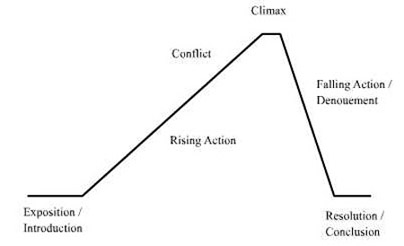
  • After discussion of this we speak about the climax of a story.  My students already know about the parts of a story so they recognize the diagram I draw on the board.  I circle the middle part because this is where the focus needs to be.
  • We discuss how movies are filled with action and then how would you write a scene from a movie?  I offer them my example. We discuss why it works as an action sequence.
  • Then it is their turn.  In small groups, they are to brainstorm using our huge whiteboards (24″ x 32″) and then write our a short action sequence using the most exciting word choices they can come up with. I project their brainstorm help questions to save paper.
  • I have them write in small groups as a guided writing step, some students would be capable of writing their own example right away but this way they help each other gain strength.  I gave my students 30 min to brainstorm and write.  They all finished just in time.
  • Share the stories and compliment what can be complimented.
  • Then I reveal the final project: their own short story, starting at the beginning of the action and ending at the end of the action.  No set up, no explanation, no denouement, just pure action.

Day 3:

  • Brainstorm using these sheets from http://www.writingfix.com.  This fit our purpose of using transtion words to shift from place to place as well as keeping the focus on the action.
  • Students will spend a lesson brainstorming and meeting with peers to help each other out.

Day 4:

  • Meet with me to discuss their idea and then begin the actual writing process.

Days spent on this lesson will depend on progress of students.  I envision about 2 weeks with a comic like illustration to go along with their action sequence.

being a teacher, being me, Lesson Planning, Student-centered, teaching

Simplify

As I prep for the upcoming week of lessons, I find myself cutting ideas out and slimming things down.  I am simplifying my lessons.  And not because I am “dumbing” them down, not at all, instead I am offering my students the luxury of only having to focus on key concepts rather than overwhelming them with all the bells and whistles.

In order for my students to take ownership of the learning they have to understand what they are owning.  They have to be able to take an idea, make it their own and then push it through.  if I add too many components to something, they will end up confused, bogged down, or just plain bored.

In college I was taught to make it exciting, to add visuals, support, brainstorming sheets and even hand signals.  I now rebel against that notion of having to add more every time. Perhaps that is why I am no longer a supporter of IWB’s in every classroom.  I don’t need to be more interactive, my students do.

So this week, I am cutting back all the extras.  I am focusing on what the goal is and letting students add their distinctive spins on it.  I will have supports ready if needed but I will not assume they need them.  I will speak less and engage more.  Simplify my teaching = expand their learning.  I am excited.

This post was partially inspired by this excellent post written Josh Stumpenhorst @stumpteacher.

math, review

Math Obstacle Course

The point has been reached in my 4th grade EDM curriculum where the kids start to really spread out as far as their abilities.  I knew I needed a review day but did not want to start at the whiteboard droning on.  Enter the math obstacle course!

The idea was simple: 5 different obstacles or stations, 3 volunteers, self-paced kids and a final project.  The five stations were:

  1. Rounding numbers
  2. Multi-digit multiplication
  3. Long division
  4. Build a Buck (adding and subtracting decimals)
  5. Fraction of Game

I recruited one fabulous parent volunteer to run the long-division station, had my fantastic special ed. teacher teach a different way of doing rounding, and then had the incredible ELL teacher teach at the multiplication station.  I ran the game stations and did various check-ins.

The students were told they had to complete all 5 obstacles before they could get to the final station; Build your Dream House using pattern blocks (they had to label them, so that was review all the way back to the 1st unit of the year).  They decided where they went, and then set their own pace.  Kid could get re-taught certain concepts if they needed it or they could choose to do the challenge questions right away and see if they completed the obstacle right away.
I drew a map of the obstacles on the board, explained the concepts, and off they went.  They loved it!  It was a bit of organized chaos, but the connections I was able to share with kids and witness them make just floored me.  All students completed all 5 obstacles, even those who needed some extra review, and they loved the creative final project.  Many of the students were eager to share their dream houses and all brought them home.  
I will definitely be doing this type of review again and could recruit more volunteers if needed.  To see the challenge questions and course card, click here for English version and here for Spanish version.
being a teacher, being me, students

When the Day is Tough

No matter the noise, no matter the distractions, no matter how perhaps one lesson didn’t go quite as expected. There is always something good to see, something wonderful to praise, and something that deserves to be recognized.

When the day has been rough and the kids have been tough, take the time to huddle. Take the time to relish the good moments because no matter what, they are there, waiting to be discovered, waiting to be remembered and shared.

So take a deep breath, gather them on the carpet, and ask them to share that one good thing from the day. Go around the circle, come back to those that need extra time, and then smile. Twenty-three golden moments all out in the open; the day couldn’t have been that bad after all.

aha moment, behavior, being a teacher, inspiration, Student-centered

Teach To Fit Your Students, Not You

Monday was a chatty day. One of those days where no matter what you do, the kids just cannot settle down and focus. One of those days where I would have moved a lot of sticks and gotten a lot of points. Except this day, I didn’t. There are no sticks to move, names to write or points to take in my room, and sometimes that is hard. You see, when you can punish students for a behavior they often change their demeanor for a short time. Punishment leads to submission and the day can keep moving. However, punishment also means that nothing corrective takes place or valuable for that student. So I don’t punish anymore.

And yet the kids, who are usually so on track, just had a hard time. Whether it was because of the impending blizzard, being tired, or one child starting the talk wave, I don’t know. But teaching proved difficult. In earlier years, I would have ended the day lamenting about how the students didn’t work hard or had problems focusing. Instead, this year I turned my glance inward and thought about how I could accommodate their jitteriness, their talkativeness, their seeming inability to it still too long. How could I change my teaching to make it a great day?

So Tuesday, I came prepared. We had decks of cards as manipulatives for math and the kids did most of the talking as we figured out probability. My planned lesson for literacy for our author study was switched to one about choral reading where the students had to create and perform their first ever choral read poem. We stayed focused on the day through small talk breaks discussiing the probability of a snow day. We spoke about our fifth grade friends in Egypt, we checked in on the live feed to an eagles nest, we took small body breaks stretching and then worked hard. That afternoon, we were able to feed our crayfish, clean their tanks and then have a small study hall with multitudes of choices. We ended with an exciting math game with our first grade reading buddies.

At the end of the day, I was unstressed. We had accomplished what we set out to do and we had also had a good day. The students had worked with their distractedness and made it a strength rather than, well, a distraction. I had realized that it is not my job to force my student into the learning, but instead shape my learning to accommodate my students. It is indeed not about me, but about them, and that is the most mportant thing to remember.

alfie kohn, being a teacher, blogging, rewards

I am a Hypocrite

Today I had one of those great thought moments that can only happen during deep professional and personal reflection.  George Couros, a principal I admire, did some thinking out-loud on my latest blog post, a follow up to another post on behavior.  Part of his comment is shown below:


I am going to challenge you a bit on this post, but not necessarily on its content. I noticed that you listed some stats on how many hits you have had, retweets, etc.. I also noticed that you listed that “Alfie Kohn” commented on it (like it was some kind of award that he did that). You have also written how you were disappointed that you did not get an edublog award: (http://mrspripp.blogspot.com/2010/12/im-loser.html)

With the listing of these stats (kind of like marks) and discussion of awards, are you somehow showing that you have a part of you driven by the same thing that you are saying we should take away from students in the classroom?

Just some food for thought. I think that your posting discussing the importance of intrinsic motivation and not extrinsic motivators is contradicted by use of the stats of your blog hits and retweets.

Is there room for both to drive us? I know I have a twitter counter on my own blog posts and love recognition.

Part of my response to George was this:

George, what a great comment that really made me think early this morning. I think your questions prove avery valid point for me; we as adults struggle for the same recognition as our students do. However, the reason why I listed those stats etc with this particular post was because it showed that somehow this particular post really struck something in people, which I had no idea it would. I never expect anyone to read my blog so the fact that that many people took the time to share or read shows that this a debate that many others are either thinking about or engaged in.

So all day I wondered; was I indeed a hypocrite (not that George implied it, I label myself that way)?  Had I published those statistics and name dropped because I too craved recognition and reward from my peers?  Could I possible be wanting the same thing that I despise so much in my own classroom?  The answer is not easy to come up with.  On one hand, I really do not seek out recognition but rather reflection, however, on the other hand, do I obsessively look at my blog counts to see if I matter?  Is that what it really comes down to?  

Perhaps when we look at our blog visits or comments received, we are really looking for some sort of validation that there are others like us out there.  That we are not alone in this educational ocean where the tide continuously shifts.  Perhaps, when a lot of people respond to a post we have found an island on which others seek refuge as well.  Perhaps, the need for recognition is so intrinsically ingrained in us that we can never truly escape it no matter how much we try.

I am not perfect, which thankfully no one has ever accused me of being.  I struggle publicly with many of my own teaching practices and choose to chronicle this struggle in order to give myself clarity from a distance.  I wish I could be 100% staunch anti-reward, but I am not, I still praise my students for great behavior, amazing work or just being all around fantastic kids.  Some would consider that a reward as well.  What I am opposed to, though, are the public reward ceremonies, the in-class recognition of only the best and brightest, rather than different categories where all children can be celebrated.  So perhaps I am a hypocrite, but at least I am a hypocrite who is willing to share their thoughts.