aha moment, assumptions, being a teacher, control, student voice

When I Finally Stopped Speaking

recite-1se8xpf

It struck me as hard as a hammer.  6th period Friday.  The fourth time I was teaching this lesson.  The fourth time I had students go through the discussion questions, do the turn and talk, and then come back together.  It hit me so hard that I instantly cringed a little bit, because why in the world I hadn’t thought of this sooner?  If only I had listened to that little nagging voice we all have inside, if only I had tuned in as it screamed,  “Stop talking, Pernille.  Stop interrupting their conversations.  Stop rushing them through what you think they need to get through and let them speak to each other.”

And yet, after only a minute of talking, I felt the ticking time.  I saw the hands moving as class slowly trailed away and so I kept interrupting them.  Guiding them to the next thing that we had to do.  Telling them to finish up So that we had the entire foundation laid.  So that I could place a check mark in my planner and move on to the next thing, knowing that we had done everything we were supposed to and gotten to the end of the text.   Yet, this is exactly what we should not be doing in our classrooms.

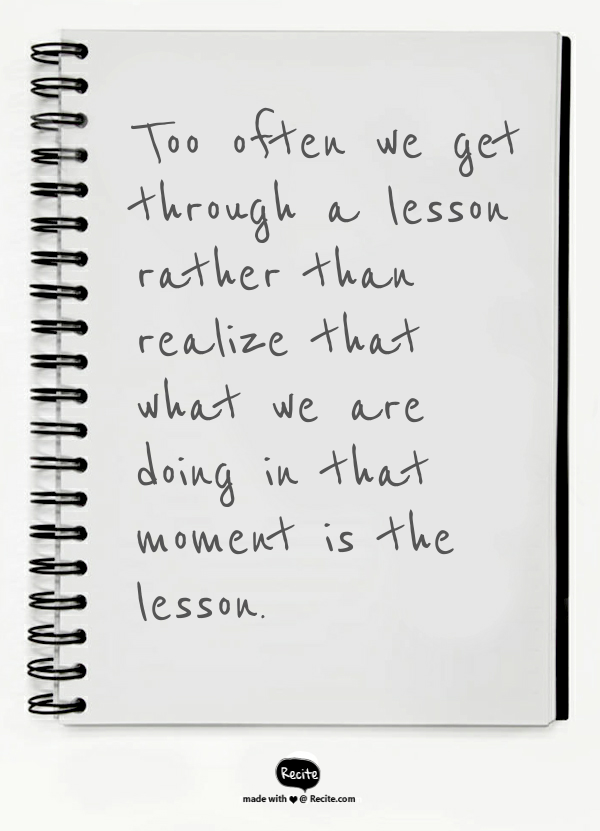
Too often, we rush.  Too often, we hurry so that we can cover things.  Too often we get through a lesson rather than realize that what we are doing in that moment is the lesson; is the point of school.  We say we want students who speak up and exhibit deep thinking, yet then limit this very thing as we teach.  We must slow down.  We must stop our incessant teacher talk, our incessant interruptions as we guide and mold and let students think, then let them speak.  And when they are done speaking let them sit in the silence for just a moment so they can be sure they are completely done speaking.

Teaching is not about getting through.  Teaching is not about getting things done.  Teaching is not about completing every single lesson we had planned so we can say that we did it, we followed the path and now we have taught.  Now our students have learned.  It is about the path we take to get there.  The exploration we have along the way.  The time we give to our students to speak so that we may listen.

So in that 6th hour on Friday, I finally stopped speaking. I finally stopped interrupting them and just let them speak.  Those who ran out of words looked at me expectantly waiting for me to start again, but then saw how others were still going in their conversations and that spurred them on to keep speaking.  I bounced from group to group, not interjecting, but listening instead.  Nodding and smiling as I saw them start to become what I hope they will be; kids that have an opinion, kids that have a voice.  After a few more minutes, a child asked a question so good that I knew we could discuss this as a class.  And so we did.  And I didn’t interrupt.  I didn’t shape the conversation.  I let them speak and they loved it.  Because it was about them and not me.  Their learning and not just my teaching.  Just the way it is supposed to be.

If you like what you read here, consider reading my book Passionate Learners – How to Engage and Empower Your Students.  The 2nd edition and actual book-book (not just e-book!) just came out!

aha moment, assessment, Be the change, feedback, grades

Some Helpful Realizations for More Meaningful Assessments

http---www.pixteller.com-pdata-t-l-190658

I have been trying to create more meaningful assessment for the past 5 years.  Not a small feat if you would, especially now when I am teaching more than 120 students.  Yet, a few things I have realized over the years may help others as they try to move away from grades as an end point, and instead move into better assessment and feedback, where students actually feel like they are in charge of their own learning journey.

Let me preface that this move from giving grades to giving feedback has not always been easy.  I find it is much easier to simply assign a grade to something, yet it has definitely been worth it.  By the end of the year my students are much better at evaluating, reflecting, and goal setting than they are when we start.  And that is worth it all in itself.  So a few things that I had to realize to make this shift was…

I am not the only one assessing.  Students self-assess on almost every assignment once we get started.  This is important, because they should not always be looking to me for how they did.  They need to know themselves well enough to reflect on their own performance.

It is an ongoing conversation.  We take the time to deconstruct the standards and rewrite them in student language.  We take the time to go through what an assignment is actually asking them to do.  We take the time to plan together so students can get ownership over what they are doing.  Assessment is not something that only happens once in a while so it should not just be discussed once in a while.

I cannot assume.  Too often we assume as teachers that we know what a child is doing or thinking.  It is not accurate most of the time.  So instead, I ask a child what they meant, I ask them to explain it to me as if I was not in the room.  I ask them to make sure that I can understand their thinking at all times.  We seem to focus too much on brevity, I would rather have a child be able to explain the full extent of their thinking than assume I know what they mean.

They need to produce more than I can assess.  Our job is not to assess every single thing that a child produces, but instead to assess the pieces they feel are worth others looking at.  Asking students to evaluate their work and only submit the one piece from a unit that they feel will show off their knowledge the best?  That is an assessment in itself.

They need to assess each other, but not until they trust each other.  We love using students as peer editors, as peer reviewers, and even as peer assessors.  However this can be incredibly hard for students who do not trust one another.  So wait.  Let them build community first.  Let them choose the people who will see their work.  Do not force them into vulnerability, it is not worth it in the end.

Assessment needs to happen in class.  They need to take ownership of the whole process, not just the end result, so that means that we are constantly evaluating our work, we are constantly engaged with our work, and we are doing it in class, not at home, not with parents.  But here, now, this day, so that the conversations can happen as a group, as a partnership and as a self-reflection.  And so the conversation can mean something and not just be homework or something else to get through.

Finally, assessment is a point in the journey, not the end of the journey.  And students don’t often understand that.  We have to have these conversations with them in order to change their mindset.  If students think that grades are something being done to them, that grades are out of their control and do not happen until the end when it is too late to do anything about it, then we are missing the whole point of assessment.  Assessment is for bettering yourself, for deepening your understanding, for helping you set goals.  Not for completing something so you can cross it off the to-do list. Once again, I am reminded of the saying; We do not teach standards, we teach kids.  And that is painfully apparent in the way we use assessment, feedback, and grades in our classrooms.

PS:  For the how-to for eliminating or limiting grades, please consider reading my book Passionate Learners.  There is a whole chapter dedicated to not just the why, but the actual how.

advice, aha moment, Be the change, being a teacher, being me, student choice, student voice

Why Are They Disengaged? My Students Told Me Why

I used to think that when students were disengaged it was their own fault, and while sometimes that is still true, I have found in my years of teaching that a lot of the fault lies with me as the teacher.  Yet, realizing that I may be the cause of my students disengagement is hard to swallow.  It certainly has not done wonders to my self-esteem, and yet, there is something liberating about realizing that while I am a part of the problem, that also means that I can fix it.  Or at the very least fix the things I control.  Student disengagement is something I can do something about.

But why are students so disengaged?  What lies behind the restlessness, the misbehavior, the bored stares?  Every year I survey my students throughout the year, and particularly on those days where nothing seems to be working.  I ask them simply to explain what is going on and they share their truths with me.  So here are their truths on student disengagement.

Students become disengaged, because..

They feel no connection to you.  I often notice that students are much more off task in the beginning of the year when we don’t know each other, right after the honeymoon is over.  This is when we seem to be in limbo and so I spend a lot of time having a lot of conversations with my students, I share stories from my life, and I speak to them in the hallways.  Students will work for you if they like you, so I try to be likable.  It may seem simple but it is repeated so often by my students.

They feel no urgency.  I have 45 minutes per class so the urgency is always there.  It is not the threat of a deadline that makes my students work at a faster pace, it is the promise of the next adventure that lies ahead.  My students and I make a deal that if they work hard and stay focused then I do not give them homework.  They know that they are given as much time in class as I can give them so they know to use that time well.  The students that don’t; they have to do the work outside of school.

They feel there is no purpose.  I use to assume that students knew what the greater purpose of something was, but they don’t.  So now we spend time deconstructing our standards and we speak about the connections between things.  We speak of why we are learning something and how it fits into our lives, not just how it is preparing us for the next year or for college.  We speak about how the learning we do right now allows us to become better human beings.

They feel they have no power.  When students feel powerless in our rooms, most become disengaged.  Particularly those kids who have often had behavior issues in the past.  Those are the kids, in particular, that need to feel like they have more control over their day.  This is why I proselytize about student choice.  Give them choice, even if just in a minor way like telling them they can sit wherever they want.  Give them power over their day so that they feel like who they are matters.

When the teacher talks too much.  We do.  We need to stop.  We need to set a timer or whatever will stop us from going on and on.  Give them knowledge then let them work with it.  Give them a chance to speak as well, after all, they are the ones that should be doing the learning.

When the teacher does not personalize.  How often do we know whether a child already knows something?  How often do we plan to find out so that we can create new learning experiences for them?  If a child has already mastered something, then let them work on something else, something more challenging.  But to do that, you have to find out what your students know.  Ask them whether through a survey, an informal pre-test, or a conversation.  Not everyone comes to us as a blank canvas.

When they do mostly worksheets.  I have moved far away from worksheets over the past few years, but that does not mean all worksheets are bad.  If a worksheet gives foundational knowledge that will be used for further learning then it can be ok.  However, if using a worksheet is part of the routine every day, or is not used for anything more, then there seems to be no deeper learning purpose behind it.  Students have told me they feel like when most teachers give them a worksheet it is because we are too lazy to teach them.

When the learning becomes something to just get through.  I have done this, said that we just need to get through this to get to fun thing.  Yikes.  When we say this, students automatically disengage from the task, after all, if teachers see no value in it, why should they?  Yes, there are things that we don’t love to teach as much so then make it better.  If it is boring or a struggle for us, then think of how it feels for the students.  We are in charge of bringing the passion into our rooms.  Not just the students.

While there are still days in our classroom where I know that students were not as engaged as I hoped, there are more great days than bad.  There are more days where students stay on-task, where they get involved, and where meaningful learning occurs.  Every year, I start over with my students and how to best engage them.  Every year I learn a new way to keep them on-task.  Yet I have learned that the biggest thing for me is to keep the above list in mind at all times.  Even if I feel like I have planned the very best lesson.  Even if the day before went really well.  I do not take my students’ engagement for granted, instead it is something I work for.  Do you?

PS:  For ideas on how to evaluate why students are becoming disengaged tune in tomorrow.

If you like what you read here, consider reading my book Passionate Learners – How to Engage and Empower Your Students.  The 2nd edition and actual book-book (not just e-book!) comes out September 22nd from Routledge, but rumor has it that it is out on Kindle already!

aha moment, Be the change, being a teacher, new year, students

The Small Changes I Can Make

Sometimes our students come to us with stories that we could never imagine.  Sometimes we are their refuge.  Sometimes, we don’t even know what part we play until years later, and sometimes we will never know.  The barriers that sometimes surround our students can be brutal, and yet, the students show up.  They try to learn.  They try to do their very best.  And we need to be the ones that welcome them.

So this will be the year that I try not to create more barriers for my students.  This will be the year where I try to make it as easy as possible for them to access the learning .  While I cannot control everything, particularly what goes on outside of our classroom, there are so many small things I can control that will make their day easier.

I can hand them pencils.  I used to be a tentative pencil-hander-outer.  There was usually a lecture involved, a smirk, and some sort of thinly veiled threat as to what would happen if they didn’t get more pencils by the very next day.  And I get it.  Pencils cost money and we don’t have a lot of that in education.  But still, a pencil is the most basic tool that our students need.  And yes, they need to bring their supplies.  Yes, they need to be responsible.  Yes, they need to come prepared.  But we all have days where we need a pencil.  Not a lecture, not a glare.  Just a pencil so we can get to work.  If you want it back, write your name on a piece of paper and tape it to it.

I can withhold judgment.  Yes, I know better than most of my students.  I better, after all, I am more than 20 years older than them.  So when they make “stupid” mistakes, when they make a poor decision, I can withhold my own judgment.  I can help them find a solution, help them find the light, or even find the humor in a situation.  Most students face enough judgment in day, they don’t need more from me.

I can let them leave.  There are days when all we need is a walk.  A quick two minutes to resettle, to find room to breathe, to calm down even if we seem very calm on the outside.  Teaching students to recognize when they need a break is something we should all be doing.  If we teach younger students then finding a way for them to take a break safely is also important, even if they cannot leave the classroom on their own.

I can make it easy for them.  I can write the date, I can write out homework, I can post my email address on the wall.  I can make as many visual reminders as I can fit onto a board so that they can access it without asking.  I can also create a website with all of the handouts, resources, and information they need to stay organized outside of school.  That doesn’t mean they won’t pay attention in class.

I can welcome them.  Even when it is inconvenient, even when I am busy.  Just because a child seeks us out does not mean they need us to speak with them.  On our team we often have students ask if they can simply work in our room.  Yes!  Please do, let me know if you need anything.  Sometimes all a child needs to be successful is a safe place to work.  If we cannot offer up our rooms, we often find another place.

I can ask a follow up question.  On our team, we teach more than 120 students.  Every day, we stand outside our doors and ask students how they are, how their evening was, how they are feeling.  When a child answers, we ask a follow up question because it’s the second question that matters.  That’s the one that shows we care, that’s the one that shows we are paying attention.  Anyone can ask “How are you?,” but it takes time to say more.

The barriers we create in our rooms are often ones that we don’t even notice, yet it is within the smallest details of our days that students learn the most about us as people.  It is when we take time to do the little things that we can make a huge difference.  What are the small changes you will make?

If you like what you read here, consider reading my book Passionate Learners – How to Engage and Empower Your Students.  The 2nd edition and actual book-book (not just e-book!) comes out September 22nd from Routledge.

aha moment, being a teacher, being me, ideas, new teacher, new year

The One Great Idea Promise

image from icanread

School is nearly starting here in Wisconsin.  Less than three weeks until we say hello.  For some of my friends, it has already started and for others this is not the beginning of a new year.  We are surrounded by the buzz of excitement that comes from starting anew.  We are surrounded by the energy that will lift us up and carry us forward, led by dreams.  We are surrounded by the myriad of ideas we have concocted, come across, and considered as we inch nearer to that first magical day.

But what do you do with an idea?  to quote one of my favorite picture books.  Because we have all of these ideas that we cannot wait to try.  We have all of these ideas that will change the way we teach, change our students’ lives, and hopefully inspire change overall.  We have so many ideas that we often overwhelm ourselves before we even begin.

So I give you the one great idea promise; promise yourself that you will hold on to just one idea and pursue it with every thing you’ve got.  Find your essence, find your core, and hold on to that with every planning step you take.  Write it out, hang it up, and keep it in the forefront whenever you plan.  This is where your energy should go.  That doesn’t mean to dismiss all of the other ideas you have, but to let them slide in when they fit.  Write them down because you will forget them, but circle the one that will set apart this year from last.  Find your one great idea and love it with all of your might.

We say we want to change the world, but sometimes we need to just change one thing.  So find your thing and do it.  Don’t give up because you didn’t do them all.  The students don’t need you to do all things, they need you to do just one; love them and your job.  The students await.

If you like what you read here, consider reading my book Passionate Learners – How to Engage and Empower Your Students.  The 2nd edition and actual book-book (not just e-book!) comes out September 22nd from Routledge.

aha moment, being me, MIEExpert15, Passion, Student dreams

A Thought on Perspective – The Fish Tank

tumblr_nso3c6hBcF1qzr04eo1_500

I sat there watching the fish swim in place, barely noticing Augustine’s excited screams.  Amazing that a 19th month old toddler pointing, yelling, and even wanting so badly to hit the glass did not shake the fish.  They barely moved.  And Augustine stood in total awe, oblivious to the world around her.

The fish seemed content.  They had clean water, a few rocks, a few fish friends and obviously enough to eat.  And yet, they were clearly too large for their tank.  There was nowhere to hide, no trees except for the fake ones painted on the back wall.  No places to go except hovering right in the middle staring out at a retirement homes’ front entrance.  A completely average life for most goldfish I presume.

What if our classrooms are much like that fish tank?

What if that is how we teach out students?

What if we give them enough to just thrive, to be complacent, to be just fine?  What if we provide our students with just the necessities in our curriculum and care?  We will surely see them grow.  They will not wither away.  But will we notice when they become too large for our tanks?  When they long for more than the artificial experiences we are providing for them?  Will we notice when their dreams outgrow the space that we share, the needs we fulfill?  And not only will we notice, but what will we do with that knowledge?  What will we do to tear down a wall?  Give them the world so that the very tanks we keep them in don’t set them on a path toward creativity suffocation?

Sometimes I think that I am doing a just fine job, and I don’t take the time to step away from our room, from the tank to speak, and look at it from an outsiders perspective.  It is hard to do when you are the caretaker of a classroom community because you think that you are doing everything you should be doing.  Yet the dreams of our students are sometimes so big that we have to unleash them on the world, because if we don’t the dreams will die.  We have to be able to create spaces where our students can continue to thrive, not just survive, not just hovering in the middle of the only space they have.

What of our students don’t know that there is more to the world than what we offer them?  Then how can we ever expect them to want to change the world?

Who ever thought a too large goldfish would remind me of that?

If you like what you read here, consider reading my book Passionate Learners – How to Engage and Empower Your Students.  The 2nd edition and actual book-book (not just e-book!) comes out September 22nd from Routledge.