being a teacher, no homework

Why the Grade X 10 Minutes for HomeWork is a Fail

As I prepared for my first orientation day powerpoint as a new teacher, I knew I had to fill in homework expectations and how much parents could count on.  I was reminded to use the old formula 10 minutes times the grade of the child, excellent, 40 minutes of homework for a 4th grader.  Now this is what my brain should have thought;  “Wait a minute Pernille, 40 minutes of homework, a night?  Plus 20 minutes of expected reading with parent initials?  And a book report every 6 weeks?  And math tests every 3?  Not to mention science and social studies quizzes, which really are tests but just with a friendlier name.  What in the world am I saying?”  Except,  I didn’t and the rest, as they say, is history. Those kids had homework coming out of both ears because that is what I thought teachers did; assign work.  40 minutes seemed fair and reasonable and why shouldn’t it be?  Aren’t we in the business of making students accountable and responsible?  Aren’t we teaching them how to be effective workers, preparing them for the real world?

Except homework is really not thoughtful when you just spew the formula.  Homework then becomes the brainless act of repetition, not metacognition that we all should be striving for.  Homework becomes the incessant chore we all seem so hellbent on making it.  I know we are trying to raise responsible children, but is homework really the only way we can do this?  Can we not accomplish those same goals of responsibility, time management, and work habits without the insane amount of homework?  Can we, as educators, realize that perhaps we do not have the right to infringe on students’ lives outside of class up to an hour or more every night?  Haven’t students already given us 7 to 8 hours of work?

I, for one, limit my homework giving and not because I am a hippie that doesn’t believe in hard work.  We do work hard in my classroom, in fact, my students relish how much we get done in a day because it means they are managing their time.  It means they are creating a work ethic that says give school your undivided attention for a whole day and you will be rewarded with free time.  Do your job here right and then you don’t have to worry about it as much outside of school.  And a formula can never encompass that.

So it is time we give up on the formula.  It is time we realize that homework is not something we have to give just to give the kids work, that there are other ways to teach students motivation, time management, and effective work habits  There are other ways to ensure all of the curriculum is covered and that knowledge is garnered.

This year, on the first day, I will tell the parents that there may be work outside of school and that it will differ from day to day.  I will tell the parents that my mission is to keep work inside of my classroom so that the students may breathe a little bit.  I will tell them there that will be projects, there will reading, sure, but there will also be time to be a kid, to live a little.  No homework doesn’t mean no learning, it means school was kept at school and that is a good thing.

being a teacher

The One Piece of Advice I Wish I had Gotten

If I could change one thing it would be to believe in myself.  To trust in my gut when I looked at lesson plans meant for others and know that they needed to be tweaked, to be changed, perhaps even to be omitted so that I could teach.  To trust the sense I got that I was displaced, putting on someone else’s clothes and pretending to be grandma.

If I could change one thing I would have listened to that voice within me repeating this isn’t you, this isn’t how you feel, this isn’t what you believe whenever homework, grades, rewards and punishment were discussed and decided.  To stand up, even if done quietly, and to believe in respect, community, and conversation rather than stickers, sticks, and names on the board.

If I could change one thing I would have trusted myself.  Trusted the instinct we are all bestowed with.  Trusted that nagging doubt in my mind asking over and over, “Would you like to be a student in your own classroom?”No, no, no…

And then it happened, I changed.  I listened to myself, really listened, and out came all of those doubts, nagging words, fears, apprehensions and then finally relief.  This was my path, not someone else’s.  This was my contribution, to believe in myself, to believe in my students, to give them a voice, to treat them fairly and with respect.  To follow my common sense that had been screaming all along; listen to your instinct, believe in yourself, and trust your own voice.

I wish I had listened long ago but all that matters is that I finally listened.  It is never too late to change how we teach.

being a teacher, education reform

Teachers Save Lives Too – We Just Don’t Get Paid Like We Do

As the recession rolls on and the politicians gear up for another fight on this new super committee, I drive back and forth to school getting ready for a new school year.  One politician was discussing what could be cut save our country from the brink of bankruptcy and discussed Medicaid, a favorite target.  The radio host asked whether doctors’ pay should be cut as well then.  The politician scoffed at this notion; “We should not cut the pay of doctors,” he stated, “They save lives…”
Maybe it’s the salary freeze my district has imposed on teachers.  Maybe it’s the rumors that my administration gave themselves raises.  Maybe it is the political climate in Wisconsin that means I take a 12% pay cut this year; but I am mad.  And this happy teacher often does not raise her voice, just ask my students.  But when that politician scoffed at the notion of cutting doctors pay because they are lifesavers, I just about lost it.  Let me tell you something; teachers save lives too.
Teachers are among the first to notice when a child goes hungry.  They are also among the first to give that child their own lunch and to buy them food.  Teachers are among the first who see children freezing, or wearing the same pair of holey shoes every day, rain or shine.  Teachers are the ones who get clothing and proper winter gear for those who need it.  If a child shows up with bruises or scratches, teachers are the ones who take note.  Teachers are the ones who make those phone calls and follow up with government when nothing happens.  Teachers are the ones who lie awake at night wondering what they can do to help those children.
And those are the big things.  We save lives every day by taking an interest, by being passionate, and by believing in the kids.  Sometimes these kids have no direction and we help them figure one out.  Sometimes these kids come to us ready to take the wrong path and we help them go another way.  Sometimes all a kid needs is a little attention, a little guidance, a little firmness and some love and we give that no questions asked.  We don’t just teach the curriculum, we teach life.
When a child enters our classrooms, we take them under our wings; they become our children.  When a child’s mood changes and depression looms, teachers are the ones who help get the help and assistance needed to veer off disaster.  When home life crashes and that child tells you that they are living in a car, teachers do everything in their power to help.  I have heard of and seen teachers bring in bags of clothing, food, furniture and donate money just to help.  I have heard of teachers who invited families in to live with them until they could get back on their feet.  Teachers save lives.  And they are not the only ones; many people involved in education save lives.  And yet, our pay can be cut because we only work 9 months out of the year anyway.
It is true some doctors save lives.  But not all.  A podiatrist makes on average $181,000 a year.  That is more than 6 times what I make.  They don’t save lives on a regular basis and yet they get the benefit of “being a doctor.”  And that title alone means they command a better salary.  Being a teacher means you better do it for the kids and not complain about the money that comes your way.  If you complain about the money, well then, you are obviously in it for the wrong reason.  Nobody tells doctors that they should be doing it for the patients.  Sure most of them love what they do I’m sure, but I am also sure that some get the degree for that lucrative paycheck, and that’s ok.  I wish everyone could get paid like a doctor.
So this isn’t to rip doctors’ of their pay or even of their status but rather ask why teachers can not be given that same respect  Why can someone not scoff a the notion of cutting teachers’ pay to save the economy? Why can someone not claim as well that teachers save lives and do invaluable work and therefore should be rewarded and respected?  I don’t ask for respect, I earn it.  I don’t ask for status because I don’t care.  I do ask for a decent salary, one to reflect the years of schooling that we go through and continue to pursue.  One that reflects the time that our job takes to do well.  One that reflects the work we do.  But I am not holding my breath.
So yeah teachers save lives; we just don’t get paid like we do.
being a teacher, love, twitter

#WhyILoveTeaching is Born

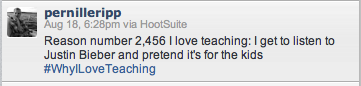
Last night as Justin Bieber played through my speakers (my daughter and I were having a dance party), I tweeted this

And with that a new little hashtag was born.  I tweeted a couple of more reasons and then others started to join in.  These weren’t the big reasons like we change lives or what we do matter every day.  We always talk about those things,.  These were all those extra little reasons that teaching is an incredible job.  That teaching matters.

So I challenge you, send out a tweet explaining why you love teaching – the goofy reasons why, the little things we forget to discuss and use the hashtag #WhyILoveTeaching.  To see the positivity in the little things, to hear how amazing our job is, now that is something to remember.

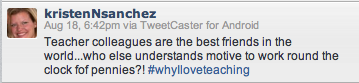
Here a couple of my favorites:


So if you have a moment, check the stream out and then add your own.  I can’t wait to hear why you love teaching.

being a teacher, new year

On Those First Couple of Days

Cross posted from my other blog 


I am in the countdown, getting butterflies, and starting to have those back to school nightmares about how much the kids will hate me.  Yes, school starts in 3 weeks.  So yesterday I sat down and brainstormed what I would do those first two days or week with my kids.  We start weird this year with orientation on Thursday and then full day Friday but then Labor Day weekend so I don’t plan out the lessons.  But I do make a list of all the things we should do.  Care to see it?

So what does it say?

  • Flag pennant – a way for my kids to show their personality and decorate their cubbies – it’s a 5th grade thing
  • Wordle about me – I have parents hand in 5 secret adjectives to describe their child and then we add 5 of our own and it make a really great Wordle about the kids which we hang up – the students get so surprised over the adjectives their parents use.
  • Intro to Blogging – we start to talk about blogging on the second day of school because it is a huge part of our classroom.  And then we start to discuss safety.
  • Paper blog lesson – this is a great lesson shared by @McTeach and one that I love to do with my kids.
  • Lunch magnets – sign in, sign out
  • Name sticks – I randomly pull sticks when we discuss and use them for group work.
  • Pencil cups – I have tables this year so no more name tags on desks.  Students will instead have a decorated pencil cup with their name on it.  They work on this while I read aloud.
  • Writing sample – I love seeing how they grow.  I think this year’s topic might be “What color is 5th grade?”
  • Read Dear Future Mrs. Ripp Student letters aloud.  Every year my students write a letter to the new kids sharing information about this classroom and how to get the best out of it.  This year some of those students are still with me so I am going to share their letters with the whole class when they work on projects.
  • Time Capsule – we measure height and write down our favorites and dislikes.  The kids always crack up at the end of the year about what they wrote.
  • Make Animoto classroom vision – the kids figure out our vision for the room and put in into Animoto.  It really gets them thinking and helps them take ownership of the room, here is last year’s.
  • Discuss classroom jobs – I have helpers every week and this year I added new jobs like Googler and Mapper.  The Goggler will google questions we have submitted on a list and the mapper will keep track of where we connect with.
  • Morning Routine – we discuss expectations; what type of morning do the kids want?  How do we get started for the day?  We come to an agreement on how it will run best.
  • Random Pictures of Mrs. Ripp – I will be sharing a slideshow of random pictures from my life to see if the kids can guess what they mean to me.  The following the kids will bring in their random pictures.
  • Connect the students – this is a great activity that only requires paper and sharpies.  The kids all write their name on the border of the paper and then one person makes a statement like “I play soccer.”  Anyone else who plays soccer gets to connect their name to theirs and then the next person states something and so on.  In the end you have a huge spiderweb of how connected we are in the classroom which I display even though it is super messy but it kind of looks like art.
  • Rules discussion – I don’t set the rules, the kids do.  So how do we want our room to function, how do we want it to sound, to look like?  What will we do to maintain it.  That conversation starts on the first day.
  • Be a tour guide – I have some of my students from last year so why not have them give tours of the classroom.  I have changed some stuff but not everything so then everyone can feel at home.
  • Name your table.  The students will come up with a table name and then create a banner for it.  This will happen monthly as the students change tables.
So there you go, just a couple of my to do’s for the first couple of days.  If you see something you like; borrow the idea.  
being a teacher, technology

4 Steps to Teaching Others About Technology (And Getting Them to Use It)

I am fresh off of teaching a week-long class to teachers on how to integrate technology into their classrooms. This experience was a great one for me because it reminded me of how overwhelming technology that I take for granted can be to others starting out. And yet, these teachers got hooked. So how?

They all did a couple of things that took them from skeptics to believers (and comfortable!)

  1. They figured out their purpose.  Technology should never be used just for technology’s sake because then it has no educational value.  These teachers narrowed in on which areas they thought could be enhanced by technology and then worked specifically with those.
  2. Pick a few.  I showed them more than 50 tools just to let them see what was out there but then we narrowed it down for each one of them.  There were things they immidiately gravitated toward; Google Docs, and others that took time; having a classroom blog.  Some they just thought were cool and got archived for later use – maybe, and I am ok with that.
  3. Work on it right away.  We have all been to classes where the instructor showed us a lot of cool things but we never had time to play with it, and guess what, most of the time we never go back to those tools.  We introduced tools then gave them time to mess around, set up their accounts, mess up and get help.  These teachers actually left the class with products they felt comfortable using and all had set up their own classroom blogs already.
  4. Give it time and purpose.  I shared why I use different tools, how it was meaningful to my students or parents, and also how mch time I spend on these tools.  When teachers can experience for themselves why a tool may be easily integrated and valuable, chances are they are going to actually use it after the class.  And that was the whole point.

So which tools were the most favored?  Prezi, Animoto, Google Docs, Blogger, and LiveBinders won this week.  Twitter, Edmodo, and StoryBird came in close second.  All the teachers left more confident and couldn’t wait to go back and share what they had learned with others in their building.  So although I may have only taught 12 teachers this week, the impact that they could have on their buildings is bigger and that is the beauty of getting teachers comfortable with technology; it spreads like rings in the water.