being me

Dear @Pink

Dear Pink, or should I call you Alecia?

You don’t really know me, not much any way, not unless you count the few minutes last night that we met in a back hallway in the Fiserv Forum as you hugged my little girl, Thea, who is not so little any more, and told her about your own experiences with bullying and how we could not let them win.

I was Mama, the woman who stood there with tears in her eyes, not quite sure that the scene that unfolded in front of her was real. Not quite sure how we went from sitting in a seat waiting for you to come onstage, fulfilling one of our bucket list items together, to standing here in your presence. Trying to decide in that moment whether we deserved to be here with you, you who have given so much of yourself to the world already. You who fight for the under dog. You who say the words that so many of us want to but sometimes don’t have the courage to. Yet here we were, living out a dream, neither one of us had ever contemplated.

You saw my tweet celebrating that the bullies had not won. That we were going to use your concert as a way to celebrate that no matter what words they flung at Thea, no matter how hard they pushed, how hard they hit, how many times they chanted all of those ugly things, they would not win. That they did not win.

And so you gave us the most valuable thing you have; your time, and for those few minutes, you changed our lives, cementing a course we had already begun, but gave us the push to keep going. You saw us in our quietest but biggest moment of reclaiming. You saw us face those words that had kept us awake for so many nights. You saw the tears of what it feels like as a parent to not be able to defend your child, to not be able to make your child believe what you shout loudly all the time, you saw the love that we have for our children and how we would do anything to build them up.

But what you didn’t see last night after you gave us your time, was how Thea reacted. How at first, she couldn’t believe it. Neither of us could. After all, who would think that a tweet would lead us to hugs and talks to you? How we kept telling ourselves that this was real, that this had happened, that you were exactly what we thought you would be – passionate, caring, real.

But what you didn’t see last night, was my little girl, who like I said is not so little anymore, feel like she was truly somebody worthy. Feel like the past year, with all of its anger and tears was no longer her year, was no longer her defining moment. Was no longer the story she was writing.

What you didn’t see last night was when you talked about Thea on stage and then sang the song we had yelled at the top of our lungs so many times at home, that Thea had tears in her eyes. My girl, who does not cry unless she is hurt badly or very tired, stood their singing along with you from section 116, row 14, seat 1, screaming your words back at you, telling you that she believed it too.

Because that’s what meeting you did for her. It allowed her to believe that the words were meant for her. That all those times we sang “…change the voices in your head, make them like you instead…” we meant it. That those words were real and true and everything I , as her mother, wanted her to believe.

So when you sang, “Pretty, pretty pretty please, don’t you ever ever feel, you are less than, less than perfect…” Thea reached for my hand, squeezed and then turned toward the world and sang. She knew the words were hers but sang loudly for the rest of the world to hear them as well. For all those kids who need those words. For all of the adults, including me, her mama, who needs them too.

So dear Pink, thank you. Not just for making the embers of what Thea is turn into a fire. Not just for giving us your time. Not just for being you and fighting for us all. But for telling Thea that what the bullies had tried to make her believe was simply not true. For allowing Thea to take a moment to tell you how she admires you. For telling Thea that she was beautiful.

And for giving me the reminder that we can all be more like you. That as a teacher, I get to tell the kids that are in my care every day, how amazing they are. How much they matter to the world. How with every moment I am with them, I can be like you, and help them see the beauty within themselves.

This morning as I drove Thea to school, she was unusually quiet. I asked her what was wrong and she told me that she was so sad it was all over. That the night before had ended. But I realized that in that moment that she was wrong and I told her so.

I told her, “This is not the end, this is the beginning, your journey forward has just begun.”

And her smile came back and I dropped her off and I swear she floated as she walked.

So dear Pink, thank you. From one mama to another, thank you for what you did last night. Thank you for fighting for us all. Thank you for putting yourself out there so little girls, and not so little girls, can remember what it means to be unapologetically amazing. And for us who have been around a while to remember it too. We can be the light that shines on others. We can be the arms that reach out. We can keep going even when it burns because like we sang with you just last night, “…just because it burns, doesn’t mean you’re gonna die
You gotta get up and try, and try, and try…”

So that’s what we will do, keep trying. Keep believing. Keep living. Keep knowing that we are not broken, just bent…

Love,

Thea’s Mom

Be the change, being me

On Forgiveness…

Black,                 Free Image

I have been thinking a lot about forgiveness. Not so much forgiveness in the sense of feeling at peace with the world, but instead the forgiveness we sometimes lack in education; the forgiveness of ourselves. While we spend our days often forgiving others for the things they say, the things they do, the slights that are bound to happen when we work with and around other human beings, we seem to forget to give ourselves the same treatment. To realize at the end of the day that we, too, are only human, and that as humans the best we can do is the best we can do.

I think of forgiveness more often as the days tick closer to yet another break in an already tumultuous winter. With all of the days off, with the weather driving us inside more than ever, we never quite seemed to settle into the lull of the winter routine, where we find comfort in the small moments shared within our learning spaces. Where we find comfort in the trust we have placed within the community to allow us to be the people we are. Instead, it felt rushed at times, forced at times, and sometimes as if we had altogether forgotten what the community that we had painstakingly built up really felt like.

And so as the children we work with at times seem to push us away harder than ever before, I have spent many nights reflecting on what else I can do. What else we can do? What now? What next? And I will admit, there are simply nights where I have come up shorthanded. Where I have realized that my bag of tricks has run dry and that for right now, there is nothing more new I can try to re-engage a disengaged child. There is nothing new I can try to help a child stay engaged, help a child learn, help a child read a book. It is a hard thing to swallow. After all, we are supposed to work daily miracles within our rooms, never giving up on a child, never resting until every child is learning, every child is reading, every child sees value in what we do, what we are together.

And yet, sometimes we don’t work miracles. Sometimes even the best of ideas fail. Sometimes the team cannot brainstorm anything else to to try. Sometimes even what has worked for every child before this one, fails. And we carry that failure with us as yet another added weight in already heavy load. We carry that failure as if it means that we have failed all of the children we teach, as if we will never be a good educator again.

Those who work on the fringes of education, those who sit in power, may tell us that the fault lies within us, the educators. That if we only gave more choice. That if we only gave more freedom. That if we only gave students more space to be who they are and not who we want them to be, then, then….they surely would learn. That if we just brought in more technology, if we only let them lead, if we only gave them the reigns, then, then…they surely would thrive. And yes, those truths ring loudly, that has been the journey I have been on with my students for the past nine years. There is so much to be gained when we have freedom, when education focuses around the individual and not around the group, when the explorations we do are led by students, created by students, and valued by students. There is so much to be gained when we create equitable spaces that are focused on the humanity of each individual and not just tests, homework, and grades.

Yet to always fault the educator with no mind for what is already in place is to dismiss the larger problem. That true education is a collaboration. That for students to really be invested in learning, they have to first be invested, and yes, that means feeling safe enough to invest. That we can provide amazing opportunities for self expression and for some kids it is simply not enough, right now.

So this week, I realized that I am only human and that perhaps others needed to forgive themselves too. That at some point, stepping away from a child who has actively refused every single opportunity we have provided to learn, to change the system, to engage somehow, is the only next step we have at that moment. And that stepping away does not mean giving up. That stepping away, for now, does not mean that that child cannot learn, that that child cannot re-engage, that that child cannot find meaning. But it does mean that right now, I am not the teacher they need, I need time to come up with new ideas, and I need to be okay with that. That perhaps what we all need is a break once in awhile to remind ourselves that we are not meant to be saviors, but instead the bringers of opportunities. And sometimes that means stepping away and forgiving ourselves.

If you are wondering where I will be in the coming year or would like to have me speak, please see this page. If you like what you read here, consider reading my book, Passionate Readers – The Art of Reaching and Engaging Every Child.  This book focuses on the five keys we can implement into any reading community to strengthen student reading experiences, even within the 45 minute English block.  If you are looking for solutions and ideas for how to re-engage all of your students consider reading my very first book  Passionate Learners – How to Engage and Empower Your Students.  

being me

To the Moments

This is not a revolutionary post. One that will echo through our chambers as it brings forth the message of new. This is not radical, nor groundbreaking, but instead a gentle reminder to the world at large of what the small things can really do.

That when we take a moment, the moment, to say thank you, to acknowledge, to praise, the ripples that emanate may just one day turn into waves. May make the difference between a child who felt school was unsafe now is a place for her after all.

That when we go out of our way, come back to the way, of what it means to see how a child is trying, how a child is doing, what a child wants to be, we may just remind them that they are, indeed, all we need them to be.

So this is a thank you to the smiles and the hi’s. To the people who stand outside their classrooms, their offices, their schools and busses and every day greet the people with the loudest hello they can.

To the notes and the postcards, to the gotcha’s, and high fives. To the praise that matters and the shoulders that carry. To the scoot in’s and scoot overs. To the “Are you ok’s?” “I got this” and “Any time…” To the hugs, the goodbye’s, the thank you’s and taking the time. Every time. Any time.

A thank you to the quiet moments and the not so quiet. To the questions, the laughs, the aha’s and uh-oh’s.

But most of all, thank you to the people who saw our daughter for everything she was and not everything some wanted her to believe. Today, through your recognition, she started to believe it a little bit more, that she, too, is somebody worthwhile. Today, she saw for the first time in a really long time, what we have never lost sight of. A kid that matters. A kid that matters to others. A kid that is somebody.

Be the change, being a student, being me

Teaching Bias Through Inference and Identity

I can’t remember the last week we had a full week of school. Between snow days, cold days, and now an ice day, I think it was December the last time I had the pleasure of being with our students for five days in a row. All of these days off have given me time to think, a luxury it seems within teaching, and in particular about how I can use the units my team had already planned to expand our work on bias and social comprehension.

Now, before I share these ideas, I want to make something very clear; I am not an expert on this work. In fact, I have gone back and forth on even sharing what we are doing because this is truly something I am working on myself, something that is nowhere near perfect, and something where I lean heavily on the work of others to do my own work. And yet, perhaps it is exactly this insecurity of trying to get things “right” that holds many educators back from doing any of this work. So perhaps then, this post will help someone else take the plunge, much like I have. I go into this work knowing that I have much to learn and that starting it is the right step for me, even if I am bound to screw up.

Focus of Unit:

Old focus: So our original main goal for the past few weeks was to focus on inferring and how we use evidence to support our inferences. In the past, I have written about the work we have done here, and while the work was good and reached its intended learning outcome, it also was a missed opportunity to discuss how what we infer is directly related to our perspective, our identity, and the bias we may carry.

New focus: So the new goal became focusing on inferences and how the evidence we use to support them are shaped by our identity and bias. A subtle difference that has made a huge difference in all of the work we are doing.

Some Resources used:

While I had my original slides that contained some great ideas, I knew I needed further resources to guide me in this work. Some of the resources I have turned to have been:

  • Teaching Tolerance – one lesson plan I am using is their ideas for teaching bias in the media through tone and word choice, however, these are not the only resource I am using as their webinars and their articles shape so much of my thinking.
  • Allsides.com I appreciate the collection of articles here that allow my students (and us) to really see how news can be reported to us and what it may look like from different news sources. This news site will also open up an opportunity to discuss whether the site itself is unbiased in how it is reporting others.
  • Being the Change: Lessons and Strategies to Teach Social Comprehension by Sara K. Ahmed. This book has really helped me think about how we can teach social comprehension through identity work with students. It is incredibly well-written and offers up a wealth of ideas no matter where on the journey you are.
  • Time Magazine and their collection of iconic images as we discuss what we see versus what we can infer. I am also using these images to help students discuss which parts of their identity may be reflected or triggered in the images.
  • #DisruptTexts and their mission of disrupting the common narrative that shapes many of our literacy experiences.
  • The National Equity Project is partnered with our district so a lot of the images and information I use is coming from the training they have been giving us.
  • Professor Deb Reese and her work in the critical analysis of the representation of Indigenous People. One of the threads of our conversation has been why we are not as “triggered” by the racist or stereotypical representations of Native Americans in our everyday life. One student shared yesterday that she has realized that she hasn’t been triggered by it before because there has been such little shared throughout her education and life about indigenous people in general except for stories of how they might have been in the past.
  • Social Identity Wheel and the personal identity wheel shared by Inclusive Teaching at the University of Michigan.
  • Jess Lifshitz and the work that she does with her 5th graders in Illinois. She has written extensively about her work on her blog and also who she is inspired by, as well as shared great resources.

This is not an exhaustive list as I am so grateful for the work of many and I highly encourage you to read a lot, to seek out opportunities to learn, and to become connected to others who are doing this work. This is also why I am purposefully not sharing my handouts and slides, because they are created specifically for my students and are based around the learning I am doing myself. I really feel like all educators, especially white educators like myself, should be learning more about this and taking on this work, if I just share all of my slides then the work may not be started..

Guiding Questions

Much of our in-class work has been reflection and discussion based, rather than creating products, which is how we normally function anyway. I wanted students to have an opportunity to work through this with each other, if they chose to, and also reflect quietly if they wanted to. I also want to honor the varied lives my students have, some are deeply aware of the bias others have because this is their lived experience, while some would be brand new to the idea of bias. I think this is simply the balance many of us face. I set this up in stages because some things took longer, some things we needed to circle back to, and I didn’t want to rush this. Once again, I realize that this is just a start, it is not the only work that needs to be done here.

Stage 1:

The focus of stage 1 was establishing a common definition of what inference is and also activate background knowledge. Questions we used accompanied with images and video clips included (amongst other resources):

Stage 2:

The focus of stage 2 was picking up on missed clues and why we might have missed them. Questions we used included:

  • Writing about how others see you.
  • What do we need to do make correct inferences?
  • What do advertisers want us to intentionally infer about their products?
  • What do advertisers unintentionally have us infer?
  • How does bias shape you?
  • Using the first half of the story Wisconsin Winter we look at a text focused on what the main character is like. Then students are given the second half and we use it to discuss how we miss clues that seem obvious when we have the whole story.
  • What are different types of bias?

Stage 3:

The focus of stage 3 was different types of bias and how we see the world as individuals. We used a lot of different images to do a lot of this work, as well as news headlines. Questions we used included:

Stage 4:

  • What associations do you have when you see…using a variety of images.
  • How do assumptions play into bias?
  • How does the media shape us in our understanding of a situation?
  • How may this strengthen or diminish our bias?

The focus of stage 4 was what do we see versus what we can infer. I felt it was important that students saw how much inferences plays into how they view an event, a person, or the world in general. Questions we used included:

  • What do you see?
  • What do you infer?
  • What are you basing those inferences on?
  • What is the historical perspective of this event using Time Magazine pictures?
  • How does your identity and experiences affect your inferences? We used the personal identity wheel to help us think about how we see ourselves.
  • What are the associations you have using a list of words such as Family, love, marriage, police, school, and Thanksgiving?

Stage 5:

The focus of stage 5 is identity and which pieces of our identity we put more weight on which then, in turn, influences how we react to the world and what we think. Questions we use include:

Stage 6:

The focus of stage 6 is thinking about how our identities are triggered by images, videos, headlines and such. This is leading us closer to our end reflection, which is based around students finding an image that connects with their identity in some way. Questions we use include:

  • Do you connect to this image? Why or why not?
  • If you connected to it, which part of your identity was activated?
  • How might this connection affect how you view this image?
  • How does bias play out in the news?
  • How does bias play out in your own identity?
  • How does word choice and tone affect our understanding of a news event?
  • How might the news shape our understanding of the world?

Stage 7:

The focus of stage 7 is introducing our end reflection; how does our identity frame how we connect to something as well how might our bias play out in our understanding? There is so much more work to do, but in order for students to have some time to process and internalize all of this work, I want them to have some time to reflect and put the work into the world they are faced with. That is why our “end” product is asking them to reflect on how they see their identity reflected. Some of the questions they can reflect on include:

  • On the social identity wheel, what were the identities you thought the most about?
  • Which social identities have the strongest effect on how you see yourself?
  • Which part(s) of your identity is reflected or reacting to the piece you found?  Or is it that your identity is not reflected in the piece?
  • How is your bias reflected in the image/video?
  • What, in particular, makes you connect with it (evidence)?
  • What does your identity make you infer in the image or video?
  • Which identities have the greatest effect on how others see you?  Is this good or bad?

Students will have time in class to find an image or video and then to discuss before they write.

Throughout the entire unit, I hope students get a chance to reflect on who they are and how all of this may play into how they see the world. It is a start as we continue our work for the rest of the year, which involves debates, TED talks, and also much more reading and reflecting. This work will become part of our existing foundation as we move forward with the work that we have planned, hopefully allowing students to take a step back and notice how bias plays out in the world around them and in their own lives. This is not the only thing we will do, it is not the only thing we have done, but it is another concentrated effort in order to help students understand the world more. As always, I am so grateful to those who share their expertise with us so that we can all grow and help our students grow as well.

Be the change, being a teacher, being me

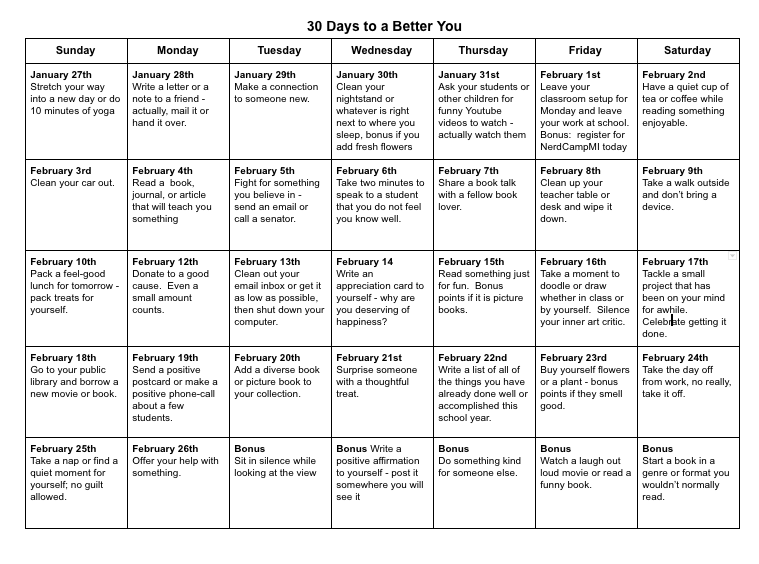
30 Day Challenge For a Happier Teacher You

If you are like me, January brings excitement, positivity but also exhaustion.  This quiet month is one where I sometimes find my energy running low, my creativity running out, and rather than take the time to take care of myself I barrel on as if that will do the trick.  So this year, much like the years before, I am challenging myself to take better care of myself, as well as those around me. And so the 30-day challenge is back. A challenge meant to remind me of all the good. Challenge me to take better care of myself.  Challenge me to slow down.  Challenge me to focus more on meaningful interactions, rather than hurried conversations.  Feel free to join me if you want or create your own.

My challenge starts on Sunday, January 27th.  I cannot wait.  To see the challenge document, go here.

If you are wondering where I will be in the coming year or would like to have me speak, please see this page. If you like what you read here, consider reading my book, Passionate Readers – The Art of Reaching and Engaging Every Child.  This book focuses on the five keys we can implement into any reading community to strengthen student reading experiences, even within the 45 minute English block.  If you are looking for solutions and ideas for how to re-engage all of your students consider reading my very first book  Passionate Learners – How to Engage and Empower Your Students.    

Be the change, behavior, being a student, being a teacher, being me

Is School Really Safe for All?

White,                Black,                Red,                 Free Image

I have been thinking a lot about belonging. About how we assume that school is seen as a safe place by all who experience it. How we assume that we are all doing enough to help these kids, these children whose lives don’t often mirror our own, these kids who someone, somewhere have made feel as if they do not belong.

I have been thinking a lot about feeling seen. About how we assume that in our schools we do enough to let every child know that we see them. That we do enough to let the adults know that they belong too. That they matter. That they are an indispensable part of our community, a community that thrives on embracing all, on love, on acceptance.

We write fancy vision statements where we tell the world that this is a safe place, one filled with opportunities for all who enter to learn, to become something more. We ask our staff to live this vision, even as they feel unsafe themselves. We have assemblies and events celebrating our accomplishments. We hand out awards and accolades. Praise and positive notes. We remind each other not to count down to the break, to the weekend, to the end of the year because for some kids home is not a safe place.

And yet, we forget that for some school isn’t safe either.

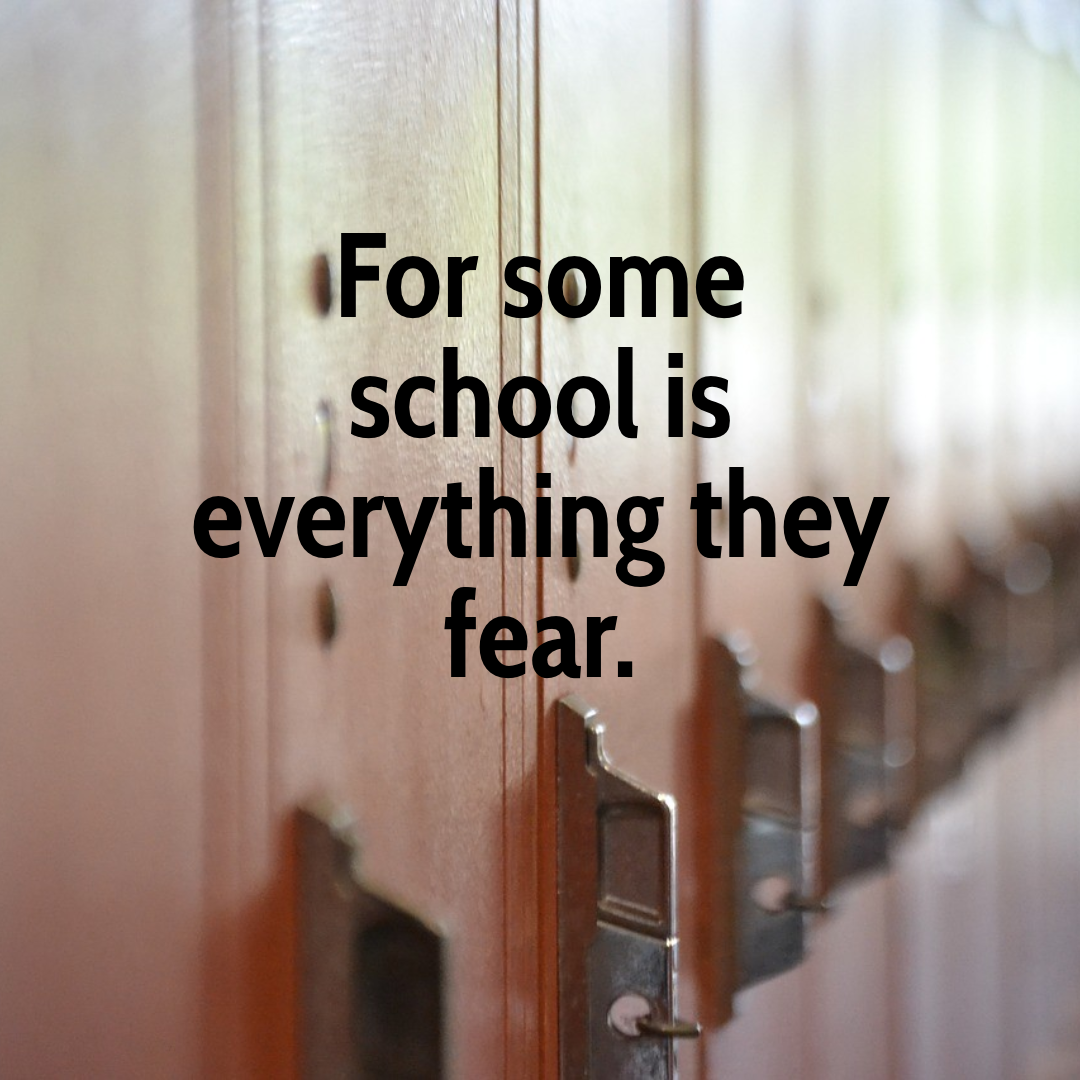
For some school is everything they fear.

For some school is only a mirror of the society who also refuses to acknowledge them as full citizens. As full human beings who deserve to be embraced, loved, accepted.

We fail at times.

Sometimes purposefully when we refuse to acknowledge that those who do not fit into our moral view of what it means to be righteous are still deserving of love. Purposefully when we suspend entire groups of children more than others. Purposefully when we enact dress codes that are only a condemnation of those whose choices we don’t agree with. Purposefully when we offer no protections for those who need it. When we let children fail at extraordinary rates because of the circumstances they face. When we continue to say that “Boys will be boys…”When we fail to stop the adults in charge from targeting each other and creating toxic work environments. When we fail to see that in our own silence, that within our own fear of rocking the boat, we are actively telling some that this, this place, is not one where they should ever let their guard down.

And sometimes we don’t even see our own failure. How when we leave certain books out of our libraries we are telling children whose stories are mirrored in those pages that their lives do not belong in our schools. That their lives are too mature, immoral, or indecent. When we tell kids to cut their hair, to change their clothing, when we display pictures of our district but they fail to show all of the people who are a part of it. When we don’t translate our news so all can read it. When we only set up events during school hours and fail to see that not everyone can change their schedule. When our texts, our videos, our learning materials fail to showcase all types of lives. When we assume that everything is a learning experience and surely those are experiencing it just need to work a little harder to find success. That we have done all we can.

And then we wonder why not every child finds success. Why educators quit. We have so much work to do.

We can do more and it starts with acknowledging those we do not see. Those whose lives are not currently valued. And I don’t mean silently valued, I mean embraced through our language, our decorations, our instructional decisions. Embraced out loud as we continually realize that there is more work to do. Making space for their voices so we can use them as a compass for how we can grow. Reflecting on our own choices and actions so we can see how we too can do more. We can ask questions through surveys and conversations and then act when people tell us that it is not safe. That they do not belong, instead of dismissing it as a fluke, only the opinion of a few. As the mother of a child who was viciously bullied, who begged us not to send her to school because it was not safe, I will tell you this, being heard is where the change begins.

The other day I overheard a child tell others about what it meant to come to our school. She said, “When I came to this school and saw the rainbow stickers, I was shook, it finally felt like I belonged.” She felt like she belonged because of a sticker. How many others do not? We assume all kids feel seen and safe at our schools, but do they really? The only way to find out is to start asking questions. Who will ask the first one?

If you are wondering where I will be in the coming year or would like to have me speak, please see this page. If you like what you read here, consider reading my book, Passionate Readers – The Art of Reaching and Engaging Every Child.  This book focuses on the five keys we can implement into any reading community to strengthen student reading experiences, even within the 45 minute English block.  If you are looking for solutions and ideas for how to re-engage all of your students consider reading my very first book  Passionate Learners – How to Engage and Empower Your Students.