attention, being a teacher, invest, questions, students

Start Asking Questions

You know the kid, usually a boy, tap, tap, tapping his foot. Gets up, gets something, sits down and then taps taps taps some more. Then whatever he is tapping breaks so he falls out of his chair trying to get something out of his desk. By this time, you are not talking anymore, simply staring as this child as he continues to fiddle,stare out the window, and tap, tap, tap.

So you go to your team and whisper ADHD, not for sure, but someone better check. Has this been a prior concern? Are there records? How would parents react? Never once do we stop to ask the kid why he taps, or rarely anyway. We don’t ask “Why do you blurt? Why do you interrupt? Why are you so exhausted and exhausting?” Instead, we assume. We know, after all, we have seen them before. We are the experts, we know kids, this is our job.

But what if we did ask? What if that boy said that I don’t like my chair because it is uncomfortable? Or how about, when the teacher talks too much, I lose interest because I want to do, to touch, to experience, and not just listen and regurgitate information.

Is your classroom set up for tap, tap, tapping? Is it set up for kids getting out of their seats? For the boy fiddling? For the girl staring out the window? Or for those kids we label because maybe some meds will probably do the trick? When do we stop assuming and start asking questions? When will we realize that we do not have all of the answers and some times we have to ask the students? I think that time has come.

alfie kohn, being a teacher, inspiration, no homework, students

So What’s My Problem with Homework?

I just read a frightening and excellent post by Mark Hansen discussing homework in a real-life example with his son and immediately I wanted to comment on it.  But then I realized that would be rather lengthy, so instead I offer this post.  What is my problem with homework?

I never use to hate homework until last year.  Something hit me when I told my husband that I knew exactly which kid would hand in the homework with “some” help from the parents, which kid would hand in something half-finished, and which kid would never hand it in but instead take my punishment.  And punish I did.  Oh, I used to be the queen of taking away privileges.  It was awful.  There we were, staring at each other every recess trying to figure out just how much help was needed versus how much effort needed to be exerted.  It was exhausting for me and the kids.

And guess what, I was right!

I knew exactly which kids would not be able to complete the homework no matter how much help I gave them in school; they simply did not have the skills or resources needed to finish it at home.  Over the summer, this was the point I kept returning to, wondering if I could be “radical” and get rid of homework almost altogether?  And so I did.  This year, there is very little homework in my room and here is why, in no particular order:

  • Homework is an excuse for the stuff we didn’t get to.  I stated this in my parent/student orientation and most parents nodded their heads.  We always have one more thing we just need to get to when the bell rings.  Well guess what?  Then we need to restructure our day and get to it, rather then slip it in to the backpack for the kids to deal with.  I know there is pressure with curriculum but if you know what your goal is for the lesson, then get to it!
  • Homework is practice – for some kids. Some kids will take 5 minutes to do homework because they already get it, some will take 30 minutes because they need parent help, others will never finish.  This is not fair.  If we do not equip students with the correct knowledge to complete the homework then we should not assign it.
  • Homework is not fair.  You know which kids will ace it and which kids will spend hours trying to solve a math page.  One sheet/assignment/report does not fit all.  If you already know how a kid will do on something then why are you bothering with the assignment, seems to me they have already shown you where their skills lie.
  • Homework steals away childhood.  Every minute of homework that you assign is an infringement of your students’ time spent experiencing the real world.  We say we want well-rounded students, but then have them spend an hour or more practicing school skills.  We already asked for 7+ hours of their time, let them have some free time to do the things that exposes them to the big world and in turn helps them become better people and students.  You will end up with kids that might just be excited about school, rather than exhausted.
  • Homework does not always fit the learning.  Worksheets are on the way out in many classrooms, and yet, we fall back on them all the time to check for understanding.  However, not all skills that we teach transfer onto paper very well.  I agree that math lends itself nicely to paper pages of problems, but why assign 3 pages if you can get away with just a couple of problems?  Before you assign think of the purpose of your homework; does it really give the students a way to show off their knowledge or will you just help you assign a percentage better?
  • Homework is maybe not just done by the student.  There are many helpful parents out there that really want their child to succeed.  As parents nothing gets us more than our child not understanding something.  How often do parents tell us that they had to help their child finish their work?  How often do we get projects turned in that required hours of craft work way outside of the range of your grade level?  The parents have already been to school, stop asking them to do work or in some cases, stop giving them a way to relive their school days through projects.
I know that there are times and situations where homework becomes a good extension such as sending kids out into the community to interview elders for heritage days, or continuing research on their own.  
I am not against all homework, what I am against, though, is the homework just for the sake of assigning homework.  I used to tell my parents to expect about 40 minutes of homework every night in 4th grade because I had been told it is about 10 minutes times the grade level.  40 minutes!  And then we ask students to read their books and do projects on top of that.  No wonder our students are exhausted when they come back the next day rather than eager to learn.
Think of what the purpose of homework is in your room, look really hard at your reasoning; why do you assign it?  Is it a meaningful learning experience that will help students become smarter, more knowledgeable, better people?  If yes, excellent.   But if no, not always, then stop, re-evaluate, clean it out, and then tell your students.  You will marvel at their response.
I was petrified to stop, worried that people would think I was skimping out on my job duties.  Almost all of my parents now rejoice in this year of calmness.  They know that if I assign something, there is a valid reason for it.  They also know that their child is learning as much as any other student in the 4th grade.  Stop the homework insanity and let these kids be kids.  We can accomplish the learning without the extra work.  You just have to believe in your own capabilities as en educate, so educate, don’t assign.
being a teacher, community, students

If We Could Grant Wishes

Yesterday we had our winter break party with our first grade reading buddies.  Students listened to holiday music from around the world, ate aebleskiver (a Danish treat), and cut out snowflakes for a wish tree.  We told them to write their wishes for the new year on these snowflakes.  This morning as I spearated the glittered and glued together snowflakes, I read them.

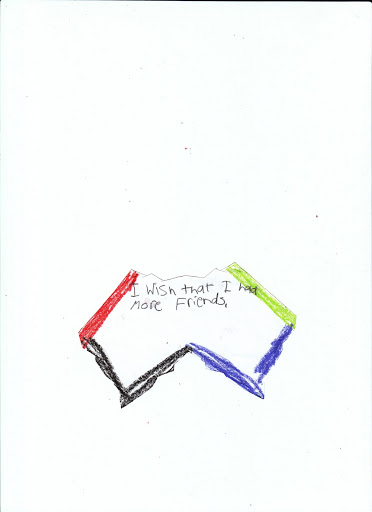
I wish for an Ipad (hey, a child can dream), for a bunny, dvd’s, games, world peace even.  I wish for a great year, for sleep, for more world peace (definitely a 4th grader).  A rat, a dog, a magic wand, flat screen tv’s, Nintendo D.S., fish, a pool, and even a bigger house.  And then there it sat, glued to another wish, unassuming and small:  I wish I had more friends.

If only teachers had a magic wand…

being a teacher, communication, community, students

The Mayor of West Middleton


The mayor of West Middleton works the crowds.  He is that kid, busy in the hallways saying hi to every kid, every teacher.  If he doesn’t know your name that day he runs after you to ask you what it is.  And then he remembers.  He knows us all, whether veterans, brand-new, student teachers, substitutes.  He knows parents, siblings, and any new kid 10 minutes after they walk in the door.  He smiles, laughs, and pays attention.  He cares and he lets you know that he cares.

It’s not an act, this welcoming thing; it is him, something in his nature that he cannot help.  Something that cannot be contained, as his teacher – trust me I have tried when we walk down the hallway.  Then I realized that it was only my sense of order that made me dislike these random outbursts of talk or stopping and hugging people.  I needed him to walk with me, not in front or behind me, not be around the corner when I needed him in line.  Now, I let him loose on the people, let him do his thing.  He never goes far, just far enough to greet, to spread that smile.  And for that I am thankful, he makes me a better person, a better teacher because he shows me every day what genuine interest does for another person.  He leads by example, and it is an example we should all follow; know everyone, greet them, hug them if you want, ask questions, and if you don’t know their name it is ok to ask.  But most of all; remember them all and show them that you are happy they are here, happy they are with us, happy they came to school that day.  The world needs more kids like him.

being a teacher, Social studies, students

When Students Decide

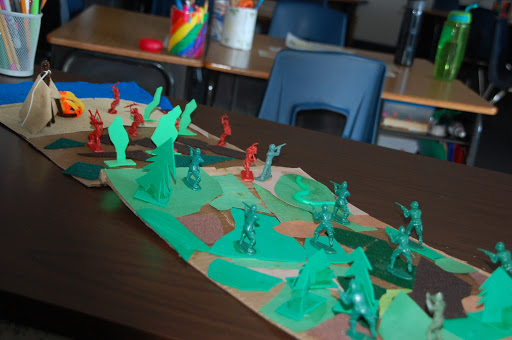
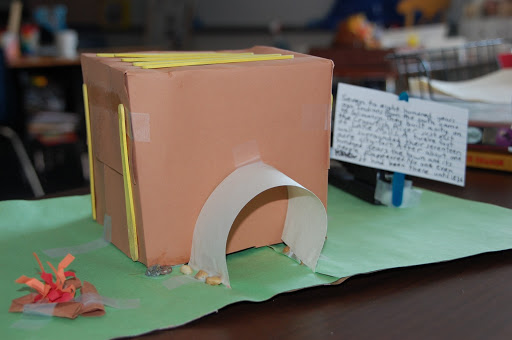
Spicy popcorn, wigwams, tipis, corn bread, blueberry muffins, bow and arrow, Aztelan homes, sugared apricots, and many other things were all the results of the students taking control of the Native American research and project.  To say I am impressed doesn’t even cover the level of genuine excitement I have about what the students mastered today.

Coupled with these wonderful projects were the presentations that began today.  Students all have to present their research in some shape to their classmates, plus be able to answer questions and engage an audience.  We discussed what the difference is between listening and active listening and stopped when the students felt the audience was becoming unengaged.

From the moment we started this project, I knew this was a different way of learning and one that would either be wondrous or disastrous.  I should have trusted the students completely because they have once again blown me away with their commitment to their projects and their hard work.  This is definitely a form of project we will try again.  And don’t worry; pictures are coming soon!

assumptions, being a teacher, poverty, students

Don’t Judge that Bus

Those kids that come from that neighborhood, perhaps it is one bus, perhaps most of your school.  Whatever the numbers, there are always those kids.  The poor ones, the ones that wont have a real Christmas because there is no money, the ones we worry about because surely someone has to save them from themselves, from the cycle.  Those kids said with connotations, with meaning, with emphasis.

What shall we ever do for those kids, with those kids, to those kids?

And yet those kids may not be what we think they are.  Yes, they may come from a certain neighborhood, or arrive on a certain bus, walk a certain way, speak differently than me.  And yes, mom may be young or dad non-existent.  There may be holes, tears, too short of pants, missing backpacks, and free and reduced lunch.  But what there isn’t is one story.  There isn’t one thing we can know about those kids.  There is perhaps no need to fret, to worry, to save.  We are always trying to save those kids.  Sometimes what is needed is the lack of connotations, the lack of assumptions about life quality or needs.

Yes, they may come from that bus but that does not mean they need help.  They may come to school with that swagger but that does not mean that life will always be hard or that bad choices will be made.  It is time to stop making those assumptions about those kids.  Stop hiding behind trying to be a better person by “adopting” those kids as your project.  Treat them the same and if there is a need for help, help, but don’t jump to conclusions, don’t guess, ask, discover, and find out.  Those kids are just that; kids.