aha moment, assumptions, Be the change, being me, Passion

5 Things I Learned to Say That Changed the Way I Taught

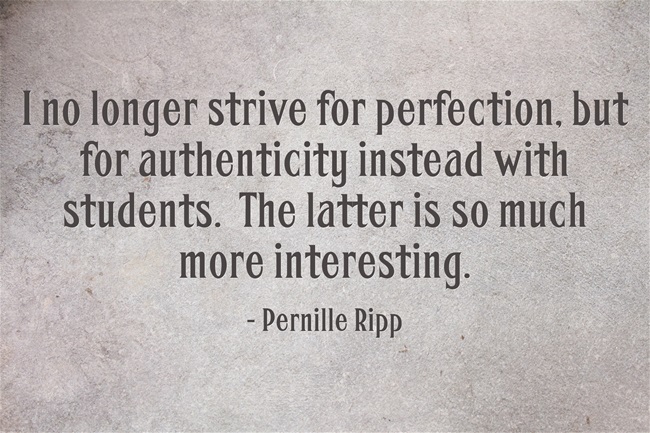
I-no-longer-strive-for

There are many things that we can change as educators.  We can all embark on major journeys toward bettering our lives, the lives of our students, and the effect we have on others.  Often those big journeys start when we hit frustration, mine certainly did.  And yet those big journey of change are not the only journeys we can take.  Every day we make a choice as to how we effect those that surround us.  We make a choice as to how we will teach, how we will react.  There are many changes that will change our lives, these are some of my simplest and most important.

I learned to say, “I’m sorry.”  Apologizing to students, and not just for the big things changed my relationship with them.  Now when I accidentally call out a wrong kid, I apologize rather than make an excuse.  When I screw up, I admit it.  When I inadvertently hurt a child’s feeling, which does happen, I apologize.  I don’t try to explain my way out of it, a quick statement is all it takes, but the power of “I’m sorry” cannot be underestimated.  Those words share the story of how we view our students.  They are human beings that deserve respect.

I learned to say, “Let me check.”  I used to know I was right.  I used to know that whatever a child said about already turned in homework, sent emails, or other obligations was a lie.  Until I realized that I was in the wrong and that even if I think I am right, it is better to check first.  Check the pile of paper.  Check my email.  Check my file.  Whatever it may, they check and I check, no lost pride, no hurt relationship.

I learned to laugh at myself.  When you teach you will make stupid mistakes that make you look like a fool.  You are bound to trip and fall, you are bound to  say things that can be misunderstood, you are bound to do something that you would giggle at if it happened to others.  Laughing at yourself with the students is powerful.  Showing students my inner dork, which I tried to suppress at all cost for so many years, has allowed them to fly their flags.  They know when I am serious, but they also know how much I love to laugh, even at myself.

I learned to say, “Ok.”  Ok to sit there, ok to turn it in that way, ok to explore this, ok to read that book, ok to have that conversation.  OK to try, ok to fail.  I learned to say ok to new adventures and epic attempts.  I learned to say when I realized I couldn’t say yes to anything more, and ok when I could.  I learned to say ok when a lesson failed, I learned to say ok when a child told me they tried.  This simple word, these two letters, have allowed me to let go of so much.  I no longer strive for perfection, but for authenticity.  The latter is so much more interesting.  “Ok” taught me that.

I learned to say, “You matter,” but more importantly I learned to show it.  I learned to look at my students when they speak to me, to stop what I am doing and listen.  I learned to read between the lines, to dig a little deeper.  I learned to say yes to lunch, to stop and talk, I learned to tell stupid jokes to break the ice.  I learned the language of my students, whether spoken or unspoken, and I learned to teach with my whole heart, with all of me.

What have you learned to say that changed you?

I am a passionate teacher in Oregon, Wisconsin, USA,  who has taught 4th, 5th, and 7th grade.  Proud techy geek, and mass consumer of incredible books. Creator of the Global Read Aloud Project, Co-founder of EdCamp MadWI, and believer in all children. I have no awards or accolades except for the lightbulbs that go off in my students’ heads every day.  First book “Passionate Learners – Giving Our Classrooms Back to Our Students” can be purchased now from Powerful Learning Press.   Second book“Empowered Schools, Empowered Students – Creating Connected and Invested Learners” is out now from Corwin Press.  Follow me on Twitter @PernilleRipp.

aha moment, assessment, assumptions, Be the change, being a teacher

You Can’t Just Do It To Them

image from icanread

“Remember, whatever I ask you to do, I ask myself to do too.”

This is how almost any assignment is handed out in my classes.  Not to make the students feel better.  Not to make them embrace the assignment more quickly.  No, it is really quite simple; I have done the assignment already.   I have spent time doing the exact same thing, following the same directions, looked at the assessment and pondered how I would do.  Not when I was their age, not when I was in college, not even last year.  No the assignment I am asking them to do, I have done in the past few days as well as I prepared.

Why is this important?  Because every day we ask students to spend their time, whether in class or after school, doing work for us to show their mastery, to practice their skills, to help them grow.  Yet often these assignments are ones that we have never experienced ourselves.  Ones that we may have used to much success before.  Or ones that we got from an amazing source. Yet, we don’t know what it feels to actually do it.  And that creates a problem based on assumptions.  We assume we know how much time it will take.  We assume we know how hard it is.  We assume our directions are clear.  We assume the assessment is fair.  All of those assumptions add up to nothing good.

I started doing my own assignments a few years back.  I didn’t get why my students groaned so much when a new project was handed out.  I didn’t get why I would get emails from parents stating how many hours their children had spent.  Whether it was book report dioramas, grammar packets, or even just outside reading, I assumed I knew what it was like to do them because I had gone to school once too.  On a whim one night, after a particular groan-filled day, I did one of my grammar packets.  9 pages, front to back copied, neatly stapled to teach me all about proper nouns versus common nouns.  45 minutes later, I threw it in the trash.  How many times could I write the same answer over and over or be asked the same thing?  Yikes.  The next day I apologized to my students and we found other ways to do grammar.

So now, I live by a simple rule.  Whatever I ask my students to do I have to do as well.  So if they have to write an assignment, I write it too.  If they have to read outside of school every night, I do too.  I discuss my struggles and problems that I encounter hoping they will feel more confident to try something new.  I tell them when I stop reading and I recommit in front of them, I tell them when I don’t feel like doing any work but now I have to.  My students will not learn from having a perfect teacher, they need someone that they can relate to, even if our years push us apart.

I know that I am not 12 years old and that I have an easier time doing their work.  That only cements my resolve to do every assignment.  If it takes me 30 minutes to write a great constructed response, then imagine how long it can take for a student?

We cannot keep forcing our ideas on kids without experiencing them ourselves.  So commit; whatever your students have to do, make yourself go through it.  Trust me, the things you will change will surprise you.  Be a learner, just like them, and tell them that you know what it feels like.  But don’t just say it, do it and mean it.

I am a passionate teacher in Oregon, Wisconsin, USA,  who has taught 4th, 5th, and 7th grade.  Proud techy geek, and mass consumer of incredible books. Creator of the Global Read Aloud Project, Co-founder of EdCamp MadWI, and believer in all children. I have no awards or accolades except for the lightbulbs that go off in my students’ heads every day.  First book “Passionate Learners – Giving Our Classrooms Back to Our Students” can be purchased now from Powerful Learning Press.   Second book“Empowered Schools, Empowered Students – Creating Connected and Invested Learners” is out now from Corwin Press.  Follow me on Twitter @PernilleRipp.

grades

How Do You Assess Without Grades – 5 Tips to Ease the Transition

When I transferred my blog from Blogger to WordPress, not only did I run into domain name problems but I also had posts that didn’t transfer.  This post is an oldie but still speaks to me.  

Two great questions came my way yesterday in regard to assessing without grades and then communicating that information.  We are so used to the ease of a letter grade that gets recorded in a book, averaged out and then translated into a letter, that moving away from that can be daunting and just a bit overwhelming.  So two years into my process I thought I would share some tips I learned the hard way.

  1. Discover your goal.
  2. Whether they are based on district standards, common core, school outcomes, or even those listed in the curriculum, figure out what the goal is for each thing you teach.  These can be large or small (don’t do too many small ones though, trust me) and then figure out what the outcome should be.  Everything you do should have a learning goal because without that there is no point to the lesson.

  3. Determine the product.  What does it look like when students have accomplished the goal?  What is finished?  What is just another stepping stone?  How will students show that they have mastered the goal?  I love to have this discussion with my students, they have amazing ideas for this.
  4. Determine assessment.  Will it be written feedback?  Will it be a rubric?  Will it be a conversation – great tip; record these with a Livescribe pen and you have it for later! Or use Voxer to send it straight to the stduents if they are over 13.   Once again, ask the students, what type of assessment will help them?  How do they learn best?
  5. Keep a record.  This has been my biggest hurdle.  I have had charts, Google Docs, grade book notes, relied on my faulty brain, and yikes.  This year I am bringing my iPad in and using Evernote to keep track of it all.  Students will each have a portfolio in Evernote with conversations, pictures of work, links to blog posts, as well as videotaped events.  This way, everything will be at my fingertips when needed.
  6. Communicate!  Assessment is not helpful if kept to yourself so have the conversations with students, take the time, write things down, communicate with parents.  All of these things need to be taken care of for this to work.  The allure of letter grades is just that; the ease of communication, nevermind that they can mean a million different things.  So when you step away from those make sure you replace that with communication.  Give students ownership of their goals and have them write a status report home, send an email, make a phone call.  Something.  Everybody should know where they are at and where they are headed throughout the year.

My 5 biggest tips for today and something I continue to work on.  Whatever your system is, take the time to reflect upon it, refine it, and make it work for you.  Ultimately stepping away from letter grades should lead to a deeper form of assessment, not a larger headache, but for that you have to have systems in place.

Be the change

Take One and Pass It On

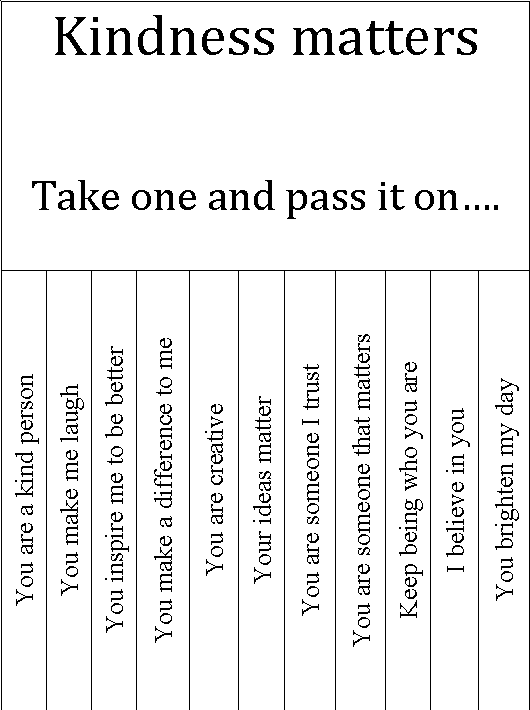
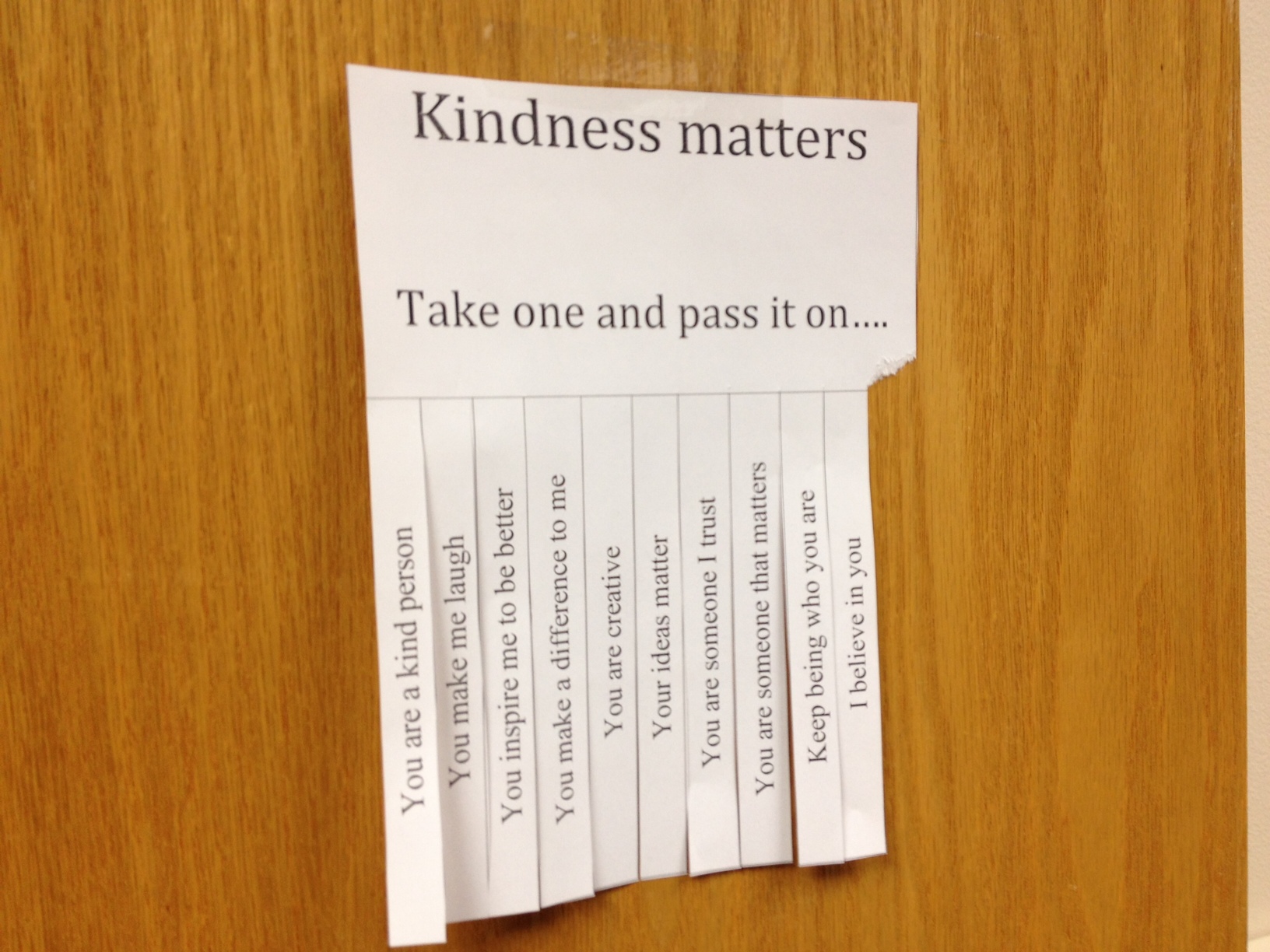
In the staff bathroom at my school something like this hung on the wall.  I should have taken a picture but I was too caught up in it to think that far ahead.  It kind of looked like this except a couple of strips had already been ripped off.  So I followed the direction, ripped it off, and passed it on.  Perhaps these should be plastered all over our schoolskindness matters

Go ahead, print it off, cut along the lines and hang it up. Start a movement of kindness.

Hanging on my classroom door, I had to replace it today because they were all gone.

To print it, go here

I am a passionate teacher in Oregon, Wisconsin, USA,  who has taught 4th, 5th, and 7th grade.  Proud techy geek, and mass consumer of incredible books. Creator of the Global Read Aloud Project, Co-founder of EdCamp MadWI, and believer in all children. I have no awards or accolades except for the lightbulbs that go off in my students’ heads every day.  First book “Passionate Learners – Giving Our Classrooms Back to Our Students” can be purchased now from Powerful Learning Press.   Second book“Empowered Schools, Empowered Students – Creating Connected and Invested Learners” is out now from Corwin Press.  Follow me on Twitter @PernilleRipp.
aha moment, Be the change, being a teacher, change, inspiration

You Don’t Have to Throw Everything Out to Be Innovative

Innovation-should-not-be

I almost felt guilty walking to the cabinet.  I almost felt as if I would get busted, as if someone would burst through the door wagging their finger and raising an eyebrow.  Touting me as a phony because am I not “one of those” educators that are supposed to be innovative?  One of those that is constantly trying something new and crazy?  One of those that tells everyone to just take a chance and make a change?  Well I am (sometimes), but I am also human.  And on this day I went to the cabinet to fetch an old lesson, something I knew would work, something that I could use again.  Something that I would probably tweak to fit my new students, but not majorly overhaul, and honestly I felt relieved.

We often confuse great teaching with constant innovation.  We think that to reach all of our students in the best way possible, we must constantly change.  we must never rest.  We must never reuse.  Yet, we forget that we are dealing with children that crave routine.  Children that yes can be creative and curious but at the same time also need some predictability.  Children that can get exhausted when we are constantly trying new things and asking them to discard the old to embrace the new.

And let’s not forget about ourselves.  The job we have is demanding, and we must constantly search for new solutions, yet we forget to give ourselves a break.  There is nothing wrong with using something that has worked before, as long as we make it better each time we use it.  There is nothing wrong with trying something we have tried before.  There is nothing wrong with pulling out old lessons.  Innovation should not be confused with discarding every thing we have tried.  There is beauty in the old, in the tried.  There is beauty when a teacher has experience.  Allow yourself that moment.

So do embrace the old when it works.  Fly the flag of your past lessons that have soared.  Don’t get stuck, but allow yourself to rest in familiarity as well.  Great things come from ideas we have tried on before.  Don’t think you have to constantly change to be a change-maker.

I am a passionate teacher in Oregon, Wisconsin, USA,  who has taught 4th, 5th, and 7th grade.  Proud techy geek, and mass consumer of incredible books. Creator of the Global Read Aloud Project, Co-founder of EdCamp MadWI, and believer in all children. I have no awards or accolades except for the lightbulbs that go off in my students’ heads every day.  First book “Passionate Learners – Giving Our Classrooms Back to Our Students” can be purchased now from Powerful Learning Press.   Second book“Empowered Schools, Empowered Students – Creating Connected and Invested Learners” is out now from Corwin Press.  Follow me on Twitter @PernilleRipp.
aha moment, student choice, student voice

These 5 Minutes Will Make a Difference

I find myself looking at the clock more and more.  Call it the constraint of 45 minute class periods.  Call it the middle school urgency that seems to haunt my every move.  That clock on the wall; yeah, it seems to be always leering.  Yet lately it has been taking on a new role for me; no longer the reminder of how little time I have left to help these students grow, but now a reminder of how much time we still have.  How much time we still have to talk.  How much time we still have to share.  How much time we still have to teach each other.

Why this change in perspective?  I have just started giving my students 5 minutes.  5 minutes to discuss.  5 minutes to figure out.  5 minutes to prepare.  It is indeed quite impressive how much can be accomplished in just 5 minutes.

5 minutes before the quiz, they review with each other.  5 minutes before the assessment, they speak to one another and compare notes.  5 minutes before the share with class, they share with a friend.  Giving them those 5 minute means that my students are more confident, are less rushed, are more ready.  Giving them those 5 minutes mean that I am forced to slow down and let them think, let them digest the learning, frame in their own words and then support each other.

I have no research to back me up.  I have no test scores to show the difference, but what I see in front of me has sold me.  Students who are ready.  Students who are willing.  Students with more confidence in their abilities.  we are moving toward becoming a community of teachers, not just learners, 5 minutes a day.

I am a passionate teacher in Oregon, Wisconsin, USA,  who has taught 4th, 5th, and 7th grade.  Proud techy geek, and mass consumer of incredible books. Creator of the Global Read Aloud Project, Co-founder of EdCamp MadWI, and believer in all children. I have no awards or accolades except for the lightbulbs that go off in my students’ heads every day.  First book “Passionate Learners – Giving Our Classrooms Back to Our Students” can be purchased now from Powerful Learning Press.   Second book“Empowered Schools, Empowered Students – Creating Connected and Invested Learners” is out now from Corwin Press.  Follow me on Twitter @PernilleRipp.