global read aloud

Sign up for Global Read Aloud 2014

I know it is really early but no time like the present to think about the Global Read Aloud for next year.  So if you are thinking you want to sign up, please fill out the form.  This will also add you to the Google group so that you can get updates as needed, even though it will probably be a while before I send anything out.  Also, here is your chance to give me your suggestions for next year.  Books will not be selected until May or June so that newly published books have a chance of being read and suggested.

If you are a publisher or an author that is interested in having your book be part of the project, the easiest way is to get me to read it.  You can contact me at p (at) globalreadaloud (com)

Podcasts

The Amazing Teacher Podcast

Once in a while I get asked to share my thoughts with other educators via their podcasts.  I love doing this because it always forces me to think about what it is I am doing and also whether or not I am staying true to my educational philosophy.  When Sam Rangel, whose blog I love, asked me to be his first guest on his new podcast “The Amazing Teacher” I didn’t know if I would be a good candidate.  After all, i don’t walk around thinking I am amazing.  But what i did know that if I could even help one person change the way they teach then it would completely be worth my time, and besides, I would get to discuss education with Sam which was a bonus.


So today, the new podcast was revealed.  Please head over here to listen to it, hopefully I can offer you at least one small idea.

Uncategorized

We Now Interrupt Our Regularly Planned Lesson

image from icanread

We were supposed to be getting ready for student-led conferences.  I was supposed to also be reading aloud.  we were supposed to be talking writing then.  But all I could think of was the big pile of book sitting on the bean table, screaming for me to introduce them.

The kids had already poked around.  Some had cautiously asked if they were for the library.  One child had squealed in delight when she saw an old friend.

So I stopped everything.  Asked them for their eyes and ears, reminded them to grab their thoughtful logs and flip to their “What I want to read next” list.  And then I began.  12 new Roald Dahl books begged for me to share my love for them and so I did.  Even though I thought they had all read them, how could they not?

After 25 glorious minutes of introducing the 30 new books, one student raised her hand, “Can we take them now?”  “Sure…” and before the last sound had escaped my lips, 27  students were surrounding me, hungrily grabbing that book that they wanted.  Rocks, paper, scissors happened over particular books, other children weren’t quite sure.  So as I pushed one book after another into the hands of waiting students, I knew.  This is why we stop the program, this is why we deviate from the plan, because are great books to be read and shared, and sometimes that can’t wait.

I am a passionate (female) 5th grade teacher in Wisconsin, USA, proud techy geek, and mass consumer of incredible books. Creator of the Global Read Aloud Project, Co-founder of EdCamp MadWI, and believer in all children. I have no awards or accolades except for the lightbulbs that go off in my students’ heads every day.  First book “Passionate Learners – Giving Our Classroom Back to Our Students Starting Today” will be released this fall from PLPress.   Follow me on Twitter @PernilleRipp.


Be the change, Innovation Day, Student-centered

What’s So Genius about Genius Hour?

Our very first genius hour – a glorious mess erupted!

I hope you have heard of genius hour or 20% time before and that this will be just an extra post to highlight its amazingness.  However, if you haven’t or are not quite sure how to do a genius hour, please read and hopefully be inspired to do it with your students.

Genius hour first started popping up in my life a few years ago as I was implementing Innovation Day in my classroom.  Luckily some really smart people whom I admire took it upon themselves to even create a wiki detailing how to do it, sharing resources, and answering questions about it.

Essentially, genius hour in my room is an hour in which the students get to learn and create something under a certain umbrella topic all within one hour.  (Actually this year it has been within 40 minutes, but still…)  Genius hour can be applied to any subject area but science and social studies lend themselves particularly well to it in my room.

Before:

  • Discussion is your key.  Explain to the students that they will be  in charge of creating something within an hour and what it will be relating to.  We have been studying early Native American in social studies, so our first genius hour was asking the students to learn and create something about the Eastern Woodlands Indians.  Students can create something by themselves or with a partner, I discourage more than 2 kids working together because it always seems to leave one child to not do much.
  • Show examples.  I give the students examples of what they could create (a model, poster, presentation etc) as I give them background knowledge needed.  They take notes of ideas as we go through the lesson and I then help out those who have no idea.
  • Focus on time and effort.  The students may think an hour is a lot, it is not, and I try to stress this with them.  They will not have time to create a perfect thing necessarily and that is totally ok.  The point here is for them to learn something that I have not covered and create something to show their learning.
  • Talk about supplies.  I tell them what I can supply (paper, tape, glue etc) and then point out that they should not break their parents’ bank account getting cool supplies.
  • Check in with everyone.  I make sure everyone has a clue before they leave my classroom.  I also post about it on our website so that parents have a clue as well.
  • Remind!  Whenever a genius hour is coming our way, I remind the students often.  There are no surprises of when they need their things by and when it will take place.

During:

  • Stay out of the way.  The genius of genius hour is truly that this is student-directed and student-created.  So we need to stay out of the way.  I check in with kids, compliment, and sometimes push a little, but I do not interfere or offer up solutions unless it is an emergency.  This is vital to build student responsibility and problem-solving.
  • Time manage.  I shout out time left throughout the hour.  It helps students get on track.
  • Be a helper.  If students need something printed and picked p, I offer to do it, or if they need an extra emergency supply due to an idea not working out I try to help.  But other than that, again, stay out of the way.

After:

  • Present.  It is important that all children present what they have created but when you have a big class like I do, this can take a long time, so behold: the gallery walk presentation.  Half of the class sets up their creation (this often happens the following day) around the room and then another child stands in front of them.  I set the timer for 1 minute – 2 if we have the time – and then the students present.  When the timer goes off, the listening student moves to the next presentation.  My students learn to get to the point and share only their best pieces of information and we can get through everyone within 30 minutes.
  • Self-reflect.  I also think it is important for the students to have a chance to self-reflect on how it went and what they need to change.  I have adapted this Google form from the wiki to fit my needs.
  • Don’t grade.  This is just me so if you want to grade, ok, but I don’t, because I don’t want students to be afraid to take risks.  Grades tend to hinder risk taking so I instead look at things like how they worked together, time management, whether they pushed themselves or made something super simple etc and then store that way for future assessment.
  • Reflect as a class.  I love hearing overall ideas, feedback, and suggestions.  What have they learned as a class,  how is this benefiting them, why should we do it again.  Let the students lead the discussion and take stock of their ideas.
  • Publish.  I always take pictures during the day and presentations, I want parents to see what we have been creating so get those out to the word.

Random Thins:

  • What if a child fails completely?  I don’t think a child can ever completely fail unless they refuse to participate, in which case, they get to work on something else in the office.  (Which  I have never had happen).  But a child may have tried to do something way too time consuming or chosen something that they finished within 5 minutes.  While I try to prevent this from happening through pre-discussions, it still sometimes does, and that is ok.  I always then speak to the child about what they would change, how it would work next time, and then have them present their ideas for that too.  Embrace the failure and learn from it.
  • What if a child brings in a completed project and has nothing to work on?  Then they get to make something else, sometimes this happens as well no matter how well we have communicated the intent to parents and students.  I then ask them to make something on the fly.
  • What if  our first genus hour sucks?  My first one is always a glorious mess with some great successes and epic failures.  I tell the students that may happen and that this is the best way to learn how to do it.  Honestly, running through it the first time is the best way to learn how to do it right.
  • How many should I do?  As many as you want.  We do them throughout the year under various topics, some people have it once a week, others don’t.  Make it work for you and your schedule but do have a few in a short amount of time so students can learn from them quickly.
  • How do I convince others it is worth the time?  Show them the learning!  I am always impressed with the variety of projects created and how students get excited about the learning, we are still covering the curriculum but in a more authentic and meaningful manner, so showcase that.
  • More questions?  Please leave a comment or email me at p (at) globalreadaloud (dot) com – I would love to help.

To see more pictures from our genius hours’ go to our website 

I am a passionate (female) 5th grade teacher in Wisconsin, USA, proud techy geek, and mass consumer of incredible books. Creator of the Global Read Aloud Project, Co-founder of EdCamp MadWI, and believer in all children. I have no awards or accolades except for the lightbulbs that go off in my students’ heads every day.  First book “Passionate Learners – Giving Our Classroom Back to Our Students Starting Today” will be released this fall from PLPress.   Follow me on Twitter @PernilleRipp.

Uncategorized

Should I Teach My Students to Be Better Test Takers?

thea-new

It’s that time again in Wisconsin, time for our yearly standardized test on which schools and students alike get graded.  Mind you, we test for 5th grade in October after only having taught them for 2 months.  Mind you we actually don’t get the results until February at the earliest, at which point we are then supposed to adjust our teaching according to said results.  Of course, all of this will change with the advent of the new test that is being created but that wont be of another year or more.

So why this post from a known anti-standardized testing teacher?  Well, because I wonder if my opposition to these tests and refusal to make them a big deal in the eyes of my students are hurting their test results?  I don’t give them pep talks, I don’t tell them how it can affect their lives, or mine for that matter.  I don’t tell them to do their very best because they should want to show everyone how much they know.  I do the practice one so that they know what the format is but I don’t teach testing strategies for days or weeks.  I don’t teach them what the test makers are probably looking for.  Instead we continue with our 5th grade exploration of learning and what makes us curious.  We spend time discussing and pushing our thinking.  We make time for genius hour and reflection.  We make time to cover the things we should in a meaningful manner that suits us as learners.  But still..

I do tell them that they are a snapshot of that moment in time.  I do tell them that they should try to figure it out as best as they can but that it is not something to be stressed about.  I know their abilities, I know their strengths, and more importantly I  know how to support their goals.  Sure, we have to have silence during the test and no one can leave for the bathroom, but when they feel they have given it their best shot, then they are free to read or to unwind.

Yet I cannot help but wonder should I be taking time to teach them better test strategies?  Should I stop what we are doing so they can spend time becoming better test takers?  Am  I robbing them of a skill they need to “survive” the rest of their education?  Should I be focusing on the gravity of this test and make them aware of how much it determines for our school?  Would they score better if they knew how much the test meant?  At this point, I am not sure anymore.  Should my personal beliefs be allowed to influence the way I teach?

reflection

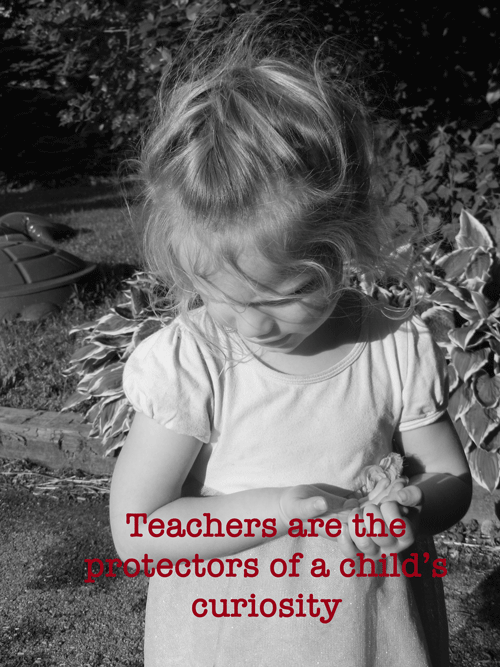
What a Teacher Does

thea-new

I am a passionate (female) 5th grade teacher in Wisconsin, USA, proud techy geek, and mass consumer of incredible books. Creator of the Global Read Aloud Project, Co-founder of EdCamp MadWI, and believer in all children. I have no awards or accolades except for the lightbulbs that go off in my students’ heads every day.  First book “Passionate Learners – Giving Our Classroom Back to Our Students Starting Today” will be released this fall from PLPress.   Follow me on Twitter @PernilleRipp.