Giveaway

Giveaway: "Awakened – Change Your Mindset to Transform Your Teaching"

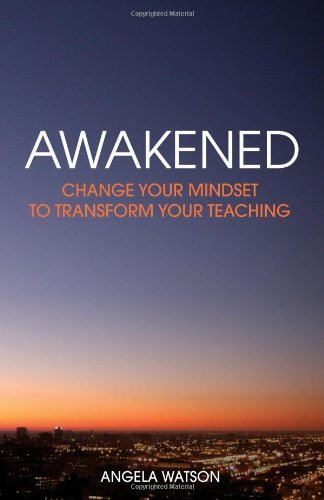
I am very excited to host my first ever giveaway!  Angela Watson, who’s mindset is an inspiration to me, was kind enough to send me a copy of her new book “Awakened – Change Your mindset to Transform Your Teaching” to read.  I loved the book and its message of positivity and the choices we make in our minds so I knew I wanted to pass it on, so rather than just my local PLN benefitting, I thought “Why not pass it on to you guys?”

This book is a great read if you feel you have hit a slump in your mindset or even if you are on path to more positivity, Angela does a great job relating her own story and the realizations she made and then helping you transform your mindset as well.  I particularly enjoyed her small steps to overcoming negative self-doubt and how to take control of your feelings.  Another thing I enjoyed was how many of the situations I could relate to even though I am an optimist myself, there are still those moments where we get sucked in and carried down a path of doubt, low self-esteem and negativity.  Angela does not present her book as a surefire quick method but more of a journey with highs and lows along the way.  Her stories were relatable on so many level and the book was easy to read.  (One note: Angela does speak of her religious breakthrough and I am not religious but still believed in her message of taking control of oneself.  So you do not have to be religious to appreciate this book.)

The giveaway is easy; leave a comment (with your email or some way to contact you) giving me either your own mantra for positivity, a story, or a reason for why I should send the book to you.  I will end the giveaway on Sunday and then alert the lucky winner.   I am happy to share this fantastic book with other readers.

being a teacher, new year, promises

A Promise or Two for the New Year

Every year, I make promises to myself of what the year ahead will look like.  Every year I promise to take better care of myself as I get all consumed by the lives of my students.  I promise to get more sleep, eat healthier, stress less, worry less, and smile, smile smile.

What I do has a profound effect on the students I teach and this year I get to teach the lives of more than 70 students since my teammates and I will be switching the kids up for math and reading.  I know that what I choose to do with myself will be translated into action in the classroom.  So kids, I promise to be there.  I promise to smile and laugh because I just can’t help it.  I promise to be fair.

I promise to take the time to listen to you and not jump to conclusions.  I promise to make you feel safe and welcome.  I promise to not punish and still reward you with time and togetherness when it fits.  To let you speak and not be the sage on the stage.  I promise to learn with you, from you, and not just to you.

I promise to change my mind when it makes sense and to admit when I am wrong.  To get my sleep so that I am not crabby and to feel good about myself.  I promise to care about you and your life outside of school, taking an interest and remembering what you tell me.  I promise to keep learning at school as much as possible because you deserve time off as well.

I promise to give you my time, fully and undivided, and I promise to treat you like my children, because that is what you are 8 hours of the day – mine.  I promise to treat you with respect and dignity and not dismiss you as just another id.  Your voice matters as does your opinion and every year you get wiser.

I make these promises today but know they may be changed, however, my devotion to my job and to my kids will not.  I have the best job in the world and no one can take that from me.  I promise to make this year the best one yet.

being a teacher, no homework

Why the Grade X 10 Minutes for HomeWork is a Fail

As I prepared for my first orientation day powerpoint as a new teacher, I knew I had to fill in homework expectations and how much parents could count on.  I was reminded to use the old formula 10 minutes times the grade of the child, excellent, 40 minutes of homework for a 4th grader.  Now this is what my brain should have thought;  “Wait a minute Pernille, 40 minutes of homework, a night?  Plus 20 minutes of expected reading with parent initials?  And a book report every 6 weeks?  And math tests every 3?  Not to mention science and social studies quizzes, which really are tests but just with a friendlier name.  What in the world am I saying?”  Except,  I didn’t and the rest, as they say, is history. Those kids had homework coming out of both ears because that is what I thought teachers did; assign work.  40 minutes seemed fair and reasonable and why shouldn’t it be?  Aren’t we in the business of making students accountable and responsible?  Aren’t we teaching them how to be effective workers, preparing them for the real world?

Except homework is really not thoughtful when you just spew the formula.  Homework then becomes the brainless act of repetition, not metacognition that we all should be striving for.  Homework becomes the incessant chore we all seem so hellbent on making it.  I know we are trying to raise responsible children, but is homework really the only way we can do this?  Can we not accomplish those same goals of responsibility, time management, and work habits without the insane amount of homework?  Can we, as educators, realize that perhaps we do not have the right to infringe on students’ lives outside of class up to an hour or more every night?  Haven’t students already given us 7 to 8 hours of work?

I, for one, limit my homework giving and not because I am a hippie that doesn’t believe in hard work.  We do work hard in my classroom, in fact, my students relish how much we get done in a day because it means they are managing their time.  It means they are creating a work ethic that says give school your undivided attention for a whole day and you will be rewarded with free time.  Do your job here right and then you don’t have to worry about it as much outside of school.  And a formula can never encompass that.

So it is time we give up on the formula.  It is time we realize that homework is not something we have to give just to give the kids work, that there are other ways to teach students motivation, time management, and effective work habits  There are other ways to ensure all of the curriculum is covered and that knowledge is garnered.

This year, on the first day, I will tell the parents that there may be work outside of school and that it will differ from day to day.  I will tell the parents that my mission is to keep work inside of my classroom so that the students may breathe a little bit.  I will tell them there that will be projects, there will reading, sure, but there will also be time to be a kid, to live a little.  No homework doesn’t mean no learning, it means school was kept at school and that is a good thing.

Uncategorized

Get Started with Student-Centered Learning – A Beginner’s How To Guide

Giving students a voice and creating a student-centered classroom sounds like the ultimate hippie fantasy, you can almost smell the patchouli drifting through my room as I give out hugs and high fives highlighting all of the awesome work my kids do.  Except that is not reality.

Reality is I have standards to meet, essential learner outcomes to follow, curriculum to cover and yes those darling standardized tests.  In fact, in Wisconsin we get to take them already in October, wahoo.   So no, my room isn’t some test free haven, but a totally typical elementary classroom with about 25 students that are all on vastly different levels, all have different talents and challenges and just want to succeed,and have some fun in school.  And yet amidst all of the demands student-centered learning worked for me, and it can for you to, so here is a little help to get you started.

  1. Know your goals.  You cannot set students on a journey if you have no idea what the goal is.  I have said this before but it so important and your goal does not have to be a certain size either.  Some projects require more in depth learning because the goal encompasses more things and others are a quick mini-lesson meant to secure only one skill.  Know your goal, seriously, and know how they relate to the bigger picture.
  2. Then rewrite and break down your goal so it makes sense to students and to yourself.  I do this in my head because some of our essential learner outcomes are really lofty, I can only use them as a guide, but how is that going to actually look like in real life?  So “Using the writing process” becomes a break down of 5 different goals each with different outcomes.
  3. Brainstorm some ideas before you introduce.  I love coming up with ideas of what types of projects we can do to reach our goals and then tell my students about them particularly at the beginning of the year.  That way, if this is new to them they don’t feel super overwhelmed.  Some kids will just fly with the whole “How are you going to reach the goal?” mentality, while others will look like they are about to cry.  Give them some scaffolding and point them in the right direction, they will take on more and more responsibility as they get used to this approach.
  4. Give the introduction enough time.  When you reveal the next big adventure you do not want to be in a hurry.  Firstly you want to get the kids excited but secondly you want them to understand what the purpose and the direction you are about to take is.  If you hurry you will regret it later.  Which leads to the next tip.
  5. Start small.  I didn’t throw all of my super scripted lesson plans out at one time.  I opened it up in social studies first, which seems wonderfully suited for student-directed learning, we got our feet wet and figured out how to navigate through it and then we started to look at other areas.  Pick something manageable for you so you are not in a panic because panic is contagious.
  6. Let the kids…  Let the kids think of questions.  Let them pick partners, even if you are thinking you would never pair someone up like that, let them.  Let the kids try out a direction and let them struggle a little bit.  You can always jump in but don’t do it right away.  You can re-direct sure or even advise but don’t take over, often we teachers take over much too soon.  For this to work you have to trust your students.  
  7. Step aside.  For this to be truly student-centered this cannot be about the sage on the stage.  Remember these kids are here to experience school not just to have it done to them.  So set the stage and then get off.  
  8. Give them time to discuss.  The best ideas often come from students so let them have the time to figure them out.  I know I don’t write the best lessons when I am rushed or don’t have time to ponder, so give that same opportunity to your students.  Have them discuss with others, let them mull over it, they don’t have to come up with a direction right away.  Sometimes projects occur naturally because their curiosity takes over, wahoo.
  9. Don’t fret about the volume.  One thing I learned was that student-centered learning can get really noisy and that’s ok.  Most of the time it is students discussing with each other or speaking to you about it, and sometimes they are just really excited.  I would rather have my classroom loud with excitement then silent.  Oh and that goes for the staying in your seat thing too.  Let them move out of their seats, get comfortable and get working.
  10. Expect failure.  And then learn from it.  Not all projects are going to be stellar, not all work will be immaculate and that is ok.  These kids are learning and it can lead to a wonderful discussion about what went wrong and where to go from there.  Everything is a learning process and there simply is no such a thing as failure (unless they do not show up), they may just not have learned as much as you were hoping for.
  11. Make room for it all.  Not all learning will be project based, sometimes there will be no end product but rather a discussion, an idea or a new direction taken.  This isn’t a “teach the material – give the test type of approach,” even though you can make it that, it is get to know the material, get invested and show me you know it somehow type of thing.  I had kids that wanted to take a test and that was fine with me.  I had kids that wanted to make a movie to show their learning, great!  And I had kids that just wanted to tell me all about it, wahoo!  Make room for all types of assessment, give a deadline, check on their progress and hold them accountable.  Student-centered does not mean it all has to be a project; it means to give them a voice in the learning!

There are so many more things I could add to this but I want to leave it a little bit open.  After all, my goal is to introduce and entice people into student-centered or student-directed learning, not to take the journey for them.  So what will be your direction?  How will you accomplish the goal of giving your students a voice?  How will you step aside and let them speak?

being a teacher

The One Piece of Advice I Wish I had Gotten

If I could change one thing it would be to believe in myself.  To trust in my gut when I looked at lesson plans meant for others and know that they needed to be tweaked, to be changed, perhaps even to be omitted so that I could teach.  To trust the sense I got that I was displaced, putting on someone else’s clothes and pretending to be grandma.

If I could change one thing I would have listened to that voice within me repeating this isn’t you, this isn’t how you feel, this isn’t what you believe whenever homework, grades, rewards and punishment were discussed and decided.  To stand up, even if done quietly, and to believe in respect, community, and conversation rather than stickers, sticks, and names on the board.

If I could change one thing I would have trusted myself.  Trusted the instinct we are all bestowed with.  Trusted that nagging doubt in my mind asking over and over, “Would you like to be a student in your own classroom?”No, no, no…

And then it happened, I changed.  I listened to myself, really listened, and out came all of those doubts, nagging words, fears, apprehensions and then finally relief.  This was my path, not someone else’s.  This was my contribution, to believe in myself, to believe in my students, to give them a voice, to treat them fairly and with respect.  To follow my common sense that had been screaming all along; listen to your instinct, believe in yourself, and trust your own voice.

I wish I had listened long ago but all that matters is that I finally listened.  It is never too late to change how we teach.

being a teacher, education reform

Teachers Save Lives Too – We Just Don’t Get Paid Like We Do

As the recession rolls on and the politicians gear up for another fight on this new super committee, I drive back and forth to school getting ready for a new school year.  One politician was discussing what could be cut save our country from the brink of bankruptcy and discussed Medicaid, a favorite target.  The radio host asked whether doctors’ pay should be cut as well then.  The politician scoffed at this notion; “We should not cut the pay of doctors,” he stated, “They save lives…”
Maybe it’s the salary freeze my district has imposed on teachers.  Maybe it’s the rumors that my administration gave themselves raises.  Maybe it is the political climate in Wisconsin that means I take a 12% pay cut this year; but I am mad.  And this happy teacher often does not raise her voice, just ask my students.  But when that politician scoffed at the notion of cutting doctors pay because they are lifesavers, I just about lost it.  Let me tell you something; teachers save lives too.
Teachers are among the first to notice when a child goes hungry.  They are also among the first to give that child their own lunch and to buy them food.  Teachers are among the first who see children freezing, or wearing the same pair of holey shoes every day, rain or shine.  Teachers are the ones who get clothing and proper winter gear for those who need it.  If a child shows up with bruises or scratches, teachers are the ones who take note.  Teachers are the ones who make those phone calls and follow up with government when nothing happens.  Teachers are the ones who lie awake at night wondering what they can do to help those children.
And those are the big things.  We save lives every day by taking an interest, by being passionate, and by believing in the kids.  Sometimes these kids have no direction and we help them figure one out.  Sometimes these kids come to us ready to take the wrong path and we help them go another way.  Sometimes all a kid needs is a little attention, a little guidance, a little firmness and some love and we give that no questions asked.  We don’t just teach the curriculum, we teach life.
When a child enters our classrooms, we take them under our wings; they become our children.  When a child’s mood changes and depression looms, teachers are the ones who help get the help and assistance needed to veer off disaster.  When home life crashes and that child tells you that they are living in a car, teachers do everything in their power to help.  I have heard of and seen teachers bring in bags of clothing, food, furniture and donate money just to help.  I have heard of teachers who invited families in to live with them until they could get back on their feet.  Teachers save lives.  And they are not the only ones; many people involved in education save lives.  And yet, our pay can be cut because we only work 9 months out of the year anyway.
It is true some doctors save lives.  But not all.  A podiatrist makes on average $181,000 a year.  That is more than 6 times what I make.  They don’t save lives on a regular basis and yet they get the benefit of “being a doctor.”  And that title alone means they command a better salary.  Being a teacher means you better do it for the kids and not complain about the money that comes your way.  If you complain about the money, well then, you are obviously in it for the wrong reason.  Nobody tells doctors that they should be doing it for the patients.  Sure most of them love what they do I’m sure, but I am also sure that some get the degree for that lucrative paycheck, and that’s ok.  I wish everyone could get paid like a doctor.
So this isn’t to rip doctors’ of their pay or even of their status but rather ask why teachers can not be given that same respect  Why can someone not scoff a the notion of cutting teachers’ pay to save the economy? Why can someone not claim as well that teachers save lives and do invaluable work and therefore should be rewarded and respected?  I don’t ask for respect, I earn it.  I don’t ask for status because I don’t care.  I do ask for a decent salary, one to reflect the years of schooling that we go through and continue to pursue.  One that reflects the time that our job takes to do well.  One that reflects the work we do.  But I am not holding my breath.
So yeah teachers save lives; we just don’t get paid like we do.