alfie kohn, being a teacher, journey, No grades, students

So What Does a B+ Mean to You – Quitting Grades Does Not Mean You are Lazy

Quitting grades to some means to quit expectations. I used to think that if I didn’t meticulously grade everything, I was inefficient, ineffective, and certainly lazy. And yet I have come to happily realize that quitting grades as much as I am allowed to do has become one of the great liberations of my young teaching experience. By quitting grades, I simply become able to better evaluate work, to in the end better “grade” my students.

When I quit putting letter grades on my papers, I did not lower my expectations for an excellent product, in fact quite the opposite happened. By removing letter grades from the final product it ceased being exactly that; final. When my students hand in an assignment now, they know it is is not done. No longer just an end product, but instead another stepping stone in our learning journey. If a test is mediocre, then they get a chance to fix it. As simple as that seems, I cannot tell you how many times I have witnessed a student say “oh” only to then erase the incorrect answer and provide the right one.

So quitting letter grades did not make me weak, simpler or even more “granola.” I didn’t quit letter grades because I wanted to shelter all of my students from the “real” world. I quit letter grades on assignment because they did not work. A letter grade only ever sparked a discussion when it was below what a student or parent thought was deserved. If an A- was given, a student did not take the opportunity to ask what could be better or ask what was great about it in the first place. Instead the grade was received, glanced at and the product filed away, perhaps to be shared with a parent, at some point to be shared with a recycling bin. So I didn’t start to wear patchouli or run chants in my classroom, I didn’t let my students academics slide to fit in with my new philosophy. Instead I challenged myself to provide better feedback, a better pathway for my students to follow to academic success.

Giving letter grades would be less time consuming then the feedback I provide now. Sometimes on busy days I even yearn for those days of easy calculations, slap on of a grade, and done with it all. Now instead I ponder, I chart, I reflect back upon previous work and then I try to write meaningful, relatable feedback that is relevant to that student. No more “Nice try” comments, but instead “You are secure in paragraph setup but still developing in sentence fluency.” And that’s only after all of my students actually know what a paragraph and sentence fluency is. So call me weak, call me a rebel, but don’t call me a softie. Letter grades for my students has meant more work, more thought, and more academic challenge than ever before. And boy do I love my new, hippidippy ways.
math, project, scale

Build a 3-D City – a math project for scale, area, and perimeter

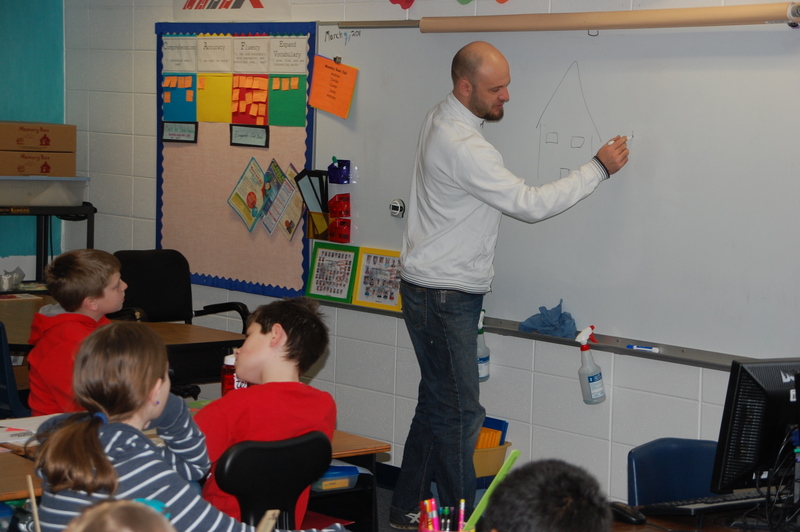
This week we started our much anticipated week-long project with the goal of designing and building a 3-d city.  I searched the internet for plans to modify but did not come across any, so please feel free to use or modify this as you see fit.

In Everyday Math, unit 8 in 4th grade is all about area and perimeter.  The unit is very short and I therefore saw a need for concrete practice with calculations.  My husband, who happens to be a house designer and builder, agreed to co-teach this with me.

Length of project: 5 days

Materials used: 

Advance preparation:

  • We wrapped the plywood in gray paper for roads and drew in all of the lots and roads.  (We placed the wrapped plywood in the classroom a day in advance to build anticipation, it was great fun!)
  • Copies for each person as needed
  • Poster hung for Building Process
  • Lottery lot numbers made and cut out, one for each student to draw.  I worte on them lot # and what type of building.

Requirements:

  • Scale decided upon: 10 feet = 1 inch
  • Height of each story = 10 feet
  • There must be 10% green space left on lot
  • Single family homes must have at least 20% garage of house square footage
  • Shopping malls etc. must have 40% of square footage be parking

Day 1:

  • My husband used this presentation to reveal what the project would be, the video was stopped when “Kelly” was introduced.
  • Then he showed a slide show of different types of houses to show the students what houses could look like, again sparking that creativity.
  • We would stop and let kids get excited with each other for a couple of minutes.  
  • We made a list of math we would need to use: Scale, area, perimeter, fractions, decimals, percentages.  There may even be more, only time will tell.
  • Then time to sketch.  Some students work in teams (if they are designing/building a large building) while others work by themselves.  This is their time to try out several ideas that will fit with their requirements.
  • The rest of the class time was used on sketching, answering questions and just checking in with students.

Day 2:

  • Start out by answering any questions students may have.
  • Discuss math conversions needed by using this prezi
  • I would also sketch out at some point what it means to draw a detailed dimension plan.
  • Meet with students to see if they have everything figured out and give them architectural approval.

    Days 3-5:

    • Students design, draw, and meet to get their building permits.  
    • The process is as follows: Concept design, architectural control, permit checklist, detailed plans, building permit, build your house.
    • This is where the support will happen as students try to do the math needed for the project.
    • Obviously different levels of support are needed for this for each student, modify as you go.

    Coming soon: pictures, video and progress reports.

    being a teacher, common sense, punishment

    The Story of My Brother the Onion Boy

    When I was 22, my 12 year old little brother brought a knife to school. Now before people freak out, it was a steak knife, kept in his backpack, until he needed to use it to cut open an onion.  You see, his 6th grade classroom had different plant experiments and my brother’s group had decided that they would slice open an onion in a live demonstration to show the rest of the class all of the layers and even have them smell it.  So he prepared as any normal Danish student would and packed one of our normal serrated dinner knives in his backpack.  Come science time, much to his teacher’s horror he pulled out the knife.  His teacher, a calm and cautious woman, sent him straight to the principal’s office for a knife possession.  And then zero tolerance took over.


    Had this event occurred in Denmark, nothing would have happened, in fact, my friends and I had a birthday cake commitment where every time someone had a birthday, cake and a massive bread knife was brought to school.  No big deal.  However, in this post-Columbine American era, no chances were to be taken.  So when my little brother, a straight A student, threatened to cut up that onion he was expelled from school for a year.  The school board argued that intent did not matter, what mattered was that he had brought a dangerous weapon to school and that it could fall into the wrong hands, a person who could then use it as a weapon.  They also argued that to be released back into the school system faster all he would have to do was admit he committed a crime, undergo extensive anger management therapy and anger management therapy.  The school district urged my parents to take the punishment, have him admit his guilt, and then he could return to school the following school year.  Mind you, this was March.


    Most parents would not have fought, but mine did.  They saw injustice being made and more importantly, they realized that zero tolerance with no perspective of situation made zero sense.  So they hired a lawyer, a family friend who specializes in bankruptcy law, but has a sharp tongue and even sharper intellect.  The school district was shocked!  They had never had a family hire a lawyer before for an expulsion hearing and when my parents opened up the hearing to the public, the media caught wind of it.  I cannot tell you how strange it is to drive to work and have the local morning radio team lambast your little brother ,who they felt was just another privileged white kid trying to get out of his rightful punishment.  And so I swore at the radio, tried to protect my little brother, who admittedly had made a stupid mistake but a mistake nonetheless, and waited for the hearing.


    I don’t think there has ever been so many people to an expulsion hearing before.  I also think a lot of people were shocked at the vigorousness with which the school district’s lawyer went after my little brother.    Had my parents not been in a situation to hire their own lawyer, it would have been a bloodbath, with a 6th grader as its victim.  The hearing lasted 3 1/2 hours with witnesses being called to testify to my brother’s character and intent.  My brother swore he did not realize he was doing anything wrong.  Finally after 3 1/2 hours, the independent examiner told the district that the 15 days my bother had been out of school was enough punishment and that this eagerness to prosecute was overkill.  It was a victory not just for my little brother, whom we still refer to as onion boy, but for all of the students of his district because it prompted a review of the district’s zero tolerance policy, and a clause was added much later that each case had to be evaluated and could not just be judged based on the same language.  A small but righteous victory indeed.


    So what made me think of this even that occurred 9 years ago?  A line in this article “How I Joined Teach for America – And Got Sued for $20 Million” in which the writer states, ” Furthermore, I saw from the first month that she generally gave delinquents no more than a stern talking-to, followed by a pat on the back, rather than suspensions, detentions, or any other meaningful punishment.”
    Meaningful punishment?  Why does those words seem to not go together?  To me they appear almost opposite of each other.  Meaningful?  When you punish a child, it is to punish, not to have them reflect or rethink, but to judge them based on their actions and then hurt them in some way, not necessarily physically.  When we suspend students, we punish them by removing them from the privilege of learning, even though this sometimes is the worst thing that can happen to them.  When we punish students for not doing their homework by keeping them in from recess, then we are taking away their rightful time to renew and reenergize before we expect them to learn again.  What would a meaningful punishment look like?  There can be a consequence, but a punishment?


    So I ask you, is there such a thing as meaningful punishment?  Is it our job as educators to punish our students?  My brother fell victim to a zero tolerance policy that wanted to punish him to the outmost of its capabilities, without common sense, without the “punishment” fitting the “crime.”  He was not angry, nor was he a criminal, and yet the district deemed him as such.  Since when do we get to lose our common sense when we make rules and them apply them blindly?  When do we realize that it is children’s futures we have in our hands and not just percentages or statistics, but real live kids that are deeply affected by our decisions to punish.


    As for Christian, he is 21 now, traveling in Asia and about to go to Denmark to study.  I miss him dearly and will never forget that phone call I got from his school back in 2002, when I was sick on my mom’s couch, telling me that he had been caught with a knife, and that scared look when he realized what was going to happen to him.


    attention, being a teacher, new teacher, Student-centered, talking

    Your Lips May be Moving But I Stopped Listening a Long Time Ago

    A question I kept asking myself last summer was, “Would I like being my own student?”  Beside bringing back a flood of unfortunate memories of my own schooling, it also stopped me in my prep tracks.  The answer was a resounding “No.”  I would have been that kid rolling their eyes at the teacher (yes, that happened daily), groaning every time a new group project was introduced (I hated group work),  and refusing to do homework out of sheer principle of boredom (and then argue with the teacher as to why it was pointless). Yikes, I am still that kid.  And so when a tweet by Jeremy MacDonald asked

    “How do we get teachers past the teacher-centric use of tech? Modeling? Should I make them let me teach 30 mins in their classroom?” 

    my mind started to spin.  Would simply asking teachers to sit through their own type of teaching, stop them in their tracks?  Or would the response be a more nuanced reflection discussing the need for various learning styles and types?  Or would we hear the stagnant adult claiming that, “they went through it so that is just how things are and to suck it up?”  I love that “suck it up” like school is just meant to be survived and not lived.

    So how do we get teachers to rethink the traditional classroom setting?  Why is it we tend to forget our own school experience and then repeat it as teachers?  Why do most teachers come to teach prepared to speak most of the time?  I have been actively trying to stop talking and let me tell you, it is hard! Our curriculum is not set up for a lot of exploration, but rather mini activities packaged with a lot of careful monologue.  What is it about our way of educating that makes question-answer seem like the best fit?

    So I start my own quiet revolution, using less words and still getting to the point.  Using less teacher-focused and more student-directed learning.  I even started thinking about it all as a learning process rather than how I am going to teach something.  In the end, we have to realize that if we want just test-taking students, then yes, talking at students will get us there.  If we want independent thinkers who are also creative and confident, then we have to stop talking.  So how do we stop talking?

    authentic learning, being a teacher, discussion, Student-centered

    An Opportunity for Discussion

    Friday is Op.Ed. day in my room and I savor this chance to ask my students some of the questions I discuss with fellow teachers. Yesterday’s was “Should students have a say in what they have to learn about.” To see all of their answers, head over to our kidblog. After 15 minutes of writing I asked students to share and this is where the magic happened. Several students shared and then someone blurted out a question. Nervously, they glanced at me to see if I would stop or reprimand them. I kept quiet. Question was answered by another student, and a new one came. Again glances were shot my way; I remained quiet. Well, that really got them going.

    For ten minutes I sat back and let my students discuss. The kids got out of their seats, used arm gestures to underscore points, and formed smaller clusters of talking groups. Their enthusiasm was contagious and a huge smile spread across my face. This is what we try to teach our students; how to discuss, how to form opinions, and how to respond properly in a conversation. I did not teach them this, I only gave them the opportunity to engage one another.

    As a teacher, I have to equip my students with life skills and those include how to have a proper discussion. I stopped the class only because they went back into kid territory of getting upset with each other. This, though, was also a learning opportunity; how do you politely disagree? How do you carry on a large group discussion? My students quickly realized that one major rule was to not interrupt each other, something I have asked for all year. And yet now they got it. They figured out the why themselves and that will always be my favorite way for them to learn.

    Sometimes it is not about what we teach but the opportunities we provide. The opportunities are what matter.

    learning, students, technology, tools

    The Tools We Use (and Those We Don’t)

                        Photo courtesy of I Can Read

    As I get ready to write my second set of report cards, I realize 2/3’s of the year has passed and I have some very technology savvy 4th graders.  And by savvy I mean critical, knowledgeable, and demanding tech users.  So what has stood the test of time in our classroom and what has died a silent death:

    Some Favorites:

    • Kidblog – hands down the most useful tool we have integrated this year.  Through this blogging platform we have reached out to more than 20 countries around the world, have had an intimate view of the revolution in Egypt and created an ongoing writing portfolio.  I cannot believe something like this is free.
    • Animoto – a tool favored by my students to present video or still pictures as a way to give an inside view of our days and of our doings.
    • Flip Camera’s – Our fantastic PTO donated 8 new cameras to our school through the Digital Wish buy 1 get 1 fee program and we have one permanently on loan in our room.  Students have created grammar videos, learning snapshots and just documented really cool things.  
    • Glogster – some of my students have the glogster bug, begging to create projects using this medium, and one even created his own glog Christmas contest.  They have gotten more creative, and better at citing through this site.
    • Google Suite – well duh, most might say, but my students have become very savvy Google users, taking initiative to search for life cycle of the crayfish when our crayfish exhibited some peculiar behaviors, as well as creating Google maps of students they speak to, and that is just the tip of the iceberg.  
    • Skype – oh yes, we skype and as the year progresses we do it more and more often.  From a quick check in with my husband (just to see what he is doing, they say) to classrooms around the world, we are bringing the world into our room.  Interested in skyping with us – let me know!
    • Wordle – ahh, yes we love our word cloud generator.  This tool has been used from everything to research, overused words, to poems about parents.  This free tool is pretty amazing.
    • Twitter – while my students are not on Twitter, this social phenomenon colors much of our every day learning.  From finding out about World Math Day to the Global Read Aloud Project, what I gain from Twitter is invaluable.
    And some that seemed fun and then not so much:
    • Edmodo – this very cool social interaction site took off like wild fire and then died out with my students.  At first, they loved speaking to each other through the site from home and then they simply got bored.  Now, I think our last update was 2 weeks ago.
    • VoiceThread – I know of many educators that successfully implement this in their curriculum, but in my classroom, it wasn’t wort  it.  Perhaps it was because we didn’t have a paid for account and so it was rather limited usage or perhaps I didn’t give it enough of a chance, whatever the case, it has been months since we used it.
    • Voki – yes I know there is a Voki for education as well, and while my students loved creating avatars of their friends, saving and uploading them was cumbersome and time consuming.
    • ToonDoo – again, I do not have an educator account for this, which means I cannot provide the safe environment that I need for my students, however, students did do a test run and while some loved it, most found it ineffective and that they could do the same work by hand much easier.
    What am I missing out on?  What do you love in your classroom?  What did you give up on?  Share, share, share.