being a teacher, believe, making a difference

How Do You Know You Made a Difference?

How do you know you made a difference? Is it the test scores? The grades? The parent approval? Or your principal giving you a thumbs up? Is it the highlights? The low moments? The tears? Or the smiles? Maybe it’s the hugs? Or the excitement? The introductions and the goodbyes?

Or perhaps, just perhaps, it is the people. The kids, the conversations, the handwritten cards. Your self-satisfaction from knowing you tried your hardest. The tiredness that comes from focusing on something you know is important. Perhaps it is the kind words sent your way, a friendly gesture, or a friendly hello. Maybe a plea for help or an offer of assistance shows you made a difference. Maybe someone letting you try that new thing or even that old tried and true thing. Maybe somebody simply believing in you or letting you try again after you failed. Maybe that means you made a difference. Or maybe, just maybe, believing you are making a difference is all that it takes to make it come true. Maybe if you believe in yourself enough you will know that it matter, that it all counts, and that the kids are noticing. Maybe then you will know you are making a diffence.

being a teacher, college, education

What I Didn’t Learn in College

I was an adult student, attending college in all of my seriousness, so eager to learn everything there was to know on how to be a teacher. I wanted to be good, great even, and I studied, and I planned, and I reflected my little heart out. And then I graduated, got my first teaching job and realized that I had very little idea of what it meant to really be a teacher.

So what I didn’t learn in college is really quite a lot. I didn’t learn how to gain my students’ trust, interest or even attention. Instead I learned systems of control, of management, of planning that would force students to listen. I didn’t learn how to teach a child that consistently gets 5 hours of sleep every night because of parent job situation and therefore puts his head down on his desk every day. I learned that that child better pay attention to me because that is what children are spposed to do.

I didn’t learn how to care about my students, this was meant to be a given, and not taken for granted. I didn’t learn how to strip away all the layers and show the true meaning of the lessons being taught. I didn’t learn to adapt at the start of a tantrum or the twist of an interesting conversation. I didn’t learn to love them all, no matter their roughness or demeanor.

I didn’t learn to change myself, to be humble, and to realize that this journey is not about my teaching but the students’ learning. I didn’t learn that there are at least five different ways to explain something, or in my case, at least twenty, because every student explains it their own perfect way. I didn’t learn that often the simplest idea, lesson, or decision can make for the most meaningful moments.

I didn’t learn how to be great, or even how to be good. I learned how to save paper, be efficient, and to plan, plan, and plan some more. I learned how to find sources, and ask for help, but not who to ask it of. I learned how to plan for the fictitious child with special needs, the unplannable, or even the out there. And so there are many things I didn’t learn in college but I am not so sure you can. Teaching has to be experienced to be learned, not just read about, discussed and debated.

A great teacher is not something you are just taught to be in college, pushed to be through test scores, or coached to become through observations, it is something you become through your experience, reflection, and everyday life. I wish, I had been taught that in college.

action, word choice, writing

A Lesson in Action and Word Choice

My students are developing their choice in words and in particular how to create a more exciting story.  I often find that students are tired of writing by the time they reach the exciting bits and so it ends up being shortened and not fully developed.  This action word lesson sprung from this problem.

Day 1:

  • I read them “Crazy Hair” by Neil Gaiman and asked them to take note of any “delicious” words that he used.  Whenever students submitted a delicious word, we discussed what other words he could have chosen and why we thought he didn’t.
  • We then return to our prior knowledge of the 6 + 1 Traits of Writing, which ones have we discussed more (organization, voice) and which ones do we need to explore; word choice.
  • This always lead to a discussion of why word choice is so important, where the students take ownership of making their writing better. 
  • I also introduce the “circle it” strategy here for spelling words: don’t skip a word just because you cannot spell it, spell it as best as you can, circle it and come back to it when you edit.  This eliminates kids stopping and losing their momentum in their writing.
  • Then they need to spice up some boring sentences to get their creative juices flowing, my list of boring sentences can be found here.  I only gave them 4 to work on in a small group and they had about 5 min. to improve.  Then present to the class and the students compliment each others sentences.
  • I do a teaser for the next day about how excited I am to introduce their writing project etc.

Day 2:

  • Write the word “ACTION” on the white board.  Let students guess for a minute why.  Then refresh their memory about the lesson from day 1.   What does action have to do with word choice?
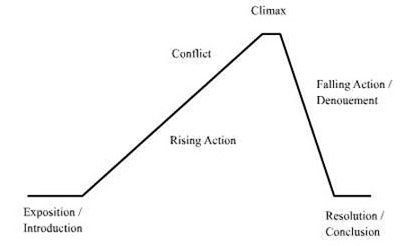
  • After discussion of this we speak about the climax of a story.  My students already know about the parts of a story so they recognize the diagram I draw on the board.  I circle the middle part because this is where the focus needs to be.
  • We discuss how movies are filled with action and then how would you write a scene from a movie?  I offer them my example. We discuss why it works as an action sequence.
  • Then it is their turn.  In small groups, they are to brainstorm using our huge whiteboards (24″ x 32″) and then write our a short action sequence using the most exciting word choices they can come up with. I project their brainstorm help questions to save paper.
  • I have them write in small groups as a guided writing step, some students would be capable of writing their own example right away but this way they help each other gain strength.  I gave my students 30 min to brainstorm and write.  They all finished just in time.
  • Share the stories and compliment what can be complimented.
  • Then I reveal the final project: their own short story, starting at the beginning of the action and ending at the end of the action.  No set up, no explanation, no denouement, just pure action.

Day 3:

  • Brainstorm using these sheets from http://www.writingfix.com.  This fit our purpose of using transtion words to shift from place to place as well as keeping the focus on the action.
  • Students will spend a lesson brainstorming and meeting with peers to help each other out.

Day 4:

  • Meet with me to discuss their idea and then begin the actual writing process.

Days spent on this lesson will depend on progress of students.  I envision about 2 weeks with a comic like illustration to go along with their action sequence.

being a teacher, being me, Lesson Planning, Student-centered, teaching

Simplify

As I prep for the upcoming week of lessons, I find myself cutting ideas out and slimming things down.  I am simplifying my lessons.  And not because I am “dumbing” them down, not at all, instead I am offering my students the luxury of only having to focus on key concepts rather than overwhelming them with all the bells and whistles.

In order for my students to take ownership of the learning they have to understand what they are owning.  They have to be able to take an idea, make it their own and then push it through.  if I add too many components to something, they will end up confused, bogged down, or just plain bored.

In college I was taught to make it exciting, to add visuals, support, brainstorming sheets and even hand signals.  I now rebel against that notion of having to add more every time. Perhaps that is why I am no longer a supporter of IWB’s in every classroom.  I don’t need to be more interactive, my students do.

So this week, I am cutting back all the extras.  I am focusing on what the goal is and letting students add their distinctive spins on it.  I will have supports ready if needed but I will not assume they need them.  I will speak less and engage more.  Simplify my teaching = expand their learning.  I am excited.

This post was partially inspired by this excellent post written Josh Stumpenhorst @stumpteacher.

math, review

Math Obstacle Course

The point has been reached in my 4th grade EDM curriculum where the kids start to really spread out as far as their abilities.  I knew I needed a review day but did not want to start at the whiteboard droning on.  Enter the math obstacle course!

The idea was simple: 5 different obstacles or stations, 3 volunteers, self-paced kids and a final project.  The five stations were:

  1. Rounding numbers
  2. Multi-digit multiplication
  3. Long division
  4. Build a Buck (adding and subtracting decimals)
  5. Fraction of Game

I recruited one fabulous parent volunteer to run the long-division station, had my fantastic special ed. teacher teach a different way of doing rounding, and then had the incredible ELL teacher teach at the multiplication station.  I ran the game stations and did various check-ins.

The students were told they had to complete all 5 obstacles before they could get to the final station; Build your Dream House using pattern blocks (they had to label them, so that was review all the way back to the 1st unit of the year).  They decided where they went, and then set their own pace.  Kid could get re-taught certain concepts if they needed it or they could choose to do the challenge questions right away and see if they completed the obstacle right away.
I drew a map of the obstacles on the board, explained the concepts, and off they went.  They loved it!  It was a bit of organized chaos, but the connections I was able to share with kids and witness them make just floored me.  All students completed all 5 obstacles, even those who needed some extra review, and they loved the creative final project.  Many of the students were eager to share their dream houses and all brought them home.  
I will definitely be doing this type of review again and could recruit more volunteers if needed.  To see the challenge questions and course card, click here for English version and here for Spanish version.
being a teacher, being me, students

When the Day is Tough

No matter the noise, no matter the distractions, no matter how perhaps one lesson didn’t go quite as expected. There is always something good to see, something wonderful to praise, and something that deserves to be recognized.

When the day has been rough and the kids have been tough, take the time to huddle. Take the time to relish the good moments because no matter what, they are there, waiting to be discovered, waiting to be remembered and shared.

So take a deep breath, gather them on the carpet, and ask them to share that one good thing from the day. Go around the circle, come back to those that need extra time, and then smile. Twenty-three golden moments all out in the open; the day couldn’t have been that bad after all.