project, Social studies

Using Animoto in Social Studies

I recently showcased a small project my students created using the fantastic Animoto website.  Now Animoto does not want student accounts, so they used mine instead, which is a free educator account.  Sorry Animoto, but I just don’t see why students shouldn’t be allowed to use your site.  Anyway,  I was asked to go into details of how these were created and the truth is, it was really simple.

  1. We brainstormed what we knew about the US Land Regions to get the kids thinking about them.
  2. I spilt the kids into 5 groups, one for each region, by picking sticks – suck it up if you don’t like your group.
  3. Then I gave the students print materials to start them off in their research  My students have a tendency to want to jump on the computer right away but I wanted them to use books first, because these books are really good.  
  4. They also got an idea sheet to get them started since this was their first project of the year.
  5. The students then had some time to brainstorm, research and search for images that they wanted to put in their Animoto.  Now they had already seen how Animoto worked because of the creation of their classroom vision.
  6. Students had different roles as decided by their group; image finder, citation expert, fact finder, fact writer (have to keep it short and snappy) and Animoto person.  I did not have them put their citations in the Animoto, instead they had it on a separate sheet for me to see.  This is important since they need to cite their sources.
  7. Once they had some research, one student would get logged into my Animoto and would be in charge of adding the pictures that they had found as well as working on the text.  
  8. The whole group would play around with the Animoto, the background, placement of facts versus pictures, etc.  It was great to see how the kids worked together successfully and some not so successfully   Everything is a learning opportunity.
  9. Once the videos were finished, the students watched all 5 of them with a scrap piece of paper and wrote down 3 facts they learned in each.  
  10. We then created big posters of all the facts we learned through the presentations.
  11. Then the students evaluated their work.  We discussed what would make a great Animoto versus a not so great one.  What type of facts should be included etc?  
  12. Students then assigned each presentation a rubric number 1 through 4 and boy, they were harsh.
  13. We finished the project discussing what we would change, how we would do it better next time and what we learned.

The last step was super important because I want my students to be teachers as well.  So it is important that they put on their teacher hats and do the evaluation.  They are often much more critical than me.  They own their work, they evaluate it, and they know what they should do better.  Sometimes we redo it, sometimes we take the knowledge and apply it to something else.  I loved seeing how engaged the students were in this project.

being a teacher, PLN

I Need Your Help

This week I was astounded by the news that I am one of 10 finalists nationwide in the Great American Teach Off.  While I am humbled, excited, and certainly shocked, I now need to make 5 videos, 90 seconds in length each by Wednesday the 28th of September (!), answering these questions:

-How am I an innovative teacher
-What I’m doing to make a difference
-Best teaching tops for teachers across America
-Endorsement from a parent or peer
-What I would do with $10,000 for my classroom 

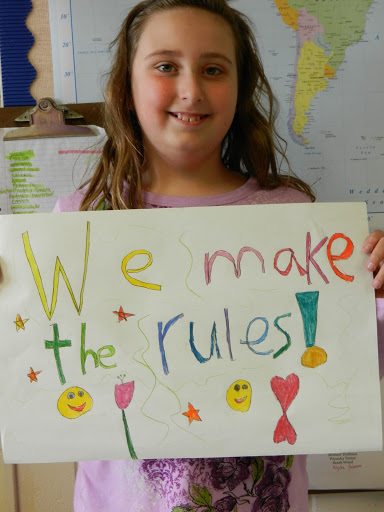
While some of these are easier to make, I need your help with one of them.  Some people tell me that I have helped inspire them to change something in their room, whether it is to get rid of your desk, join the Global Read Aloud, get your students blogging or other things.  If you are one of those people, please consider taking a picture of yourself holding a sign where it says what I inspired you to do, your name and where you are from and email it to me (psripp at gmail.com).  I may then use it one of the videos.

So something like this (courtesy of my amazing students):

You don’t have to be super creative, just write it in sharpie and hold it up.  I cannot tell you how much this would mean to me and my kids as the grand prize winner gets $10,000 for their classroom.

Thank you!

being a teacher, community, school staff

I am Nothing Special – Why Are Teachers Afraid to Share their Successes?

Even in the staunchest of schools, teachers celebrate their students.  Whether it is through formal rewards, which I am not a fan of, or informal recognition, which is more my style.  We celebrate achievements, goals, and recognize our students for the incredible minds, people, and human beings they are.  Teacher brag about their students in the lounge, and to their families.  We are quick to share the funny things they and highlight the amazing ideas they concoct.  We blog, we film, and we sing their praises to those that will listen because we think they deserve it.

So why is it that within teaching, if a fellow teacher or a teaching team receives recognition we have a harder time celebrating it?  Why is it that we often see other’s achievements as a knockdown to our own abilities?  Why is the competition so fierce among teachers to be the one recognized that we cannot celebrate the successes we all have?

I work in a school with incredibly talented people, who have amazing successes every day.  You walk through our hallways and you will see the excitement in classrooms, you will see innovation wherever you go and teachers striving to do everything possible to reach each and every child.  I have often written about the incredible people I work with.  And I wish we celebrated it.  I wish people were recognized just as much as we recognize our students.

So administrators and fellow teachers; what do you do in your building to celebrate everyone, and not by handing out awards?  How do you recognize the achievements of all of your staff?  Where do you start your celebrations?  It is time we stand together and and decide that one person’s success is a whole school’s success and that we are only as strong as our team.  Educators should not be afraid to share the great things they do, they should be yelling them from the rooftops.

Student-centered, testing

How Often?

In the time of rush, rush, rush, we often forget that the kids need time to breathe.  As we spectacularly plan our days to make sure we cover every single last bit of information, we often forget to ask whether the kids are with us or not.  So when it comes to learning goals we expect the kids to all know on our set day for checking, except they don’t, and then we wonder how we failed.

Yet kids learn at different paces, and often one child may be ready while the other is ready the following week.  How often do we take the time to spiral back and double-check whether something is secure later?  After the test?  After the project is handed in?

How often do we ask that child whether they actually know it now, or even knew it then and just couldn’t find the words?

blogging, kidblog, letter, student blogging, students

Student Blogging Resources to Get You Started

I love that I get asked a lot about student blogging because it is something I am passionate about.  I often find myself sharing various posts, letters, and lessons that I have created, which means I have to find them first.  So to make my life easier, and perhaps even yours, here are my best resources on the why, the how, and the do on student blogging.

I am sure I forgot something, so if I did, please let me know.  I hope this is useful to you.

being a teacher, power, students

Know Your Place

I once was told to know my place.  And much like our students are asked to conform, fall in line, sit down and be quiet so we can fill these empty vessels with our knowledge, I was so hurt that it took months to recover. Funny now really, because I do know my place.

Sometimes it is that of an expert, most of the time it is of one who soaks up knowledge from the incredible people I learn with.  My place is in a team that is not afraid to speak its mind but does it with kindness and honesty.  My place is among the students because it is created by the students, for the students, and about the students.  My place is where dreamers dream and believers continue to believe.  It is one of positivity, humility, and passion.  Change, vigor, and failure.  My place is ever evolving, sometimes it goes in a straight line and other times it spirals back.  I would not want to change the way my place shapes me.

So when someone tells you to know your place, tell them that you do.  It is wherever we can teach and learn the best.  Wherever our dreams take us and wherever our imaginations go.  I know my place; do you know yours?