aha moment, being a teacher, connections, PLN, trust

Voxer Takes Connections to the Next Level If You Let It

This summer I, along with many other educators, got on Voxer and started discovering just how powerful of a PLN tool it could be.  Although I wrote a post extolling the virtues of the app then, it is not until now 5 months into using it that I have truly witnessed the incredible power it holds for me.  Voxer is not just for collaborating, it is for connecting, and those connections are changing my life.

As educators, and especially female educators, there seems to be a weird phenomenon surrounding us; the seemingly overabundance of highly connected male educators, whether administrators, teachers, or tech integrators.  (Yes, this is a simplification, but bear with me).  I have often wondered about the apparent “mens/boys” club that seem to exist on Twitter, at conferences, and on blogs that list who people must follow, and have even written about it in the past.  Don’t misunderstand; I don’t feel the need to be a part of a male club, instead this realization made me long more for my own female version that could share the same camaraderie that seemed to exist in these groups, the ease with which they communicated and had each others’ backs.  I wanted my own group of women that would inspire me, support me, and actually become friends.  Enter Voxer.

5 months ago a few acquaintances and I started a Voxer group.  I didn’t think much of it, after all I was in about 8 different groups at the time all discussing various things related to education, and loving it.  The group consisted of 5 women from different parts of education that all had a few things in common but were nowhere near being close friends.  At first the Voxes were funny, little slivers of our lives and thoughts being shared.  Yet with time those Voxes grew, sometimes spanning more than 5 minutes, and as they grew so did our bond.  I never knew how much I needed this group.  I never knew how much I needed a group of women to grow with.

Yet, this group is not the only one I go to every day hoping for my heart to be filled, for my inspiration to be renewed, and my thoughts expanded.  Another Voxer group is between a few female educators I greatly admire and am lucky enough to call friends.  These two women have inspired countless blog posts, helped me make huge life decisions, as well as made me laugh.  Every week we check in, we update, we share our thoughts, making sure that we all feel supported, that we all feel cared for.  How powerful is that.

So if you are in need of a tribe like I was; don’t be afraid to reach out.  Use Voxer a s a way to connect to others in a deeper way and don’t be afraid to ask others to be in a group with you.  If you are a female connected educator but feeling alone sometimes, Voxer is your place.  Start a group, take the plunge, reach out tot those that you maybe only know a little and see what happens.

The groups I get to be a part of, those that really matter to me, weren’t planned. We didn’t set out to create these bonds, but they happened because we tried.  They happened because we realized that by having this tool to bring our voice together, we grew stronger as a group, we grew because we trusted each other.  You don’t have to feel alone even if you are a connected educator.

I am a passionate teacher in Oregon, Wisconsin, USA,  who has taught 4th, 5th, and 7th grade.  Proud techy geek, and mass consumer of incredible books. Creator of the Global Read Aloud Project, Co-founder of EdCamp MadWI, and believer in all children. I have no awards or accolades except for the lightbulbs that go off in my students’ heads every day.  First book “Passionate Learners – Giving Our Classrooms Back to Our Students” can be purchased now from Powerful Learning Press.   Second book“Empowered Schools, Empowered Students – Creating Connected and Invested Learners” is out now from Corwin Press.  Follow me on Twitter @PernilleRipp.

aha moment, being me, Passion

How Much Does Fear Drive Us?

image from icanread

I didn’t think it was real, not when I saw it on Facebook.  After all, no state would truly pass a law like that.  And yet, with Michigan passing a law that allows for discrimination toward anyone who you feel sincerely burden your religious belief, I am almost at a loss for words. Only almost, because once again fear and hatred leads the way in decision making.  Only almost at a loss for words because it in times like these that we must take stock of our own fears and hatred and not let the dark ones drive the way.

Yet, fear seems to be a constant companion in education.  Fear of the change.  Fear of the new.  Fear of the old in some ways.  Fear that our students aren’t learning enough.  Fear that the new initiative will render us voiceless.  Fear that a new administrator will leave us powerless.  Fear of technology.  Fear of each other and the stealing of ideas.  Fear of being praised too much so that colleagues feel jealous.  Fear of giving control.  Fear of being not good enough.

We can let our fears run us; propel us forward at a breakneck pace.  We can led them lead the way as we stumble blindly behind.  Or we can turn them around, embrace them for the fuel they may be and allow our fears to push our forward.  Not toward a more secluded experience where we assume everyone will be out to get us, but one where we assume that everyone is a supporter.  Everyone has ideas.  Everyone is a learner.  Every change has something good in it.

While the world may continually grow more fearful, and for some there are so many good reasons to want to be afraid, we have to continue to fight.  To not let our country be run by hatred.  To not let our teaching be run by fear.  Fear will always be a companion in any life you lead, what you do with it is what matters, how you let it form you is what counts.  I, for one, will use it to push me forward not hold me back, or at the very least I will try.  Who knows what the future holds, but I declare my intentions anyway.

I am a passionate teacher in Oregon, Wisconsin, USA,  who has taught 4th, 5th, and 7th grade.  Proud techy geek, and mass consumer of incredible books. Creator of the Global Read Aloud Project, Co-founder of EdCamp MadWI, and believer in all children. I have no awards or accolades except for the lightbulbs that go off in my students’ heads every day.  First book “Passionate Learners – Giving Our Classrooms Back to Our Students” can be purchased now from Powerful Learning Press.   Second book“Empowered Schools, Empowered Students – Creating Connected and Invested Learners” is out now from Corwin Press.  Follow me on Twitter @PernilleRipp.

aha moment, being a teacher, student choice

Why I Don’t Want My Students to Fail All of the Time

I-want-students-who-will

“I want students to fail in my room all the time.  I want them to be unafraid of failure.”  This was me, all the time.  In conversation with other teachers, on Twitter, in blog posts.  Always discussing how students should fail.  How our rooms should be filled with opportunities to fail.  How we should model failing any chance we got.

I assumed this is what students needed; fearlessness in the face of failure, chances to fail every single day.  So much failure that they would never be afraid to conquer it or be stymied by it, but instead saw it as a dragon to slay.  And then, one day,  I said it out loud to my students.  And they looked at me in horror.  And then they laughed.

“Why do you want us to fail so much, Mrs Ripp?”

“Isn’t that against the rule?”

“Won’t you be a bad teacher if we fail all the time?”

I shrugged it off that day; clearly they had missed the point.  Failure wasn’t about me being a bad teacher, if my students failed then it would mean I was doing great things, teaching them great resilience, getting them ready for “real life.”

Yet, the thought kept nagging me late at night when teachers tend to get nagged by thoughts like these.  Did I really want my students to fail?  Did I really want them to be surrounded by failure so they could develop more grit?

We forget that as adults we would never stick with something if we were constantly failing.  That we have to have small successes along the way to keep us going.  That some days we need it to be easy so that we can get ready for the next big challenge.  We need to be aware of our own fears and we have to work through them.  We are not fearless, so why do we expect our students to be?

I realized then that constant failure is not what I want.  Nor is fearless students that barge ahead, with little thought, because they have to conquer their fear.  I don’t want my students to be surrounded by failure.  I do not want them to be fearless in every decision, nor do I want them to constantly have be resilient.  That is not “real life.”  That is not what we are as adults.

Instead, I want students who will face their own fears and still do it. Students that see their fear of failure and still try.  I want students who acknowledge that they are moving into territory that makes them uncomfortable and still stick with it.  And I want kids who know where their boundaries are.  Who understand their own limits, their own comfort zones.  Not so we can burst through the barricades, but instead so we can inch out of it, day by day, expanding ourselves, growing and feeling comfortable with the way we grow.

Failure will always be a constant companion in our classrooms, but they shouldn’t be the driving force.  Opportunities should be, challenges should be, with the possibility of failure.  We shouldn’t be striving for students who are unafraid to fail, but rather students who are willing to try.  Willing to think.  Willing to still do something even though they are afraid.  That’s “real life.”  That’s what we should be modeling.

aha moment, being a teacher, being me

When Was the Last Time You Stopped Talking?

image from icanread

I didn’t know how much expertise I needed to stop talking until I switched districts.  Having to start over again, being brand new and friendless, I started listening better, quieting myself, and tuning in.  I started asking for help, recognizing that not only was I in a new district, but also in a new school, in a new grade level, on a new team.  Amazing what changes does to your listening skills.

What I heard was astounding; it is quite remarkable when you stop talking about your own ideas and listening to those of others, what you learn.  I couldn’t believe the varied experience of people, the things they knew, the ideas they had.   Sure, I knew I had been surrounded by greatness before but I hadn’t paid much attention to it, I was usually too busy forging my own path, sharing my own thoughts, touting my own expertise, when I should have been listening.

In fact, now that I think about it, I wonder when I stopped listening to others as much.  When did I become the supposed veteran or expert in the room?  When did I start to feel that I had more to teach than to learn?   I feel like all of those labels that people so graciously bestow upon me due to this blog has sometimes plugged my ears.  But not anymore.  Thank you 7th grade!

So my challenge this year is to stop talking so much.  To start listening more.  To actively learn from others.  Not just those that I adore online, but those I get to call colleagues every day.  Teaching shouldn’t just be about teaching others, it should be about our own learning journeys.  hOw we are listening to the genius that surrounds us.  I know we all have amazing things to share, but for a moment, allow others in so they can share.  So ask yourself; who are you learning from tomorrow?  Who are you listening to?  If it is yourself, then you’re probably doing it wrong, just like I was.

I am a passionate teacher in Oregon, Wisconsin, USA,  who has taught 4th, 5th, and 7th grade.  Proud techy geek, and mass consumer of incredible books. Creator of the Global Read Aloud Project, Co-founder of EdCamp MadWI, and believer in all children. I have no awards or accolades except for the lightbulbs that go off in my students’ heads every day.  First book “Passionate Learners – Giving Our Classrooms Back to Our Students” can be purchased now from Powerful Learning Press.   Second book“Empowered Schools, Empowered Students – Creating Connected and Invested Learners” is out now from Corwin Press.  Follow me on Twitter @PernilleRipp.

aha moment, Be the change, Passion, student choice, student voice

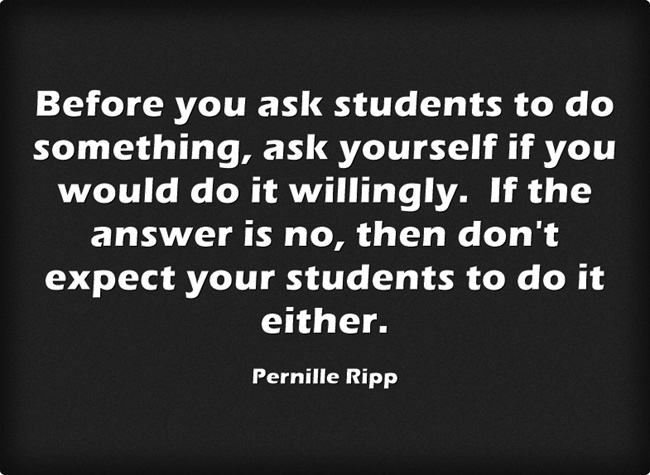
5 Rules We Impose on Students that Would Make Adults Revolt

Before-you-ask-students

I remember the first time I walked through a silent school, the quiet hallways, the shut doors.  You would think it was testing season, but no, simply a school going about its day. At first I felt in awe; what order, what control, what focus!  Yet that night, as I shared my story with my husband, I realized something; schools aren’t mean to be silent.  They are filled with kids after all.  Quiet sure, but silent, no.  Yet here this school was; silent, and all I could think about was; why?  So what things are we expecting students to do that we would probably not submit to as adults?

Expect them to work hard all day with few breaks.  I could not do the schedule of my 7th graders; five 45 minute classes, then 30 minute lunch, then 3 more classes.  In between those classes?  3 minutes to get from one place to the next.  And high expectations everywhere they go.  We assume that they can just do it because we were subjected to the same, because the classes are all different, because this is not that bad, but as adults we would never be asked to sit focused, giving our best, and problem-solving for such long periods without taking small brain breaks, stretches, or in some other way reigniting our focus.  I know we do it so that we can fit everything in, but it still amazes me that we think it is is a good system.

Silent hallways.  Or most of the times we force silence when it is not for studying.  Of course, there needs to be quiet in the hallways while learning happens, but silent hallways – not needed.  Neither are silent lines, silent lockers, or silent lunch rooms.  Quiet and respectful can include talking.  Once, when I asked why my 5th graders had to be silent while they got ready for lunch, I was told it was in order to speed them up, apparently talking slows them down.  On the surface that may be a great reason, we want them to get to lunch sooner.  BUT.  These kids have just spent how many hours being told when to speak, not being allowed to speak to their friends, and now we tell them they have to be silent for longer?  As adults, we speak to our colleagues as we walk down the hallway, in fact, sometimes more loudly than the students.  We get to where we need to go just fine, often with a better focus because we got to relax for a minute.

Only go to the bathroom during breaks.  I remember telling my students that they had better use their lunch breaks to go to the bathroom because we didn’t have time the rest of the day.  Then I got pregnant and the whole idea of planned bathroom breaks imploded.  Yes, there are good times to leave the classroom and bad times, and yes, some kids will use the bathroom to get out of class because they are bored, tired, or want to simply get out.  So what?  To ask students to only go certain times, serves little purpose other than to establish teacher control.  Going to the bathroom can be just  the brain break a child needs to come back awake.  We use it all of the time as adults, why need trust students to do the same?

Do hours of homework.  I have long been an opponent of meaningless homework.  My severe distaste is based on many things, but one of them is that we have just asked students to put in a full day of hard work with us in the classroom.  Now, we are asking them to work even more outside of school.  Yes, some jobs require work outside of work hours, hello teaching, but not all, and often those jobs are by choice.  However, when we ask students for several hours more of their time, no matter our intentions, after they have gives us their best in class, we are treading on dangerous territory.  Why would students want to give us their best in school if we simply ask them to do more after?  I expect my students to work hard, use their time well, and get work done with me.  Yes, there is sometimes homework, no I am not perfect either, but I do think long and hard before I assign anything.

Be ready to show mastery on the same day.  This one took a while for me to realize.  You see, it doesn’t matter that you taught the concept at the same time; kids learn at different rates.  We know this intimately as adults; what may take our friend a day to understand, may take us a week or more.  Nowhere is that more apparent than in college where some students seem to study for weeks, while others breeze through the same material, ready for the test.  So why we expect our students to show mastery on the same day I will never understand.  Obviously it makes sense from a management perspective; it is hard to manage 113 students on different learning journeys.  It is also coming from a completion standpoint; the end of the quarter is the end of the quarter.  Yet research upon research shows us just how crazy this notion is, so why do we keep pushing it for it?  We need fluid mastery to serve our students best.

What other rules have you encountered?  Why do we do this to kids?

I am a passionate teacher in Oregon, Wisconsin, USA,  who has taught 4th, 5th, and 7th grade.  Proud techy geek, and mass consumer of incredible books. Creator of the Global Read Aloud Project, Co-founder of EdCamp MadWI, and believer in all children. I have no awards or accolades except for the lightbulbs that go off in my students’ heads every day.  First book “Passionate Learners – Giving Our Classrooms Back to Our Students” can be purchased now from Powerful Learning Press.   Second book“Empowered Schools, Empowered Students – Creating Connected and Invested Learners” is out now from Corwin Press.  Follow me on Twitter @PernilleRipp.
aha moment, behavior, being a teacher, students

I Was Ready With THE Speech

image from icanread

I was ready with THE speech.  Had been since about 5 AM when I woke up and knew exactly what I needed to do.  All day I was waiting for that class to come in, to tell them that there was a new sheriff in town, and yes, we have been having fun, but we are wasting too much time and it is time to get serious.  Ugh, sometimes I hate serious but my meager 45 minutes doesn’t allow me much breathing room.

There they came, eager as always, happy to be in our room, not so much because of me but because of all their friends and the discussions we might have.  I was ready.  Counting down the seconds until their usual raucous nature would erupt.  Almost holding my breath, running the words I had rehearsed through my head.  “…there will be no more of this….the time is being wasted….serious….pay attention….things to learn….” I was ready.

Except, they didn’t start.  I started teaching and showed them our deadline.  I showed them how big of a time crunch we were in.  I told them I was serious, that I meant it, and that the world would practically fall on our heads if we didn’t make this timeline.  Ok…So they got to work, they started speaking to each other a little, so I figured now was the time.  I started my speech, ready to be asked hard questions, ready to be challenged, or even interrupted.  Instead they just looked at me…and then kept working.

It wasn’t perfect today.  It never is.  But for a moment I had forgotten that we have bad days and good days.  That sometimes our bad days seem to last much longer than they really do.  And sometimes our good days don’t even count because they must have been a fluke, right?  And sure, there was talking, and sure there are consequences, but they were not the ones from my head.  They were not the ones I was ready to dole out.  Kids change.  Sometimes from day to day.  Who knows what tomorrow will bring, but I am hoping for a good day.

I am a passionate teacher in Oregon, Wisconsin, USA,  who has taught 4th, 5th, and 7th grade.  Proud techy geek, and mass consumer of incredible books. Creator of the Global Read Aloud Project, Co-founder of EdCamp MadWI, and believer in all children. I have no awards or accolades except for the lightbulbs that go off in my students’ heads every day.  First book “Passionate Learners – Giving Our Classrooms Back to Our Students” can be purchased now from Powerful Learning Press.   Second book“Empowered Schools, Empowered Students – Creating Connected and Invested Learners” is out now from Corwin Press.  Follow me on Twitter @PernilleRipp.