aha moment, being me, reflection

10 + 1 Lessons I Learned the Hard Way

When I moved my blog from Blogger to WordPress last summer I mistakenly assumed that all posts would seamlessly transfer.  I have since found the error in my thinking and have decided to re-post some of my more discussed posts.  This post first appeared in October of 2011 but still rings true to me, in fact, I think this list could be much longer now so I have updated the post a little.

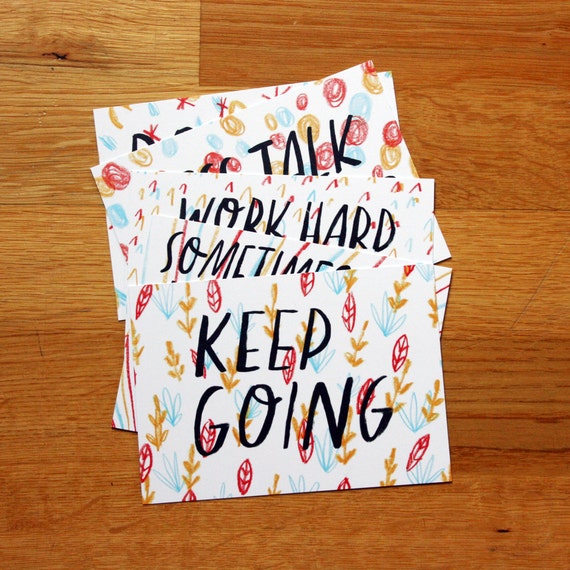
image from etsy
 

Sometimes life smacks you in the face and makes you change your ways for the better.  Fortunately in education, this happens quite a bit, unfortunately it is not always in the most pleasant way.  I present a list of my lessons I learned the hard way.

  1. You may be really excited about something but that does not mean anyone else will be.  I joined Twitter more than 3 years  ago and I have yet to convince anyone close to me of its value.  It is not that they don’t want to understand, they do, but they just don’t have the time or see the need to join.  I remain undeterred in my plug for Twitter but at the same time also realize that perhaps they just don’t want to join, and I am ok with that.  I then just find other ways to share all of the amazing things I learn via Twitter.
  2. When you make a lot of changes, not everyone will think they are great.  I have changed many things in my classroom and while I see all of the amazing benefits, not everyone does.  I have many critics and my skin has grown a lot thicker, and yet, ouch.
  3. Not everyone wants to hear your opinion, even if you think it s a good one.  Enough said.
  4. Not all parents want less homework.  I thought every parent would stand up and cheer at my decision to nearly eliminate homework, but no, some want a lot of homework for their children for various reasons.  I now encourage open dialogue on it and help out where I can.
  5. Lecturing does not engage – and neither does raising your voice and scolding the kids when they tune out.  I figured this one out after 2 years of teaching with glazed over eyes and less than enthusiastic students.  Now I look back at those two first years and shudder.
  6. Rewards diminish the learning.  I used to be a rewards fanatic but realized that kids focused more on which sticker they got then the feedback I gave them.  I also created a class divide in my room with the have’s and the have not’s.  If only I could tell all of those kids that I am sorry for what I did.
  7. When you think everything is going great, you are about to crash.  I don’t know how many times I have been on a teaching high only to crash and burn wickedly.  Life changes quickly, so enjoy the “high” while you can.
  8. Putting your thoughts on a blog means many people know how you feel.   Some will cheer, some will challenge, and some will just downright criticize.  Either way, you have to take the good with the bad; it is all part of developing your voice.
  9. Even the best classroom can have a bad day.  I used to beat myself up wondering what went wrong when the day fell apart.  Then I realized that sometimes there is just nothing to do it about it that day, what matters is that you start over the next day.
  10. I am not always right, even if I really, really want to be.  I have some pretty strong opinions and fortunately for me, sometimes they change.  That means I have had to apologize to people, publicly state the change and eat crow in a number of ways.  This is a not a bad thing, but a human thing.
  11. I am not the only teacher in the room.  I thought I was the ultimate authority on everything in my room, and loved to share my vast knowledge with those empty vessels that were my kids.  What a rude awakening when I realized that my students are not blank slates.  Now I remind myself daily to step aside and let them explore and teach each other and me.


aha moment, answers, assumptions, balance, being a teacher, believe, change, education, education reform, educators, elementary, hopes, inspiration, invest, school staff, talented, teachers, teaching

Bring Out the Experts

The education community loves experts. Experts are flown in, bussed in, and wined and dined. If you are an expert on something chances are there is a school that wants to pay you for sharing your thoughts. In fact, you don’t even have to claim to be an expert, others will often bestow that title upon you as a favor. After all, how else will your expense be excused? So I wonder, how does one become an expert, after all, aren’t we all just humble learners?

The word expert is tinged with weight. To be an expert you must be not just knowledgable, but also an authority. Yet who decides when one is an authority? Does it need a book deal? A huge following? Or someone else who is an expert to look at you kindly? Who decides who the experts are?

We are quick to bring in outside experts whenever there is a need but often I wonder who could we have turned to on-site? Who at this school could already have shared that same information at a fraction of the price? Who at this school could have had the opportunity to teach others, much as we teach our students every day. I consider myself lucky being surrounded by experts every day. I find myself among some incredible educators that work hard to bring their expertise into the classrooms to benefit the students. Isn’t it time for all of us to recognize the experts among us?

I dare to propose that we are all experts. Although not world known, or even known outside of our small circles, yet we are knowledgable of something particular, something that we can claim authority on. And so consider this; at school you are indeed surrounded by experts. Whether they are experts at teaching the civil war, grammar, haikus or how to dribble, they have deep intimate knowledge that they can pass on to others. So share your expertise with others, go ahead open up and discuss what you know you are good at. We have to get better at celebrating each others knowledge, each others succeses, simply each other. We are all experts, how will you foster expertise?

aha moment, behavior, being a teacher, inspiration, Student-centered

Teach To Fit Your Students, Not You

Monday was a chatty day. One of those days where no matter what you do, the kids just cannot settle down and focus. One of those days where I would have moved a lot of sticks and gotten a lot of points. Except this day, I didn’t. There are no sticks to move, names to write or points to take in my room, and sometimes that is hard. You see, when you can punish students for a behavior they often change their demeanor for a short time. Punishment leads to submission and the day can keep moving. However, punishment also means that nothing corrective takes place or valuable for that student. So I don’t punish anymore.

And yet the kids, who are usually so on track, just had a hard time. Whether it was because of the impending blizzard, being tired, or one child starting the talk wave, I don’t know. But teaching proved difficult. In earlier years, I would have ended the day lamenting about how the students didn’t work hard or had problems focusing. Instead, this year I turned my glance inward and thought about how I could accommodate their jitteriness, their talkativeness, their seeming inability to it still too long. How could I change my teaching to make it a great day?

So Tuesday, I came prepared. We had decks of cards as manipulatives for math and the kids did most of the talking as we figured out probability. My planned lesson for literacy for our author study was switched to one about choral reading where the students had to create and perform their first ever choral read poem. We stayed focused on the day through small talk breaks discussiing the probability of a snow day. We spoke about our fifth grade friends in Egypt, we checked in on the live feed to an eagles nest, we took small body breaks stretching and then worked hard. That afternoon, we were able to feed our crayfish, clean their tanks and then have a small study hall with multitudes of choices. We ended with an exciting math game with our first grade reading buddies.

At the end of the day, I was unstressed. We had accomplished what we set out to do and we had also had a good day. The students had worked with their distractedness and made it a strength rather than, well, a distraction. I had realized that it is not my job to force my student into the learning, but instead shape my learning to accommodate my students. It is indeed not about me, but about them, and that is the most mportant thing to remember.

aha moment, being me, blogging, mistakes

When You Lose Your Voice

I lost my voice.  No, not my speaking voice but the one that writes, that blogs, that sometimes even inspires others.  It wasn’t something that I noticed happening, it just slipped away until I realized that I was in drastic need of something to regain it.  I didn’t set out to lose it, it just merely happened as life got a little too busy and the rhetoric a little too heavy.  As criticism got to my head and my own self-importance whittled, as did my voice diminish.

I am not that important, in fact, not being important is what makes this journey so incredible.  Being able to reach out to others through this blog and listen to their ideas, their creativity, their passions.  So I knew something needed to change when I started to over-think my writing, limiting myself and my reflections based on what “people” might think.

But I cannot write for an audience, I can only write for myself.  I started this journey to reflect so that is where my focus must remain.  To put it all out there, the good and the bad, the inspired and the embarrassing, because that is what makes life’s journey so interesting.  I didn’t come here to inspire or to engage, only to be me.  So with this; I reclaim my voice, unfurl it and uncover it.  Hopefully this time, I will remember to stay true to myself.

aha moment, assumptions, being a teacher, memories, school staff, students

It Happened at a Meeting

Today I took notes at our staff meeting.  Yes, a highly unusual task for me as I just sit and listen most of the time.  But today was a day for note taking as we discussed hidden assumptions in life.  I have written about this before mainly on this post, but the discussion keeps pulling me back in as I continue to challenge myself.

To assume means to suppose to be the case, without proof and it is this last bit of the definition that really sparked my interest today.  When we assume in our classrooms, do we do it because it is easy?  Because of intellectual laziness?  Or is it some inane need to classify in order to navigate through life?

As teachers we often assume whether we can admit or not.  We assume perhaps that a child who rides a certain bus has a laundry list of issues that need correcting.  Or a child who comes from a wealthy neighborhood should be fine academically.  Perhaps we assume socioeconomic status based on a pair of worn out shoes, rather than stop to ask the child, who may in the end, just really like those shoes.  We provide snacks for the kids who live in rental properties, and extra time to do homework because their home-life may be tough, but how often do we ask our middle-class kids whether they are having difficult or whether food is sparse at their house?  So in this instance, we assume because we are used to it.

I didn’t start my job with these assumptions, in fact, I prided myself on how much of blank slate I was.  And yet, here they are now, fighting me every day.  We see our class list and images and connotations frequent our thoughts until we meet the kids and then (hopefully) realize how wrong we are.  We base our class lists for the coming year on even more assumptions about how a certain student may be do in a certain class based on the assumptions we make about that teacher.  Sometimes others correct us and sometimes the assumptions is given more life because others nod their head, already victims of the same cloaked inferences.

So why are assumptions bad?  As a victim of many, I can tell you they diminish you as a person unless you fight hard enough to break out of them.  Because I moved a lot as a child due to my mother being awarded Fullbright scholarships, I was assumed to be transient with everything that entails.  Because I was taught English at a very young age, and thus was the only 1st grader fluent in English, I was assumed to be gifted, which I am not.  Because I was raised by an incredible single parent, I was assumed to have “daddy” issues or be the victim of a lackluster childhood, when the opposite is true.  My mother’s scholarships means I learned what it means to be a global citizen.  Being fluent in English means that I can teach my class with a native accent, rather than the awful Danish one (Lars Ulrich anyone?), and being raised by the most passionate and inspiring of mother’s who later married her soulmate gave me a role-model that I will forever try to emulate both in life and in love.  In short, my “messed up life” on paper proved to be a fantastic journey.

As we pass our assumptions on in the hallways, meetings, or lounge conversations, we breathe new life into them.  When we have one more child that fits the bill of what we thought they would be like, then we pat ourselves on the back, and know that we were right to categorize them such in the first place.  Every year, as more students come our way, we strengthen our categories, our distinctions, and it becomes harder to see the truth, to wipe them all away.

Some will argue that there is nothing wrong with assuming certain things, and I agree that this is not a black and white discussion.  Yet something has to be done with the monologue constantly running in our heads.  When we do not speak our assumptions aloud, no one is there to refute them, and so they take on more “truthiness” until we don’t remember a time when we didn’t know this to be a fact.  We have to fight our assumptions before we make them truths, the future of our students are at stake.

aha moment, being a teacher, believe, classroom expectations, communication, get out of the way, honesty, hopes, inhibitions, inspiration, kids, learning

When Learning Fails – We Blame the Students

Being a 3rd year teacher in my district means writing a PDP or Professional Development Plan, in which we are to continually reflect upon our learning and our focus for our professional development.  I am therefore constantly reflecting with other students both face to face and through the internet on that most important question of all; why did I become a teacher? Well, I became a teacher because I believe in children and in their potential.

 Over the summer, I went through one of the most transformative periods of my life, developing a PLN and going through my chosen curriculum asking myself, “Why, why, why?” Why do I choose to teach the things I teach, besides the obvious state and district standards? Why is it that I force students to do book reports when I find them boring and unproductive? Why do I do packet work when it does not ensure learning? Why do I talk all the time, is it for control, for learning or because I am that in love with myself? Why do I fail 4th grade students? Why do I assign at least 40 minutes a homework a night? All of these were massive questions that were daunting and breathtakingly hard to be honest about, but I did it, I survived and for that I am a better teacher.

I realized over the summer that when teachers stop to question themselves is when the curriculum becomes stagnant. I know that we all get in our comfort zones and we feel that something works, so it becomes hard to give it up. But how many times have we stood in a situation where a particular cherished lesson or approach did not work and we end up blaming the students, rather than the teaching method? I had to realize that if something was not a success than I was to blame, not the make up of the students, or the particular day of the week, just me and my delivery. I therefore also knew that if I was going to rethink my teaching process than I had to fully believe and be passionate about what I teach. So this year my classroom is all about the students, or as I like to call it; it is the student-centered room. You will still find me teaching the students some of the time, but you are also more than likely going to find me walking around or sitting down and discussing curriculum. The students are learning to take control of the classroom, however, they are frightened at times, not quite sure what they are doing and yet I urge them to speak, to think, and to listen to one another. This system is not perfect, it is work in progress, but as my students grow, so do I.

So as I continue my conversations with fellow teachers, and we constantly re-evaluate ourselves, often being our own harshest critics, I am honored when others feel secure enough to tell me of the overwhelmedness or exhaustion.  I know that I have been in that same place but that this year I won’t be. Sure there may be things that do not work out, and learning that does not quite happen as well as I would like it. However, when I glance around my room and see the confidence level of my students and also the excitement that is building in regard to our learning, I know that I am to something. I am back and I am staying.