assessment, assumptions, Be the change, being a teacher, grades, ideas

7 Simple Things that Make Feedback and Assessment About the Students Again

http---www.pixteller.com-pdata-t-l-191398

I think we all are always looking for ways to ease the assessment and feedback process in our classrooms, I know I am!  And I get it, giving feedback and doing great assessment with 120 students, or even just 20 students, can seem like an unwieldy beast at times.   So while I wrote about lessons I have learned while trying to limit grades, I thought I would also offer up the practical things that have made my day-to-day better.  Behold, a few things to maybe make your feedback and assessment process easier.

Background:  I now work in a district that is doing Standards Based Grades and moving away from letter grades.  We also believe that formative work is practice work and can therefore not count toward a summative score, and finally, that students have the right to re-take work.  At my middle school, we have a 2 week automatic re-take policy that we encourage students to use in case they need extra help with a concept.  

They have a notebook that stays in the room.  I have learned the hard way that when students leave with their notebooks,  they sometimes do not come back with them.  So this year, I instead created a readers notebook for them to keep in the classroom.  Yes, it was a lot of paper, but it means that my students always know where to write their thoughts, it means that all writing about reading only happens in the classroom, and it also means that I have access to them at all time.  This means that not only do we have a routine established for responding to reading, which frees up time, but also that student scan see their thoughts develop over time along with the feedback I give them.  Each class has a bin on my shelf for easy access every day and they grab them when they come in before they start their independent reading time.

They have a manila folder with their names on it in real life or electronically.  Each class is separated into 5 different groups and each group has a folder.  All work that students do that is not in their readers notebook go in these folder.  This year, the students will even file it themselves to save time.  Why collect the work?  Because my students write way more than I can assess, so this allows them a gathering place for all of their work.  When a unit is nearing its end, I ask them to pick the one piece that they want me to assess.  I also do this for anything we do electronically (but I respect the fact that some of my students want to hand write rather than type).  The discussion that happens based on what they select for me to look at are richer because I know they had to think about it and not just hand me the last thing they wrote.  This also signals to them that they are not working to get through things, but to learn, and that every piece of work they create has value eve if it does not get assessed

I have pre-printed labels with comments.  Not for everything, but when I give feedback in their readers notebooks there are certain things that crop up again and again.  That is what the pre-printed labels are for.  These change throughout the year and I do not reuse the same ones from unit to unit.  It is always catered to what we are working on  what I am noticing with the students, and are explained before they are put on their work.

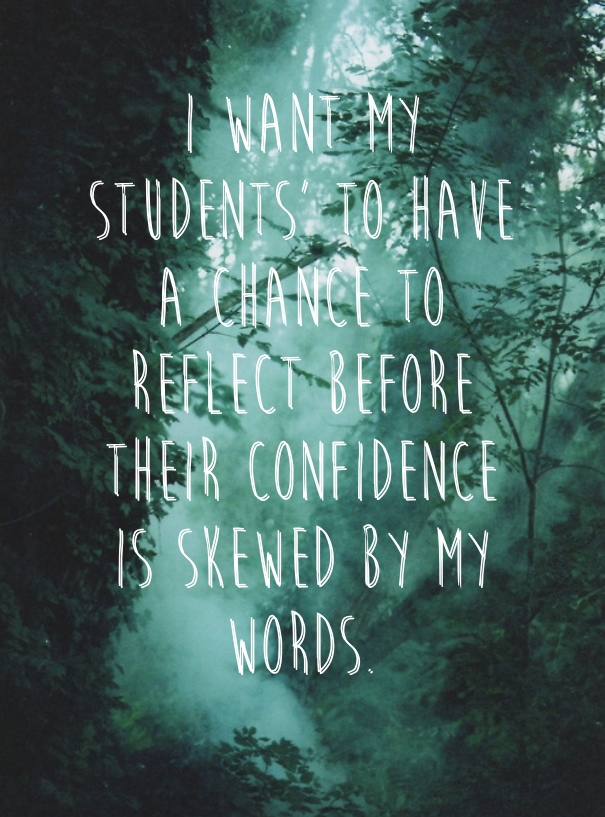
The students self-assess before I assess.  At the end of unit, before anything is handed back by me, the students will then set goals and reflect on their work.  This involves them scoring themselves as far as where they are with their  proficiency in the chosen standard.  The score is based on a standard they have deconstructed to put into student-friendly language, and also based on a rubric they have built with me or we have discussed.  I want my students’ to have a chance to reflect before their confidence is skewed by my words.

Standards are assessed twice at least.  We have 7 standards to cover in English this year and all of them will be assessed for a summative score at least twice in separate quarters.  It is a chance for students to truly see that mastery may come at a different time for them than their peers and that that is ok.  It also allows us to establish a baseline score and then see how they grow.  When a standard is only assessed once, we assume that all students grow at the same rate, which we know is not true.   So instead, make it a point to show students that knowledge is something we gain at all times and that they are the masters of their growth.

They have a chance to disagree.  Once students have self-assessed, it is my turn.  I will either handwrite their assessment or speak to them about it.  But even then it is not final, it is a conversation, and students know that this is their chance to speak up.  Too often we gloss over the assessment piece by handing things back at the end of class and forget that this is one of the largest opportunities we have for meaningful conversations about their learning journey.  Don’t rush through it but take the time to discuss, reflect, and set new goals.

All work is kept in the classroom, pretty much.   I need to know what my students know.  Not what others know, not what they later figured out, but what they know right now.  So any kind of summative work is done in the classroom, not at home, so that I can see how they work on a product with time management and the need for them to think deeper.  This also fits into my policy of limited homework.  And it forced me to evaluate what I am asking them to do, since I can see how much time something takes.  ( I also do all of the work my students have to do, which has definitely been an eye-opening experience).

PS:  For the how-to for eliminating or limiting grades, please consider reading my book Passionate Learners.  There is a whole chapter dedicated to not just the why, but the actual how.

aha moment, assessment, Be the change, feedback, grades

Some Helpful Realizations for More Meaningful Assessments

http---www.pixteller.com-pdata-t-l-190658

I have been trying to create more meaningful assessment for the past 5 years.  Not a small feat if you would, especially now when I am teaching more than 120 students.  Yet, a few things I have realized over the years may help others as they try to move away from grades as an end point, and instead move into better assessment and feedback, where students actually feel like they are in charge of their own learning journey.

Let me preface that this move from giving grades to giving feedback has not always been easy.  I find it is much easier to simply assign a grade to something, yet it has definitely been worth it.  By the end of the year my students are much better at evaluating, reflecting, and goal setting than they are when we start.  And that is worth it all in itself.  So a few things that I had to realize to make this shift was…

I am not the only one assessing.  Students self-assess on almost every assignment once we get started.  This is important, because they should not always be looking to me for how they did.  They need to know themselves well enough to reflect on their own performance.

It is an ongoing conversation.  We take the time to deconstruct the standards and rewrite them in student language.  We take the time to go through what an assignment is actually asking them to do.  We take the time to plan together so students can get ownership over what they are doing.  Assessment is not something that only happens once in a while so it should not just be discussed once in a while.

I cannot assume.  Too often we assume as teachers that we know what a child is doing or thinking.  It is not accurate most of the time.  So instead, I ask a child what they meant, I ask them to explain it to me as if I was not in the room.  I ask them to make sure that I can understand their thinking at all times.  We seem to focus too much on brevity, I would rather have a child be able to explain the full extent of their thinking than assume I know what they mean.

They need to produce more than I can assess.  Our job is not to assess every single thing that a child produces, but instead to assess the pieces they feel are worth others looking at.  Asking students to evaluate their work and only submit the one piece from a unit that they feel will show off their knowledge the best?  That is an assessment in itself.

They need to assess each other, but not until they trust each other.  We love using students as peer editors, as peer reviewers, and even as peer assessors.  However this can be incredibly hard for students who do not trust one another.  So wait.  Let them build community first.  Let them choose the people who will see their work.  Do not force them into vulnerability, it is not worth it in the end.

Assessment needs to happen in class.  They need to take ownership of the whole process, not just the end result, so that means that we are constantly evaluating our work, we are constantly engaged with our work, and we are doing it in class, not at home, not with parents.  But here, now, this day, so that the conversations can happen as a group, as a partnership and as a self-reflection.  And so the conversation can mean something and not just be homework or something else to get through.

Finally, assessment is a point in the journey, not the end of the journey.  And students don’t often understand that.  We have to have these conversations with them in order to change their mindset.  If students think that grades are something being done to them, that grades are out of their control and do not happen until the end when it is too late to do anything about it, then we are missing the whole point of assessment.  Assessment is for bettering yourself, for deepening your understanding, for helping you set goals.  Not for completing something so you can cross it off the to-do list. Once again, I am reminded of the saying; We do not teach standards, we teach kids.  And that is painfully apparent in the way we use assessment, feedback, and grades in our classrooms.

PS:  For the how-to for eliminating or limiting grades, please consider reading my book Passionate Learners.  There is a whole chapter dedicated to not just the why, but the actual how.

assessment, attention, authentic learning, being a teacher, Literacy, MIEExpert15, student choice, student voice, technology

What About the “P” In Your B.Y.O.D.?

quotescover-JPG-45

The final quarter of last year, our classroom was a limited B.Y.O.D. zone, meaning yes, bring your own device but check it at the door unless we had a purpose for it.  I instituted this because I felt we were getting distracted, myself included, we were having a hard time resisting the instant temptations that our smartphones seem to provide for us.  So we left them out of the room and the students were just fine with it.  I was too.  In fact, there  were times where I knew that our conversations, our reflections, our thinking traveled to deeper levels because we did not have a device nearby to distract.

Yet, I felt like I had taking the easy way out.  That declaring our room a device free zone was limiting the students.  So I have been thinking a lot about meaningful purpose lately, because much like I would not take a pencil away from my students unless I had to, I don’t think we should be taking devices either.  What we need instead is purpose, and purpose starts with us.  Especially in our literacy classroom where we have such an opportunity to use the devices to further a love of reading.

The beauty of students with devices is not just the instant access to information, but the ability to give them a voice even if we are not discussing.  To give them a further purpose than just the immediate one in the classroom.  To create a digital platform for them to share their voices with the world.  Therefore, this coming year, we will not be device-free but rather device-purposeful.  Together we will be deciding how to use, when to use, and what to do with our devices.  There will be clear student-set expectations and they will be a natural part of our classroom, not something to always leave at the door.

A few ideas so far for the purpose part are:  (For students with  no devices we will have access to Chromebooks to do some of these things. )
An ongoing TodaysMeet backchannel.  This idea, shared by Ira Socol at ISTE, means that I am creating a TodaysMeet room for each class and having that as a place for students to discuss, ask questions, and also to take the pulse of my classroom.  Because, of course, students will probably veer off the prompted conversation, but will they do it all of the time?  This will allow my shyer students a way to speak up, allow students to help each other, and also a way to leave me questions that perhaps they don’t feel they need the answer to right away.  This backchannel will also allow me a way to assess to see engagement, interest, and confusion.  All useful tools as I prepare and plan.

A Goodreads community.  I plan on using Goodreads with my students this year as a way to log their books, share recommendations, and explore new books.  It is the same tool I use for myself and so adding it will be a natural extension of what adult readers use.  For those who teach younger students, you could use Biblionasium to do this as well.

A Padlet Wonder wall.  I really want us to start being more curious and wondering more, so having a Padlet with things we wonder about will be another tool for the students to access.  I plan on sharing a daily wonder as well, and may use Wonderopolis if we have time.

A Padlet book share wall.  This idea shared by the inspiring Kristin Ziemke at ILA is having a place for students to post “Book shelfies” plus a recommendation of the book.  I loved Kristin’s idea especially of opening this up to the world and having students around the world sharing their books as well.

Those are just a few ideas, but I am sure more will come soon.  I cannot wait to discuss these ideas with my students and see what else they have to offer.  What ideas would you add?

I am a passionate teacher in Oregon, Wisconsin, USA but originally from Denmark,  who has taught 4th, 5th, and 7th grade.  Proud techy geek, and mass consumer of incredible books. Creator of the Global Read Aloud Project, Co-founder of EdCamp MadWI, and believer in all children.  The second edition of my first book Passionate Learners – How to Engage and Empower Your Students” is available for pre-order now.   Second book“Empowered Schools, Empowered Students – Creating Connected and Invested Learners” is out now from Corwin Press.  Join our Passionate Learners community on Facebook and follow me on Twitter @PernilleRipp.

aha moment, assessment, being a teacher, being me, MIEExpert15, Passion, Personalized Learning, student choice, student voice, testing

So It Turns Out I Am a Terrible Teacher

It turns out I owe everyone an apology.  Or at least a great big “I am sorry” to all of the people who have ever been inspired by this blog to change the way they teach.  It turns out I don’t know what I am doing, at least not if you look at our test scores.  You see, my students took our district standardized test, the one they take three times a year, and it turns out that at least for some all of my crazy ideas have apparently ruined their English skills.  It wasn’t that their scores dropped just a touch, no, some lost hundreds of points in their comprehension skills; whole grade level disseminated by this terrible teacher.  And there is no one to blame but me, after all, I am the one responsible for all of the teaching.

These tests are a funny thing really, they have a way of messing with even the most stoic of teachers.  We say we don’t care what the test scores are and yet we cannot help but feel fully responsible for the negative scores.   The positive ones, the ones that gained hundreds of points since January; those cannot possible be my doing, because I am teaching all of these kids.  And not all of these kids are improving by leaps and bounds.  So those great scores, they have to be a fluke, but those kids with the big fat minus next to their number, yup, I did that.

As I wrestle with my own feelings of ineptitude tonight, I have realized that who ever thought that teachers could be evaluated by scores that change so dramatically over a year, has never been a teacher.  I could re-test my students tomorrow and guarantee you that all of them would have different scores.  How a test like that can help me plan instruction is beyond me.  How a test like that can be used to evaluate teachers in some states is even further out of my understanding.  And yet it does, and we take it ever so personal because we care.  We think if we had just tried a little harder, worked a little more then maybe we could have reached all of our kids, and not just the “easy” ones.

So I am sorry for ever thinking I could help change education from within.  I am sorry that I have told others to give the classroom back to students, to create passionate learning environments where students not only have a choice, but they also have a voice.  The test told me today that I am doing something wrong for these kids, because there is no way a 34 question test can be wrong, right?  All I can say is that I am thankful to work in an incredible district with an amazing administration that sees beyond the test scores.  That has faith in us and in all we do.  That knows we are bigger than the test scores our students get, because if I didn’t, according to this test, I don’t have any business teaching some of them, or blogging about what I do.

I am a passionate teacher in Oregon, Wisconsin, USA but originally from Denmark,  who has taught 4th, 5th, and 7th grade.  Proud techy geek, and mass consumer of incredible books. Creator of the Global Read Aloud Project, Co-founder of EdCamp MadWI, and believer in all children.  The second edition of my first book Passionate Learners – How to Engage and Empower Your Students” is available for pre-order now.   Second book“Empowered Schools, Empowered Students – Creating Connected and Invested Learners” is out now from Corwin Press.  Join our Passionate Learners community on Facebook and follow me on Twitter @PernilleRipp.

assessment, assumptions, Be the change, being a teacher, education reform, No grades, student voice

What My Students Told Me – Students Take on Grades

I thought teaching 7th graders would mean that they had a cool distance to school.  That they knew that the grades we give reflect the work they do.  That a report card is not meant as a slap in the face, but rather a tool to be used as they grow toward their goal.  I thought that moving from letter grades to standards based meant students would get it better, would embrace the chance to see what they needed to focus on and then work harder to master their deficits.  Yet again what I thought has proven to not be so, so when I asked my students their thoughts on grades so that I could add their voice to the re-publication of Passionate Learners, I had to take a moment to digest what they told me.  It wasn’t what they said about whether teachers should grade or not, it was how they reacted to the grades they were given.

Once again, I am the mouthpiece for my students, they asked that I please share this with the world in the hope that it will inspire change.  In the hope that it will inspire discussion, that we will take their thoughts and use them to push our own.  So what my students wish teachers knew about grades is simple, yet significant.  I hope it makes you think.

That they feel they have little to no control over what grade they get.  Even in a standards-based grading district, where I ask them to show me mastery with deconstructed standards using rubrics we have created together, they still feel that they have little control over how they are assessed, and more importantly what that assessment means to them.  Now imagine how students feel when they haven’t created the rubric, self-assessed, or deconstructed the standards.  They don’t understand the rubrics we give, they don’t understand at times what they should know to be labeled proficient.  They don’t understand the number they are given.  They crave feedback and conversation, rather than a number or letter.  They crave classrooms that relish growth, failure, and attempts at learning.

That grades means they are done.  The minute we grade something, they are done with it.  It is the signal they need to move on, no matter that I teach in a district that allows and encourages re-takes for everything.  If we want them to continue working on something then we should give feedback but no scores.

That grades sometimes become the one thing that their parents look at, nothing else.  The minute a grade is placed on something that is all their parents can focus on.  Their parents don’t always care about the effort, they don’t always care about the growth, just what the final result is.  The conversations then centers around reaching the “3” or the “4,” to get that A, rather than what they learned, how they liked it, and what they are working on next.

That a grade tells them whether they are smart or not.  We may say that grades are in their control and that they don’t reflect how smart they are, but they are not listening.  If you get good grades, you must be smart, if you don’t well then you are dumb.  Grades are leading them to a fixed mindset, rather than the growth mindset we are all hoping for.

That publishing honor rolls or GPA’s mean that their private learning is now public.  We may see releasing these names as a way to celebrate their learning, but many of my students says it just creates a divide.  And it’s not the students who are not on honor roll that said this to me, no, over and over it was the students that made it.  They didn’t see their accomplishments as anyone else’s business.

That grades are for the future, not for the now.  So many of my students reported that grades mattered because they want to go to college, and while at first I found this to be great (they care about the future!) I soon realized that this is so far from the purpose of what school should be.  Students should keep an eye on the future, yes, but they should also keep an e eye on the now.  They should be focused on the learning journey they are currently on and be excited to see their own growth and how it will help them right now, not 6 years from now.

Once again, my students are pushing me to change the way I asses in the classroom.  While I strive to give them meaningful feedback, I have slipped from my ways.  That’s what happens when you teach more than 100 students.  Yet, the numbers I am so carefully doling out are not helping them grow, so I am not doing my job as their teacher.  My students are making me a better teacher, imagine if we asked all of our students what grades means to them?

I am a passionate teacher in Oregon, Wisconsin, USA but originally from Denmark,  who has taught 4th, 5th, and 7th grade.  Proud techy geek, and mass consumer of incredible books. Creator of the Global Read Aloud Project, Co-founder of EdCamp MadWI, and believer in all children. I have no awards or accolades except for the lightbulbs that go off in my students’ heads every day.  The second edition of my first book “Passionate Learners – Giving Our Classrooms Back to Our Students” will be published by Routledge in the fall.   Second book“Empowered Schools, Empowered Students – Creating Connected and Invested Learners” is out now from Corwin Press.  Join our Passionate Learners community on Facebook and follow me on Twitter @PernilleRipp.

assessment, being a teacher, grades, MIEExpert15, Personalized Learning, student voice

“What Are You Proud Of?” – Using Letter Grades For Good

I was exhausted to say the least.  Voice raw, thoughts muddled, and a lead brain.  I felt like I had worked days without sleep as I dragged myself home.  All day Thursday, I conferred with almost all of my students.  100+ kids and I sat down, one on one, and spoke about scores, grades,  goals, growth and most importantly what they are proud of.  And I was exhausted.

I hadn’t intended to have a day of conferring.  I had thought we would have a read-in party, I would hand them back their grade slips with my grades for them, the ones they had first decided and I then had added my input to.  After all, most of us agreed on the letter grade that somehow would define their progress in English.  Yet, as I looked at the slips of paper in my hand, I realized that this was not a paper conversation.  That every child deserved to have a moment, even if only for a few minutes, to discuss why that grade somehow represented them and more importantly a moment to carve their own path forward.

So one by one I called them up, showed them their slip of paper and then we talked.  What did I notice, what did they know?  How had they been doing?  How had they felt about being in English?  What could change?  What were my hopes as we moved forward?  What did they hope for?  What did they need?  The conversations changed depending on the student, yet every single one ended with; what are you proud of?

What came from them were almost never their scores.  Nor the grade they were getting.  Instead, child upon child told me how they were actually reading now.  How they had become better readers.  How some didn’t hate writing as much.  How English was getting easier for them.  How they felt they had something to say.  They spoke of insecurities.  They spoke of being unsure.  They spoke of trying.  Of growing.  Of wanting to become better people.  Every child opened up and spke of their journey and together we spoke of the future.

One child summed up the day perfectly for me when he said; “I am not sure what I am most proud of.  I have grown, I don’t know how, but I am now better.”  And I thought, so am I.  I am better teacher because I know my students better.  I am a better teacher because I cannot wait to see what they do next.  I am a better teacher because the students are starting to really trust me.  I am a better teacher because my students push me forward every day, and I let them.

I did not intend to spend a day speaking to my students and doing nothing else, but now I know; it was the best way I could have spent a day.  It was the best way to help my students know that they are more than a grade. More than a score.  More than a letter.

I am a passionate teacher in Oregon, Wisconsin, USA,  who has taught 4th, 5th, and 7th grade.  Proud techy geek, and mass consumer of incredible books. Creator of the Global Read Aloud Project, Co-founder of EdCamp MadWI, and believer in all children. I have no awards or accolades except for the lightbulbs that go off in my students’ heads every day.  First book “Passionate Learners – Giving Our Classrooms Back to Our Students” can be purchased now.   Second book“Empowered Schools, Empowered Students – Creating Connected and Invested Learners” is out now from Corwin Press.  Follow me on Twitter @PernilleRipp.