assumptions, authentic learning, Be the change, classroom expectations, collaboration, Critical thinking, MIEExpert15, Passion, Personalized Learning

9 Barriers to Personalized Learning And How We May Work Around Them

image from icanread

I didn’t know I was doing personalized learning when I first changed the way I taught.  It wasn’t until I wrote about it in a blog post and someone gave me the name and description that it clicked.  It made sense really; I wanted students to have a voice, have choice, and to be re-ignited passionate learners within my classroom, all tenets of the personalized learning philosophy.  For me it was a no brainer; why not teach in a such a way that students would want to be part of the learning?  Why not teach in such a way that students became experts and have a place alongside the teacher?  Yet, wherever I go resistance remains for personalized learning.  In fact, some educators or districts are quite against it, but for many different reasons.  I cannot be alone in seeing this resistance, so I thought a discussion of what those barriers may be and how you can approach a discussion to work around them would be in order.

Barrier:  It’s one more thing to do.  We are faced with seemingly more tasks every single year as teachers, from major ones  forced upon us to the little ones we cannot wait to do because we were inspired.   When will we ever find the time to do personalized learning as well?

Discussion Point:  Personalized Learning should not be an add-on but a replacement.  So if you are already doing something, change it with a lens of personalized learning.  Can you add choice into a pre-existing project?   Can students show mastery in a multitude of ways?  Embrace personalized learning as a way to become a better educator by sharing more control with the students, keep it manageable for you and integrate in a natural way to alleviate the feeling of one more thing being added to the to-do list.

Barrier:  It is overwhelming.  It is easy to see why personalized learning can be viewed as overwhelming.  Often those who discuss its merits have been doing it for years and has framed their whole classroom around it.  Their personalized learning initiatives is a long list of to-done’s.

Discussion Point:  One small step at a time.   When discussing personalized learning focus on how to start, what to do in the beginning, and the small changes that can make a big difference.  Certainly keep the end-point in mind, but don’t worry about it yet.  Worry about where you are right now and how you will start your journey, not when you are going to get to the end.

Barrier:  It will be chaotic.  We often envision chaos when we stop doing a one path to the learning  format for students and that when students are given choice they will not know what to do.

Discussion Point:  Personalized learning does not mean giving up control, but rather that control is shared with the students.  It also means multiple paths to mastery, but these are planned out either by yourself or in conjunction with your students.  Yet, you know yourself best; what can you give up control of and what can you not.  You are also a member of this learning community so if there are certain things that need to stay in order, such as an assignment being done a certain way, or students sitting in a particular way, it is okay to hold onto that.  Find the things that you can let go of, invite student input into the process, and grow together.

Barrier:  My subject matter won’t work.  Personalized learning means hands-on and project based; how do you do  that in English, Spanish or any other class?

Discussion Point:  Personalized learning can be implemented into any classroom, the lens just has to switch.  I had a lot easier time giving choice in social studies and science because a lot of our learning was hands-on, project based.  So when I switched to just teaching English, I had to change my way of thinking.  Personalized Learning in my English class means students have choice in how they show mastery (different project choices), when they show mastery (timeline), and often how they work within the classroom (classroom setup/management).

Barrier:  It will be replaced with another idea soon.  Education is a long list of new ideas and change is the one constant we have.

Discussion Point:  Personalized Learning really just means great teaching and great teaching will not be replaced with a new idea.  So while new initiatives are bound to come, the ideas of personalized learning helping you be a better teacher remain because it speaks to student autonomy and re-igniting a passion for learning.

Barrier:  I don’t want to  integrate more technology or don’t have access.  Technology inequity is a real problem.  So is technology fear.   Some teachers want to feel comfortable with the technology they bring in before students use it, and others will never be able to get the things they wish they could.

Discussion Point: Personalized learning is not about the technology.  Personalized learning is about creating an education process that takes into account the needs and desires of each child, while still working through the set curriculum.  Technology is a tool that can be used in this process but not a central tenet.  I started out with 4 computers in my room for 26 students.  We naturally did not incorporate a lot of technology and we didn’t need to.  Choices involved the things we did have and students bringing in things from home if they wanted to.  We made it work with what we had.

Barrier:  I won’t be a good teacher.  It is hard to change the way we teach because we may already be teaching really well.

Discussion Point:  Change is hard for all of us, but modeling risks for students is instrumental in their learning journey.  I am uncomfortable every time I make a big decision about the way I teach or something we will do, but I think the discomfort makes me a more thoughtful practitioner.  By sharing and modeling this for students, I am showing them that I take risks and that sometimes those risks pay off and other times they don’t.  We have to grow to evolve and sometimes that means even leaving behind things that were just fine.  Besides, our students change every year, so should we.

Barrier:  I have to do the same as all the other teachers in my subject or grade level.  We don’t want students to be a part of an educational lottery where the quality of their education hinges on which teacher they get, so sometimes uniformity and in turn, conformity, is preached above all else.

Discussion Point:  Have what other teachers do as one of the choices for students.  This brilliant idea was shared at the task force meeting I was a part of in my district.  Instead of dismissing what other teachers are doing, simply make it on e of the paths that students can take.  That way you are also catering to the myriad of ways that students learn.  You may learn best in a hands-on project based environment, whereas others may learn best with a read/reflect/discuss with a test at the end pathway.  make room for all of your learners and include the ways of other teachers in your room.

Barrier:  Parents/administrators/community will be upset.  When we are faced with unknowns our first instinct may be to revolt.

Discussion Point:  School should look different than when we were students.  Yet communication, understanding and examples are vital when integrating more personalized learning into your classroom our school.  Any change is hard for parents who want to try to help their children, so make sure you are communicating the why and the how behind your changes whatever they may be.  If administration is wary bring them in to see the change, show them other classrooms, and explain your motivation.  Tell them you will do a trial period and you can discuss and evaluate.  Just like you are asking others to be open to change, be open to frank discussion yourself.

Moving toward personalized learning has been one of the most significant changes I ever did in my educational journey, but it wasn’t always smooth.  I have faced many of these barrier myself but now love being in a district that has it as part of its vision.  Wherever you are in your journey, or even if you haven’t started, don’t be discouraged by the barriers that may face you.  Reach out, connect with others who are on the same journey, and find the support you need to be successful.  I am here to help if you need it.

If you want to see 6 things you can change to start your personalized learning journey, read this.

I am a passionate teacher in Oregon, Wisconsin, USA,  who has taught 4th, 5th, and 7th grade.  Proud techy geek, and mass consumer of incredible books. Creator of the Global Read Aloud Project, Co-founder of EdCamp MadWI, and believer in all children. I have no awards or accolades except for the lightbulbs that go off in my students’ heads every day.  First book “Passionate Learners – Giving Our Classrooms Back to Our Students” can be purchased now.   Second book“Empowered Schools, Empowered Students – Creating Connected and Invested Learners” is out now from Corwin Press.  Follow me on Twitter @PernilleRipp.

advice, Be the change, being me, MIEExpert15, Passion, reflection, technology

Am I the Barrier to My Students’ Full Tech Integration?

I have been integrating meaningful technology into my classrooms since 2010, trying my hardest to find tools that would help my students find an audience, spark their passion, and find their voice.  I wouldn’t call us tech infused, I don’t use a lot of tools, but the ones we do, I love.  And yet…I cannot help but feel that sometimes I stand in the way of my students and the technology they use.  That sometimes the parameters I set up hinder rather than grow.

It is not from a place of fear, I am all for technology and using it well.  It is rather from my own ignorance.  Often I don’t t know what I don’t know.  Often I don’t know whether a tool will work for the thing we are doing.  Often I get a little scared, wondering whether they will be able to be successful if they veer off the beaten path.  Often I assume that I have to be the expert and this should know everything and have all of the answers, giving all of the permissions.  But the big thing is; I have forced myself to recognize this and boy, did it make me feel uncomfortable.

How often do we as teachers let our own fears stand in the way of what we “allow” students to do?  How often does our own lack of knowledge of a tech tool (or anything for that matter) prompt us into saying no, rather than yes?  How often do we dismiss rather than invite?

So the next time we propose a project, how about we ask students what tools they want to use?  What tools do they already know?  Rather than rush into creation take a day to explore tech tools that may benefit all.  Have students teach each other.  Share your own knowledge.  Open up your classroom and show your own place as a learner.  Acknowledge that perhaps tech scares you, or perhaps trying a new thing leaves you worried about time line.  Perhaps you are not sure a tool will work or that the students will get it.  So what?!  Embrace this fear and allow it to push you forward, rather than hold you back.  Let students see that their ideas, voices, and prior knowledge matters.  And not just to make them feel heard but to change the way learning happens within our classrooms.

Technology tools surround us, with more being added every day.  We cannot keep up.  We cannot be the only experts.  If we truly have a community of learners in our classrooms then students’ knowledge has to be embraced.  So don’t say no when a child asks if they can use a new tool.  Say yes.  Embrace the fact that you may not know it and learn along with them. Admit your own fear, admitting your own lack of knowledge will only show students the power of doing just that.  Be a learner with your students every day.

I am a passionate teacher in Oregon, Wisconsin, USA,  who has taught 4th, 5th, and 7th grade.  Proud techy geek, and mass consumer of incredible books. Creator of the Global Read Aloud Project, Co-founder of EdCamp MadWI, and believer in all children. I have no awards or accolades except for the lightbulbs that go off in my students’ heads every day.  First book “Passionate Learners – Giving Our Classrooms Back to Our Students” can be purchased now from Powerful Learning Press.   Second book“Empowered Schools, Empowered Students – Creating Connected and Invested Learners” is out now from Corwin Press.  Follow me on Twitter @PernilleRipp.
aha moment, Be the change, Passion, student choice, student voice

5 Rules We Impose on Students that Would Make Adults Revolt

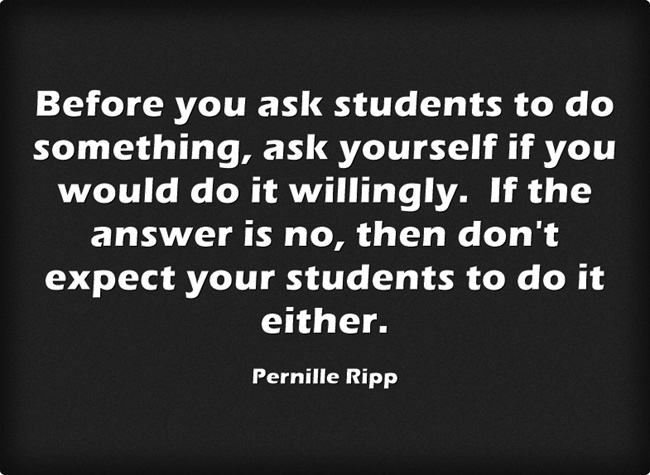
Before-you-ask-students

I remember the first time I walked through a silent school, the quiet hallways, the shut doors.  You would think it was testing season, but no, simply a school going about its day. At first I felt in awe; what order, what control, what focus!  Yet that night, as I shared my story with my husband, I realized something; schools aren’t mean to be silent.  They are filled with kids after all.  Quiet sure, but silent, no.  Yet here this school was; silent, and all I could think about was; why?  So what things are we expecting students to do that we would probably not submit to as adults?

Expect them to work hard all day with few breaks.  I could not do the schedule of my 7th graders; five 45 minute classes, then 30 minute lunch, then 3 more classes.  In between those classes?  3 minutes to get from one place to the next.  And high expectations everywhere they go.  We assume that they can just do it because we were subjected to the same, because the classes are all different, because this is not that bad, but as adults we would never be asked to sit focused, giving our best, and problem-solving for such long periods without taking small brain breaks, stretches, or in some other way reigniting our focus.  I know we do it so that we can fit everything in, but it still amazes me that we think it is is a good system.

Silent hallways.  Or most of the times we force silence when it is not for studying.  Of course, there needs to be quiet in the hallways while learning happens, but silent hallways – not needed.  Neither are silent lines, silent lockers, or silent lunch rooms.  Quiet and respectful can include talking.  Once, when I asked why my 5th graders had to be silent while they got ready for lunch, I was told it was in order to speed them up, apparently talking slows them down.  On the surface that may be a great reason, we want them to get to lunch sooner.  BUT.  These kids have just spent how many hours being told when to speak, not being allowed to speak to their friends, and now we tell them they have to be silent for longer?  As adults, we speak to our colleagues as we walk down the hallway, in fact, sometimes more loudly than the students.  We get to where we need to go just fine, often with a better focus because we got to relax for a minute.

Only go to the bathroom during breaks.  I remember telling my students that they had better use their lunch breaks to go to the bathroom because we didn’t have time the rest of the day.  Then I got pregnant and the whole idea of planned bathroom breaks imploded.  Yes, there are good times to leave the classroom and bad times, and yes, some kids will use the bathroom to get out of class because they are bored, tired, or want to simply get out.  So what?  To ask students to only go certain times, serves little purpose other than to establish teacher control.  Going to the bathroom can be just  the brain break a child needs to come back awake.  We use it all of the time as adults, why need trust students to do the same?

Do hours of homework.  I have long been an opponent of meaningless homework.  My severe distaste is based on many things, but one of them is that we have just asked students to put in a full day of hard work with us in the classroom.  Now, we are asking them to work even more outside of school.  Yes, some jobs require work outside of work hours, hello teaching, but not all, and often those jobs are by choice.  However, when we ask students for several hours more of their time, no matter our intentions, after they have gives us their best in class, we are treading on dangerous territory.  Why would students want to give us their best in school if we simply ask them to do more after?  I expect my students to work hard, use their time well, and get work done with me.  Yes, there is sometimes homework, no I am not perfect either, but I do think long and hard before I assign anything.

Be ready to show mastery on the same day.  This one took a while for me to realize.  You see, it doesn’t matter that you taught the concept at the same time; kids learn at different rates.  We know this intimately as adults; what may take our friend a day to understand, may take us a week or more.  Nowhere is that more apparent than in college where some students seem to study for weeks, while others breeze through the same material, ready for the test.  So why we expect our students to show mastery on the same day I will never understand.  Obviously it makes sense from a management perspective; it is hard to manage 113 students on different learning journeys.  It is also coming from a completion standpoint; the end of the quarter is the end of the quarter.  Yet research upon research shows us just how crazy this notion is, so why do we keep pushing it for it?  We need fluid mastery to serve our students best.

What other rules have you encountered?  Why do we do this to kids?

I am a passionate teacher in Oregon, Wisconsin, USA,  who has taught 4th, 5th, and 7th grade.  Proud techy geek, and mass consumer of incredible books. Creator of the Global Read Aloud Project, Co-founder of EdCamp MadWI, and believer in all children. I have no awards or accolades except for the lightbulbs that go off in my students’ heads every day.  First book “Passionate Learners – Giving Our Classrooms Back to Our Students” can be purchased now from Powerful Learning Press.   Second book“Empowered Schools, Empowered Students – Creating Connected and Invested Learners” is out now from Corwin Press.  Follow me on Twitter @PernilleRipp.

Be the change, being me, Passion, student voice

How Dare You Tell Me You’re Bored?

image from icanread

I remember the first time a student told me that they were bored.  Not with school. Not with life. But with me.  I remember the anger.  I remember the disbelief.  “How dare they tell me I’m boring?  How dare they be bored?  Don’t they know how important this is?  Don’t they know that I am the teacher?  Don’t they know that it is not my job to entertain, but to teach?”

There was no moment of clarity.  There was no moment of thankfulness.  Instead I got upset at the child.  I carried my resentment with me, and it tainted our relationship.  I didn’t grow, I didn’t reflect, I didn’t push my teaching to realize what a gift that was.  Those moments would come much later, two years to be exact when enough students had told me they were bored that I realized that something had to change.  And it wasn’t them, they kept changing, it was me, and I needed to grow some thicker skin.

We tell our students that we want to help them become lifelong learners.  That they should learn how to advocate for themselves.  That they should try to change the world by adding their voice.  And yet, we get angry, defensive, upset when students tell us that the way we are teaching does not work for them.  We don’t want to hear their opinion often.  We don’t want to hear their thought about us.  Sure, they may not always phrase it well.  Sure, they may tell us at a really bad time.  Still, when they tell us, we should listen.  Even if we can’t change at that very moment, we should listen.  Even if we are not sure how to even change, we should listen.

If we truly want empowered students who take control of their own learning journey then we have to grow thicker skin.  Then we have to grow.  Period.  We have to be able tot take the criticism we so effectively dole out.  We have to learn our own lessons of seeing every moment as a chance for growth, as taking every chance we have to be better.

So the next time a student tells you that there has to be a better way.  The next time a student asks you to change.  The next time a students asks why they have to learn this, don’t get mad like I did.  Don’t waste those learning moments.  Reflect instead.  Ask questions,  search for change.  Yes, being told you are boring hurts, take it from someone who was, but I wouldn’t change the past.  I would rather have students who speak their mind in a thoughtful way, than students who are afraid to speak.  Wouldn’t you?

I am a passionate teacher in Oregon, Wisconsin, USA,  who has taught 4th, 5th, and 7th grade.  Proud techy geek, and mass consumer of incredible books. Creator of the Global Read Aloud Project, Co-founder of EdCamp MadWI, and believer in all children. I have no awards or accolades except for the lightbulbs that go off in my students’ heads every day.  First book “Passionate Learners – Giving Our Classrooms Back to Our Students” can be purchased now from Powerful Learning Press.   Second book“Empowered Schools, Empowered Students – Creating Connected and Invested Learners” is out now from Corwin Press.  Follow me on Twitter @PernilleRipp.
aha moment, assumptions, Be the change, being me, Passion

5 Things I Learned to Say That Changed the Way I Taught

I-no-longer-strive-for

There are many things that we can change as educators.  We can all embark on major journeys toward bettering our lives, the lives of our students, and the effect we have on others.  Often those big journeys start when we hit frustration, mine certainly did.  And yet those big journey of change are not the only journeys we can take.  Every day we make a choice as to how we effect those that surround us.  We make a choice as to how we will teach, how we will react.  There are many changes that will change our lives, these are some of my simplest and most important.

I learned to say, “I’m sorry.”  Apologizing to students, and not just for the big things changed my relationship with them.  Now when I accidentally call out a wrong kid, I apologize rather than make an excuse.  When I screw up, I admit it.  When I inadvertently hurt a child’s feeling, which does happen, I apologize.  I don’t try to explain my way out of it, a quick statement is all it takes, but the power of “I’m sorry” cannot be underestimated.  Those words share the story of how we view our students.  They are human beings that deserve respect.

I learned to say, “Let me check.”  I used to know I was right.  I used to know that whatever a child said about already turned in homework, sent emails, or other obligations was a lie.  Until I realized that I was in the wrong and that even if I think I am right, it is better to check first.  Check the pile of paper.  Check my email.  Check my file.  Whatever it may, they check and I check, no lost pride, no hurt relationship.

I learned to laugh at myself.  When you teach you will make stupid mistakes that make you look like a fool.  You are bound to trip and fall, you are bound to  say things that can be misunderstood, you are bound to do something that you would giggle at if it happened to others.  Laughing at yourself with the students is powerful.  Showing students my inner dork, which I tried to suppress at all cost for so many years, has allowed them to fly their flags.  They know when I am serious, but they also know how much I love to laugh, even at myself.

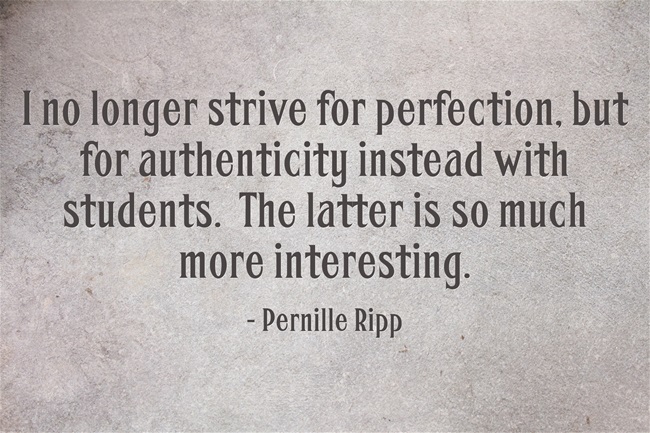
I learned to say, “Ok.”  Ok to sit there, ok to turn it in that way, ok to explore this, ok to read that book, ok to have that conversation.  OK to try, ok to fail.  I learned to say ok to new adventures and epic attempts.  I learned to say when I realized I couldn’t say yes to anything more, and ok when I could.  I learned to say ok when a lesson failed, I learned to say ok when a child told me they tried.  This simple word, these two letters, have allowed me to let go of so much.  I no longer strive for perfection, but for authenticity.  The latter is so much more interesting.  “Ok” taught me that.

I learned to say, “You matter,” but more importantly I learned to show it.  I learned to look at my students when they speak to me, to stop what I am doing and listen.  I learned to read between the lines, to dig a little deeper.  I learned to say yes to lunch, to stop and talk, I learned to tell stupid jokes to break the ice.  I learned the language of my students, whether spoken or unspoken, and I learned to teach with my whole heart, with all of me.

What have you learned to say that changed you?

I am a passionate teacher in Oregon, Wisconsin, USA,  who has taught 4th, 5th, and 7th grade.  Proud techy geek, and mass consumer of incredible books. Creator of the Global Read Aloud Project, Co-founder of EdCamp MadWI, and believer in all children. I have no awards or accolades except for the lightbulbs that go off in my students’ heads every day.  First book “Passionate Learners – Giving Our Classrooms Back to Our Students” can be purchased now from Powerful Learning Press.   Second book“Empowered Schools, Empowered Students – Creating Connected and Invested Learners” is out now from Corwin Press.  Follow me on Twitter @PernilleRipp.

aha moment, assessment, assumptions, Be the change, being a teacher

You Can’t Just Do It To Them

image from icanread

“Remember, whatever I ask you to do, I ask myself to do too.”

This is how almost any assignment is handed out in my classes.  Not to make the students feel better.  Not to make them embrace the assignment more quickly.  No, it is really quite simple; I have done the assignment already.   I have spent time doing the exact same thing, following the same directions, looked at the assessment and pondered how I would do.  Not when I was their age, not when I was in college, not even last year.  No the assignment I am asking them to do, I have done in the past few days as well as I prepared.

Why is this important?  Because every day we ask students to spend their time, whether in class or after school, doing work for us to show their mastery, to practice their skills, to help them grow.  Yet often these assignments are ones that we have never experienced ourselves.  Ones that we may have used to much success before.  Or ones that we got from an amazing source. Yet, we don’t know what it feels to actually do it.  And that creates a problem based on assumptions.  We assume we know how much time it will take.  We assume we know how hard it is.  We assume our directions are clear.  We assume the assessment is fair.  All of those assumptions add up to nothing good.

I started doing my own assignments a few years back.  I didn’t get why my students groaned so much when a new project was handed out.  I didn’t get why I would get emails from parents stating how many hours their children had spent.  Whether it was book report dioramas, grammar packets, or even just outside reading, I assumed I knew what it was like to do them because I had gone to school once too.  On a whim one night, after a particular groan-filled day, I did one of my grammar packets.  9 pages, front to back copied, neatly stapled to teach me all about proper nouns versus common nouns.  45 minutes later, I threw it in the trash.  How many times could I write the same answer over and over or be asked the same thing?  Yikes.  The next day I apologized to my students and we found other ways to do grammar.

So now, I live by a simple rule.  Whatever I ask my students to do I have to do as well.  So if they have to write an assignment, I write it too.  If they have to read outside of school every night, I do too.  I discuss my struggles and problems that I encounter hoping they will feel more confident to try something new.  I tell them when I stop reading and I recommit in front of them, I tell them when I don’t feel like doing any work but now I have to.  My students will not learn from having a perfect teacher, they need someone that they can relate to, even if our years push us apart.

I know that I am not 12 years old and that I have an easier time doing their work.  That only cements my resolve to do every assignment.  If it takes me 30 minutes to write a great constructed response, then imagine how long it can take for a student?

We cannot keep forcing our ideas on kids without experiencing them ourselves.  So commit; whatever your students have to do, make yourself go through it.  Trust me, the things you will change will surprise you.  Be a learner, just like them, and tell them that you know what it feels like.  But don’t just say it, do it and mean it.

I am a passionate teacher in Oregon, Wisconsin, USA,  who has taught 4th, 5th, and 7th grade.  Proud techy geek, and mass consumer of incredible books. Creator of the Global Read Aloud Project, Co-founder of EdCamp MadWI, and believer in all children. I have no awards or accolades except for the lightbulbs that go off in my students’ heads every day.  First book “Passionate Learners – Giving Our Classrooms Back to Our Students” can be purchased now from Powerful Learning Press.   Second book“Empowered Schools, Empowered Students – Creating Connected and Invested Learners” is out now from Corwin Press.  Follow me on Twitter @PernilleRipp.