being a teacher

10 Upcoming Picture Books I Cannot Wait to Read Aloud #PB10for10

I wanted to publish my post about the picture books I plan on using with my students at the beginning of the year, but I don’t have 10 selected yet, not even close, I have 4, because I haven’t met the kids yet and so I don’t know which books we will need just yet. So instead, I thought I would throw a spotlight on a few picture books that I am so excited are coming into this world. These are the ones I have pre-ordered so I will not miss them when they are published. Perhaps you have heard about them too or not, but here they are in random order.

In this empowering ode to modern families, a boy and his father take a joyful walk through the city, discovering all the ways in which they are perfectly designed for each other.

Release date: November 5th, 2019

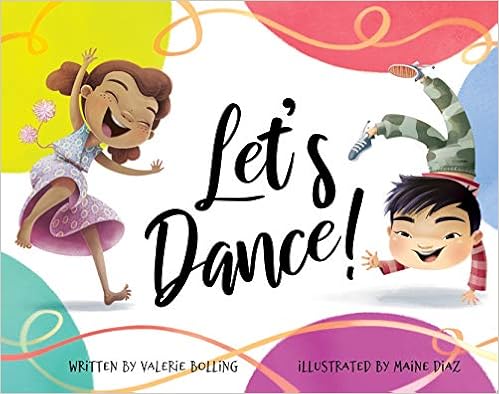
Tap, twirl, twist, spin! With musical, rhyming text, author Valerie Bolling shines a spotlight on dances from across the globe, while energetic art from Maine Diaz shows off all the moves and the diverse people who do them. From the cha cha of Cuba to the stepping of Ireland, kids will want to leap, dip, and zip along with the dances on the page!

Release Date: March 3, 2020

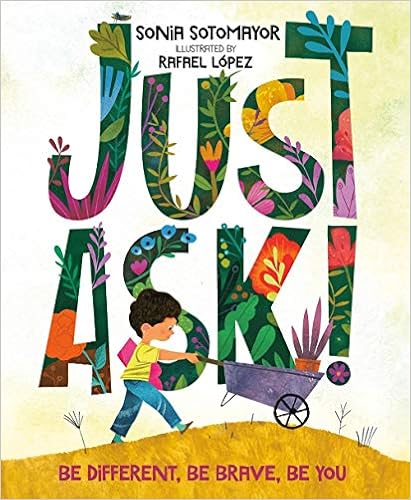
Feeling different, especially as a kid, can be tough. But in the same way that different types of plants and flowers make a garden more beautiful and enjoyable, different types of people make our world more vibrant and wonderful.

In Just Ask, United States Supreme Court Justice Sonia Sotomayor celebrates the different abilities kids (and people of all ages) have. Using her own experience as a child who was diagnosed with diabetes, Justice Sotomayor writes about children with all sorts of challenges–and looks at the special powers those kids have as well. As the kids work together to build a community garden, asking questions of each other along the way, this book encourages readers to do the same: When we come across someone who is different from us but we’re not sure why, all we have to do is Just Ask.

Release date: September 3rd, 2019

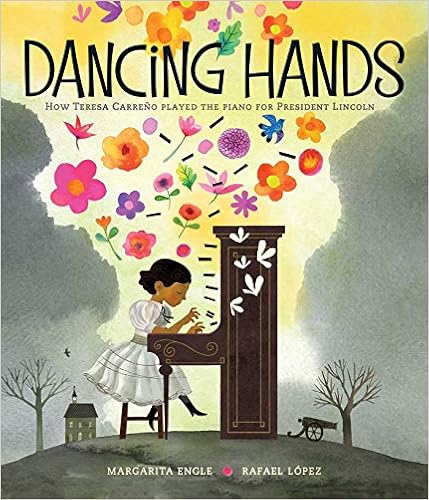
As a little girl, Teresa Carreño loved to let her hands dance across the beautiful keys of the piano. If she felt sad, music cheered her up, and when she was happy, the piano helped her share that joy. Soon she was writing her own songs and performing in grand cathedrals. Then a revolution in Venezuela forced her family to flee to the United States. Teresa felt lonely in this unfamiliar place, where few of the people she met spoke Spanish. Worst of all, there was fighting in her new home, too—the Civil War.

Still, Teresa kept playing, and soon she grew famous as the talented Piano Girl who could play anything from a folk song to a sonata. So famous, in fact, that President Abraham Lincoln wanted her to play at the White House! Yet with the country torn apart by war, could Teresa’s music bring comfort to those who needed it most?

Release date: August 27th, 2019

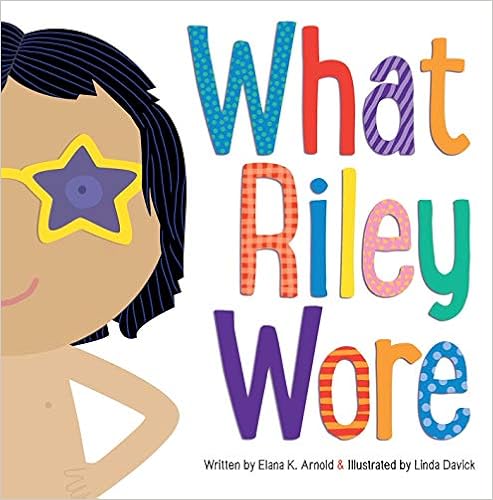
Riley wears whatever clothes feel right each day. On Monday, Riley feels shy and wears a bunny costume to school. On Tuesday, a scary trip to the dentist calls for a super hero cape. For a trip out with Otto and Oma, a ball gown is the perfect outfit.

This charming picture book is a gentle exploration of self-expression and source of encouragement for being true to oneself despite the expectations of others.

Release date: August 27th, 2019

Mars has a visitor.

It likes to roam…

observe…

measure…

and collect.

It explores the red landscape―
crossing plains, climbing hills,
and tracing the bottoms of
craters―in search of water
and life.

It is not the first to visit Mars.

It will not be the last.

But it might be…
the most curious.

Release date: October 29th, 2019

M is for Melanin
shining in every inch of your skin.
Every shade, every hue.
All beautiful and unique.

Each letter of the alphabet contains affirming, Black-positive messages, from A is for Afro, to F is for Fresh, to W is for Worthy. This book teaches children their ABCs while encouraging them to love the skin that they’re in.

Be bold. Be fearless. BE YOU.

Release date: October 1, 2019

Harpreet Singh has a different color for every mood and occasion, from pink for dancing to bhangra beats to red for courage. He especially takes care with his patkahis turban—smoothing it out and making sure it always matches his outfit. But when Harpreet’s mom finds a new job in a snowy city and they have to move, all he wants is to be invisible. Will he ever feel a happy sunny yellow again?

Release date: September 3, 2019

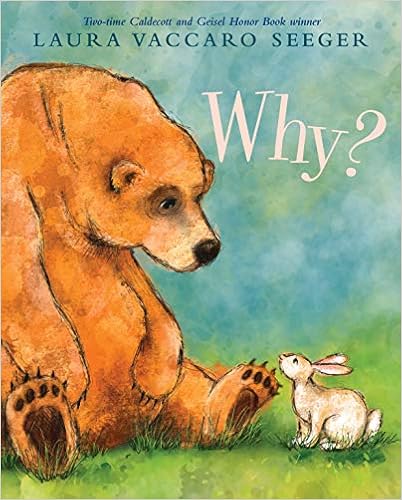
Bear just wants to water his flowers, but Rabbit needs to know: why? Bear is looking forward to a peaceful night of stargazing, but all Rabbit cares about is: why?

As the two friends spend time together through spring, summer, and into fall, Rabbit persistently and simply asks Bear why, encouraging the reader to figure out for themselves the reason for each question that Bear patiently answers, over and over again. . . until there’s a question that he has no answer for.

Release date: August 13th, 2019

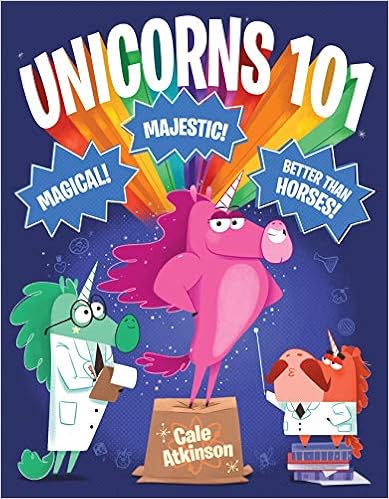
Unicorns! You love them, but how much do you really know about them? Join Professors Glitter Pants, Sprinkle Steed, Star Hoof, and Sugar Beard, plus their trusty lab assistant, Pete, as they reveal mind-blowing unicorn facts never before available to the public! For example:

*  Buttercup Sparklecheeks was the first unicorn to trot on Pluto!
*  At one time in history, there were dino-corns!
*  One unicorn accidentally made it rain waffles for a week!
*  Unicorns have giant slides inside their homes!
*  Rare and exotic unicorns include the mer-corn and the hamster-corn!

Release date: September 3rd, 2019

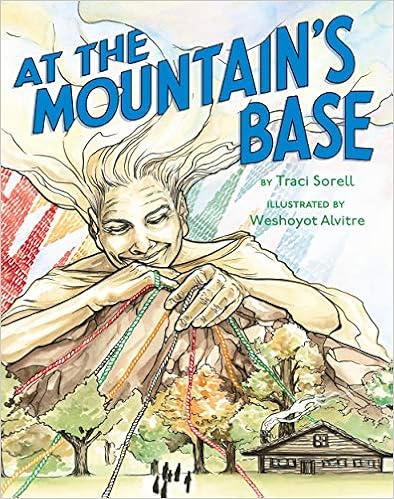
At the mountain’s base sits a cabin under an old hickory tree. And in that cabin lives a family — loving, weaving, cooking, and singing. The strength in their song sustains them through trials on the ground and in the sky, as they wait for their loved one, a pilot, to return from war.

With an author’s note that pays homage to the true history of Native American U.S. service members like WWII pilot Ola Mildred “Millie” Rexroat, this is a story that reveals the roots that ground us, the dreams that help us soar, and the people and traditions that hold us up.

Release date: September 17, 2019

Writer, activist, trolley car conductor, dancer, mother, and humanitarian Maya Angelou’s life was marked by transformation and perseverance. In this comprehensive picture-book biography geared towards older readers, Bethany Hegedus lyrically traces Maya’s life from her early days in Stamps, Arkansas through her work as a freedom fighter to her triumphant rise as a poet of the people.

Release date: August 13, 2019

The creators of Pink Is for Blobfish are back, and they’ve brought 17 of their most revolting friends: there are slippery, slimy snot otters, gulls that projectile-vomit on command, fish that communicate via flatulence, and chipmunks that cultivate healthy forests by pooping a trail of seeds wherever they go. But there’s more to these skin-crawling creatures than meets the eye, and as zoologist Jess Keating explains, sometimes it’s the very things that make us gag that allow these animals to survive in the wild.

Release date: October 29th, 2019

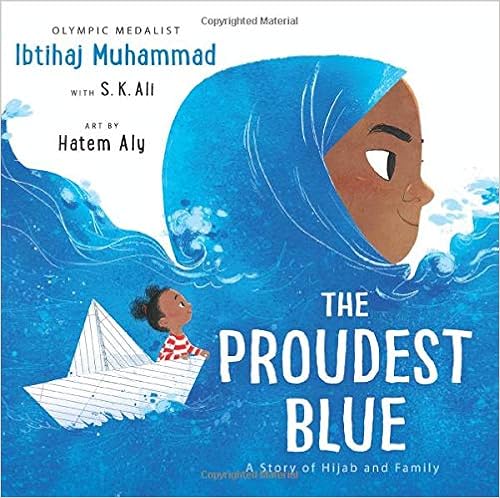
With her new backpack and light-up shoes, Faizah knows the first day of school is going to be special. It’s the start of a brand new year and, best of all, it’s her older sister Asiya’s first day of hijab–a hijab of beautiful blue fabric, like the ocean waving to the sky. But not everyone sees hijab as beautiful, and in the face of hurtful, confusing words, Faizah will find new ways to be strong.

Release date: September 10, 2019

Okay, so this is more than ten, but the truth is there are just so many great picture books coming out and I cannot wait to add them to our collection. These books should be read aloud, shared, and celebrated in any way we can.

being a teacher, being me, new year

On Posters and Welcome Displays

The post I wrote before this was really long and rambling, so much so that I got sick of writing it and instead decided to just get to the point. So here’s the point…

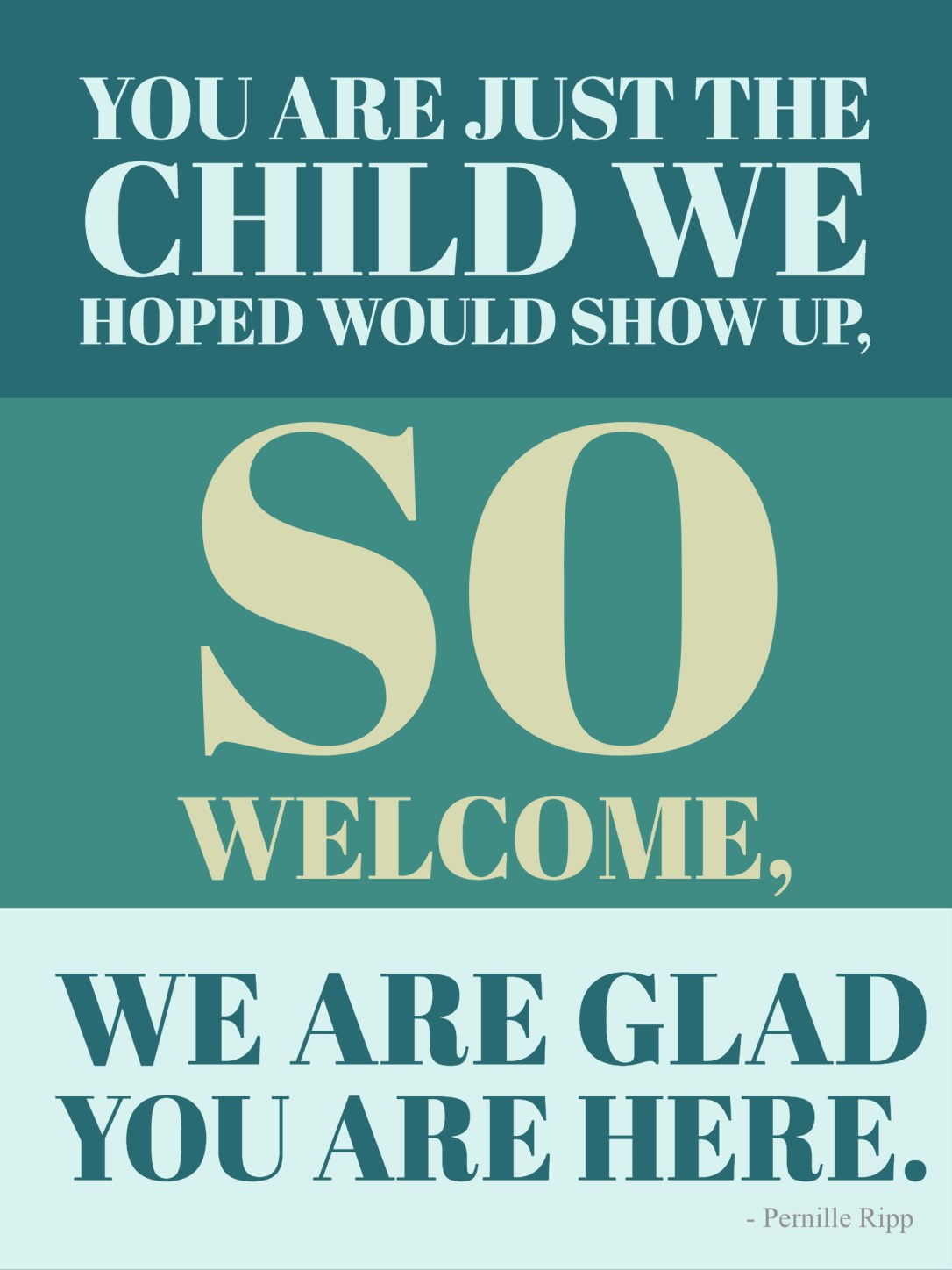
If you come to our room, and many people do, you will see this poster hang next to the door, in a prominent place where I hope every person sees it. This poster is my heart on display, but it also so much more.

Image result for you are just the child we hoped

It is a promise.

A reminder.

A stern warning when needed.

And not to the kids, no, they barely glance at it, but to myself.

A promise to every child that walks in that day no matter their mood, no matter their temper, that in our space they will have space and I will do my best to value them.

A reminder to live the words I choose to share with the world, even when I am tired, frustrated, out of ideas.

And a stern warning to myself when my actions and reactions go against the very words I say I believe in. To stop. To breathe. To find love.

Because let’s face it, the display is easy to make but hard to live up to. Especially after the first few week’s excitement has worn off, especially once we settle into the every day routines, especially after the dust settles and we realize that we have so much to do and somehow we need to get doing it. Especially once we realize that we are, indeed, only humans with dreams and flaws that sometimes get in the way of success.

And so the poster hangs proudly as a reminder to myself to continue to reflect. To look at my own practice, to hold myself accountable even when others may think I am doing just fine. To use my voice to speak up, to try to make change, when so many inequitable practices still exists within the structures of school. To stick my neck out and fight for the kids who we don’t always fight for, even when I am the problem, even when my choices are the problem.

To remember that I cannot say that every child is welcome if the truth is far from it. That I cannot support the education of all children if the inequitable systems are not questioned, changed, broken. That I cannot pretend to be happy that these are the children that showed up if my pedagogical and psychological decisions don’t reflect that.

And so at the beginning of this brand new school year, with a classroom as ready as it can get for now, with all of these ideas in my head, with all of these hopes and dreams, I say this out loud so the universe knows; how will I live up to the words that I promise? How will you?

If you like what you read here, consider reading my newest book, Passionate Readers – The Art of Reaching and Engaging Every Child.  This book focuses on the five keys we can implement into any reading community to strengthen student reading experiences, even within the 45 minute English block.  If you are looking for solutions and ideas for how to re-engage all of your students consider reading my very first book  Passionate Learners – How to Engage and Empower Your Students.      Also, if you are wondering where I will be in the coming year or would like to have me speak, please see this page.

being a teacher, being me, books

On Trigger Warnings and Potential Censorship

Warning: This post contains me changing my mind as well as unfinished thoughts. Read on to see what happens when you open your discussion to the expertise of others.

You may have come across them if you read adult books. A list at the beginning of the book telling you what types of sensitive content you are about to be exposed to. A gentle reminder to take care of oneself, to breathe and step away if needed. To pay attention to the reading experience in more ways than understanding the text, but also understanding one’s own reaction to something in order to make an educated choice about the type of risk one is willing to take.

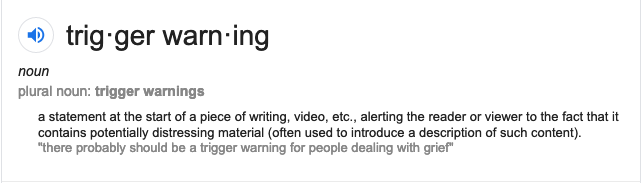
I usually skim over them but appreciate the gesture, but as I came across another one, it made me think; should our classroom and library books have trigger warnings? Should we as educators, librarians, add in potential trigger warnings in order for students to be more informed about the book they are about to pick up or not. It couldn’t hurt surely…

And yet, I wanted to think this out loud. What was I not seeing this discussed more because it seemed like such a simple idea. If it was so helpful, why wasn’t everyone doing it?

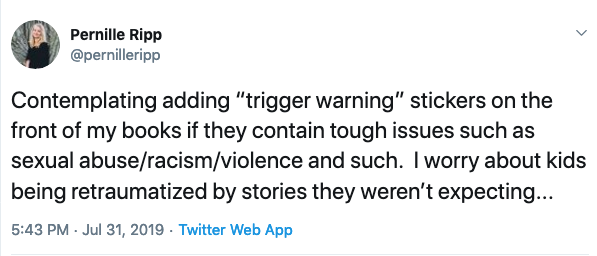
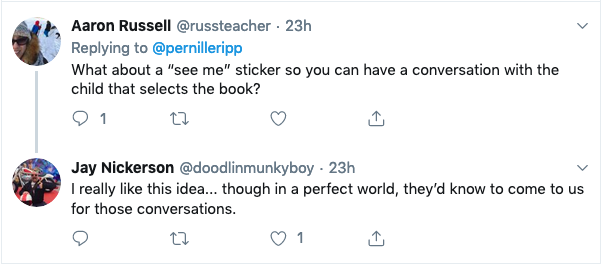
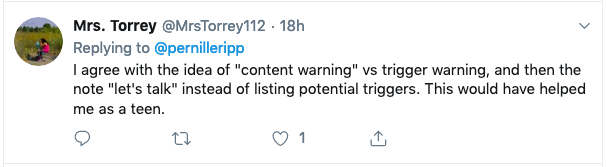
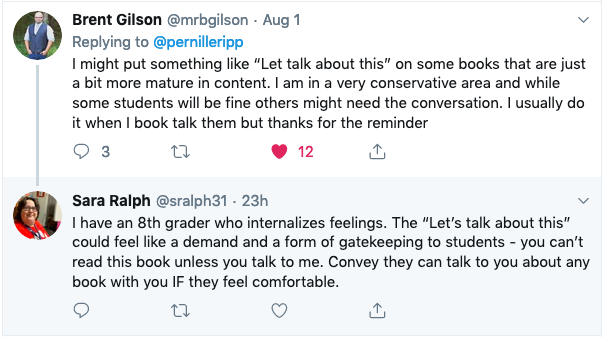
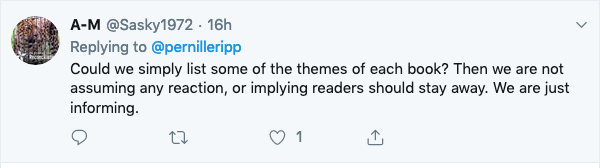
So I tweeted my thinking…

…and was not disappointed.

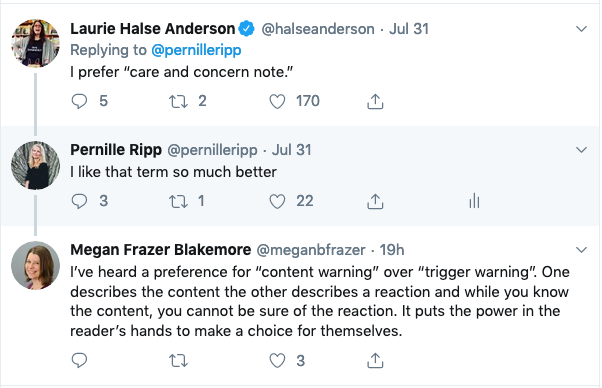
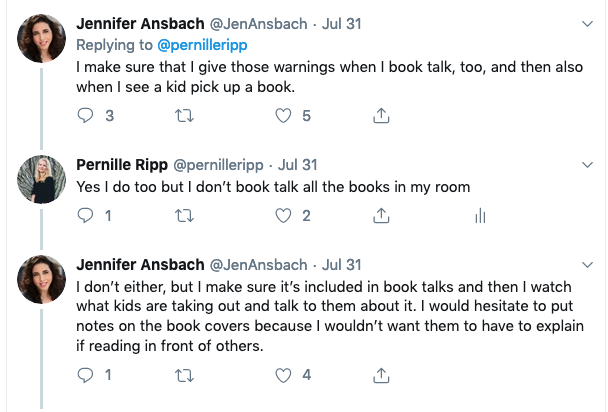
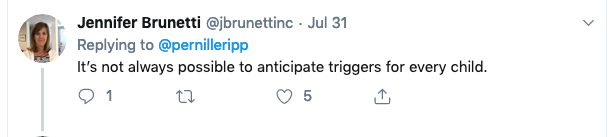
A few different discussion ensued; one about the language “trigger warning,” one about the placement of a potential sticker, and then also one about the problems with this practice.

On the language of using “trigger warning”

On the placement of the label on the front of the book

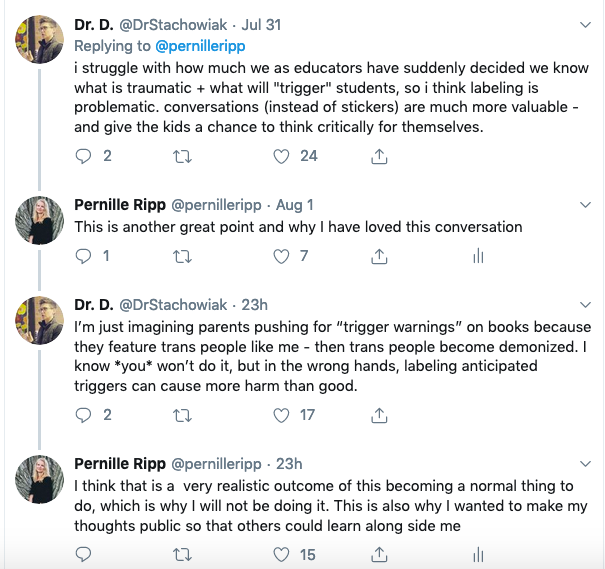
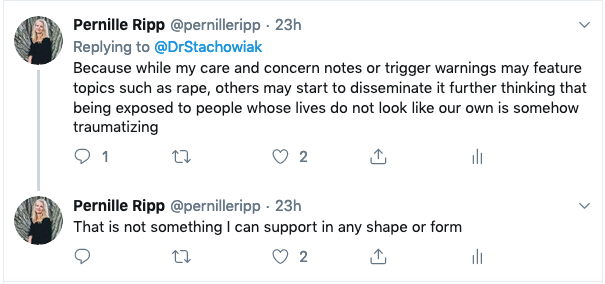
And most importantly on the whole concept

So, as you can see, my thinking changed as others added their thoughts. It went like this…

  1. Great idea, Pernille, get labels and make them colorful and bright so all kids can see them on the front of the books that discuss sexual abuse and violence, have racist language like the “N” word, feature violence against children and maybe other topics as well.
  2. Don’t call them trigger warnings – call them care and concern notes instead. Keep them on the front.
  3. Hmm, don’t put them on the front, put them on the inside instead.
  4. Wait, perhaps, it should just say “Come speak to me…”
  5. Hang on, what do I know about what will trigger a child?
  6. Will I end up needing to put a label on every single YA book in my room?
  7. Whoa, I may be encouraging censorship through this process.
  8. Whoa, I may be encouraging wider censorship of books through my original tweet sharing my idea.
  9. Where will the boundary be for what is considered a trigger? How will this look mixed in with hate/animosity towards marginalized populations?
  10. Someone may take my original idea and think to do this and end up demonizing marginalized people further.
  11. I need to write about this

And so, where does this take me?

Well, I still have a lot of thinking to do, but I know I won’t do trigger warnings. What I will do instead is many folded because the identities of our readers are complicated and nuanced.

I started by reading this article shared by my friend Sara Ralph and others

I will send home our classroom library letter at the beginning of the year in order for those at home to have an idea of what types of books their learners may encounter in our classroom.

When students are introduced to our classroom collection, I will specifically discuss how Young Adult books differ from middle grade and explain how I use the PG-13 rating on books.

I will book talk many of our tougher topic books so that students can hear me discuss some of the potential emotional parts in them so they can make the decisions that will work for them.

I will encourage, as always, that each child knows themselves well enough to know when to abandon a book.

I will confer as much as possible with my students about their book choices and whether they feel the book is great for them or not.

Books that have to do with suicide or sexual assault, I will place a label on the inside with help-line numbers.

And then I will continue to mull over the fine balance between helping kids find great books and hurting their choices instead.

The bottom line is; censorship lives and breathes in our collections of books. We already know that most of the challenged books as reported by ALA in the past few years have had to do with sexual and gender identity. We know that there are many active book challenges happening at this time. We know that sometimes through our well-meaning intentsion (like my original tweet) we may be furthering censorship. But the good news is that we don’t have to.

As a child growing up in Denmark, there was no censorship on the books I was encouraged to read. If I wanted to read about mature topics, I could, my mother trusted me to navigate these books when I was ready and then also let me know that at any point, we could discuss them. It fundamentally shaped my worldview today; that children know more than we assume, that we cannot shield them from tough things in the hopes of keeping them innocent, and that they are eager to learn about others.

By bringing this discussion online and now here, I encourage others to look at labeling systems that are already present in their schools, such as “mature” sections which only some kids can access, or books that need to be checked out with parent permission. Are these really helping kids or are we stopping them from reading books that will speak to them? That may be about them? That may give them hope? Do our “helpful” systems to shield children actually end up hurting them instead?

The kids show up in a month and one day, the books will be waiting. I cannot wait to see the stories they will gravitate toward, I will be there to help them.

Follow up: After posting this post, this incredibly thoughtful comment was left on it in a Facebook group it and brought to my attention. This once again shows me how much I still have to learn, despite being acutely aware of PTSD and how it can affect you.

Pernille Ripp you’ll be in our area at the end of this month, so I shared this post with our librarians, and one of them had this response. “I appreciated Pernille’s showcasing of dialogue and evolution of ideas on the topic. However, the origin of the trigger warning I feel is completely lost in the article. Trigger warnings are for people who have Post Traumatic Stress Disorder (PTSD). As someone who has PTSD and actually has to seek out signs for potential triggers when I engage in materials, trigger warnings are literally supposed to help prevent me, who has experienced trauma, from going into panic and/or fight or flight mode. Trigger warnings are not supposed to filter distressing topics. Those of us with PTSD are not distressed. We have a diagnosable condition where our brains are like broken records that when triggered can easily be stuck on repeat, reliving trauma over and over. When triggered we can forget where we are and who we are with, we can have a complete nervous break down, suffer insomnia, physical pain, lose consciousness, need medical intervention. This article did not seem at all to be dealing with actual triggers. Many of us experience trauma in a myriad of ways – and that can include reading material that covers topics discussed in the blog you shared because, let’s be honest here, reading is an empathetic experience. However, not all of us who experience trauma develop PTSD. My point here is: If a person needs trigger warnings, they need professional help.

I think the goal behind the conversation is valid and worthy of our time. However, the focus is misplaced. In order to properly label materials with warnings or care and concerns or whatever you want to call them, we would have to be well-equipped to understand what constitutes a trigger and then engage all our collection’s materials on a deep enough level to be able to properly label each and every one. That’s not a realistic goal. So instead of zeroing in on the materials themselves let’s focus efforts instead on making sure every library has a consistently updated and very visible and accessible: poster of hotlines and local resources, book collection, and series of programs designed to equip patrons with the tools they need to handle their pain/medical conditions. Let’s train every library staff member to recognize suicidal ideation in our patrons (a lot of times that stuff just leaks right out without them even knowing), how to talk to someone in crisis, and how to stay up to date on who to contact in an emergency. “

PS: THANK YOU so much to all who discussed this with me. To see the original tweet and thread go here

If you like what you read here, consider reading my newest book, Passionate Readers – The Art of Reaching and Engaging Every Child.  This book focuses on the five keys we can implement into any reading community to strengthen student reading experiences, even within the 45 minute English block.  If you are looking for solutions and ideas for how to re-engage all of your students consider reading my very first book  Passionate Learners – How to Engage and Empower Your Students.      Also, if you are wondering where I will be in the coming year or would like to have me speak, please see this page.
being a student, being a teacher, new year, Student Engagement

Space

I have been thinking a lot about space lately.

Not the kind that surrounds us on a dark night, but the kind that surrounds us as individuals.

Perhaps it is because I have been flying more and as a woman, I constantly find my space taken by white men sitting next to me, refusing to even share an armrest.  I am so used to it, I have found I slip into patterns to make myself smaller in order to not encroach on their space.

Perhaps it is because in my thinking work this summer I keep coming back to how white my professional space is within my district, reflective of the lack of diversity of so many districts here in Wisconsin.  How can we change this to be reflective of the kids we teach?

Perhaps it is because I see the critical conversations surrounding education online and how often it is silenced because people say we need to speak nicely to each other, to not make the space unwelcoming or unkind.  We use these platitudes so often to silence the voices of those who have been silenced for so long that we fail to recognize the same destructive patterns.

Perhaps it is because I see my own daughters apologize for the space they take up at times as we remind them to be nice, to be kind, to speak appropriately, whatever that may mean.  Even as I cringe when the words slip out inadvertently, taught to me by many years of public socialization where we are taught which type of women should be heard in this American society.  And I can tell you from experience that the minute you raise your voice, you are deemed angry as if anger is a bad thing.

Perhaps it is because I feel like as a white woman I am often afforded more space because of my skin color than I really deserve.

Space, and how much space we are given, seems to be crowded with well-meaning intentions and misguided constraints.  Space and what we do with it also seems to be dictated by those who feel their space encroached upon and who must make a decision of whether enough there is enough space for us all.  (I think there is, but that is for a different time.)

I think of space when it comes to our students, how for years I have discussed student voice on this blog and how I have attempted to create an environment where students can speak up no matter what they are saying.  How for a long time, through my personal reflection, I have implored others to give students’ voice without recognizing the inherent problem in that statement; students already have a voice, they come to us loudly, yet, it is within our pursuit of calm and compliant that we silence them for the benefit of “learning for all.”  And so I come to the natural conclusion that my work is not about giving students a voice but instead about space and more specifically, giving them back the space we took from them in the first place.

And that starts with the very first day, the inequity of our voices as we go through our day with kids we don’t even know.  How many of us talk about those first days as exhausting because our voices are constantly heard?  How many of our students feel drained not because of all that they had to do but instead all they had to listen to?  How many of us plan out to the minute what we will be doing in order to “Set the year up right” without a care for how welcome or even safe students may feel in our rooms? Perhaps what we need is a little bit of silence, more them than us, more we than I.

So as I plan for those first of many days, I am thinking about the space of my voice.  The space of me within the room and how it needs to be balanced with the space of others.  How I need to think of my voice, the adult voice, as something that also takes up space and therefore needs to be weighed in order to give back space to others.  And not just in the classroom, but in life.  After all, we get one chance to start off right with these new kids, why not get our priorities straight from the get-go?

If you like what you read here, consider reading my newest book, Passionate Readers – The Art of Reaching and Engaging Every Child.  This book focuses on the five keys we can implement into any reading community to strengthen student reading experiences, even within the 45 minute English block.  If you are looking for solutions and ideas for how to re-engage all of your students consider reading my very first book  Passionate Learners – How to Engage and Empower Your Students.      Also, if you are wondering where I will be in the coming year or would like to have me speak, please see this page.
being a teacher, being me

These Kids, Our Kids

She tells us that she is not smart.  That school is not a place she wants to go to because that’s where all the smart kids go.  The ones who can read.  The ones who can do things so much easier than her.

She shows us that she is trying.  That every word that sits in front of her is a mountain to be climbed, seemingly no matter how many times she has seen it before, the climb is still there.  The doubt is still there.  The wanting to give up, because “This so hard, Mommy..” and we tell her to sound it out, to try again, to see the letters, even as they move and squiggle and run away from her eyes as she tries once again.  Everything taking twice as long as her twin brother.  Everything coming at a price of time that seemingly no other child has to give up because to them it just comes easy.

So we search for answers, for teachers who see the girl before they see the problem, for others who like us, sit with a child where reading does not come easy.  Where reading is not a magical adventure but instead dreaded work that doesn’t bring happiness but only affirmation of her supposed lack of can.  And we get the doctors involved and they tell us their diagnosis and I cry in the meeting because wouldn’t it have been nice if it wasn’t a specific learning disorder but instead just something that hadn’t clicked?  Wouldn’t it have been nice if we had it all wrong and she had us all fooled?  Wouldn’t it have been nice?

So we sit down with our little girl, who really isn’t so little anymore, and tell her that we did get answers and as we thought it turns out her brain just learns differently.  That reading is, indeed, hard to figure out but not impossible.  That now that we know more, we can do more, we can get help, we can get support, and we can go in the right direction rather than searching in the dark hoping for something to help us.  We can tell she doesn’t believe us, not yet, anyway.

And as summer unfolds, we hope that having this time can give us the time we need to build her back up, not because anyone tore her down, but because this mountain of reading has been telling her for too long that she is not as good as she thought she was.  And once those whispers started they were awfully hard to drown out when the proof is right there in front of her on the page.

And I think of how the systems of school play into this self-evaluation.  How the grades and the labels so often harm.  How we, as educators, sometimes confuse good grades with dedication, as if a child who is failing a class isn’t dedicated?  As if all a child needs is to just work harder, or hard enough because then the learning will surely come, and how for some of our kids, that is simply not true.  That I can see my child work hard.  That I can see my child stay at the table longer.  That I can see my child give her best every single day.  That I can see my child get extra teaching, tutoring outside of school, and yet the results don’t come because it turns out that hard work doesn’t always equal results.

And these kids, our kids, who are behind are often the ones working the hardest if we really had to compare.

And these kids, our kids, who are behind are often the ones pulled out of recess and fun activities in order to go work more.

And these kids, our kids, who are behind are often the ones given fewer opportunity for choice because it turns out that when you need extra support we have to cut something out of your schedule.

And these kids, our kids, sit with the same kids year after year, traveling as a group because the only thing we have identified them by is their lack of ability.

And these kids, our kids notice.

And these kids, our kids, know it.

And these kids, our kids, feel it.

And these kids, our kids, slowly start to take on the new identities we have created for them in our data meetings, in our hallway conversations, in our quick meetups when we make our lists, where we make our groups, where we share the stories that we think define these kids.

And these kids, our kids, are honored for their efforts by being given new names; struggling readers, lower level learners, behind, and you wonder how they lose themselves in the process.

And you wonder why one day, despite our best intentions, they tell us that they don’t think they are smart and that they don’t want to go to school.

So as my family once again adjusts itself in our pursuit of learning for all.  As we celebrate the answers we have been given this week while nurturing the child who is at the center of it all, I ask you to please consider this.  My child, our daughter, is not a struggling reader, she is a reader.  Period.  To tell her otherwise would break her heart.

And so these kids, our kids, deserve to be fully spoken about, to be fully known.  For us to start a conversation asking how they see themselves and if it is through a negative lens we actively fight against that.  And we tell them we see their effort, we tell them we see their progress.  We tell them we see their smart, and we stop with the labels, and the assumptions, and we see the kid for who they are rather than what the data tells us.

Because this kid, my kid, doesn’t think that reading will ever be something she can do, and I need, she needs, everyone that works with her to believe otherwise and loudly, because my voice is not enough.

Please.

being a student, being a teacher, building community, new year, student choice, student voice

Getting to Know Our Students Survey

Every year, I do several surveys at the beginning of the year, I don’t think I am the only one.  As we try to get to know these kids that have come into our lives, I think it is so important to gather as much information as they are willing to tell us in order for us to be better teachers for them.  But I also think about how hard it can be to answer questions those first few days of school when you don’t really know what your answers will be used for, when you are not quite sure who this person is who is asking you these questions, when you are perhaps not even sure what the questions mean.

So this year, I am changing my approach a little bit.  The questions have been changed to be more of a progression of trust, not because I am under any impression that from Tuesday to Friday the students will trust me, but because I want to honor the relationships we are building and the fact that they take time.  Students will be asked to answer a few questions every day, but can also choose to speak to me about these things.  They are focused more specifically on what the child needs from me potentially to be successful and not so much on academics.  Students will do a separate survey every day, while not ideal, it will allow me to see their answers as the week progresses and then create one answer froup per student at the end of the week.

Along with these questions, I will also give my reading and writing surveys during that first week.  Those will be on paper as I place them in my conferring binder alongside the notes I take during our conversations.

Before the children have shown up, we will also have asked those at home about them.  We want to reach out to parents and caregivers as experts on their children and honor the knowledge they have through a home survey.  It is sent electronically before school starts and I respond to each person that takes it with follow up questions, those who do not have access to email or choose not to take it online are handed a paper version once school starts.

While the first-week surveys are not done, I am sharing here in order to receive feedback.  What have I missed?  What have I misworded?  What would you add or remove?  You are more than welcome to make a copy and make it fit your students, just please give credit.  To see the surveys, please see here:

Tuesday – Go here

Wednesday – Go here

Thursday – Go here

Friday – Go here

Thank you to those who have already helped me make it better, here are all of the questions together.

If you like what you read here, consider reading my newest book, Passionate Readers – The Art of Reaching and Engaging Every Child.  This book focuses on the five keys we can implement into any reading community to strengthen student reading experiences, even within the 45 minute English block.  If you are looking for solutions and ideas for how to re-engage all of your students consider reading my very first book  Passionate Learners – How to Engage and Empower Your Students.      Also, if you are wondering where I will be in the coming year or would like to have me speak, please see this page.