Be the change, being a teacher

The Choice We Make

We can spend our days thinking of our past glories.

Of how it turned out we were right all along.


We can spend our days reliving the past.

We can spend our days thinking we are right, no matter what others say.

We can spend our days never looking back except to the moments where we knew it all.

We can focus in on the things we figured out, how we saved the day and everyone in it.

We can congratulate ourselves on a job well done, how we were the loudest voice, how we had all of the answers if only the world would listen to us.

We can spend our days tearing others down when they disagree.

We can spend our time holding so tight to our beliefs that we forget what we are holding on to, only knowing that we must cling to them or be lost.

Or we can pause…

Hear the voice of others…

Hear people out…

Reset our understanding to not exclude, but include.

To really listen to understand, not to respond.

To ask more questions rather than jump to the defensive.

To discuss rather than dismiss.

To build others up instead of tearing them down.

Perhaps agree to disagree but do so with respect.

At the end of the day, it is a choice we make.  A choice we commit to.  And a choice we can change.  Let’s not forget that.

If you like what you read here, consider reading my newest book, Passionate Readers – The Art of Reaching and Engaging Every Child, out August 2017.  This book focuses on the five keys we can implement into any reading community to strengthen student reading experiences, even within the 45 minute English block.  If you are looking for solutions and ideas for how to re-engage all of your students consider reading my very first book  Passionate Learners – How to Engage and Empower Your Students.      Also, if you are wondering where I will be in the coming year or would like to have me speak, please see this page.
 

being a teacher

On ISTE and Its Cost

Sunday night, I went to register for the annual ISTE conference in Chicago, excited that the conference was so close to my own home that I could drive there.  Excited that I get to present on digital literacy with a powerhouse team that included Kristin Ziemke, Teri Lesene, Donalyn Miller, Sara Kajder, and Franki Siberson.

I booked my hotel a long time ago, talk about sticker shock, even with the ISTE negotiated rate, it came to $862 dollars for four nights.  I knew parking would be on top of that.  I knew meals would be on top of that.  I knew I was looking at more than a $1,000 conference experience.  A cost that I pay for myself like so many other educators.   A cost that in my head I try to justify and yet it takes my breath away.

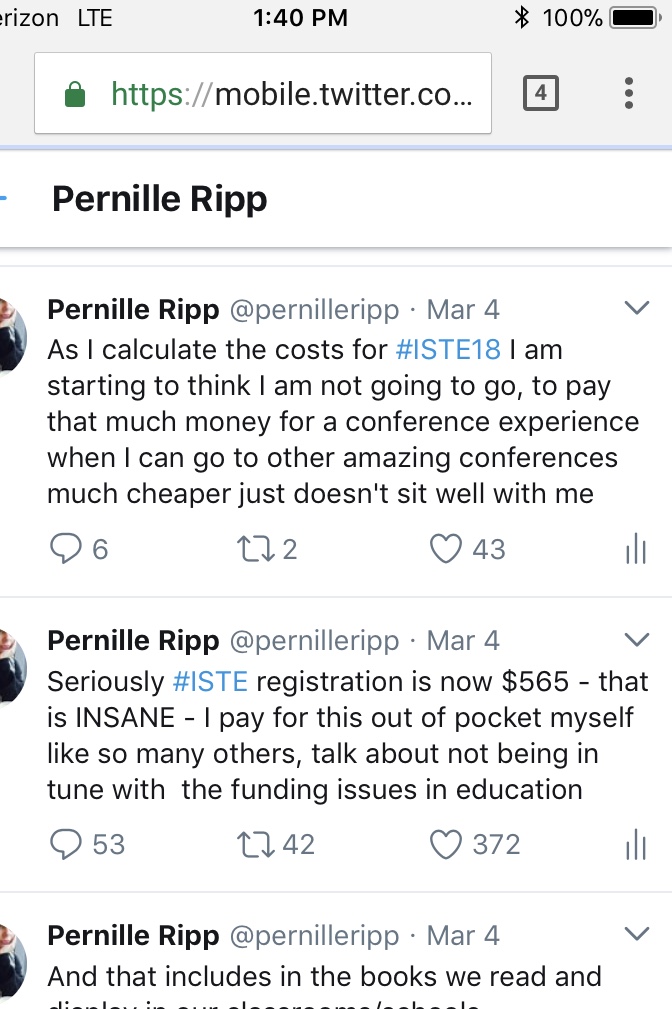
So as I went to register, the cost according to ISTE would be $565 for me.  $565. …I was in shock to say the least, so I tweeted out the following IMG_3292.jpg

And then watched all of the comments come in; people who like me couldn’t believe the cost.  People who were saddened they couldn’t go.  People who told me what the cost should be.

Quickly a pattern in the conversation occurred; are conferences outpricing themselves for regular educators to attend?  Is there even space for educators to come to these conferences any more or are they so outside of our ranger that our presence is no longer needed?

The following day I was contacted by ISTE who explained that part of the reason why my registration cost was so high was because of an email mistake on my end.  Upon further inspection, the price for me now to attend would only be $440.  But $440 for a conference registration is still a lot of money.  Is still really high.  And so my questioning continued.

Today I received the following email from ISTE, who once again did an awesome job of trying to be a part of the dialogue.

Hi Pernille,

 I hope you know how much we value educators like you here at ISTE. I have worked for ISTE for the last 13 years and wanted to personally reach out to you in response the concern you shared on Twitter.  

 Each year, we strive to present the highest quality professional learning experience for educators at the best value. At the scope and scale of ISTE with both educator-driven content and a robust expo, we definitely have constraints and price realities that are not a factor in more intimate venues. Still, we understand the value in having more accessibly priced options and will be introducing a series of focused regional events later in the year, that will come in at a much more modest price point.

 This year, we are thrilled to be in Chicago for our annual conference, within reach of educators across the midwest — a region where we have not been in quite a while. As you might expect, hosting an event in Chicago comes with some added expenses over and above even a typical conference year. We tried to pair our pricing model up with new discounts such as a presenter discount and member loyalty discount to make attending as within reach as possible for as many as possible.

 ISTE is working diligently with the host city and venues near the conference center to create the best experience at the best price possible for our educators. Air travel is less expensive in and out of Chicago (than other ISTE conference destinations), so we are hopeful that this will help offset the registration price increase for many attendees and their bottom line costs will not increase.  

 We also provided additional value for members and presenters, responding to requests to include as much content as possible within a single registration price, eliminating additional individual costs for workshops. We’ve added a flat fee premium registration option for pre-conference workshop content, and folded the workshop content during the main session days (M-W) into the regular program at no additional fees. We’ve also and added a full day of crowdsourced content on Sunday, and we hope this helps attendees make the very most of their time at ISTE.

 I hope that by explaining a bit about the cost increases we’re up against and how we’ve tried to mitigate them, you’ll have a better understanding of the registration fees for ISTE 2018 . I understand from our registration team that the pricing you received was due to some email login confusion and that you weren’t receiving the much lower presenter pricing that you should have been.  If you’re still having any issues with pricing, please let me know so I can help you get it straightened out.

 Regarding education funding, at the core of our mission is advocating for ed funding at the national and state level, and in fact our CEO and chief learning officer have spent two days on the Hill in the last few weeks meeting with congressional staff to discuss the need to safeguard ed funding in the next budget, particularly for professional development. Next week we are co-hosting an Edtech Advocacy & Policy Summit brining educators together to do more of this important work.

 I know you’ve been a frequent ISTE conference attendee and speaker, and that you’re also very generous in sharing your expertise for the ISTE Blog and member magazine. All of us at ISTE are extremely grateful for your dedication.

I appreciate the outreach, but I also wanted to open up this discussion to those it affects.  What do you think?  I sent the following response back and am still torn; can I justify a conference expense of more than $1,400 to my husband, to my kids, to myself?  Why the disconnect between educators and conference pricing?  Who are they really trying to get to come?  Because it certainly doesn’t feel like educators like me.

My response:

I appreciate you taking the time to reach out to me and explaining your philosophy and what is happening behind the scenes.  I hear you, I do, but the reality is this, even with the corrected price, my hotel for 4 days is $862 – that is the ISTE negotiated rate.  I can drive there, which means parking is an additional cost, as well as meals for those four days.  If I eat for $40 a day, which would be a miracle in Chicago terms, I am still looking at more than $1,400 for a four-day conference experience.  That is with my member and presenter discount.  That is an incredible amount of money for one educator to pay to attend ISTE and that is only based on me getting discounts because of presenting and being a member.  That is simply an amount that is so beyond the scope of most people’s budget, even school districts.
I get the ramifications of holding it in Chicago because it allows Midwest attendees to finally make it, but it also feels like ISTE is not as in tune with what educators need.  Knowing how expensive Chicago is, the registration fee should have been lower to make up for the increase in cost of hotel and food.  Creating regional events are great but will not have the same level of presenters because they will not be going at the same rate since the benefit for them is not as great as going to the national conference.  I love that you are advocating on a national level, but how about implementing more steps in your own pricing as well?  Could there be a discount for being an in-classroom teacher or coach?  Could there be a discount for having attended multiple years?  Could there be an actual presenter discount rather than just locking in early bird pricing?
I fear ISTE is losing touch with the everyday educators who are the ones creating the change.  Who are the ones bringing in the tools.  Who are the ones that would benefit so much from being able to attend.  
This is a discussion that has taken place on both Twitter and Facebook, I am grateful for your response but also saddened at how many stellar educators even within the Chicagoland area are telling me they cannot go because of the cost.
As for me, I am still deciding.  I want to go, I love ISTE which is why I put in proposals and am a member, but at the end of the day it is hard to justify that big of a cost.
Be the change, being a teacher, being me

It’s All in the Small

She tells me, “You know, Mrs. Ripp, I really learned a lot in 7th grade…”

I grin, and ask whether she is sure, that I often wonder if anything we do really helps them learn.

She says, “What helped me the most were all of those little things you would teach, the easier ways to do things.  I use those now…”

The bell rings, my sub time is over in 8th grade, I tell her to see me for a book, and she is off to see her friends.

I am reminded in these moments that as an educator I need to see the small steps.  That I need to count the little moments that really are the big wins in the bigger picture.  That it is easy to see that one child who all of a sudden becomes a reader, or a  science lover, or a coder, or a successful student.  But that when I only look for those big moments, I miss all of the small ones that are equally important.  I miss the moments that show signs of important growth, that may not be as obvious as that big aha moment.

Like the child who independently abandoned his book and then immediately went to the bookshelf to grab another one.

Like the former student who told me he didn’t have a book and then actually came and book shopped and found one.

Like the student who told me that he thought it was pretty cool that he doesn’t hate reading now, but doesn’t mind it as much anymore.

Like the child who trusts me enough to tell me that she is lost and needs help.

Like the child who only takes two reminders to settle in rather than five.

If we only measure education in the big successes, we may lose faith in our ability to actually create change.  For our students to actually grow.

Because those changes happen so gradually that they are easy to miss.

Because those changes often happen after they have left us.

Because those changes aren’t always shared in an outward way.

Because those changes often get overlooked when we compare students to each other and then wonder why they are not all acting the same way.

So if March is bringing you down.

If you are having a hard time remembering why being teacher is the very best job in the world.

If you are wondering if you are making a difference.

If you are wondering if your students are learning and growing.

Look for the little change.

Really remember how they came to us.

See how far they have come.

And if you are not sure, ask them.  Do they know how far they have come?

Count the small steps and then count yourself lucky that you get to be a part of this incredibly complex process we call school.

If you like what you read here, consider reading my newest book, Passionate Readers – The Art of Reaching and Engaging Every Child, out August 2017.  This book focuses on the five keys we can implement into any reading community to strengthen student reading experiences, even within the 45 minute English block.  If you are looking for solutions and ideas for how to re-engage all of your students consider reading my very first book  Passionate Learners – How to Engage and Empower Your Students.      Also, if you are wondering where I will be in the coming year or would like to have me speak, please see this page.

Be the change, being a teacher, being me

Priorities

Can I just discuss priorities for a moment?

I find myself at a point in time where it apparently bears repeating that some of our priorities in education seem a little misplaced.  After all, I don’t know how many more discussions I can bear witness to that centers around which expensive curriculum to purchase when our librarians are being forced out of their jobs.  How many more giveaway prizes are needed rather than actual books?  How many more paras we need to help the students, rather than certified staff?

If our priority is to create education that actually works for all kids and not just the ones who are easy to teach, then we need to discuss what our priorities should be.

Our priority should not be how to punish the kids that misbehave but rather how we help them remain in our classrooms instead.

Our priority should not be for how we can force kids into our rigid systems but instead how we can make our systems more flexible.

Our priority should not be how many skills a program will teach if we don’t have the foundational knowledge to understand why these skills are needed.

So can we instead decide that it only makes perfect sense to…

Invest in certified staff, particularly in areas that have the biggest impact such as special education, the arts or the library.

Invest in books before basals.  Books before programs.  Books before computer programs that teach basic reading skills.

Invest in raising student’s voice, rather than finding ways to quash it.

Invest in mental health services, in counseling, in smaller class sizes so we can truly connect with all of the students we teach rather than in more security and locks.

Invest in the staff we have, in order to retain an experienced staff, rather than always focusing on how to recruit the new?

Invest in community.

Invest in access for all kids.

Invest in hugs.

In smiles.

In high expectations for all.

In challenging all.

In equity and in hard conversations that uncover our own areas of weakness.

In the basic components of education that may not garner news headlines but that we know works, respect, credibility, training, reflection, and yes, love.

Can we please make it an expectation that if you teach kids you have to actually like kids.  After all, it doesn’t feel like too much to ask.

Perhaps if we straightened out our priorities and went back to common sense, we wouldn’t be having so many of the same conversations again and again.

Perhaps…

If you like what you read here, consider reading my newest book, Passionate Readers – The Art of Reaching and Engaging Every Child, out August 2017.  This book focuses on the five keys we can implement into any reading community to strengthen student reading experiences, even within the 45 minute English block.  If you are looking for solutions and ideas for how to re-engage all of your students consider reading my very first book  Passionate Learners – How to Engage and Empower Your Students.      Also, if you are wondering where I will be in the coming year or would like to have me speak, please see this page.


Be the change, being a teacher

The Missing Part of Great Professional Development

I started my newest book Passionate Readers with a chapter on teacher reading identity.  At first, I couldn’t quite grasp why my brain kept going there, after all, this was meant to be a book for teachers, not about teachers.  And yet, every time I went to write, my mind wanted me to write about teachers and the decisions we make.  How our own reading experience colors every decision we make within our reading instruction and beyond.  How our own school experience sneak into the way we teach, whether we are aware of or not.  How the very essence of who we are influences everything we do.

Need proof?  Look at your classroom library and search for your own reading gaps, books you don’t like to read,  and then look at which books you are purchasing most of?  Which ones are you not?  I guarantee that part of your book gap comes down to your own reading preferences.

I started Passionate Readers with teacher identity because so much of what we do depends on who we are.

Depends on what we bring with us through our own experiences.

Depends on how we see ourselves in the world.

And yet, how often is our professional development focused on who we are?

How often are our conversations focused on what we need to change in ourselves, rather than what students need to change?

How often do we get multiple ideas for what students will experience or create without looking at the process we need to go through as professionals first?

How often do we spend lots of time learning about student’s needs, development, or even the latest greatest thing, without ever turning the lens inward?

How often would we rather embrace change when we are the ones implementing it rather than the ones experiencing it?

Yesterday, as we had a professional day in our district, I was reminded of the power of starting with teacher development, rather than what to do with students.  To focus on who we are, what we bring, and how we need to change before we focus on more things to work on with students.

We have been going through an equity discussion throughout the year and rather than focus on all of the things we could be doing with students, we have been focusing on who we are as teachers, as people.  We have focused on what we need to work on ourselves before we even dive into the work with our students.

It is powerful to start with ourselves, it is also super hard, even uncomfortable at times.

To realize my own implicit biases and how they color my worldview.

To realize how my own value system directly influences many of the small decisions I make every day.

To realize how much of who I am is what I rely on when I am making decisions that impact all of my students.

But all of the reflection, all of the discussion, the time to think, is what we need to do this work right.  to not just pull out another lesson that will hopefully help our students when we haven’t done the work ourselves.

So to all of us who plan professional development.  To all of us who are on our own journey.  It is okay to start by looking at ourselves, in fact, it is necessary.  Start with yourself before you ask for a change in your students.

And plan for it, make time for it, value it, and expect it.  How can we possibly expect our students to grow under our care if we are not growing ourselves?  And I don’t mean in having more strategies to apply, but truly growing as a human being that understands why they do what they do.

So play by the same rules we set forth for all students; take the time to reflect on who you are, how you want to grow, how you need to grow and then set a goal.  Pursue your own change as you would that of your students.

Start with you before you start with them.

If you like what you read here, consider reading my newest book, Passionate Readers – The Art of Reaching and Engaging Every Child, out August 2017.  This book focuses on the five keys we can implement into any reading community to strengthen student reading experiences, even within the 45 minute English block.  If you are looking for solutions and ideas for how to re-engage all of your students consider reading my very first book  Passionate Learners – How to Engage and Empower Your Students.      Also, if you are wondering where I will be in the coming year or would like to have me speak, please see this page.

Be the change, being a teacher, student choice, student driven, Student Engagement, student voice, Student-centered

Ideas for Helping Students Raise their Voice

Student voice-PixTeller-204654.jpg

My mother raised me to raise my voice.  She raised me to believe that my voice mattered.  That speaking up when I saw injustice was a part of my civic duty.  To not take my position of power within my white privilege for granted but to recognize it and share it with others.

My teachers taught me I was different.

That I was too loud.  Too opinionated.  Too much.

That I was the bad child to be avoided.

That I needed to learn how to tone it down.

Lower my voice.

Speak less.

Let others speak before I added my voice.

If it wasn’t for my mother’s insistence that my voice mattered, I would have been a silent child.

A silent adult.

As I see students speak up in the aftermath of yet another horrific school shooting, I cannot help but be proud.  This is why I teach the way I do.  This is why I believe that what we do matters.

When we create learning communities that thrive on discussion.  That thrives on student voice.  That tell those we teach to speak up rather than to stay silent, this is when we are truly changing the future of this world.

So what can we as teachers do to encourage student voice?  How can we make sure the very children we teach know that their voice is needed for a better future?

Let them speak.

While it sounds so simple for many of us, it is not.  Afterall, faced with curriculum deadlines, content standards, and all of the things we need to do, there are times that we forget that teaching is not meant to be a performance of one, but a chorus of many.  In fact, research indicates that teachers speak more than 60-75 % of the time.  That leaves very little time for those we teach to find their own voice.  So monitor your own.  Ask a question and step back or better yet, ask the students to ask the questions and guide them along the way.  This doesn’t start as they get older, this starts as they enter school.


Teach them to question.

Questioning is one of the single most powerful skills we can pass on to students.  And yes that also means questioning us.  Provide opportunities for them to question what they see, let them know that they should be questioning what they are learning, and show them through example that it is fine to question you, the authority in the room.  I would rather have students who dare to speak than those who remain silent.  We discuss how to question authority with respect, but also that you should fight for what you believe in.

Make room for debate.

I know it is scary at times to be a teacher in a heated political climate, at times, I feel like whatever I say feels like a loaded question, and yet, we must find ways to bring hard topics into our classrooms and then step aside.  I tell my students that I am not here to shape their opinion, I am here to give them an opportunity to shape their own.  They know our discussions are not about what I want them to believe but instead about them coming up with something to believe in and then fact-checking it.  It is not enough to have an opinion, you must realize where it stems from.

Ask, “Now what?”

My wise friend, Dana Stachowiak, taught me to always ask, “Now what?” when I believe in something.  She reminds me that forming an opinion is not the point, but doing something about it and continuing to question is.  So when students write persuasive essays, when students discuss, when students uncover new information, ask them, “Now what?”  What do you plan on doing with the information?  What else do you need to learn? What can you do with this belief that you have?

Show them change.

I survey my students throughout the year about how I can be a better teacher.  It is one of the best things I do.  And yes, there are criticisms every single time I read the surveys, things I could do better.  Things they would like to see me improve.  And so I try when I can and we discuss the changes needed for the experience to be better for all of us, me included.  When students see an adult, who does not have to listen to their voice because let’s face it nothing says we have to, actually listen to them and implement change because of them, they see the power of having a voice in the first place.  This is vital for them to believe that they can be changemakers.

Support don’t punish.

I have been appalled at the districts that are telling students they will be suspended if they protest.  Have we forgotten that this very nation was founded on the notion of protest and speaking up when we saw a wrong?  Why we would tell students, who we teach about inequality, about courage, about sacrifice, that they cannot exercise their right to free speech, blows my mind.  So instead of saying no, find a way to support.  Show them where they can go to protest, show them how to do it safely.  Step up as leaders of this future generation rather than the oppressive older generation, a cliché that has been held on to for too many years.

Create deeper learning opportunities for all.

Last weekend, I had the amazing opportunity to read the final draft of Sara Ahmed’s book Being the Change, a book being released on March 29th by Heinemann.  Sara’s book ignited my already present fire to create further opportunities for students to dissect their own identity, to push their own knowledge boundaries, and find a way to bring the world in as part of our curriculum.  This book is a game changer and provides a blueprint for us to do more with what we already do.  Centering on student identity and not the teacher’s this book gives us the needed tools to create classrooms that are focused on social comprehension without dictating a political path.  I am thankful that this book will be out in the world soon for all of us.

Don’t forget our purpose.

Education is to better our world, not to create better test takers.  Education is to create a new generation of literate adults who question the world around them, who uncover information, who seek to right the wrongs of this world.  To help children become complex thinkers and problem solvers, who strive to make this world a better place not just for themselves but for a society as a whole.  That is not a political sentiment, but a humanitarian one.  We must continue to do better.  We are teachers of the children who will write the history of this world, so what type of history would we like them to create?  One that echoes the dystopian novels that sit in our classrooms, or one that continues to focus on better for all?

For the past weeks, my students have looked to me and the other adults in our building for answers more than ever before.  I have been asked how I will keep them safe, what our plan is in case the unthinkable happens, how I feel about what is going on in the world.  I have done the best I can to share my own thoughts without scaring them, without forcing my opinion on them.  And yet, I keep thinking about all of the things we already do; how our job as educators was never to be the sole voice in the classroom, but instead to help our students raise theirs.  So how do I plan on keeping them safe, by making sure that they know they can change the world.

If you like what you read here, consider reading my newest book, Passionate Readers – The Art of Reaching and Engaging Every Child, out August 2017.  This book focuses on the five keys we can implement into any reading community to strengthen student reading experiences, even within the 45 minute English block.  If you are looking for solutions and ideas for how to re-engage all of your students consider reading my very first book  Passionate Learners – How to Engage and Empower Your Students.      Also, if you are wondering where I will be in the coming year or would like to have me speak, please see this page.