assumptions, being a teacher, being me, student choice, student voice

Today I Chose Not to Share – When Is It Our Right to Share the Work of Our Students?

I am spent.  Exhausted and drained as I type this.  My mind is swirling with thoughts that I cannot quite get a grasp on and yet, I feel compelled to share some words with the world.   My students started sharing their This I Believe speeches today, a project I was told would be powerful but that I had never done before.  I threw my faith into it, dedicated the last 3 weeks to write with them, borrowed ideas from amazing teachers like Brianna Crowley and held my breath just a little; would they really get what this assignment was about?  Would they believe in something bigger than them?

When I read their rough drafts I had to take a break.  Hurriedly written were stories of unexpected death, racism, bullying, and other anguishes that you don’t think any child, let alone a 7th grader should experience.  It took me three days to read through them, not because it was hard work, but because it was hard.  Hard to read their words and know that these are not just their stories, but their lives.  And so I knew I had to protect those stories, not share them with the world like we so often do.  That these stories belonged to us and no one else.  Which surprised me a little bit as I have always been an advocate for students sharing their stories to change the world.

Yet, more than a month ago, Rafranz Davis got me thinking about the things we share from our classrooms.  How we often share student work with their permission, but sometimes do not think of the larger consequences of sharing it.  How we view the internet as a vast land where no one will know the students whose work we magnify, and yet, this isn’t true.  We share and our students see us sharing.  We ask for permission from parents in blanket forms and they give it to us because they trust we will use their child’s work in a trustworthy way.  Yet, we sometimes share without thinking of how a child may be recognized in the work, or how something we don’t give importance can harm a family.  We simply don’t know what the unintended consequences may be when we let the world in.

Today, the stories intertwined with their beliefs came from shaky hands and downward glances.  Yes, this was a speech assignment but the hush at the end of each speech proved just how powerful silence could be.  These kids with their heartbreak.  These kids with their dreams.  Who had decided to give us the ultimate gift; their words.  Whose dedication to the community we have built this year told them it was safe for them to share.  Who believed in us and in this assignment and allowed others to see a side of them they don’t always show.  I have to protect that.

Sometimes the most amazing experiences we have with our students are those that no one but us know about.  Those that no one would be able to be a part of because they are not part of our community.  I asked my students to go as deep with this assignment as they were comfortable with, and their journey today showed me just how much trust we have built.  I wish I could share it.  I wish others could have been here to witness the courage of my students, to see the emotional reactions from their peers, but they couldn’t.  And they won’t.  And I am grateful because today happened and the rest of the world will just have to take my word on it.

So stop and think before you share your students work.  Think before you post.  Did the child mean for the whole world to see it or just for you?  Who did they write it for?  Would their parents or guardians want the whole world or even just the school to know?  If you are not sure, stop, don’t, there will be other things for the world to see.

I am a passionate teacher in Oregon, Wisconsin, USA but originally from Denmark,  who has taught 4th, 5th, and 7th grade.  Proud techy geek, and mass consumer of incredible books. Creator of the Global Read Aloud Project, Co-founder of EdCamp MadWI, and believer in all children.  The second edition of my first book Passionate Learners – How to Engage and Empower Your Students” is available for pre-order now.   Second book“Empowered Schools, Empowered Students – Creating Connected and Invested Learners” is out now from Corwin Press.  Join our Passionate Learners community on Facebook and follow me on Twitter @PernilleRipp.

aha moment, authentic learning, being a teacher, being me, life choices, Reading, student choice

When Your Child Hates Reading- Some Advice From Those of Us Who Try

Note with content: When your child hates reading

One of the top questions I work through with friends, family, parents of my students, and even my own children is what to do when a child doesn’t want to read.  Or  I am asked for ideas for how to increase a child’s desire to read.  This is not a question I take lightly, nor one that I have a magical solution to.  I wish.  But I do have a few ideas that may help a reluctant reader get more interested in reading taken from my own experience as a teacher and parent.

First of all; be a reader yourself.  Nothing speaks louder to a child than having reading role models.  Read as much as you can, discuss your reading, share your reading, and read widely.  Switch it up to showcase that reading is not just one thing to you, but can consists of many types of books and genres.  I always have a book in my purse, backpack, and in my house.  I read when I am waiting for people, when we sit a traffic lights, whenever we have an errand to run and I stay back in the car.  Be a reader yourself so that the children in your life can see the value of it, not just hear about it.  Also pass books on in front of your children, I often hand books to others and discuss why they might love it.  My children and students have started doing the same.

Secondly, keep reading aloud.  We read aloud to all four of our children every single night.  They pick the books and we gladly comply.  It is a perfect way to end the day and allows a moment to create a shared experience.  This goes for older children as well.  Several of my students have reported sharing a book with a parent and I can tell you; it makes a huge difference to them.  I also cherish the read aloud time we have in class, much too little of it unfortunately, but again it allows us to have a shared experience that will shape future conversations about books.  (One tip:  Read the first book in a series aloud to ensure students get hooked and have more books to read).  Create a shared read aloud experience with the world by joining The Global Read Aloud or other shared read aloud projects.  This helps students connect with the world and also gets them excited about incredible books.

Third, take them to the book store.  Yes, I love a great library but there seems to be a stigma to some kids about “those old books” that they can find in the library versus the new and shiny ones they can see in a book store.  My trick, so that I don’t go bankrupt is to take my own children to the book store first , let them select all of the amazing books they cannot wait to read, write them all down, and then head straight to the library to get them from there.  Once in a while they get to select a book to purchase from the book store and we make a big deal out of it.

Fourth, keep handing them books.  Be specific with why you are handing it to them.  “I read this book and think you might like it because…” and keep doing it every chance you have.  Don’t be offended when they don’t want to read it.  I tell my students all of the time that even if I think a book is great they may hate it, which always turns into a great discussion of taste.  Children need chances to develop their own taste and in order to do that they need to be presented with a lot of books to choose from.  (This is also why I have a large classroom library and many books at my house).  And don’t just hand them the Classics, or whatever you think they should read, if they express interest in something hand that to them.  My mother never limited what I read even if she felt something was too hard or outside of my interest, she just let me read.  When we micromanage we stop children from discovering themselves as readers.

Fifth, don’t let your own ideas of what great reading looks like ruin great readings for others.  I think we are all super guilty of thinking we know what great reading looks like.  Whether it is reading a certain book or genre, whether it is reading in a certain type of environment or noise level, whatever we prefer is what we assume must be best for all.  Just don’t.  I have had students get deep into the reading zone while listening to soft music.  I have had students only want to read one certain genre and nothing else no matter what I presented them with.  I have had students swear that the best reading they can do is when they walk around the room.  Yes, really!  And guess what?  They were right.  Their best reading is their best reading, not the silent lying on the couch method I prefer. But you should have the conversation with them, ask them what it looks like and then have them cultivate that.  Discuss your own reading preference so they can find their style as well.

Sixth, don’t do rewards.  Ever.  Reading is its own reward.  The minute we start to tie reading with a tangible reward, we remove the intrinsic pleasure we hope our readers discover.  Although reading for a reward can offer a short-term solution to get a child reading, it will set a long-term precedent of what reading is for.  It is not worth it.  It will almost never lead to some sort of revelation of how pleasurable reading is and instead you have created a new bad habit; the “give-me” monster whose outstretched hand will only read when there is a tangible prize at the end.  So don’t start, even if it seem  like it might help a little, the damage it will do will not be worth it in the end.

Seven, give it a break.  I can be a high-strung reading parent, particularly because reading has not come super easy for one of my own children.  When we saw her struggle, my immediate reaction was to want her to read for longer periods of time in order to practice more.  My husband intervened, thankfully, and reminded me that when she does read it is hard, concentrated work and so we want to keep it short and sweet.  Make it a pleasurable experience, not a drill sergeant moment.  So if your child is really fighting you on reading, or struggling, don’t force them to read for a long period of time every day, keep it short, pleasant, and predictable.   Let them browse books, read a bit and support them throughout. They will get there, it may just take time and that one great book, but making something already difficult or hated into a long battle is not going to change their mind or help them love reading.

Eight, talk about reading but in a non-threatening way.  My daughter and I invent stories a lot on our drive home, sometimes based off of read alouds we have done.  My students and I discuss movies all of the time, particularly if they are based on a book and we need to compare it.  I show book trailers, I do impromptu picture book read alouds, and I get very, very excited about new books that I am reading.  Books are a constant undercurrent of my life and I do my best to bring it to the attention of the children I am surrounded by, but in a non-obvious way.  So go to author talks and signings, do read alouds, go to movies based on books, leave books out, listen to audio books on road trips, be excited about being a reader and don’t give up.  You never know at what moment a child will start to love reading.

Nine, realize it’s ok if they don’t love reading.  I can’t believe I just write that but it is true.  Yes, we should make opportunities for all children to love reading but we also need to be ok with a child if they don’t.  My mother raised my 4 siblings and I to love reading (I really have 11 siblings but these were the ones at my mom’s house) and 4 out of the 5 kids love it more than anything.  My one brother… not so much.  He is a great reader and once in a while will fall in love with a book series, but most of the time he is busy doing other things.  His life is not less full or less pleasurable than mine.  So we need to be ok with having a child that doesn’t love reading as much as we do…That doesn’t mean we stop, but it means we stop judging them on it.

What did I miss?  What ideas do you have to share?  I know many of us struggle with this.

I am a passionate teacher in Oregon, Wisconsin, USA but originally from Denmark,  who has taught 4th, 5th, and 7th grade.  Proud techy geek, and mass consumer of incredible books. Creator of the Global Read Aloud Project, Co-founder of EdCamp MadWI, and believer in all children.  The second edition of my first book Passionate Learners – How to Engage and Empower Your Students” is available for pre-order now.   Second book“Empowered Schools, Empowered Students – Creating Connected and Invested Learners” is out now from Corwin Press.  Join our Passionate Learners community on Facebook and follow me on Twitter @PernilleRipp.

being me, conferences, connect

Well Hello ISTE 2015!

I have never been to ISTE.   A few times I have almost gone and something has always gotten in the way; finances, pregnancies, courage…  I hear ISTE is amazing and yet I am so terribly nervous to finally be going.  Will I get lost (probably), will I feel overwhelmed (probably), but more importantly – will I get to meet all of the amazing people I want to meet?  Will I get to make connections?  Will it be worthwhile?

So if you are going to ISTE, I would love to meet you.  I am pretty shy when it comes to meeting people, but this will be my chance to work through that.  So where can I be found for sure?

Bloggers Cafe – I think this will be my preferred hang out spot.  The only reason I get to do all of the incredible things I get to do is because of my blog.

Sunday:

ISTE Townhall Lead & Transform Panel – Sunday, June 28th 9 AM to 11:30 AM.  I am honored to be the teacher representative on this panel where we get to discuss how we are changing professional learning in our communities.  The best part of the panel is that I get to listen to  he amazing students from SLA, who will start the discussion!

ISTE Ignite Sunday, June 28th 1:30 PM to 3  PM.  I have dreamed of doing an Ignite for several years and what better place to try it than at ISTE.  I don’t know whether I am more excited to speak about having courage to create passionate learning environments or listen to the other Ignite presenters!

Monday:

Monday morning – Award breakfast where the Global Read Aloud and I will be honored with the ISTE Innovation in Global Collaboration Award. 

Monday lunch – The ISTE Making IT Happen award luncheon.

Tuesday:

Set Their Voices Free:  How Students Can Share Their Stories – Tuesday, June 30th 10:45 AM to 11: 45 AM.  I am pumped to be presenting on this topic and with these people; Erin Klein and Colby Sharp.  We started planning this session this week and it promises to be hands-on with time to work, discuss, and share ideas.  Isn’t that what we all hope to get from a session.

Wednesday:

Corwin Connected Educator PanelWednesday, July 1st 8:30 – 9:30 AM.  I get to see some of my favorite people and discuss one of my passions; how do we empower students and staff in our schools with my friend and inspiration, Tony Sinanis.  What isn’t there to like?

Other than that I plan on hanging around the Skype booth and otherwise bopping around.  So if you are there, please say hello.  I am going to make as many connections as possible and would love to connect with you.

I am a passionate teacher in Oregon, Wisconsin, USA but originally from Denmark,  who has taught 4th, 5th, and 7th grade.  Proud techy geek, and mass consumer of incredible books. Creator of the Global Read Aloud Project, Co-founder of EdCamp MadWI, and believer in all children.  The second edition of my first book Passionate Learners – How to Engage and Empower Your Students” is available for pre-order now.   Second book“Empowered Schools, Empowered Students – Creating Connected and Invested Learners” is out now from Corwin Press.  Join our Passionate Learners community on Facebook and follow me on Twitter @PernilleRipp.

advice, aha moment, assumptions, being a teacher, being me, Passion, student voice

What My Students Want to Know

I asked my 7th graders to tell me the truth and for 170 days they haven’t stopped.  Sometimes their truth was harsh, angry reactions to the perceived faults that school and teachers have.  Sometimes their truths weighed heavily on me as I drove home contemplating how to be a better teacher.  Sometimes their truth spoke of challenges I knew nothing of and had no idea how to solve.  Their truths became my truths as they shared, and shared, and shared.

My students have had opinions on everything, from the way teachers speak to them, to where they sit, to what we do.  Their words have shaped me more as a teacher than any other professional development opportunity, any other teacher, any other book I have read.   They have offered up their opinions even when I didn’t ask.  Showing me the trust they have in our community, the implicit trust they have in me to carry their words forward.  And so I have shared their words with anyone who crosses my path; placing them in my book, into my presentations, and into any conversation I have had.  I have made it my mission to share their words because for some reason students have little voice in today’s education debate.  And with their words behind me, I continue to change the way I teach, hoping to become than I am today.

So as I turned to my blog today to reflect on something completely different, their words encouraged me to write this instead.  They told me to ask a simple question to anyone who reads this; have you asked your students about your teaching?  And if you haven’t, why not?

That’s it.

I am a passionate teacher in Oregon, Wisconsin, USA but originally from Denmark,  who has taught 4th, 5th, and 7th grade.  Proud techy geek, and mass consumer of incredible books. Creator of the Global Read Aloud Project, Co-founder of EdCamp MadWI, and believer in all children.  The second edition of my first book Passionate Learners – How to Engage and Empower Your Students” is available for pre-order now.   Second book“Empowered Schools, Empowered Students – Creating Connected and Invested Learners” is out now from Corwin Press.  Join our Passionate Learners community on Facebook and follow me on Twitter @PernilleRipp.
aha moment, attention, being a teacher, being me, technology

Why I Will Be Going Device Free in My BYOD School

I work in a fantastic district that believes wholeheartedly in the power of BYOD or Bring Your Own Device.  All year, we have harnessed the power of especially cell phones as we have taken pictures, recorded video, searched for facts, and used them in ways that made what we were already more meaningful, easier, and more efficient.  I believe in the power of great BYOD.  I believe in the power of teaching students how to use the devices they have in a meaningful way.  I believe that all schools should allow students to use the devices they already have so they can work with what they have access to, not what we decide they need.

And yet, my students are distracted.  They are often on their phones checking the time, checking their notifications, moving it, taking one from a friend, or wondering where they put it.  And so am I.  My own phone is an integral part of our classroom.  I send out pictures of students working throughout the day, I take pictures for parents to see, I tweet from my phone to showcase their learning, and I search quick facts we may need as we discuss.  But I also look for my phone, get distracted by its blinking, and check that quick notification and then wonder what that email, Vox, or text may say while I am supposed to be teaching.  Not all the time, but it happens, and it happens more and more.

As a teacher, I am worried about the constant distractions.  About the small bursts of attention we can give to things before we get that check itch.  The itch that tells us to check our phone quick, check the time, check whatever.  That rush we get whenever we see something new come across our screens.  As a parent, I worry even more as I see how much my students rely on their phones to communicate, about the intense scrutiny their social media presence gets, and how wrapped up their self-esteem is in their device and the messages they get through them.  What I am not worried about so much is how students seem to be less connected with those in front of them, I am that way, but with books, which just happens to be a more socially acceptable way of disconnecting.  But the constant urge in the back of our collective minds to just check really quick; that is getting in the way of learning for all of us.

So with 11 days left of school, I am declaring our room a device free zone.  At least on some days.  At least on the days where the constant distraction of merely having the device will stop us from going deeper with our learning.  At least on the days where everything we need to can be accomplished without the help of any devices.  It is not a declaration of war against devices.  It is not a breach of rights.  I will simply be asking my students to leave their cell phones in pockets, lockers, or a designated bin along with my own.  So that we can focus on what we have in front of us, not what someone might have said or the rest of the world.  But us, the community we have right here, and the actions we want to take a part in.

Yes, cell phones and devices have a rightful place in our classrooms, but just like any tool, they are not needed every single day, every single moment.  And sure, there will always be distractions, we all need brain drifts where we can activate our brains in a different manner, but the focus on just this one thing has to be spread out.  Has to be ,discussed, processed, and changed.  So it starts tomorrow, no better time to start than right away.   .

I am a passionate teacher in Oregon, Wisconsin, USA but originally from Denmark,  who has taught 4th, 5th, and 7th grade.  Proud techy geek, and mass consumer of incredible books. Creator of the Global Read Aloud Project, Co-founder of EdCamp MadWI, and believer in all children.  The second edition of my first book Passionate Learners – How to Engage and Empower Your Students” is available for pre-order now.   Second book“Empowered Schools, Empowered Students – Creating Connected and Invested Learners” is out now from Corwin Press.  Join ourPassionate Learners community on Facebook and follow me on Twitter @PernilleRipp.

being me, global, MIEExpert15, mystery skype, student voice

A Few Ideas for Using Skype in the Classroom

There are technology tools that come along and make your day easier, that make your day better.  There are technology tools that integrate themselves so seamlessly into your lessons that you soon forget what life was like before.  There are tools that you know you can rely on whenever you need them.  And then there are tools that encompass all that and oh so much more.  Tools that elevate your teaching ideas to places you never thought they could have gone.  That’s how I feel about Skype.  Skype and I have been faithful friends for the past 16 years, ever since I moved to America, but our relationship really deepened 5 years ago when I brought it into the classroom.

So why has Skype been such a central piece of my classroom?  Because it is free, efficient, easy to use, and opens up a world of possibility that I never could physically bring into my classroom, yet through its power and immense network I can.  Skype simply makes what we are doing better.  It gives us audiences, authors, experts.  It connects us with places around the world and gives my students a way to change the world.

So what are some of our best ideas?

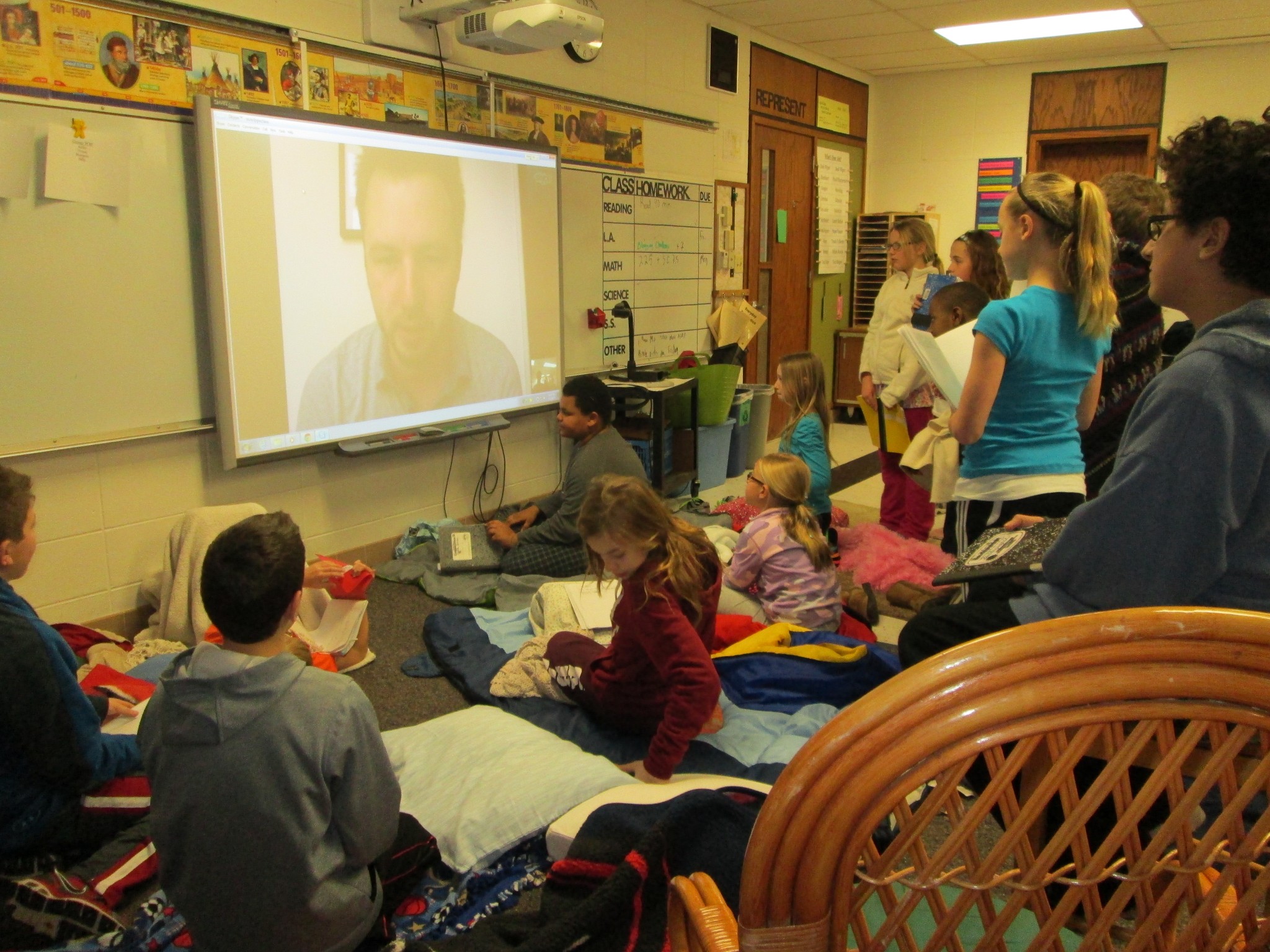
Students speak to author Adam Gidwitz

How about using Skype to do market research?  We did just that in our epic nonfiction picture book project where the students had to write a book catered to a K and 1st grade audience.  So voila, through the magic of Skype we spoke to several classrooms throughout North America and learned what we need to learn to make our books so much better.

How about speaking with an author?  This has always been one of my favorite ways to use Skype since so many authors speak to classrooms either completely free or for very cheap.  It is powerful for students to see the genius behind their most favorite books and only heightens their experience with the book.  Did you know that the incredible Kate Messner has a list of authors who Skype for free?

How about working on geography skills while building community?  That is exactly what playing Mystery Skype has done for my students.  If you have never tried this simple guessing game, please make sure you plan one this year.  They are so easy to plan and incredible to be a part of. This is always one of the most favorite things my students do throughout the year.

How about having students teach others how to do something?  My students have used Skype to teach others how to blog and how to play Mystery Skype.  They have been teachers for other classes and other teachers.  Think of the power in that!

How about using it to share book recommendations?  As summer nears, my students are adding books to their “Plan to read” lists and a great way to get more suggestions is by scheduling Skype calls with other students eager to recommend great books.  This is a great way to get new suggestions both for my students and for my own classroom library and it seems to hold more power when it is a student-to-student recommendation rather than just me book-talking.

How about bringing an audience to you?  It would cost a lot of money for my students to visit an elementary school to perform or speak, but via Skype our audience can come to us.  So whenever the chance exists, I try to bring in a live audience through the camera.  Having the live audience ups my students’ performance and gives us a way to connect with others.

How about learning about other cultures?  I think we often think that every call has to be planned out and structured but sometimes just giving students tim e to  speak to other students can be exciting within itself.  One of my classes spoke to a school in inner-city New York, something I did not think would mean much to them because it was not out of the country, but the experience rattled them.  They could not believe how different their school and community was from theirs.  That call cemented something that I had been telling them all year but that they didn’t quite believe; America is a very diverse nation indeed.

How about to raise awareness?  My students have used Skype calls to raise awareness about the “R” words, bullying, and other issues near and dear to their heart.  Again, by providing them with a platform to spread their message that extends beyond our classroom walls, they see the significance that their words may carry.

And finally, how about to learn something more?  With the massive network of experts that Skype In the Classroom provides it has never been easier to bring in someone who knows more than me to help the students learn.  All I have to do is search for what I need and I can almost always find someone who matches that.  I love showcasing new fields of information to the students, and they love getting to ask even the weirdest questions.

I am a passionate teacher in Oregon, Wisconsin, USA but originally from Denmark,  who has taught 4th, 5th, and 7th grade.  Proud techy geek, and mass consumer of incredible books. Creator of the Global Read Aloud Project, Co-founder of EdCamp MadWI, and believer in all children.  The second edition of my first book Passionate Learners – How to Engage and Empower Your Students” is available for pre-order now.   Second book“Empowered Schools, Empowered Students – Creating Connected and Invested Learners” is out now from Corwin Press.  Join ourPassionate Learners community on Facebook and follow me on Twitter @PernilleRipp.