Be the change, reflection, Student-centered

We Must Create Room for Failure and Mean It

image from icanread

“…I failed…” the disappointment leaks from my student as he looks at his contraption.

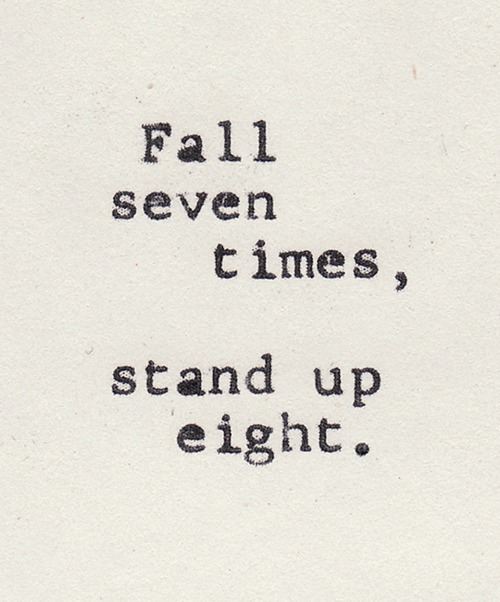
I am stopped by his words because it is March and we have been trying to embrace failure since September.  Failure is our friend, failure is something we learn from.  Failure is not the “f” word.  Not in this room.

And yet, here he sits, so upset with himself that I am not even sure I have the words to fix it.

I am reminded that embracing failure is not just a line we say to our students.  We must fully live it out in our rooms.  We must admit our own failures, I know I do, and then celebrate the learning that happens from them.  But more importantly we must assess students not just on how successful they were with something but also their persistence in trying.  We must move away from the thinking that to succeed means that the project or product is correct and adopt the notion that success can take on many shapes.  That perhaps success to one child is that they didn’t give up.  To another that they attempted in the first place.

This is not to say that students should not be pushed to succeed.  Of course they should.  All students need success in order to continue learning.  But it is to say that we need to assess students on more than their successes.  That we need a whole child approach that celebrates all of the steps in the journey without reducing them to just a little number.  Grades or numbers can never do that for us but our words can.

It took me a few seconds but I finally found the words to say.  “You didn’t fail, you tried and it didn’t work.  There is a big difference.  Now what can we do to make it better?” I walk away and give him time to think.

At the end of the day he comes up, says “I am taking it home to show my brother, I think I found a way to fix it.”  He smiles and leaves.

Failure is not something we should just pretend to accept – our actions, our words, our assessments must embrace it to.  We must celebrate the failures and give students time to learn from them.  We must discuss the growth, the trial, and the ideas.  We must be more than a motivational poster.

Student-centered

Project Time and How My Students Made It Theirs

In our classroom we have been big fans of genius hour and Innovation Day.  yet when I realized that my 30 minute block of resource time ( a block meant for remediation/intervention and enrichment) wasn’t being used to its fullest, I knew I had a chance to change things.  So during a creative burst, our new resource time rotation schedule was born and within came something new – project time, or just time to learn.

photo

I love genius hour, I love Innovation Day, I love the idea of learning and creating something.  But I felt we were starting to focus too much on the creation part rather than just the learning part.  That too much time was spent creating the imagery of their learning rather than the learning itself.  So instead I asked the kids to do what we have called project time, 30 minutes once a week where they just get to learn.  Sure, they can create, sure they can make things, but they can also use the entire time to just read, study, ask questions, whatever they want to do.  I decided on a big category to help them  focus their curiosity, geography,  and with held breath I sat back.

The last two weeks have been incredible.  Students have read library books on countries, they have studied maps, they have created impromptu map quizzes, and yes, they have even created presentations.  The learning that has happened has been tangible as kids ask questions about the broader world, about their place in it.  When I asked them what they thought, the response was overwhelming; “We love it, Mrs. Ripp.  Please don’t change it.  What will we focus on next?”  (History for those who wonder).

So project time is here to stay, with a few tweaks requested by the kids.  More resources, computers if they are available, and study hall rather than dedicated spelling time.  It is a thing of wonder to see 26 students working on what they need to be working on without me standing over their shoulder.  Once again, my students are examples of what can happen when we trust kids  to take control of their learning, when we give them freedom to learn.  We should have more school like this.  I cannot wait to see what else they learn.


being me, reflection, Student-centered, students

Is it Okay That 5% Don’t Get It?

image from icanread

“…I wish I could do 5th grade over again…” the student looks at me sadness in his eyes.

“Why?” I ask.

“Because then maybe I would have a chance at getting it.”

My heart breaks.  This kid has tried so hard but the holes in knowledge just seem to grow as our curriculum picks up speed and we are asking them to do more, figure out more, understand deeper.  The math test he holds in his hands with all of the circled problems, asking to be fixed, seems to be insurmountable at the moment.  So I rack my brain, what else can we do?  My team and I try so hard to reach every kid, to fill in the holes, to help them understand not just regurgitate and yet it is not enough.  Some of our kids still don’t get math, some of our kids still don’t grow in areas where we have tried so hard.

And this isn’t the first year, every year we have these kids.  These kids that show up with gaps already.  These kids that work hard, even if they get a bit distracted, and yet what we are doing is simply not enough.  The language we speak in math is above them and no matter how much we try with smaller groups and remediation it doesn’t catch them up.  So we keep on pushing, hoping that something clicks and then pass them on to the next year’s teachers hoping that perhaps they have the solution.

We tend to feel successful in our math instruction because most of our kids get it.  Most of our kids do well on tests.  Most of our kids grow a lot.  But is “most” enough anymore?  Can we really say we are successful if all the kids are not getting it?  Is it okay to base success on the 95% that do and just live with the 5% that don’t.  I don’t think it is anymore, but I don’t know how to help them. Yet.  How do we reach those kids with their gaping holes in a day that is already chock full of new?  How do we build up their confidence?  How do we make the curriculum accessible?

I hope you have some ideas to share.


So we can do two things.  We can say that is just how it is.  That every year some kids will not grow as much as they should.  That we tried our hardest  and hopefully some of it stuck even though we know it was not enough.  After all, most of our kids do just fine with the curriculum, so what are a few loses?  Or we can do as my team does.  Get to gether and try to come up with a new plan.  Try again.  Try to reach every kid.

Reading, Student-centered

For the Love of Book Clubs – Creating Meaningful Conversations

“….I think you are right because…”

“…on page he said…”

“…I really connected with…”

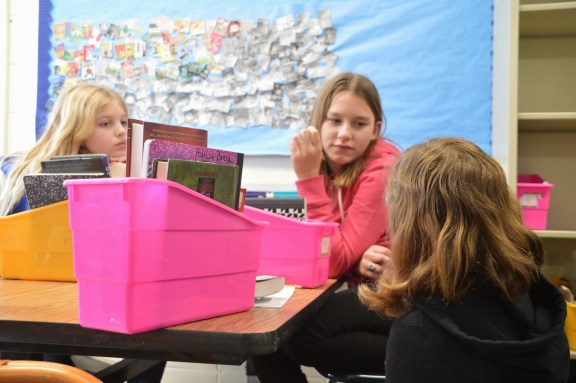
I am drifting around my classroom listening in on the book club conversations happening during reading.  Some times I stop and guide, other times I just listen, smile and move on.  What a glorious sight indeed, 26 students discussing their books.

It wasn’t always this way in my room.  I remember the days of guided reading, teacher front and center, and the students skimming the surface of their books waiting for their turn to read aloud.  I remember the times when 2 children dominated every conversation and others just watched.  Or the time when I thought book clubs meant I had to have all of the questions prepared in all of the books.  Gone are those days and thank goodness they are.  So how did we get to this stage, because I can tell you it didn’t just happen by magic!

  1. We started the first day of school.  The very first thing I did in my classroom was read aloud a book and ask my students to discuss it.  Everything we have built off started that day.
  2. We set the goal beyond school.  I don’t want my students to have deep conversations to get a good reading grade,  I want them to be able to have meaningful conversations about anything in life.  The goal is bigger than 5th grade and the students get that.
  3. I gave them a timeline.  I told the students that later in the year we would be in book clubs and so everything we were practicing in reading led up to this; real “adult” conversations about books.
  4. We practiced.  Deep conversations don’t just happen so we practiced with every read aloud.  That way the students had a shared experience to discuss without it taking up much time.  Practice wasn’t just out loud, students would also write down what their response would be on post-its, thus allowing everyone a chance to be a part of the conversation.
  5. We built off each other.  Younger readers tend to state their opinion without really listening  to what has been said before them.  I modeled how to build off what has just been said and students then practiced every chance we got.
  6. We did it across subjects.  Creating great discussions isn’t contained to just reading but is something we need in all subjects because it is a life skill.  We have many discussions across the board and they all practice the same skills with the goal of pushing our thoughts deeper.
  7. We created cheat sheets.  Students don’t always know what questions to ask to push a conversation so we created cheat cards together; little note cards with printed questions that they could refer to anytime they want.
  8. I stopped talking.  Rather than lead the conversation, I am now on the side coaching in and helping when needed.  I also have a designated weekly time set aside for each book club so that I can really see how it is going and help as needed.  It has been wonderful to see the clubs grow.
  9. They picked the book.  And abandoned the book if needed.  Just as every book doesn’t work as a read aloud, every bookd doesn’t work as a book club book either.  Students had about 12 different books to choose between and gave me a top 4.  Each group knows they can abandon the book if it does not live up to their expectations but that it needs to be a shared experience.
  10. They set the expectations and the pace.  Before we started reading, all groups met to create the expectations within their group.  They discussed what they should look like, sound like, and feel like and then created a poster.  All the posters are different based on the group.  The groups also decide how many pages they are going to read every day, leading to 100% completion and buy-in.

My students know that book clubs are their chance to show off everything they have learned in reading, but also that it is bigger than that.  Book clubs are not just reading and discussing a shared book, it is about growing as a person.  I am so proud of my students and what they are accomplishing.

photo 3
Book Club Expectations

photo 1

photo 2
Book Club Expectations

Be the change, being a teacher, Student-centered

You Mean We Just Get to Learn?

image from etsy

The students look a bit confused as I finish speaking.  I wait a second and then ask them if they have any questions.

“No project?”

“Nope.”

“Nothing to present?”

“Not if you don’t want to.”

“Can we present if we want?”

“Sure, if we have time.”

Then smiles, murmurs, and whispered comments.

“Ok, Mrs. Ripp, this sounds fun.”

I have just told the students about our new resource time schedule and how I have built in project time – a  30 minute time block once a week for each child where they get to just learn something.   Not time to create a presentation, not time to think of how they will share what they have learned, not time to work on homework, but just pure, self-regulated learning for the fun of it.  Learning driven by their curiosity.  Learning driven by their desires.  Not genius hour even, just soaking in knowledge.

We decided as a group we would have an overarching theme every week, a common theme to get excited about, so geography will greet us next week.  The students can create if they want or they can just soak in knowledge.  They can work by themselves or learn with a friend.  They can decide what part of geography they want to learn out of need or out of interest.  I don’t set the direction, I don’t set the tone, I don’t tell them how.  I give them the time, they pick the tools, they push themselves.

I can’t wait to see what they learn.  I can’t wait to see what they do.


Be the change, being a teacher, reflection, Student-centered

Hey Why Don’t You…Some Ideas to Shake Up the Week

image from icanread

In one week I return to my amazing classroom full-time.  Done with a messed up maternity leave and eager to be back, yet sad to leave our little baby at home.  Being at home has let me not only snuggle 4 kids any time I want, but it has also allowed me to reflect on small changes I want to incorporate into my own routine when I get back  to my other kids.  Perhaps you will find some ideas to shake things up a bit as well.

  • Be a PD ninja.  So often we think of PD as a whole day affair but PD can also come in the form of a really great 5 minutes.  So why not print out an article and slap it on the bathroom door?  Why not forward a link to the whole staff?  Why not start a PD related discussion at lunch?  I love the little moments of learning that can be found in a day.
  • Ask your students.  I swear this should be on my non-existent business card.  My students have had an incredible sub while I was gone so the first thing I plan on doing is asking them what they loved about her way of teaching.  I love stealing ideas that have worked in my room already, we should always embrace our chance to grow from others.
  • Incorporate a talk break.  My students really struggle with transitions, they even blogged about it.  Yet instead of beating them up about it, I plan on incorporating a mini-talk break before we transition.  Students get a chance to switch their brains and also just get it out.  A few minutes invested in talking will hopefully pay off the whole day,
  • Seek mindfulness.  This article on mindfulness really made me think of how much it is needed in my room.  While I have yet to figure out where it will fit, I am going to make it fit somewhere.  I think we all need a moment to just be content and quiet as we tackle our learning.
  • Encourage unsupported reflection.  I get to do conferences the week I am back and as always they are student-led.  However, this time rather than having students fill out a questionnaire, I created a reflection sheet for them.  I really want to see where they are not just as thinkers, but also how they will express themselves.  How deep will they go in their conference when it isn’t just a fill in the blank sheet?
  • Make more connections.  We got really busy before winter break and then I went into the hospital and everything got a bit chaotic.  Making global connections was not our first priority.  So the first week I am back we have 2 mystery skypes and a literacy share in honor of World Read Aloud Day.  I have also reached out to a 5th grade in Australia to start a collaboration with them.
  • Start a continents project.  Geography seems to be the loser in our curriculum with very little time to figure out where we are in the world.  We will therefore be researching the continents and learning about the world during our resource block, hello Twitter connections!, what we will be doing I have not decided, after all, I need to ask my students.
  • Give back.  I was inspired by this article  on a 6 year old getting books for homeless children in NYC to think about what my own students could accomplish.  We will therefore be starting a service learning project as well, once again proving that even children can change the world.

I can’t wait.