
Be the change, reflection, students

We Must Be the First to Stop the Labels

Right after birth
Brandon was the first to notice it.  Moments after delivery, he asked the nurse, “What’s that on his face?” and he pointed to my newborn perfect little baby boy’s face and then waited.  The nurse looked at it and said “Probably a port-wine stain…”  At the moment I didn’t think much of it, perhaps it was a bruise like the doctor said, perhaps it was a strawberry birthmark that would go away, but a port-wine – probably not.  
The next day we had the verdict, yes, that nurse was right and he would need to go see a dermatologist quickly because of its placement.  (For those that do not know what a port-wine stain is, it is is birthmark that continues to grow as it fills with blood leaving the skin disfigured and dark purple as a person ages.)  Later we were told that because of the placement on his face, we had to get treatment or the further growth of the birthmark would pull his skin up into his nose and away from his teeth, meaning he would have a harder time breathing and eating.
But that night in the hospital, all I could see were two little babies who needed me.
Yet, now 3 years, I realize how often I stare at that birthmark.  How often I wonder what his face would be without it?  I know that in the scheme of things this is incredibly minor, a mark that treatment will hopefully help (so far it has helped very little).  And yet, it catches my eye too often and I realize that I have to be able to look past it.  That his face is still beautiful, that he is still perfect, that I did not do something wrong during my pregnancy.   That the world may judge him based on this mark, and that I therefore need to be the first champion of him, his rock if he ever needs it.
I think to the children in our classrooms that come to us with labels, whether physical or emotional ones.  That come to us with people’s eyes already upon them, expectations different somehow because of either choices made or things out of their control.  I think of those children and how I have to be their biggest champion at school, how I have to be the one that looks past everything and sees them for the whole kid they are.  Not whatever the world would rather categorize them as.  I have to be their rock if they ever need it.  I owe it to them and I owe it to Oskar.
For a long time, I didn’t post pictures to Facebook of Oskar right after treatment, he looks much like a prize fighter after the laser has done its work.  I didn’t want people to see how bad he looked, how much pain he had gone through.  I didn’t want him to be judged.  Now, though, I know that he does not care.  That he still has a life to explore whether I can see past this birthmark or not.  That he will not be stopped by something out of his control and neither should I be.  My little boy is perfect, this is the way he was made, and no, I didn’t do anything wrong in my pregnancy to cause it.  He bears no label as long as I do not create one for him.  And neither should any of our students.
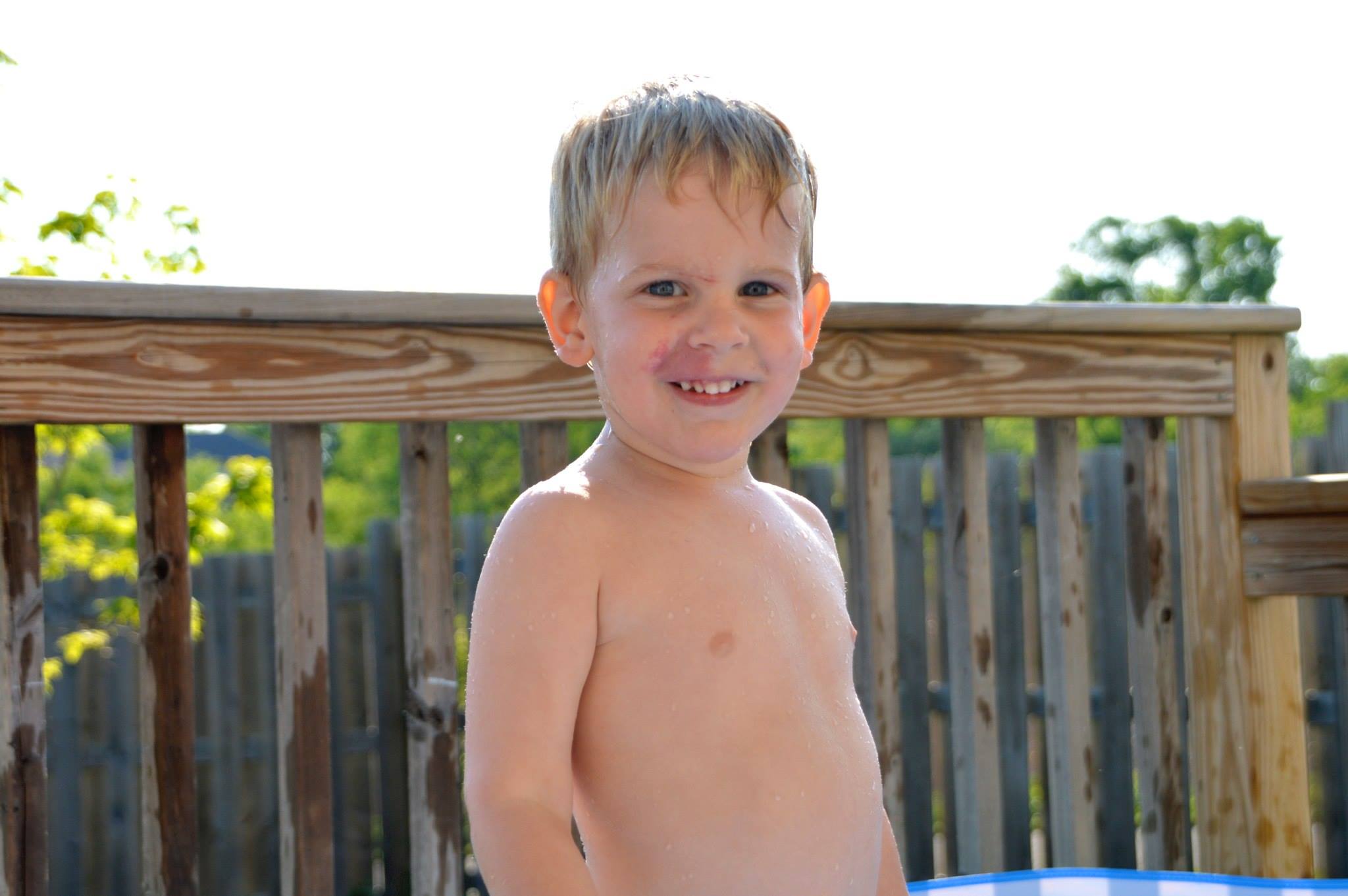
3 Years Old
If you like what you read here, consider reading my book Passionate Learners – How to Engage and Empower Your Students.  The 2nd edition and actual book-book (not just e-book!) comes out September 22nd from Routledge.
new teacher, new year, Reading

What Will You Do the Very First Moment of the First Day of the Year?

image from icanread

Yesterday I started setting up my classroom for next year, yes really, with 2 months almost left of vacation, I couldn’t wait to get in there and see what I needed to change, what worked already, and just fiddle with the room.  As I shelved new books that have found their way into my reading life, I pondered, how will I start this year?

Not how will the day go?  Not what will we do?  But how will I start the day, that very first day, with my so far 26 new students.  In the past we would have done an ice breaker, we would have done a pretend quiz on me (I know it’s mean but funny once the kids get that the quiz is about me and not curriculum), in the past I have even showed them exactly the way I wanted them to enter the room.  Great way to show who is the boss.

This year, I want it to be different though, I want us to focus on our passions and I want that to be the very first thing we do.  So instead of rules, instead of games, I will read a picture book to them.  Invite them to the carpet, tell them to get comfortable, and then share one of my passions; books.  I hope they have the courage to share their thoughts as w read, I hope they have courage to show their emotions as we read, I hope they have the courage to show that even though they are now the oldest kids in the school it is ok to think picture books are magical.

Which book?  I don’t know yet.  It could be the incredible “Bluebird” by Bob Staake, which is just as powerful as any books with words I have ever read.  Or how about the funny “Creepy Carrots” by Aaron Reynolds that show us that things aren’t always as they seem.  Or “This is a Book” by Dimitri Martin which would be a wonderful way to showcase another of my passions; blogging.  Or in the end it may be “Chu’s Day” by Neil Gaiman so that I can tell them that every time I read it aloud to Thea, she giggles when Chu doesn’t sneeze and that she is starting school this week too for the very time and I know that we start a new chapter with her just as I do with my new kids.  Perhaps it will be that one.  No matter the book, though, what matters is the thought behind it.

So what will you do the very first moment with your new kids?

I am a passionate 5th grade teacher in Middleton, Wisconsin, USA, proud techy geek, and mass consumer of incredible books. Creator of the Global Read Aloud Project, Co-founder of EdCamp MadWI, and believer in all children. I have no awards or accolades except for the lightbulbs that go off in my students’ heads every day.  First book “The Passionate Learner – Giving Our Classroom Back to Our Students Starting Today” will be released this fall from PLPress.   Follow me on Twitter @PernilleRipp.

Reading, student voice

Reading Book Clubs – A What To Do and What Not To Do

image from here

I have had the privilege of being a student at Teachers College this week and thus now have a brain bursting with ideas of what to do in reading this year to continue to grow our passion for reading.  One of the ideas I cannot wait to implement is book clubs, something I have implemented with limited success in previous years, mostly because I was going about it in a wrong manner.  While I wish these were my ideas, they are not, they are the ideas of many of the fabulous instructors at Teachers College so please check their stuff out for even more great ideas.  And as always, make it your own!

What I was doing wrong:

  • Thinking it was all about me.  I used to run book clubs like a guided reading group.  I facilitated all conversation, I decided the rules, I decided what to do.  
  • Have large clubs.  I thought it would be easiest if I grouped many kids together because then I would have to read and keep track of fewer books.
  • Have them meet on different days.  Again, since every club had to meet with me I had to do it on different days meaning I didn’t have much time to pull other small groups.
  • Deciding the book.  I thought I should determine the exact book because I knew best.
  • I set the goals.  And they were not really individual goals, they were for the group not for the kid.
  • I thought it was about the reading and their opinions, not their thoughts.  So kids just needed to speak about something, not actually engage in a discussion.
What I will do now:
  • Groups will be small.  4 kids at the most and they will get to write a list of 12-15 kids they would like to be in a group with.  
  • Groups will meet at the same time.  The noise level will work for everyone because everyone will be engaged in their own discussion.
  • Book choices will be determined by the kids.  There will be many choices for them of which book to read together.
  • The kids set the rules.  They determine how they want their book club to function, what the consequences should be for kids that don’t do their part, and how they will share.
  • The kids set their group goals.  The kids will be setting their own goals for their reading, including how much to read and what direction they want the conversation to go in.  
  • The kids set their individual goals.  Whether with me through a conference or by themselves depending on their ability, they will also make these public to the group so that they can support each other and hold each other accountable.
  • I will coach in.  I will not be in the middle but rather in the circle with the kids, helping if I need to, fishbowling for the class when needed, scaffolding if needed, and whispering in kids’ ears to get them to engage in the conversation.
  • Kids will problem-solve their club when needed.  They need to fix their clubs to create their learning community and that comes through working through problems, trusting each other, and growing together.
  • Give kids the tools they need to push their discussion further: help in the beginning, prompts for later, chart paper, post-its – whatever they need.
  • Confer often.  Pop in and out when needed and trust the kids.  This is about digging deeper into the text not just sharing ideas or opinions.
  • Support the kids to think deeper and discuss deeper.  Remind them that they should build off each other’s ideas and not just share their thought.
  • Book club meetings will be short.  These will be 5 or 10 minutes at the most so that students can have high quality , intense discussions, not drawn out conversations where they are not sure what they should discuss next.  This will also help create a sense of urgency and excitement.
  • Students will sit together in their clubs even when it is not a book club day.  That way they can still rely on each other for help as they read their book, even if they are not officially meeting.
  • You can put kids in book clubs without an actual book.  Early in the year you can group kids so that they start developing the trust and also develop their discussion habits.  I love this idea of a mini group that they know is theirs to use throughout the year, even if they are not actually reading the same book.
In the end, my biggest take away was that these book clubs are about the students developing deeper thoughts about their books through engaged discussion.  As Kathleen Tolan said, “We are not teaching kids to get them ready for the next grade, we are teaching them to get them ready for life.”  Book clubs are meant to be passionate discussions about great books that make us think.  I cannot wait to give this experience to my students.

I am a passionate 5th grade teacher in Middleton, Wisconsin, USA, proud techy geek, mass consumer of incredible books. Creator of the Global Read Aloud Project, Co-founder of EdCamp MadWI, and believer in all children. I have no awards or accolades except for the lightbulbs that go off in my students’ heads every day.  First book “The Passionate Learner – Giving Our Classroom Back to Our Students Starting Today” will be released this fall from PLPress but until then I muse on education on my blog “Blogging Through the Fourth Dimension.”   Follow me on Twitter @PernilleRipp.

Be the change, Reading, student choice

The Danger of the "Just Right" Books and Other Helpful Reading Interventions

My mother never told me what to read.  Neither did my teachers.  Sure, I was an insatiable reader, a child that loved riding her bike to the public library only to return with the biggest bag of books my handlebars could handle.  Sure, I would sometimes stay up past midnight just to see what would happen next.  Sure, I used to be able to read in the car without getting carsick.  And yet, it wasn’t because I read just right books. It wasn’t because I logged how many minutes I read at home and at school so that I could see the pattern.  It wasn’t even because my teacher told me I would love this book and I had to read it next.  It was simply because I loved the freedom of reading.

The freedom of reading….

How often do we discuss that in our classrooms?  How often do we just let our students read whatever they choose and then let them discuss however they want why they just loved reading whatever they chose?  How often do we let them sing the praises of a certain book even if it is not just right for a majority of the class?  How often do we let them try that book even if we think it may just be a tad too hard, too long, or too boring?

The freedom to read….

We seem obsessed with the particularity of reading.  Of breaking it down into nothing but strategies so that students understand what great readers do.  Of logging every minute and every page.  Of finding “just right” books through levels and forcing them upon children because we know best.  Yet the problem with breaking something down is after a while all of those pieces become just that; pieces, and we lose sight of why we did it at all.  When reading becomes a strategy to master, we forget about the love that should be a part of it as well.  When we take away students freedom to read, we take away a part of their passion, a step of the path to becoming kids who just love to read.  And when we continue to tell them what to read, we take away part of what it means to become a great reader: knowing thyself.

So when we discuss “Just right” books don’t forget that that may just mean just right for that kid.  Just right for their interest.  Just right for their passion.  Just right for their curiosity.  Just right for their need.  And that may have nothing to do with their reading level.  When we discuss strategies don’t forget the big picture and what the goal is.  When we discuss logs and minutes and genres, well, just don’t discuss reading logs, please.  In fact, do your students a favor and gt rid of them.   If you want to see why, read this post by Kathleen Sokolowski titld “How Do You Know They Are Reading?” and then think about it.

Give students the freedom to read so that they may want to read.  How powerfully simple is that.

Be the change, reflection, student choice

Our Classrooms Don’t Have To Be Perfect To Be Wonderful

image from icanread

Smeared glitter paint greets me as  I step into Thea’s room and my heart drops a little.  As I cautiously make my way through her piles of things, I spot more evidence of an artistic explosion scattered throughout the room.  A drenched fluff ball there.  Some brushes here.  Finally, in the corner sits the artist herself; beaming as she turns to me and says, “Mama, isn’t it beautiful – it is for you!”  She hands me a large, dripping wet, glitterfied painting in pink and purple shades and I bite my tongue.

I want to tell her she should have asked permission to use those paints.  I want to tell her that she should not be painting on her bedroom floor.  I want to tell her that she should be wearing her smock and have her hair pulled back.  Instead I say, “Yes, I love it!”  And I mean it, and I smile, and I hang it on the fridge, proud of what she has made all by herself.  The mess we can deal with together.

I think of my classroom, of how I meticulously try to plan our days together.  How I try to plan for when the students will create something and how that will be created.  Although I give as much choice as I can, I still feel that there needs to be a plan in place.  And yet, often the true beauty of a classroom lies within those independent, creative moments.  When a child takes it upon themselves to create something beautiful.

We tend to overplan, oversee, and over-manage our students, afraid that if we don’t it will be a big mess.  And sure, when students create on their own, it is messy, the room shows evidence of it, and yet, the excitement and pride cannot be emulated by any other activity.  The way students show off what they came up with, what they pushed themselves to do cannot be replicated by a prescribed assignment.

So when I advocate student voice and student choice, I think back to Thea, who stands at the beginning of her school career.  I hope that her teachers will see the artist she is inside, the creator she carries within her, and will build a classroom where creating, making, and exploring takes center-stage rather than just listening, doing, and producing.  I hope Thea, some day, will turn to her teacher and beam with pride as she shows her work, just as my students do, when I step back and let them create.

My classroom on Innovation Day – our favorite day of the year
Be the change, reflection, student voice

We Must Do More Than Just Engage Our Students

I recently had the privilege of having a post published on SmartBlog on something I am passonate about: student voice.  And while they called it ” How to give students a voice in the classroom” I like my title better, thus the title change.

Those who know me, know that student voice is one of my biggest passions in education. And not just any student voice, but including the voice of my students, all students, in the education that is being done to them every day. And yet, when I discuss student voice, many people assume it is just another quaint term for student engagement. The truth is that it is so much more. Student voice means giving students power to change the way education is happening, to offer them an outlet and an audience, to have their voices heard. To change the way I teach.
I fight every day to include my students in their own educational experience. I fight the standards that tell us that yes, students should participate but here is how. I fight the prescribed curriculum that tells us when to stop and discuss and tells us when to keep on moving because there are too many pages to get through in today’s lesson. I fight the traditional way of teaching where the teacher is in locked control, holds all of the power, holds all of the knowledge and decides how and to whom they dispense these precious droplets. I fight because if I don’t fight, my students don’t stand a fighting chance to have their voice heard either.
So every year, I give the classroom back to my students. Every year, I have them blog, and not just what I ask them to write about but whatever they feel like. Then I give them an audience through #comments4kids and Twitter and anybody else who will listen to the voice of these fifth-graders with their grand ideas. I don’t shy away from hard topics; I don’t shy away from criticism. I cannot grow as a teacher if I do not ask my students how I am doing. How do they feel about the education that they are forced to be a part of? I give the classroom back by asking for their ideas, what their path to learning should look like and then actually incorporating that into how we do things. If lessons are boring, we don’t just get through it; we stop, reflect, and then we change it.
I say all this because it is easier than we think. Giving students a voice is not the hard part in education; listening to it is. You have to realize that when students tell you that something is boring, boring may mean that they just don’t understand, boring may mean that they are having a bad day, and yes, boring may mean that it is putting them to sleep. To facilitate a community where students actually have the guts, because it is indeed about guts here, to tell you how they feel about what you are doing — that is the sign of ultimate success in my classroom.  Not the grades, not the test scores, but the kid who raises their hand, looks me in the eye and says, “Excuse me, but could we change this, please?”
So how do you start? First, you give them an outlet. Give them a blog. Kidblog can be set up in less than five minutes. Give them a Twitter account to connect them with others. Set up classroom discussion time. Ask them  to make the rules of the classroom. When they criticize; listen and change, discuss their ideas and come to meaningful agreements. Your change will give them the confidence that you are not out to get them. After each unit, ask them what they liked, ask them how it should change. At the end of the year, survey them. What was the best and what was the worst. Ask the tough questions and be prepared for the honest answers. Thank them every time they criticize in a meaningful manner. Thank them every time they come up with a suggestion. Sometimes their change is not doable, but oftentimes it is; be open, be aware, and be a learner alongside them. Ask yourself: Would I like being  a student in this classroom? If the answer is no, then figure out where to start with your change.