Uncategorized

Giving Grades is the Easy Way Out

Somewhere in the grade debate, colleges came into the picture.  As in if you don’t grade a student, they will never be able to get into college.  However, this simply isn’t true, in fact Alfie Kohn just discussed it in his latest article “The Case Against Grades.”  In it he also makes the point that even if a college did require grades, they don’t care about the grades from middle school or elementary school.  And yet as a nation we are obsessed with numbers and ranks.  We love to sort our children and compare them to others. Unfortunately because we have so many to get to, we do it the easy way; by assigning them a letter grade based on a percentage.

Now, you may think that I am bashing teachers who grade, but no, I am discussing the system that requires us to do so.  I grade.   I have to for trimester report cards, that is also the only time my students see a letter grade.  It is decided upon through a conversation between the student and where we discuss their progress and their goals.  Also, don’t confuse this for an attack on assessing students, because it is not.  Grades do not equal assessment at all times.

So let’s be frank, it is way easier for me to grade my students than it is to properly assess them.  Grading means I can tell them when something is due, collect it from them, take it home and based upon a rubric or key I assign their percentage which then translates into a grade.  All I then have to do is enter it into my gradebook and hand it back to the child.  Assessment done.  I don’t need to speak to the child about their work because it would not change how they did.  I could also dock them points if they handed it in late, or didn’t have their name on it.  I could dock them points for neatness or creativity, because I am the judge of both of those.

True assessment is messy and time consuming.  It involves speaking to the children about their work and their progress.  You have to find the time to speak to all of them about whatever they are working on.  You have to actually listen while they speak and brainstorm together.  And this can’t be a one-time visit either if the project is larger, then you have to find the time for multiple check-ins.  When the project is finished you look through it with the child.  You discuss its strengths, its weaknesses and how it could be improved.  You discuss what they have learned, what they have discovered, and sometimes you even let them take it back and work on it some more.  Those conversations don’t translate into neat percentages.  They don’t translate well into grades because my “A” is going to be different from anyone else’s “A.”  Together you assess and perhaps even find new venues for learning.  You walk away feeling that you know the child, their knowledge, their passions and what they need to focus on.  Percentages don’t tell you that.

Now I know what some will say; I don’t have time to discuss all of this with my students, especially people who have more than one classroom.  And to them I say; who decides what your assignments look like?  Who decides how the time is spent in the classroom?  We have more power over how we teach than we think, even with all of the crazy standards and regulations we all face.  We decide how the time is spent in our rooms, how material is covered, how students learn together.  We decide more than we know.

So next time you sit down to grade an assignment, wonder whether it can be done a different way.  Wonder whether this is truly giving you the best perception of the child’s learning and growth.  You might be surprised of what you realize.

Be the change, being a teacher, believe, failure, Student-centered

Please Don’t Mark It Wrong – How Our Society Raise Children Afraid to Fail

Another child stands by me asking for my help, 5 seconds after the assignment has been given, “But I just don’t get it, Mrs. Ripp…”  And I ask, because this is the 3rd time today that this child has come up to me immediately into work time, “Well, did you try?”  She hasn’t, she is scared, and she admits it readily;  “Please don’t circle it.  Please don’t mark it wrong.”  So upset, she raises her voice, pleads with me as if my circle matters.  As if my marker holds the power.  And I am stumped because how does a 5th grader get that scared of failing?

The truth is we are doing this to kids, we, this society in pursuit of perfection is doing it to our kids, because it was done to us as well.  My daughter, who granted is only a wise two and a half year old is not afraid to fail.  She gets frustrated sure, but she tries and tries and then sometimes tries again.  We encourage this at home, urging her on, urging her to explore, to pick herself up.  Again, again, again.  Will she be the child in 8 years that stands petrified in front of me, asking for help because trying seems too daunting?

No teacher or parent tries to make their child afraid of failure.  Yet our practices in schools support this notion that failure is the worst thing that can happen.  An incorrect answer on a test pulls down your grade, you get enough, and you get an F for failure stamped across it for the world to see.  That F means nothing valid, nothing worth reading here, nothing worth.  Homework that is meant to be practice is tabulated, calculated, and spit out on our report cards.  The child who gets the answer right is heralded as smart, the child who gets it wrong is told to keep trying and maybe they will get it someday.

How we run our classrooms directly affect how students feel about themselves.  About how they feel about their own capabilities and their own intelligence.  I fail all the time in front my kids, not on purpose, I try stuff and it doesn’t work and we talk about it.  And yet,  I am not perfect either.  I catch myself in using practice problems as assessment, where really they should be viewed just as practice.  I praise the kids that get it right and sometimes don’t praise the ones that kept persisting but never reach a correct answer.  I don’t alway have enough time to explore all of the options so I guide the kids toward success knowing that some venues will lead them to failure.  I shield them from it sometimes because I don’t want to crush their spirits.

We have to stand up for our children and we have to turn this notion around that failure is the worst thing that can happen.  Failure is not the worst; not trying is.  We have to keep our kids believing in themselves and having enough confidence to try something.  If we don’t we are raising kids that follow all of the rules, that never take risks, that never discover something new.   And that failure is too big to remedy.

collaboration, connections, projects, skype, Student-centered

So You Want to Do Mystery Skype?

Mystery Skype is one of those ideas I wish I had thought because it just so fun but instead I was lucky enough to hear about it from Caren MacConnell.  The concept is simple:  classrooms Skype call each other and try to guess where the other classroom is located either in the United States or in the world.   There are many great resources out there but for my own sanity I am creating one list for future reference:Before the call:

  1. Sign up – there are many places to sign up and some are even grade level based.  I signed up a couple of places but also tweeted it out; the response was immediate as a lot of people are doing this.  If you would like to sign up:
    1. 4th Chat Mystery Skype
    2. 6th Chat Mystery Skype
    3. Mystery Country/Mystery State
    4. The Official Mystery Skype Community from Skype
  2. Decide on a date and time – don’t forget to consider in timezones.
  3. Prepare the kids
    1. We wanted to know facts about our own state so that we would be ready for any question.  We therefore researched the following questions: climate, region, neighboring states, time zone, capital, famous landmarks, geographical location.  All of this gave the students a better grip of what they might be asked.
    2. We also brainstormed questions to possibly ask.  We like the concept of the questions having to have yes or no answers as it makes the game a little harder and has the students work on their questioning skills.  Questions we came up with included whether they were in the United States, whether they were east of the Mississippi, Whether they were West of the Rocky Mountains, If they were in a specific region, whether they border other countries, whether they are landlocked etc.
    3. Give jobs.  I think it is most fun when the kids all have jobs, so this was a list of our jobs:
      1. Greeters – Say hello to the class and some cool facts about the class – without giving away the location.
      2. Inquirers – these kids ask the questions and are the voice of the classroom.  They can  also be the ones that answer the questions.
      3. Answerers – if you have a lot of kids it is nice to have designated question answerers – they should know their state facts pretty well.
      4. Think tanks – I had students sit ina group and figure out the clues based on the information they knew.  Our $2 whiteboards came in handy for this.
      5. Question keepers – these students typed all of the questions and answers for us to review later.
      6. Google mappers – two students were on Google maps studying the terrain and piecing together clues.
      7. Atlas mapper – two students used atlases and our pull down map to also piece together clues.
      8. Clue keepers – worked closely with answerers and inquirers to help guide them in their questioning.
      9. Runners – Students that runs from group to group relaying information.
      10. Photographer – takes pictures during the call
      11. Clue Markers – These students worked with puzzles of the United States and maps to remove any states that didn’t fit into the clues given.
      12. Problem solver – this student helped students with any issues they may encounter during the call.
      13. Closers – End the call in a nice manner after guesses have been given.
    4. Note my students have since then tweaked these jobs – here is a link to our new Mystery Skype jobs

During the Call:
During the call you just have to step back and trust the kids.  My students were incredible, both with their enthusiasm and their knowledge, I think I was more nervous than they were.  I did have to fact check some of their answers so I did stay close by but otherwise it ran pretty smoothly.  We decided which class would go first with their first question and then there were two options:

  • Yes answer: They get to ask another question.
  • No answer – Other team’s turn to ask a question.

Students were allowed to guess whenever they thought they had a great answer (and it was their turn).  In the end, both classes were able to guess each other’s location.
One note; Don’t allow kids to use the Internet to try to google the other class – it spoils the geographical purpose of the challenge.

A list of questions as created by my students to help you start.


Resources:
For our preparation for this, I showed the kids this video on Linda Yollis’ blog – it really gave the students a concrete example of what to expect and they got very excited. Also Mr. Avery has a great discussion of jobs he had students do during the call.
Jerry Blumengarten also has a nice collection of links on one of his many pages that was helpful to me.

Here is a video of our first call with Joan Young’s class

We are already excited to try it again!

being me

So We Lost…But We Didn’t Really

So what do you think when you see you are no longer in the running to win The Great American Teach Off?  Bummedness at first, after all $10,000 is almost half my net salary and would go an incredibly long way in my school, but then something else… relief.  You see, who would want to be at their most innovative 4 years into their teaching career?  Who would want to peak at such a young age when I have so many years of teaching still left in me?  I hope that when I am 70, I can look back at my years of teaching and see the change, the progress.

So while my students were so disappointed, I was just fine with the news.  We have new challenges to face, new ideas (and old ones) to explore, and new things to learn.   We are on to the next adventure; thank you for believing and thank you for voting for us.

education reform

Why Are So Many Students Absent?

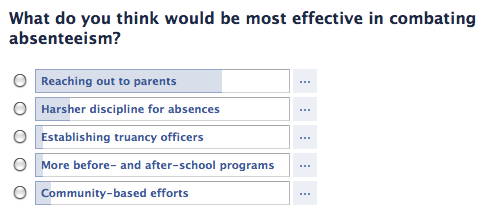
Today Education Week is running a poll on their Facebook page asking the question:
What do you think would be the most effective in combating absenteeism?

The choices:

  • Reaching out to parents
  • Harsher discipline for students
  • Establishing truancy officers
  • More before – and after-school programs
  • Community-based efforts
And while some of these ideas are not bad, the most effective method isn’t even mentioned:  
Have engaging curriculum with student choice.  Until we make school worth coming to, students are not going to be invested.
Really, Education Week, you couldn’t think of that?
education reform

The Creation of the Lifelong Learner

Crossposted from The Cooperative Catalyst


“Mommy!!!  BUG!!!”  Thea screams at me as we walk around our deck.  ”Lookit mommy, bug,” she runs to me grabs my hand and pulls me near. Behold; the lifelong learner sans education.
Children are naturally curious; if you give them a box they are not allowed to open, they will beg and beg until they finally get to peek inside.  If you tape a box on the floor of your classroom, they will continue to guess at its purpose even past the big reveal.  Children do not need rules to be curious, or even strategies. They are born with this ability.  Now as educators we may fine-tune these skills but schools cannot take credit for their natural curiosity.
So why is it so many schools have a vision statement that includes “creating lifelong learners?”  Why this need to take credit for something they have not indeed created?   Do schools really think that children are not learners when they first enter the hallowed hallways and they therefore need to be fixed?   What an offensive statement to parents everywhere.  Yet schools and the rigidity of some classrooms can often be the reason that the lifelong learner is stymied.  Schools end up breaking the child’s curiosity only to try to take credit for it being re-built.
I would like to see a school with a vision that declares they want to “maintain lifelong learners.”  I would like to see a vision in which children are recognized as the insatiably curious learners they truly are.  We have to change our schools to allow time for curiosity and true exploration.  We are not in the business of creating robots, and yet, that is the direction our government wants to push us.  Bring back the curiosity, maintain the lifelong learner, and perhaps then our system wont seem so broken.