They get so excited sometimes that they yell out. They get so loud in their planning that I just let them work because I don’t want to intrude. They break their pencils because they just want to scribble so fast when inspiration strikes. They come to me and wonder what else can we do? What other things may we try? Is this idea any good? And I say yes, try it, do it, think it, dream it. You may not think that our kids are doing enough in school. You may not think that our kids are learning enough. I say, come into my room and we will prove you wrong.
When We Compare Test Scores
- They have had a good night’s sleep
- They are not hungry
- They do not have any family or friendships issues distracting them
- They have all had access to the same information
- They have all had the same chance for practice
- They have all had the same teaching leading up to the test
- They all have the same type environment in which to take the test
- They all speak and understand English at the same level
What if just one of those assumptions is incorrect, or worse, what if they all are?
These 5th Graders Recommend
The Invention of Hugo Cabret by Brian Selznick
Eragon series by Christopher Paolini
The Schwa Was Here by Neal Shusterman
Number the Stars by Lois Lowry
The Alchemyst by Michael Scott
13 Gifts by Wendy Mass
Little House on the Prairie by Laura Ingalls Wilder
Spiderwick Chronicles by Holly Black
Camp Confidential by Melissa J. Morgan
Soulsurfer by Bethany Hamilton
Amulet Series by Kazu Kibuishi
The Secret of Platform 13 by Eva Ibbotson
The Lost Children by Carolyn Cohagan
Ghosts in the Fog by Samantha Seiple
Tuck Everlasting by Natalie Babbitt
Rules by Cynthia Lord
The Miraculous Journey of Edward Tulane by Kate DiCamillo
The Lightning Thief Series by Rick Riordan
Ability Grouping Versus Tracking – What’s in a Name?
For math you can do flex grouping, also based somewhat on ability as determined through pre-tests and personalties, and this too is totally permissible. It allows for smaller groups and different pacing of curriculum, as well as remediation and enrichment.
Yet, if you take away the gentler names and introduce the word “tracking”, then both of these scenarios lose their luster. So I wonder, out loud as usual, is ability grouping really just tracking with a kinder name?
If we ability group in elementary are we setting students on their path for the rest of their academic career or are we indeed teaching them within their zone of proximal development and then spurring further growth? Are we able to group students in such a way that all are challenged at their level without breaking them apart? Can we effectively meet every single child’s needs within in a classroom setting during our instruction time without identifying which skill they specifically need to work on and them grouping them to work on them?
I would love your thoughts on this.
Theirs
Now I organize myself, leave their piles, smile as I shut off the lights and think, “This is their room now.”
We Did It to Ourselves
Teachers are their own worst enemy it seems. We are not expected to share our successes in case someone gets offended that they are not being highlighted. We are not expected to shine a light on the things we do well in our jobs, and there are many, because someone may get jealous. We shouldn’t draw attention, rather pass it to our kids. We shouldn’t tell people our pay, or how many hours we put in but rather stand as saints hoping someone might notice. Indeed we are expected to stand up for our students, but not for ourselves because it is just so uncouth. We are supposed to be selfless, with no wants besides the basics; food, shelter, and maybe some respect. We are not supposed to say that we would like better pay for the incredible amount of work we do. We are not supposed to say; look at me, look at what I do, and give me some respect. (Which yes, can be done in a nice manner, that then can be easily dismissed).
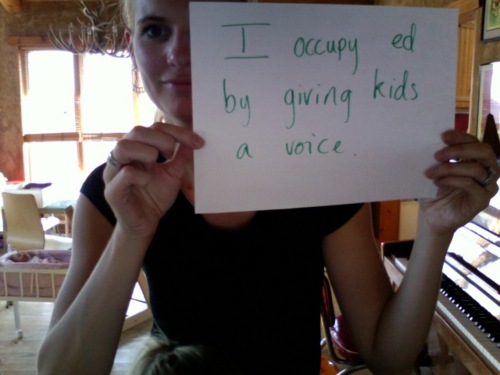
Teachers should play nice, like we tell our students. Don’t cause too many waves because it is unbecoming of our profession. Don’t raise your voice too much because you may offend. Whatever happens to us, happens, because we choose to not raise our voice, to not band together, and instead waste our time fighting amongst ourselves. It is time to rise up, it is time to raise our voice, to occupy our classrooms and stand tall. To highlight the incredible work we do, to get the respect we deserve. To be treated like we treat our students. So as I give my students a voice, I allow myself to speak as well. We are the 99% and together our whispers will become a roar.
