being a teacher, hopes

Have Hope

DevineMusic.org.uk Photo Credit

Some people say that they are tired of fighting.  That this is the end of education.  That the reform has gotten so far out of hand that there is no more room for common sense, for creative thinkers, for partnership.  Some people say that our students will suffer, and yes I agree, but some see no end to it all.  No winning, no change, just more tests, more papers, more, more, more – with less.

I say there is hope.  That amongst all of this fear, all of this uncertainty, we can still look at our students and see that spark.  That they know we suffer through testing with them and we teach them to be resilient.  We teach them that sometimes life asks you to do things that  make no sense, and we must get through it with grace, valor, and creativity.

So when it all seems to be too much, too crazy, too little, too late, think of the students.  Think of what we do for them every day when they enter their rooms at school, when we tell them good morning, when we end the day by saying thank you.  Thank you for being part of this, thank you for being part of something that is bigger than us, for placing your faith in me as your teacher.  For placing your faith in this school and this wonderful learning journey.  Have hope; our students do every day.

challenge, connect, connections, honesty

A Challenge to All

I was the new kid in town 4 times before I turned 14.  I hated being the new kid.  My sister, Christine, was a dazzler.  She made new friends simply because she arrived, she drew people to her, and she still does.  I was the awkward kid that kind of looked like a boy, had huge feet, and was way too serious for her age.  Not a great combination for dazzling new people.  So when I first joined Twitter, I felt the clammy hand of past embarrassment gain hold of me.  What if no one cared?  What if no one responded?  What if no one followed?  I want to say that I joined Twitter to learn, which I did, but I also joined the blogging and tweeting world to connect with people, and it is this connection that keeps me coming back every day.  It’s the connection that urges me to get others to join, that makes me write my heart out on this blog, and that makes me push myself into new challenges.  But what if you just can’t make that connection?

There were a couple of people who immidiately took me under their wing Lisa Dabbs @Teachingwthsoul, Edna Sackson @WhatEdSaid and Joan Young @Florishingkids.  If it hadn’t been for them, I don’t think I would still be tweeting.  So as I look at my own follower count and see it grow way beyond this shy girl’s expectations, I wonder, who can I reach out to and how?  How can we make deeper connections, especially with those people that like me felt like the new kid in town?  How can we let people know that Twitter is all about connections and not to be afraid to reach out?

I think a movement has gained momentum lately spearheaded by Katie Hellerman who posted this incredible video: The Connection Challenge.  This then sparked an amazing post by Jabiz Raisdana called “Next Level” which urged us all to reach out and open up.  Cale Birks came up with the idea of the Ten Picture Tour of our schools, which you can follow on Twitter under #10PIXTR. And today Justin Tarte wrote a great post asking what can we do to keep the momentum going called “It’s All about Sustainable Momentum..” 

So I have been wanting to open up, after all, I am way to honest on my blog anyway.  And the one world that we often keep hidden is our home, afterall, we can hide behind our computers. What if we did the 10 picture of our homes instead?  Wouldn’t that also provide another layer to our connection?  If you see the mess I sit in every day when I blog, will it make you know me better?  So I offer up this challenge:

Do a 10 picture tour of your home.  Nothing fancy, I don’t expect masterpieces.

Post it on your blog and tweet it out using the same hashtag #10PIXTR (I hope that’s alright).

 Let’s see if we can take this connection one step further.

education reform, hopes, testing

Bring Back the Thinking

One of the biggest struggles in my classroom and teaching is how to infer.  This vast concept of being able to process information and knowledge to produce an answer is a lifeskill, one of those daunting tasks as a teacher that we must accomplish making sense of for our students.  I don’t think the students are the problem, in fact, they are quite creative in their thinking; it is the educational system as a whole that is to blame for this.

With an emphasis on tests we teach students there is only one packaged answer, at least at the elementary level.  We do not teach them that the answer can be deeper than just one sentence or that their answer may differ from ours.  Why?  Because you cannot measure that on a test.  A test requires one bubble filled in or writing that fits into someones rubric.  A test requires conformity in our thinking and particularly in our creative problem-solving skills.  Tests do not like when we debate or argue various points.  Tests urge simplicity in our instruction.

That is not to say that all tests are bad.  We often discuss how it is what you do with the information that measures the worth of a test, and yet, tests hinder us from doing exceptional things in the classroom on a daily basis.  That urgent need to constantly check for progress through a test experience, stiffles students in their quest to become bigger and better thinkers, and to help create inferences.  SO most of our instruction is teaching to the test, math has one answer, when we ask questions they almost always have one answer as well.  Teacher bias means a need for student thinking to line up with their own interpretation, so it becomes right versus wrong.   After all, how many of us after the correct answer has been given, stop to ask whether there are other correct answers?

So why am I so hung up on inferences?  Well, they require that one gathers a lot of information, mixes it up with background knowledge, and then draws a new conclusion.  Inference requires confidence in ones own qualities as a thinker, as an independent creator.  Tests do not teach confidence.  My instruction attempts to, yet I am constantly battling students who think that there is just ONE answer.  After all, that is what they have been taught.  So if they miss that one true answer, then they must be stupid.  It appears that we, by pushing tests on our students, become the creators of our own demise; students who have no confidence in their abilities to learn.  And by “We” I mean the system as a whole.  In our incessant quest to measure, we are dumbing down our student population, urging them not to think creatively but rather stick to the known, the facts, the things that can be measured.  We are making them believe that the world has a right and wrong answer in every scenario, but it doesn’t.  No wonder some of our most successful thinkers did not feel the urge to complete college.  We have to get past the one answer tests to help our students.  We have to get past the constant need for progress measurement.  Get back to teaching.  Get back to discussion.  Get back to creative solutions.  It is time to bring the thinking back in education.

our classroom, pictures, school staff, tour

Ten Picture Tour – Plus One

Inspired by three fantastic people Cale Birk @birklearns, Katie Hellerman @TheTeachingGame and Jabiz Raisdana @Intrepid Teacher, I am happy to open up and share 10 pictures + 1 of my school environment.  So this is West Middleton Elementary…

The long hallway that I walk countless times a day.  Our building has been added to  3 times at least, each time it seems, adding another hallway.

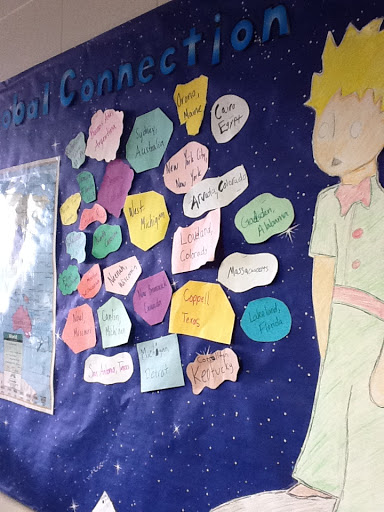
As the founder of the Global Read Aloud, we have the Little Prince watching over us and all of the connections we make around the globe.

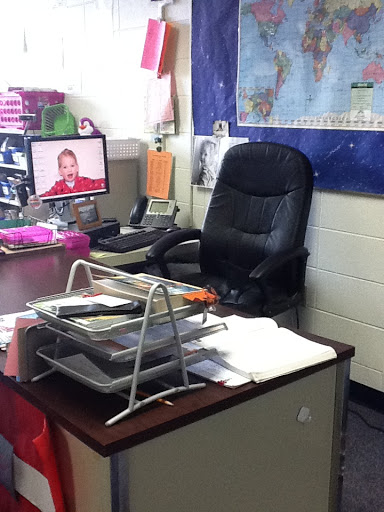
A very unmessy desk day, usually I have piles of stuff my students want me to watch or read, as well as all their work.  However, I leave a clean desk every single night – sick habit.  Notice my daughter’s picture on the computer, I change it weekly so the kids can see her too.

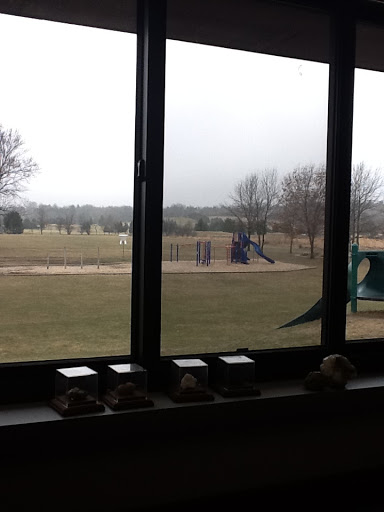
The school lies off a busy road leading out of Madison but my window looks into the playground area.  I have the most divine sunlight come in and we almost never have all of our artificial lights on in the room.

We are taking part in the Students Rebuild crane folding, I never knew how to fold origami before this and the kids are way better than I am.  It has been amazing to see student leaders emerge in this and the kids get fired up over helping others.

Being a native Dane I was raised on the fairy-tales of Hans Christian Andersen so a big thrill of mine is the annual fairy tale unit I do.  We go all the way back to the gruesome versions and then discuss the moral of the story from back then.  Right now we are reading “The Little Mermaid.”

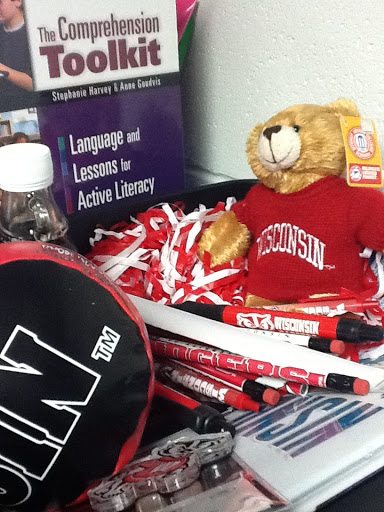
A special collection of gifts for a care package we are mailing to Mr Foteah’s class in New York City – Matt, no peeking!  

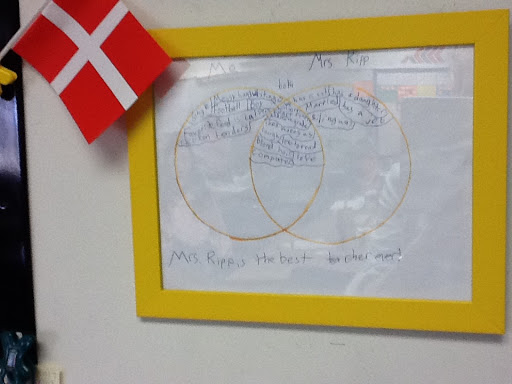
A Venn diagram given to me by my favorite Nolan.  He surprised me with it on our last day together as a split class.  One circle is him, the other is me.  If I ever have a bad day; this is what matters.

Another reference to The Little Prince reminds me every day what my teaching philosophy is; if the kids fail, it is my fault.

They put me in the kindergarten wing, which means I get to look at incredible colorful art every day.

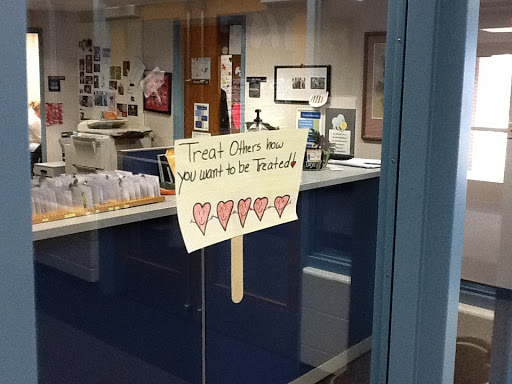
A glimpse at our office run by the amazing Sue.  Our school is fighting bullying and 5th graders have put up slogans all over.

 For other amazing 10 picture tours make sure you check out:
@mmhoward: http://bit.ly/gIjcDg@johnnybevacqua: http://bit.ly/gxJDqH
@birklearns: http://tiny.cc/18o9s@justintarte: http://tiny.cc/kawd1

@thetheachingGame:  http://ow.ly/4vGcW 

attention, authentic learning, being me, questions

A Lesson from Dora the Explorer

Image taken from Nickelodeon

It appears that when colleges panic or run out of ideas of how to teach, they take their cue straight from Dora the Explorer when it comes to teaching people how to teach.  I reached this conclusion at about 5:30 AM this morning as my daughter insisted on watching another episode.  You see, bear with me here, but Dora asks her audience for participation – my daughter does not participate, so silence fills the void.  Dora then asks for affirmation in her answer, still silence, sometimes “right” squeaks from my two-year old.  Classic call and response.  Isn’t this the same approach we are first taught in college when we learn how to be effective teachers; ask a  question, then reaffirm the answer?  So what’s the problem, after all, Dora is successful?  Well, when you ask a very simple question, you receive simple answers.  And sure many colleges flaunt Blooms Taxonomy and points to it for inspiration, but day-to-day how many of us really reach deeper level thinking?

Instead we ask the simple questions, not quite yes or no, but close, and then when we perhaps do receive an answer we reaffirm by restating, and then we feel great.  Look at how much they are learning!  Now Dora can be excused in this matter, after all her target audience is 2 to 3 year olds who are just learning the language.  We cannot.  We are meant to ask questions that do not always appear straightforward; clear yes, but not always with an easy answer.  One of my biggest challenges has been to kick myself out of easy question land and and instead answer most questions with another question.  Dora never does that, she waits patiently the appropriate wait time (2 seconds roughly) and then squeaks “right?”  My daughter patiently waits for the action to continue, she is trained to know that at some point Dora will speak again.  Our students know that we too will fill the silence, if they stay quiet or passive long enough, we will take over and give them all of the answers.

If we do not heighten our questioning skills in the classroom, we create an audience of learners.  One child may be brave enough to answer our question, yet the others remain passive, knowing that either way, the answer will be given to them.  What if we didn’t provide the answer?  What if we stopped talking?  Instead offering up deeper-level questions and when we don’t have any, turn the table.  Which questions do the students have?  Could we move our classrooms away from call-and-response, reaffirmation, or even just mere audience participation?  Could we make our students engage by simply changing our own engagement?

Who knew, Dora had such deep lessons embedded. 

hopes

A Dream

I dream of being a teacher that learns along with her students.  I dream that for my children to soar I must soar along with them.  That we shall reach our dreams through hard work, diligence, and creativity.  I dream to be the teacher that says “yes” instead of “no,”  “do it” rather than “stop,” “dream it” instead of “hmmm.”  I dream of a classroom where students are engaged, on the floor, in chairs, on top of desks, busy learning because that is what they want to do not just what they are expected to do.  I dream of a school that encourages collaborations and even gives us time to do it knowing that we are only as strong as our weakest idea.

I dream of a classroom where student questions come before teacher lesson plans.  Where the goal may have been set but the journey is always being recreated, invented, or totally changed.  I dream of a school where children cannot wait to come to class because they know that they will leave there being better, more, bigger somehow.

I dream to be a teacher of all students, where culture and heritage is embraced.  Where differences are respected, accepted and then used as a strength to unite rather than to seperate.  I dream of a room where the students feel like they belong, they they are cared for, that they are loved and that their voice always, always matter.

I dream of a system where the students are not just numbers, but whole people, where we encourage individuality even in our teaching and cater to all needs, not just the ones that suit our teaching style the best.  I dream of a job where experimentation is encouraged, expected and always respected.  Where ideas are discussed, turned upside down, and shared without fear or judgment.  I dream of being in a job that is respected for what it gives to the community, for what we do every day for our students.  I dream that there is a place for me where these dreams become reality.  Where I will get to experiment with all the dreams I have, knowing that students are the ones who benefit so that they too can become dreamers.