Be the change, being a teacher, technology

The True Power of Technology

He told me that this year he wanted a friend.  Just one.

That other kids didn’t like him.

That they made fun of him.  That they were mean.  That they went out of their way to make him feel less than.

That perhaps he had no reason to be alive because no one seemed to care whether he lived anyway.

I told him we did.

He told me that he wanted to be a writer.  That he had all of these stories to share.  To create.  But that no one would care, no one would read them anyway.

So we told him to write.  Write on your blog whatever you want.  Share your story and I will amplify it for you.  And so he did.  He wrote about a prince and his mission.  Asked me to please send it out.  “Will anyone like it?”

So I did and they did.  Teachers and students left comments urging him to write more.  To not leave them waiting for the next installment.  I approved every comment.

He came to me the very next day, “Did you see it, Mrs. Ripp?  They really like me…I must write more.”

And for that moment he saw himself as a writer.  As someone worth knowing.  Not the child that others found strange, or angry, or unfit to be a friend to.  A writer with words that mattered.

And so he wrote.  And he believed that he, too, mattered.

She came to us wearing cat ears.  Then a tail.  A big jester’s hat.

Her laugh was loud but you didn’t it hear it much.  After all, no one else seemed to get the jokes.

She would go on and on about games she played online.  Filling our ears with Minecraft terms that I had no idea about.  I saw the eye rolls from other kids.  The ones who chose not to be at her table.  The ones that whispered.

And we spoke about kindness as if the kids hadn’t heard it all before.

She asked if she could write whatever she wanted and we told her of course.

And so she wrote about Minecraft.  The place where she felt like others got her.  The place where she felt that she had value.  Where others saw her as indispensable and not just as that weird girl.

And so she wrote, Minecraft fanfiction, I had trouble following it and yet her passion, her creativity marked her words. And so I shared, the least I could do, and the very next day she had 85 comments from kids around the world telling her to write more.  To tell them more.  Asking her to be their friend.

She would come up to me to tell me about her latest installment.  About her newfound fans.  She knew that at our school perhaps many wouldn’t see past the hat, the tail, the laugh, but online, she was something.  I told her she was something to us as well.

At the end of the year, she wrote a speech detailing how friends found online were true friends.  How sometimes you needed the online world to make you feel found.  That she had found her community in the games she played, in the worlds she created.  That she would have never felt as accepted, as valued, as she did online.

That technology meant that she was more than what those face-to-face saw her as.

We bring in technology thinking it will add the next level skills to our classrooms.  That technology will help our teaching come alive, our curriculum have a deeper meaning.  That it may “hook” the kids as if they are fish, keep them engaged, get them ready for the future.

And yes, those are valid reasons.

But the true power in technology is not just the readiness.  The skills.  The playing around with tools to create something impossible.

It is the power to be seen.

To not be alone.

To feel that in the world, someone values you.  That someone out there gets you.

Our oldest daughter cemented her best friendship through Minecraft.  They play together, side by side, and it drew them tighter together as Thea faced the bullies at her school.

When I think of technology, I don’t just see it as a tool.  I see it as a way for kids to be seen.  For kids to be found.  For kids to not be alone.  And for adults too.

Someone out there values us.  Someone out there, who wonders whether they have worth, is waiting for all of us.  Technology means we don’t have to be alone anymore.

If you like what you read here, consider reading my newest book, Passionate Readers – The Art of Reaching and Engaging Every Child, out August 2017.  This book focuses on the five keys we can implement into any reading community to strengthen student reading experiences, even within the 45 minute English block.  If you are looking for solutions and ideas for how to re-engage all of your students consider reading my very first book  Passionate Learners – How to Engage and Empower Your Students.      Also, if you are wondering where I will be in the coming year or would like to have me speak, please see this page.


being a teacher, Literacy, Reading, Reading Identity

Some Small Ideas to Help Students Self-Select Books Better

I was asked this morning on Twitter how we move students beyond wanting hand-picked recommendations every time they book shop.  How do they move beyond needing someone, typically, the adult or trusted reading role model to help them find the next book to read?

The truth is there is no simple answer, however, there are things that we can do starting on our very first day that starts this process of independent book selection that will last beyond our classroom experience.  And while it certainly starts on the first day of school, there is no “too late” for this to be implemented.  These ideas make a difference no matter when, so it is not too late (nor too early) to start working toward student independence in self-selecting texts.  So where do we start?

We build our libraries, both whole school and classroom libraries. 

In fact, we need to become advocates for our school library and our certified librarians to make sure that everyone knows just how much they matter to our school and to our reading lives.  (If you need to see research on the importance of school librarians, here is a great place to start).  And then we build our own classroom libraries as well, filling them with a wide representation of topics, readability and format that fits all of our readers and not just a few.

In fact, we must bring classroom libraries into every classroom so that children can see that reading is something that can happen in any subject area and not just English.  While supporting classroom libraries and school libraries may seem costly, they make a difference, in fact, Morrow and Neumann both report that children read 50-60% more in classrooms with libraries in them than those without.  And we must think of the books that we surround our students with asking ourselves not just WHO is represented, but HOW are they represented and also who is NOT represented?  Students must be able to find themselves but also see others in the very books we place in front of them.

We carefully craft our book displays.

I was at my public library yesterday, a beautiful building that has a dedicated library staff, and yet their teen section is bland and boring.  Every time I go there, I wonder why?  Why not pull books and put them on display?  Why not use the power of visual representation to pull our readers in?  Why not show off the hottest new reads and help kids find the books they may not know they want to read?  SO in our classroom, the displays are always changing.  The books facing out rotate through.  Our book tree where students and I showcase our favorite books is always being reworked.  Books surround us because they need to be staring at us, calling to us at all times.  And I place books knowing where they will catch the eyes of students so that they want to grab them.  Not in haste, but carefully so that students feel the urge to read.

We have a to-be-read list.

This simple list in our reader’s notebook is our someday list to quote Nancie Atwell.  The books that perhaps we want to try reading.  The books we are enticed to read but may not have time to read just yet.  The book list is always growing and it is a must for all students to have it in some form, whether on paper or on their device.  Whenever a child book shops, I ask them to pull out their to-be-read list so that it becomes a habit.  Whenever a book talk happens, I ask them to pull out their to-be-read list so that they remember they have it.  We discuss them, we share them, and we remember that they should be filled with maybe books because they know that some of those books they will abandon.  This list is also sent home with students on the last day of school physically, and an image of it is emailed home or shared in some other way.

We book talk books almost every day.

I start every single day with 10 minutes of independent reading unless we are in book clubs where the time comes later in the period.  After this sacred ten minutes, it is time for a book talk, first by me and then by others.   I keep my book talk short and sweet, holding up the book and showcasing an image of the cover behind me so that students can write down the title.  If it is a student doing a book talk I quickly find the cover to project behind them as well. I remind students to write the title down if they are enticed by it, otherwise, many will forget to do this simple step.

When students do book talks, we either do it on the fly, asking simply if someone has a book they want to recommend or I have them fill out a notecard with a 30-second book talk and then give them their notecard when it is their time to recommend.  I will have the book cover images ready to project as well.

We do lessons on how to book shop.

One of the first lessons I do in the year is how to book shop, while this may seem crazy, I teach 12-year-olds after all, I have found it to be a necessary reminder.  Kids will tell you they know how to bookshop but then they simply go through the motions, not actually looking at the books or even finding any they want to read.  So we break it down into a whole lesson, described more in detail here so that students know what I am expecting and are also reminded of what they should do while browsing books.  Before we head to our school library every other week, they are also reminded of how to book shop down there, transferring their skills to a different environment as practice, because this is what they need to do once they leave us.

We just say no.

Many of my students would rather I book shop with them at all times, and while I will gladly support this in the beginning of the year, as the year progresses I pull back that support.  I tell them they have to book shop on their own, show me their pile, and then I can certainly help out after.  While it depends on the child, some get the idea pretty quickly and develop that independence, while others need repeated experiences.  While I feel bad telling a child “No,” I also see the necessity of it; if we never say no, they will never stop asking, because, let’s face it, it is much easier just to ask an adult than do the work themselves.  We have to teach children to not be helpless in our classrooms, and that includes when they select their next book.   If we never give them the opportunity to try to figure it out themselves then they will not have grown like they should have.

We dive into their reading identity.

If a child does not know how to self-select a text, independent of Lexile, levels, or other outside systems, then they do not know themselves as a reader.  So this becomes our mission throughout the year; having students reflect on who they are as a reader and how they create successful reading experiences for themselves.  After all, as an adult reader, this is how I keep reading; I am in tune with what I am in the mood to read.  This is what I describe a lot more in detail in chapters 4 and 5 of Passionate Readers.  After all, if a child does not know how to create a successful reading experience for themselves while they are with us, then how will they do so once they leave us.

Throughout the year, we set meaningful reading goals, we reflect on how we are growing, and we decide what’s next for our journey.  This ownership is vital for students to develop as readers and needs to be carefully cultivated throughout the year, not left to chance or happenstance.

We read every single day in class.

You may wonder what does actually reading have to do with selecting the book they are reading, but the answer is; everything!  If we do not have students read in front of us, we will not see their reaction to the book they have chosen to read.  We will not be there to notice when they start to skim the pages, pretend to read or shut the book completely.  So if we want students to successfully self-select their texts then we need to also give them the time to actually try the text out with our guidance if needed.  This also goes for those kids that consistently pick “Ok” books.  These are the kids that are having decent reading experiences, but not amazing ones, these are the kids we end up often losing as readers because they never have incredible experiences and thus never get what the magic is all about.

How do I know how students are feeling about their books?  I ask them in my quick reading check-ins during their independent reading time and we discuss how book abandonment as a major component of being a reader who knows themselves.  Because the ten minutes (and I only do ten because I have 45 minutes altogether, if you have a longer period do more!), allows me time to see my students reading, I can often point out things they have not noticed themselves yet.  It allows me a chance to connect with them, reader to reader and to individualize their instruction.

Helping students self-select a text has many different components, and in all honesty, this blog post is only the beginning.  For further reading, I highly encourage you to read Donalyn Miller’s Reading in the Wild, Teri Lesene’s Reading Ladders, Penny Kittle’s Book Love, and my own book Passionate Readers. 


Be the change, being a teacher

Unintended Consequences

“But I don’t have to read, Mom, it’s Friday.”

Our daughter looks at us with fire in her eyes, refusing the graphic novel I am holding toward her.

“What do you mean, it’s Friday, what does this have to do with anything?  Of course, you are going to read, we always read.”

“Not on Friday’s…”

“Why not?”

“Because my teacher tells me I don’t have to do any homework…”

And so my daughter, the reader, refused to read when I asked.  Every weekend, every time.  All because in her mind, reading was homework and if her teacher said they did not have to do any homework, then they did not have to do any reading.  Have I ever shared that my daughter is as stubborn as me?

Now the funny thing is, I know that her teacher did not mean to not read.  She had, instead, declared to the students that she did not want to give them homework for the weekend.  A policy we loved.  Our daughter just took it a step further, and no reading over the weekend became an unintended consequence of an otherwise marvelous policy.

And so the thing is, I find myself wondering about unintended consequences and how often do they play out in our classrooms and we just don’t see them? Or worse, we refuse to see them wrecking real havoc under the surface.  We refuse to see how these little decisions we have made with the best of intentions, actually end up doing more harm than good and then hope that maybe our experiences are simply wrong and at some point, students will, surely, be fine?

Take reading logs for examples.  I used to have students do reading logs with parent signatures, because I thought that’s what you did for reading homework.  The reading logs gave me a quick way to see who read at home.  To see their practice, or so I thought.  I used them as a way to reward, to praise, to even separate those who did from those who did not.  My intentions were noble; reading logs meant accountability and accountability meant more time spent reading.  This had to surely be a good thing, and yet, what I had failed to notice was how reading logs meant reading for some was now something they measured in minutes,  eager to shut the book once they got to the 20 minutes.  Eager to fulfill their duty and not read until the next night required it.  Reading logs now meant that if they didn’t have a signature then they surely must not have read, that perhaps parents were not as invested as I had first assumed they were.  Reading logs meant I had “good” kids who followed the requirements and “bad” kids who bucked the system.  Reading logs meant that our conversations changed; it wasn’t about loving reading, it was about why the reading log was not filled out or why they didn’t read more at home.  It was about how I couldn’t just take their word for it, I had to have the proof, even if I thought some of those signatures didn’t really mean what they were supposed to mean.

I had never intended for this to happen, but it did.  Unfrotunately, it took me several years of using them to understand the damage they were doing for some kids.

And that’s it.  

How many other systems and procedures do  we put in place without really examining the unintended consequences of these procedures?  How often do we follow the system rather than question it simply because we are not sure where to even start with our questions?  How often do we not pilot something but instead implement it as law, never to look back and examine whether it actually did more good than harm?

How often do we leave systems and procedures in place because they are not inherently, or glaringly, that bad, and so we may as well just leave them in place?

Our kids deserve more than this.  They deserve for us to ponder.  To question the very foundations that we put in place for our classrooms to function, for our schools to operate.  They deserve for us to start questioning everything, even if it takes time.  They deserve for us to realize that we are, indeed, just human and that as humans we sometimes make flawed decisions where we fail to see what we really have decided.

A constant factor of education is change, so why not initiate it ourselves?  Why not start the line of questioning with the very practices we implement ourselves so that we may uncover the truth about how they really work?  Why not examine our unintended consequences and do something about the things we already have in place, rather than always searching for the new?

If you like what you read here, consider reading my newest book, Passionate Readers – The Art of Reaching and Engaging Every Child, out August 2017.  This book focuses on the five keys we can implement into any reading community to strengthen student reading experiences, even within the 45 minute English block.  If you are looking for solutions and ideas for how to re-engage all of your students consider reading my very first book  Passionate Learners – How to Engage and Empower Your Students.      Also, if you are wondering where I will be in the coming year or would like to have me speak, please see this page.

Be the change, being a teacher, Literacy, Reading

On Which Reading Program to Purchase

I was recently asked if I could give a 2-minute answer to which reading program would be best for a district.  While I was flummoxed at first; 2 minutes, that’s not enough time to discuss the needed components?!  I quickly realized that I really don’t need even two minutes to answer this question, because here’s the thing…

If a program does not leave time for independent reading every day – don’t buy it.

If a program does not leave space for students to self-select their books independent of their level or Lexile at any time – don’t buy it.

If a program does not leave room for teacher’s to adapt it to the needs of their students – don’t buy it.

If a program tells you that students should sit in front of a computer every single day to be successful – don’t buy it.

If a program is based on short segments of texts, filled with lots and lots of things to do, with no room to build stamina or to go beyond the obvious in their answers – don’t buy it.

If a program dictates that every single teacher must follow every single lesson with fidelity or their students will not be successful – don’t buy it.

So what should we look for instead?

A program that supports choice, independent reading time, small group, one on one conferring, as well as lessons for ideas.

A program that focuses on the needs of the individual as much as the needs of the group.

A program that leaves teachers and students alike thinking that reading and being a reader is something good.

A program that builds hope for all readers to be readers.  That balances out between reading for skill and reading for pleasure.  A program with an emphasis on developing reader identity as well as reader skill.  A program that doesn’t kill the love of reading but instead bolsters it.

That is the program you should buy.  And then don’t ever forget that fidelity should always remain to the students and not to the program itself to quote my Assistant Superintendent, Leslie Bergstrom.

And if you are not sure if that is the program you have; ask the very students who are forced to endure it.  Ask the teachers who have to implement it.  Ask the caregivers and parents who hear the stories.  They will always tell you the answer if you are ready to hear it.

Ps:  Wondering what research says about best practices in reading instruction? Here are a few articles; one from NAESP, one from ILA and one from NCTE

If you like what you read here, consider reading my newest book, Passionate Readers – The Art of Reaching and Engaging Every Child, out August 2017.  This book focuses on the five keys we can implement into any reading community to strengthen student reading experiences, even within the 45 minute English block.  If you are looking for solutions and ideas for how to re-engage all of your students consider reading my very first book  Passionate Learners – How to Engage and Empower Your Students.      Also, if you are wondering where I will be in the coming year or would like to have me speak, please see this page.
Be the change, being a teacher, Literacy, Reading, students choice, students teach me

How Do You Reach Your Vulnerable Readers?

This morning I was asked what we do for our most vulnerable readers to help them be successful.  As I took a moment to ponder this question, I realized a big thing;  what we do for the most vulnerable is also what we do for all of our readers.

We have fidelity to our students, not to our programs.

I work in a district that believes in fidelity to the students and not to the program.  Think about that for a second.  Oregon School District believes in staying true to what the children need and not what an outside purchased program, no matter how research-based it is, tells us what to do.  We use components from incredible programs, but they do not dictate our decisions; our students do.

We place them with amazing teachers.

We give them the best teachers we have to work on interventions.  These teachers know their research and use best practices.  They are given longer books, they have choice, they do meaningful work.  We make sure they work on stamina in books, not chopped up passages to just check their skills.

And we do not put them in front of computer programs.  We need our students to read, to think, to work through a text and then come out on the other side with a deeper understanding.  We need face-to-face interactions to gauge what they really know, not what a computer may think.  There is no replacement for a qualified teacher and so every child deserves one, especially those who are not where we would hope they would be.

We have them surrounded by books. 

We have a beautiful school library, staffed by a fully certified librarian, and we also promote classroom libraries.  As Neumann researched, having a classroom library can increase reading up to 60% and so we believe in the power of great books within their reach at all times.  As one student told me Friday, “Mrs. Ripp, I love that we have great books right here, I never have to go far to find my next read.”

We are also mindful of the books we surround them with.  Inspired by the work of Dr. Simms Bishop, Chad Everett, Nerdy Book Club, and so many other passionate advocates for better library experiences, we think of how our library shapes our students’ identities.  Can they see themselves?  Can they see others?  Who is represented, how are they represented, and who is not?  All of this pushes us forward as we purchase more and better books.

We are careful with our language. 

I flinch a little whenever I hear the term “struggling readers.”  As Donalyn Miller has taught me, there is little hope in that term.  How about vulnerable?  How about careful?  How about developing?  How about just readers?  Our language promotes a growth mindset so we have to be aware of what our language does to shape their self-image.  How do we speak about our readers when they are around or not around?

We cultivate patience.

It is really hard to not lose hope when you have implemented best practices (choice, time, books, and a reading community) and then see little results.  And yet, sometimes we are working against years of a negative reading identity.  We are working on catching up years of stalled reading experiences.  We are working against unseen forces that derail us any chance they get.  So we must be patient.  Patient with the child who is trying.  Patient as the teacher hoping for results.  I have said it before and will say it again; sometimes we are just the tourniquet that stops the growth of the hatred of reading or the negative reading experiences, not the teacher that will see the actual seeds of change grow and bloom.

We balance our purchasing decisions.

While we may be going one to one with Chromebooks, my principal will also tell you that she always has money to purchase books.  Our literacy coach asks us if we want more books because if we do then she will get us some.  This speaks volumes because if a district is spending money on technology without spending money on books there is a serious imbalance in priorities.   And if that is the case, a conversation needs to be started about what is more important?

So when I think of what we do for our vulnerable readers, I once again see the thread that runs through our entire school community; every child a reader, every single day.  Every child deserves the best chance.  Every child deserves the best teachers.  The best experiences.  The best, period.

If you like what you read here, consider reading my newest book, Passionate Readers – The Art of Reaching and Engaging Every Child, out August 2017.  This book focuses on the five keys we can implement into any reading community to strengthen student reading experiences, even within the 45 minute English block.  If you are looking for solutions and ideas for how to re-engage all of your students consider reading my very first book  Passionate Learners – How to Engage and Empower Your Students.      Also, if you are wondering where I will be in the coming year or would like to have me speak, please see this page.

Be the change, being a teacher, being me

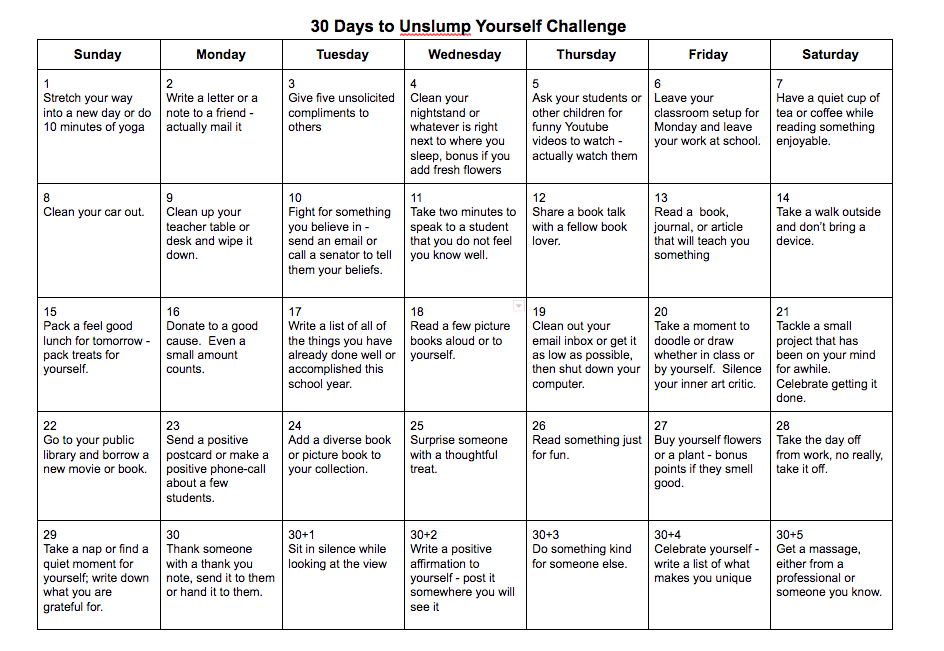
The 30 Day Unslump Yourself Challenge

If you are like me, January brings excitement, positivity but also exhaustion.  This quiet month is one where I sometimes find my energy running low, my creativity running out, and rather than take the time to take care of myself I barrel on as if that will do the trick.  So this year, I realized I needed to challenge myself.  Challenge me to take better care of myself.  Challenge me to slow down.  Challenge me to focus more on meaningful interactions, rather than hurried conversations.  And yet I know that as soon as I say I will do it, I just don’t.  Such is life.  Such is so many of our realities.

So I created a 30-day challenge to unslump myself.  To remember to take care of me.  You are more than welcome to join me or create your own.  My challenge starts on Monday.  I cannot wait.  To see the challenge document, go here.

4884095594397696.png

If you like what you read here, consider reading my newest book, Passionate Readers – The Art of Reaching and Engaging Every Child, out August 2017.  This book focuses on the five keys we can implement into any reading community to strengthen student reading experiences, even within the 45 minute English block.  If you are looking for solutions and ideas for how to re-engage all of your students consider reading my very first book  Passionate Learners – How to Engage and Empower Your Students.      Also, if you are wondering where I will be in the coming year or would like to have me speak, please see this page.