being a teacher, student choice, student driven, Student Engagement, Student-centered

A Better Way to Write Fiction Stories

We have been immersed in fiction writing for the past three weeks.  I have been amazed at the focus of my students, at the need for creation,and also their creativity.  As always, the plans I started with now look nothing like the plans we had, and so I thought it only fair to share what writing fiction in 7th grade English has looked like for the past three weeks and what I have learned and remembered.

Create Something

I knew that I did not need them to create the same product, after all, my standards assessed involve organization, word choice, conventions, and plot.  Nowhere does it say that they must write a certain story, but instead I asked them to create something that would allow me to assess these things .  I have been enthralled with their creativity process; yes, many students gravitated toward a written story with a neat beginning, middle, end, but others stretched their legs writing Minecraft fan fiction, movie scripts, picture books and even choose your own adventures.  I have students co-creating stories from opposite perspectives, I have students writing free verse (it is harder than it looks).  I have tales from their own lives and ones they have invented with made up words of their own.  Because it has been their story, their way, they have wanted to work on it every day, excited to share it with others.

Few Lessons

I have spent most evenings leaving feedback to students, thank you Google Classroom for making my life easy.  I have spent most class periods meeting with students asking them to tell me what I should look at when I read their work and then helping them from where they are.  I have gathered information on lessons needed and tried to support each child on their own writing journey, with the help of the support teachers I sometimes have.  Always trying to move students one step further and helping them think about what they need next, rather than a broad lesson that could apply to all.  The few whole class lessons we have had have been brief and centered around reminders on paragraphing, dialogue, and consistent verb tenses.

Speak Up

I have asked the students to please speak to one another, to please share their stories, to find those they want to write with and use each other as I use my own writing friends.  I started with putting them into writing trio groups but since abandoned the idea, realizing that the stilted conversations they were having would never get them much further and instead asking them to find someone that will not only read their work, but also be honest in their criticism.  This is still a work in progress, but I have seen the improvements, I have seen the growth and know there is something there.

Best Draft

I have asked them for their best draft, not their final version, and I owe so much to Kelly Gallagher for this wording.  Gone is the anxiety over perfection.  Gone is the notion that they must reach an unachievable goal as they hurtle toward the end.  Instead they work diligently, trying to get it to the best of their abilities before they turn it over to me.  Before they turn it over for more feedback that will ultimately push their story even further.  They know the process is not done just because they hand it in today, because the project is called best draft, even though in reality, many of them have handed in amazing stories that need little more work.

Use the Space

I have asked them to please find out how they write best within the environment we have.  How they best can support their own writing process, how they can use the classroom in a way that helps them better focus and find their flow.  Kids have been in corners, moved tables, on bean bags and in the team area.  We have had music, gum, and conversation.  For some we have had headphones for quiet and spaces to concentrate.  Each child is now a step closer to knowing how they write best, even within the confinements of a typical English classroom.

Find the Experts

For the past three months we have reached out to those who have walked the path before us; the authors that inspire us to write better.  Using Skype we have asked amazing authors whose books delight us what their writing process is and how they edit.  Every class has had different conversations but they have all centered around the same thing; find your own way, there is no right way for all, just a right way for you.  Hearing it from the mouths of those whose books inspire us will always amplify the message we already teach; writing needs t be a part of you so find your way of writing.

So now what?  We rest a little.  We change our focus as our stories simmer in our minds and then in a about a week we return.  Once the dust has settled, we look at the feedback we have received and we try to make it better.  We speak of revision as if it is just one step but I know from my own writing experience that revising is ongoing, editing is hard, and that it sometimes means stepping away only to come back later.  I still have much to learn as a 7th grade English teacher, I still have much to figure out, but this process?  It made a difference in the last three weeks.  Who knows how they will grow as writers next?

I am currently working on a new literacy book.  The book, which I am still writing, is tentatively Passionate Readers and will be published in the summer of 2017 by Routledge.  I also have a new book coming out December, 2017 called Reimagining Literacy Through Global Collaboration, a how-to guide for those who would like infuse global collaboration into their curriculum.    So until then if you like what you read here, consider reading my book Passionate Learners – How to Engage and Empower Your Students.  Also, if you are wondering where I will be in the coming year or would like to have me speak, please see this page.
being a teacher, being me, Reading, Reading Identity

We Have Already Grown

I realized today as my students sat quietly reading that if a stranger were to walk into our classroom, it would all look so effortless.  As if the kids had always quietly settled in with their books and this hush had fallen over us.  As if the kids had always read when I asked them to.  As if they had always known just what to do and when to do so.  Yet, that is not the true story.  Ask any teacher and they will tell you; creating a space for independent reading time is not easy, nor does it just happen.  It is hard work.  It takes effort.  It takes planning, and boy, does it take a lot of patience.  It takes great books.  It takes dedication.  And it takes a community, takes trust, takes respect, and takes conversations.

We build our communities in small pieces.  We plant the seeds on the very first day when we welcome our new kids into our lives and into our classrooms.  When we say this is your room, these are your books, and we mean it.

We build it when we ask them to pick up the books.  To read a few pages.  To talk to one another and to share their truths.  We build it when we accept their truths about why reading does not matter and promise that we will try to help them change their minds.
Every day as we plan our lessons and build our communities, we give them the reading pieces to place into the puzzle of their identities and hope they will see the value.  And we do it one day at a time.  One conversation at a time.  One book at a time.

It may be almost December, we have so much time still left, and yet I cannot help but marvel at how far so many have come.  How many actually will read, not because I ask them to but because it is their habit.  How many of them will casually abandon a book because they know they can find a better one.  How many of them will recommend a book because they want to,  because they need to share it, because someone else deserves to have the same experience with this book that they just had.

This is work.  This is love.  This is what we do.  And we do it in such small steps that sometimes we forget to look back at just how far we have come.  So as I sit tonight, exhausted, thinking back to all of the moments we shared today, I also realize that while we are not all there yet, we have come a long way.  We have already grown.  We have become better readers, even if if for a second I may have forgotten that.


I am currently working on a new literacy book.  The book, which I am still writing, is tentatively Passionate Readers and will be published in the summer of 2017 by Routledge.  I also have a new book coming out January, 2017 called Reimagining Literacy Through Global Collaboration, a how-to guide for those who would like infuse global collaboration into their curriculum.    So until then if you like what you read here, consider reading my book Passionate Learners – How to Engage and Empower Your Students.  Also, if you are wondering where I will be in the coming year or would like to have me speak, please see this page.


being a teacher

Dear Dav Pilkey

Dear Dav Pilkey,

You don’t know me, not unless you count the every brief moment I stood in front of you a few hours ago in your book signing line.  Yet I feel like I know you, perhaps that is what happens when your books have shaped the reading lives of so many of my students, I have seen the power they hold to transform children, I am grateful.  But just recently your books have taken on a new meaning for me.

You see, our oldest daughter, Thea, is what some would define as a struggling reader, we choose not to but instead just see her as a child who has not yet found her place in the world of reading, who so desperately wants to belong but still feels like she is on the outside looking in.  Who is developing with every book encounter she has.  Who has to work so hard when it comes to something that others find to be so easy.  Who for all of the years of her school experience has been given support by extraordinary teachers who have helped her believe that one day those words will come off the page and come alive.   Just not yet…

She reads every night, pulling a stack of picture books next to her bed and fighting me when I tell her it is time to turn off the light.  Her reading is flipping through the pages pulling the story from the pictures.  I am astounded at her inferring, at her comprehension, yet the words on the pages escape her and often she simply gives up trying.  The pictures must be enough as she spins her tales of what the authors meant to write.

Just a few weeks ago she told me that she was not a reader.  That she hated reading because it was so hard.  And who can blame her?  She sees how easy reading comes to some and knows just how much time it can take for her to just conquer a single page.  But she tries and she does.  Coming back long after many kids would have given up.

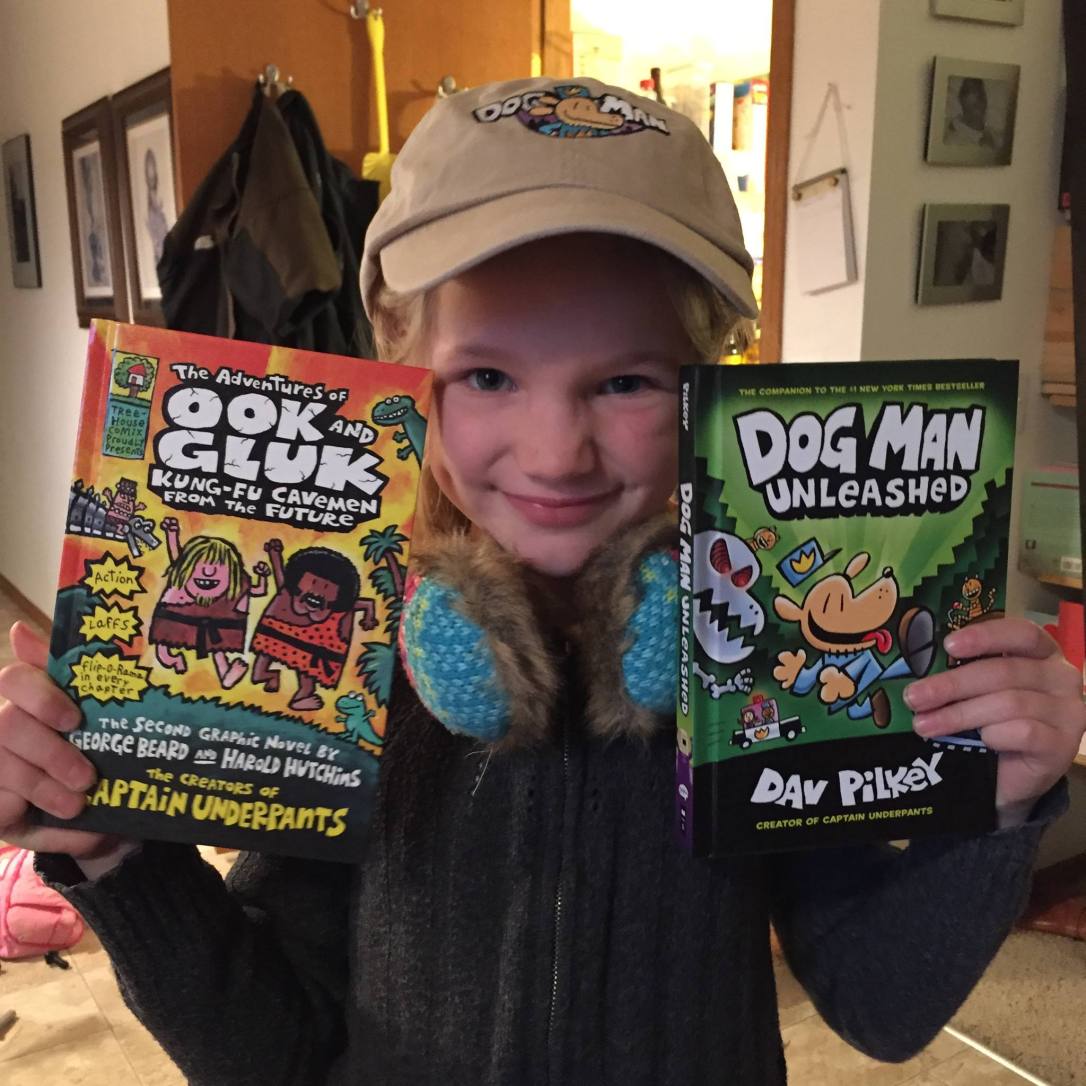
Last week she came holding up a copy of Dog Man.  She had gotten it at her book fair.  “Mom, I can read it!” she told me.  In my head I thought that would make sense because of all of the illustrations.  She would probably be able to put together most of the story.  As if she read my mind, she repeated triumphantly, “Mom, I can really read it!”  And she did and she could and she sat next to me reading the first page and then the next, carefully figuring out the works as the story unfolded before her. She said that she was so happy because she had finally found the book that was just the right fit for her and were there any more because she had reading to do.

As she sat next to me, there were so many things I wanted to say.  To congratulate, to point out her success, to her I told you so, but she didn’t need that.  She needed me to laugh out loud with her.  She needed me to look at the flip-o-ramas.   She needed to me experience the book with her and so we did and I thought of the kids in my own 7th grade classroom who don’t discover your books until they get to our library.  Who don’t discover their own powers as readers until the pages of Captain Underpants or Dog Man open to them.  Who for so long have given up on reading and then find you and then realize that it wasn’t that reading wasn’t for them, it was just that the just right books took a long time to find them.

As I told her I was headed to NCTE she asked me if you would be there.  If you were if I could ask for another book for her.  I told her I didn’t know but I would look.

So when I came around the corner today and saw you signing your book, I felt the universe aligning in way it hasn’t done in a long time.  Like somehow it knew that this proud but worried mama needed to know that her kid that works so hard really is on the path of becoming a reader.  And so I got in line and I waited and when I got to you I found that I had few words because there you were and there weren’t enough words to tell you just what you have done for me.

So here are the words that I meant to say, “Thank you for writing books that are meant to be laughed at.  Thank you for writing books that I can place in the hand of my 7th graders and know that they will read them.  Thank you for writing books that remind us about everything that is good with reading and the imagination.  Thank you for writing books that make kids feel like they are readers, even if they have a long way to go.

So dear Dav Pilkey, I am sorry I couldn’t quite get the words out but just know that you being the kid that sat in the hallway doodling led to my daughter believing a truth we had been telling her for so long.  I don’t think I will ever have enough words to thank you, but I thought I, at least, should try.

Best,

Pernille, Mama of Thea

PS:  Yesterday at school a package arrived.  Much to my surprise it was from Dav Pilkey.  Turns out this little blog post had somehow made it to him and as I read the note, I started to cry again.  In the box among several things was Dogman 2, the final copy, and a note letting Thea know she was the very first child to receive this version in the world.  There are no words to describe how Thea reacted when she opened the package.  She has spent the last 24 hours reading in her room; laughing, showing me pictures and telling me how much she loves Dav Pilkey.  I do too, Thea, I do too.

15069021_1158566690859609_6352350937684085706_o

being a teacher

What Do We Do Now

On Tuesday the video highlighting the amazing work my students do was released by Microsoft to the world.  On Tuesday I went to Youtube to watch it.  On Tuesday, I saw the comments left below it.  “Indoctrination…Lose her job…Islam is evil…”  My heart sank and my first reaction was to ask Microsoft to please close the comments to shield my students.  To shield them from the hate of others who do not seem to see the bigger picture.  From those that are bound and determined to spread more hate.  It seems we have seen a lot of this lately, even more than we have in a long time.

But I didn’t send the email.  I didn’t ask for the comments to be closed.  I didn’t ask for my students to be shielded from this hate because this is the world we live in.  One that is filled with many opinions, some so hateful they make me angry, and yet, my job is not to shield at all cost.  My job is to educate.

So how do we fight back?  We continue to educate.  We show both sides and not in its ugliest, but in a way that will show our students that their job is to find their own opinion and the only way they can do that is by learning, by reading, by trying to understand things that they may not agree with

So we continue to educate and then we stand up for what we believe in.  We stand firm on the shoulders of righteousness, of love, of unity, of belief in other people, even those that are different from us.  Even those that we do not understand.  Parts of our country may feel like our country is broken, I know I certainly do,  so we must stand even firmer and continue to pave the way toward a nation that comes together not through our fears but through our hopes for a better future.  One where we do not just point out all of our differences and how we think others are wrong, but one that we can see how we are similar.  Fear unites those that fear.  Hate unites those that hate.  But so does love, and a love that is determined to conquer even hate is not one to count out.

I refuse to be afraid of the future that lies ahead of our nation because I know that as educators we can present the facts.  We can create opportunities for our students where they are presented with information that is not laced by fear or filled with hatred and then allow them to choose their own opinion.  We can use technology and outreach so that students will meet other people that dispel the myths we carry.

The road ahead may seem long.  The road ahead may seem like it will lead us down a dark rabbit hole where we are not sure what is waiting for us on the other side.  But we have knowledge.  We have the power to bring the world in so that our students may experience more than what they are told to believe form those whose voice are filled with hate.

I refuse to be afraid, for I am emboldened.  We can continue to work toward the future we have always envisioned, that has not been taken away from us.  Don’t let anyone tell you otherwise.

being a teacher

Making the World Kinder

Two weeks ago, we had the very surreal experience of having a professional film crew in our classroom filing us.  To be put under the microscope in such a way is odd to say the least, yet, it was business as usual here in room 235D.  We had learning to do, explorations to have, and so our days continued, film crew or not.

I did not know at first which angle Microsoft would take on their video highlighting cloud technology in the classroom, but just knew they wanted to see what we do.  To say that I am proud of the final result is an understatement.  I am so proud of how my students are growing, I am so proud of how they question the world, seeking their own conclusions and figuring the world out.

Yesterday the president of Microsoft, Brad Smith, tweeted our video out.

So here is a peek into our classroom, thank you Microsoft for giving me a way to show the world the power of kids and technology.

being a teacher

A Few Tips From a Parent for Better Parent-Teacher Conferences

‘Tis the season of parent teacher/conferences, not just for me as a teacher, but also for our three school-aged children.  Having been on both sides of the table now for a few years, I have been thinking about how we as teachers can use the parent perspective to prepare well.  So here are a few tips for better parent/teacher conference from a parent’s perspective.

Send home a questionnaire beforehand.

All three of my children’s teachers did this and it allowed us to really think about what we were hoping to hear about at their conference.  We knew that my husband would be the only one present and so we could discuss beforehand what was important to both of us.  We then sent it back a few days before so the teacher had time to prepare.  Simple questions such as; what would you like to know more about or what concerns do you have if any will do the trick.

Have the child evaluate if they are not present.

While I am a firm believer in student-led conferences, if that is not a possibility have the children self-evaluate beforehand and also invite them along.  Thea had circled her answers on her own behavior and work habits and it was great to see the self-reflection.

Start with the praise, sure, but be realistic too.

While I would love to know all of the great things about my child, I certainly need to know where their areas of growth are, even if it as hard conversation to start.  More than likely the teacher will not say something surprising.  We know children act differently often at school and home, so let me know what the school version of my child is, even if it is a kid that does not make the best of choices.

Give us specific things to work on with them.  

While there may be many things our child needs to work on, give us a few specific things.  We know that one child really needs to work on his pencil grip and his letter recognition, while another needs to work on chunking and handling frustration more easily.  While we know there are many goals we can work on with them, these are the ones that take priority right now.

Give us tools.

I was so impressed with the tools we were handed by our children’s teachers.  From math program logins to the computer, to cut out letters, we now have specific tools we can use with our children as we support their further learning.

Allow it to be recorded.

Our children’s conferences were on the days that I had to give conferences so my husband asked if we could record the conversation on his phone.  That meant I did not have to rely on his retelling but instead could hear the whole conversation.  While I wish I could have been present to be a part of the conversation, this was the next best thing.  I was so grateful to hear the whole conversation and not just the big parts.

Show us that you know our child.

This is something I am still working on with my many middle school children, but I try to show parents that I actually know their child just a little.  Again, we were impressed with the care that our childrens’ teachers took with how they interact with them.  It was clear that not only are they great teachers, but also great human beings that truly care about the kids they teach.

Let your enthusiasm shine through.
Even when we had to discuss a few not so great decisions or things to work on, it was clear that these teachers love their job and the kids they teach.  Leaving a conference feeling like your child is in the best of hands is an incredible feeling.  It also means that if  these teachers have to have harder discussions with us about things our kids may have done or not done, we know that they are coming from a place of love.

I am so grateful to the stellar education all of my children are receiving and also to the way that their teachers communicate with us.  While our children are by no means perfect, we know that every day they are in the best of hands; caring teachers who will challenge them and also be partners as we try to help them grow into even better human beings.

I am currently working on a new literacy book.  The book, which I am still writing, is tentatively Passionate Readers and will be published in the summer of 2017 by Routledge.  I also have a new book coming out January, 2017 called Reimagining Literacy Through Global Collaboration, a how-to guide for those who would like infuse global collaboration into their curriculum.    So until then if you like what you read here, consider reading my book Passionate Learners – How to Engage and Empower Your Students.  Also, if you are wondering where I will be in the coming year or would like to have me speak, please see this page.