
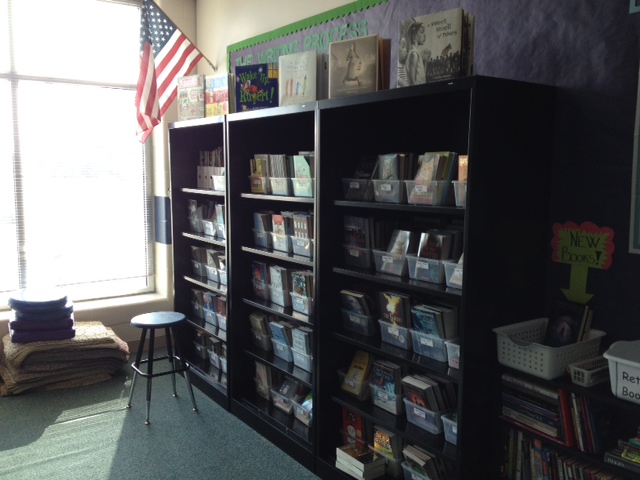
Anyone who enters our classroom immediately notices all of the books we have. It’s hard not to, they seem to be everywhere. While I have always believed in having as many books as possible in the classroom, I was not always sure on how to best organize it for optimal student access and interest. Now, seven years into having a library, there are a few things that have made my life easier.
No check out system
I have tried so many different check out systems, from a catalog system, to student librarians, to an electronic version, and all of them turned out the same; a ton of work for me and I still lost a lot of books. So a few years ago I abandoned the check out system. Now students know they can grab any book as long as they promise to return it. It is amazing to see the look on a students’ face when they hear that. Yet, I am not sure this is still the best way, I do lose a lot of books but for now replacing books is easier than spending all of that time checking them out.
“Return Your Books Here” Bin
I used to have students shelve the returned books but I always ended up having to remind them and then re-teach them how to get them in the right bin even though everything was marked. I now have a plastic tub with a “Return your books here” sign taped to it right by all of our bookshelves. Once a day I take the time myself to shelve all of the returned books because it gives me a way to see what is popular, look for books other students are wanting, and check on the conditions of some of our most beloved books. It takes me less than five minutes and all the books are in the right bin.
Bins for every genre and then some
I have loved having book bins for many years. While they cost money and give you less shelf space, it has proven to be the easiest way for us to categorize books. Bins are grouped by genre and some by popular authors. Students suggest bins as well as they see a certain collection grow. Two such examples are our newly formed Cassandra Clare bins and military history bins when students pointed out that we had a collection now.
This Book Belongs to Mrs. Ripp Stamp
This inexpensive stamp purchased from Amazon several years ago has saved me so much time. All new books get stamped with “This book belongs to Mrs. Ripp. Please return when finished” on the inside cover and then the genre abbreviation (or author if they are in an author bin) is handwritten below it in black sharpie. I cannot tell you how many books are left behind in other classrooms around our school and this little inexpensive stamp means they all come back to me.
The Hardcover Post-It
The only exception I have to my no book check out system is that if a student is borrowing a hardcover book, I ask them to give me the book jacket and put their name on it with a post-it. I then save them all in a bin and ask students for them periodically. This has saved many hardcover books from disappearing as students see their name and then remember that they probably left in that one place. It also gives me a way to track a book down if someone else is looking for it.
The Gutter Picture Book Organizer
Someone long ago hung gutters all around my room under the white boards and I could not be more happy. Gutters make a perfect display rail for any amazing picture books we may have and ensure that all of the new ones get read right away as well. A very inexpensive way to get more display space indeed.
Printed and Laminated Bookmarks
We use Kylene Beers’ book Notice and Note throughout the year to give us a shared reading language, so it was natural for me to make some printed bookmarks reminding students of the strategies as they read. Bookmarks are i the same place next to post-its, which some kids prefer to use. They don’t have to ask for one, they take them as needed, and return them when they don’t if they feel like it.
“Our Favorite Books” Spinning Wire Rack
For a long time I had a wire rack where I placed all of my favorite books on for students to browse. Yet, it was not being used very much even though it was in a prime location. After inspiration by Nancie Atwell, I hung a sign above it declaring it a rack for the students to share their favorite books and then took all of my books off. I told the students its new purpose and have since watched it fill up with their favorite reads. This spinning rack has now become the first stop whenever they need a new book.
A Separate Book Case (Or Two) For Picture Books
While we have many of our favorite picture books out on display in the classroom (it’s amazing how many time students gravitate toward them in a day when they have a few minutes), I also have an entire book case just designated to picture books. I used to organize them and group them together and then realized it didn’t make the slightest difference to the students. They looked through a lot of books anyway whether they were organized or not. Since I don’t have these in bins, I gave up on organizing them and haven’t looked back since.
The Readers’ Notebook That Doesn’t Leave
I used to ask students to carry their readers’ notebook back and forth for some reason, which meant many days they left it in their locker, or at home, or didn’t know where it was. I also had to ask them to specifically leave them behind whenever I needed to assess them which meant the pressure was on to get them assessed so I could hand them back. Now I ask the students to leave all of their readers notebooks in the classroom. I have a bin for each class, I don’t care what name order they are in and at the start of each class all I have to do is grab the right bin off of my shelf and put it out for the students to grab. This is also how I do attendance these days, by seeing whose notebook has not been picked up.
Pre-printed Standard Comments Sheets
I assess my students readers notebooks every two weeks and while I often take the time to write in specific comments to them, I have also learned to pre-print address labels stickers with certain broad comments such as “Remember to use text evidence to support your thinking” or “Why do you think the author did this?.” Not only has it saved me a lot of time when I need to assess 120 readers notebooks, but it also allows me to focus on the comments they really need while covering all bases. The students do not mind (I have asked them) since they know it allows me to support them more often with my thoughts.
Learning to Let Go
This has been my biggest take away in having a classroom filled with books and readers. Sometimes you don’t have to have a perfect system for it to feel perfectly fine. The students make our book loving classroom their own so they change the organization of books, the shelving of them, and even how we read them. I don’t mind, I just have to let go sometimes and trust the students.
I am a passionate teacher in Oregon, Wisconsin, USA but originally from Denmark, who has taught 4th, 5th, and 7th grade. Proud techy geek, and mass consumer of incredible books. Creator of the Global Read Aloud Project, Co-founder of EdCamp MadWI, and believer in all children. The second edition of my first book “Passionate Learners – How to Engage and Empower Your Students” is available for pre-order now. Second book“Empowered Schools, Empowered Students – Creating Connected and Invested Learners” is out now from Corwin Press. Join our Passionate Learners community on Facebook and follow me on Twitter @PernilleRipp.


