reflection, Student-centered

This is What Learning Looks Like

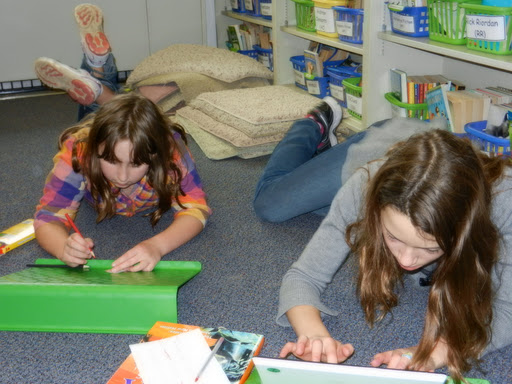
This past Friday, my incredible students participated in the 4th Innovation Day I have done.  While it is a hard day for me because I tend to get bored, since I cannot jump in and teach, I always marvel at the energy and enthusiasm throughout the room.  The sheer driven desire to create something fueled by their curiosity and imagination never ceases to astound me, and this day is always a highlight for the students.    At one point, I tweeted out the following picture

photo (16)

captioning it, “This is what learning can look like…”  Immediately, someone replied, “This is what learning SHOULD look like!”  (Emphasis added by me).  At first, I agreed, nodding, yes, this is what learning should look like.  Then I stopped, thought about it, and I realized, no, this is not what learning should look like at all times.

If learning looked like this every day, I would go crazy.  The mess, the noise, the scattered projects and directions, where I barely took part in anything, no thank you.  And I wouldn’t be the only one.  My students would not want learning to be like this every day either, how do I know?  I asked them.

Instead, they told me that learning should look like this…
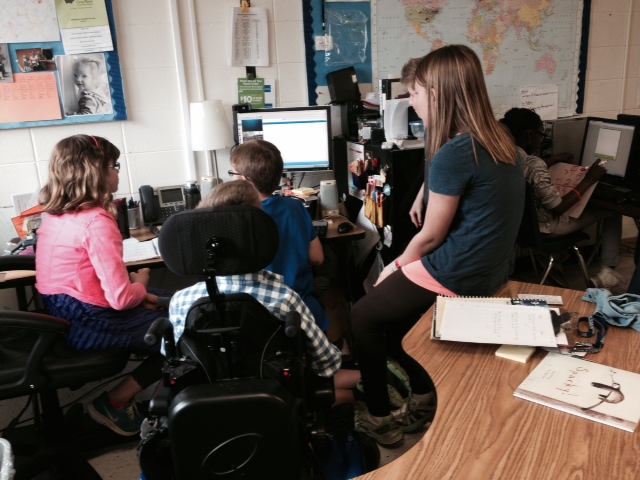
photo (6)

Like this…

Or like this…933a8-dsc_0060

Learning should look like this…

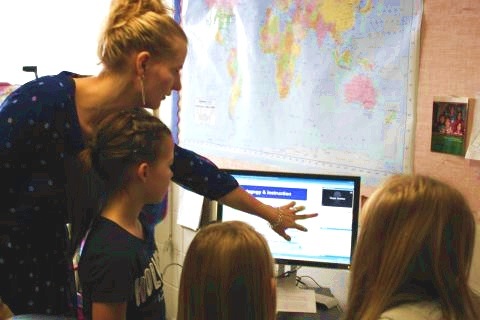
This is what Student-centered Looks Like

Or like this…

An Hour of Wonder

Or like this…

Ripp-tech-Photo

Sometimes learning even looks like this…
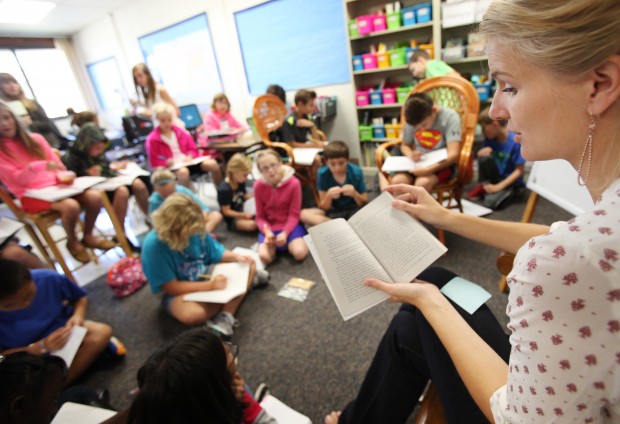
5254aa5c12f69.preview-620 (1)

In the end, learning looks the way our students need it to look.  Whether that means a teacher in the front setting up a foundation for exploration, students exploring their way through something, individual quiet contemplation and in-depth thinking, or even small groups teaching others; learning is many things, looks many ways, and feels many ways.  It has to because we all learn differently, we all process things differently.  We all need different things at different times.

If we run our classroom in one way, even if it is an incredible way in our eyes, we risk losing the love of learning from a child.  Every child should feel at home in our rooms, every child should feel like they can learn.  Every child should feel that the way they learn is right.  So there is no one way that learning should look like.  It should look however fits our kids best.  And that changes often, just like our students do.

I am a passionate (female) 5th grade teacher in Wisconsin, USA, proud techy geek, and mass consumer of incredible books. Creator of the Global Read Aloud Project, Co-founder of EdCamp MadWI, and believer in all children. I have no awards or accolades except for the lightbulbs that go off in my students’ heads every day.  First book “Passionate Learners – Giving Our Classrooms Back to Our Students” can be purchased now from Powerful Learning Press.   Follow me on Twitter @PernilleRipp.

being me, books

Win A Copy of My Book “Passionate Learners”

On May 14th, a dream of mine came true, I became an author with the publication of my first book “Passionate Learners – Giving Our Classrooms Back to Our Students.”  Since then I have been excited to see readers respond to my book and how they will use it in their teaching lives.  While I have loved this book and writing it has been a very personal journey for me, what matters now is whether it will help others avoid some of the pitfalls I fell into as a teacher.  So to help spread the word and reward all the readers of my blog, we are giving away two copies of my book!  Entering is simple, just leave a comment.  I will pick two winners at random this Friday, May 30th at 10 PM.

Here are what a few people have said about the book after they read it.

I knew even before I read it that Passionate Learners: Giving Our Classrooms Back to Our Students was going to become one of my favorite education resources and something I would recommend to every teacher I know.” – Angela Watson

“I strongly suggest that every educator read this book whether they agree or not because ultimately, we are all motivated by doing what is in the best interest of children, right?”    

– Tony Sinanis

“I wish that I had read this book a year earlier as I struggled with being a change maker at my school. Although I have a broad PLN I can call on for support, somehow reading these words felt like an extended conversation with a wise friend. Thank you, Pernille, for your oh so honest story that affirms the gifts and challenges of our vital profession. “

– Joan Young

Print or digital? How wd you prefer to read my new book Passionate Learners? http://bit.ly/1kb9orz Quick survey: https://www.formstack.com/forms/?1734872-So4tMjtPvg

Now it is your chance to read my book.  Enter below for a chance to win one of two copies by leaving a comment. (Please note there isn’t a print version of the book available at this time, but you can read the eBook on any computer or mobile device.)  The contest ends at 10 PM EST on Friday, May 30th. Good luck!

Reading, reflection, Student-centered

How I Know My Students Are Reading at Home

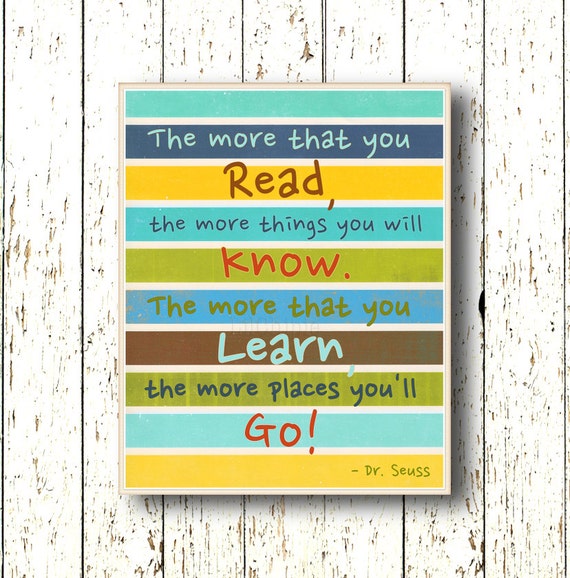
image from etsy

I remember the reading logs well, my brothers hastily whipping them out Sunday night asking my mom to sign off that they had read x number of minutes.  My mother never checked, she did not want to be the reading police, after all, she knew my brothers read.  She didn’t care how many minutes or which book, all that mattered was that at some point their eyes met something to read. A great post by Angela Watson got me thinking, how do I know my students are reading if I don’t check their reading log?  How do I know that at some point their eyes meet a text?  There are many ways actually.

  • I watch their reaction.  Kids who read want independent reading time.  Kids who are in a great part of a book want time to find out what will happen next.  Kids who slowly get their reading bin, who distract others on the way; those are the kids I need to check in with and help.
  • I keep an eye on their book bin.  A whole book shelf in my room is the proof that my students read.  Periodically I go look through their bins, noting which books a kid has and whether those book have changed.  If they haven’t, I check in with that child.
  • We recommend.  Another favorite in our room is the speed book dating.  We quickly rattle off a book we love and why it should be read while the listener has their “I can’t wait to read ” list in their hand.
  • We show off our reading.  I have my reading door outside of the room so that my students always know what I am reading and my students can recommend books on a bulletin board.  Our reading is visible.
  • We discuss.  Reading should not be a solitary endeavor so we make time to discuss our books and why they are the best or the worst book ever.
  • We reflect.  I often ask students to tie in today’s teaching point with whatever they are reading right now.  Whether it is in our thoughtful logs or on a post-it, students take a moment to think and apply and once again lets me see what they are reading.
  • We do monthly reading reflections.  This year I really wanted to have a open dialogue with the students in regard to their reading life and although I do constant one on one or small group instruction, I wanted something more formal that I could file away and look at when needed.  My students know they are not judged on what they write but rather that I use it as a way to start a conversation with them.  I always appreciate their honesty and my actions show that.
  • We have great books.  If you want kids to read, have great books.  I do not know how much money I spend a year on books, I know it is a lot, but every time I am able to booktalk a book and see the reaction in my kids, it is worth it.  Couple that with an incredbile librarian and my students are pretty lucky in the book department.
  • I lose a lot of books.  Because I encourage my students to take our books home to read, I inevitably lose a lot of books.  While it is hard to think of it from a financial standpoint, I also know that hose books are being read by someone.  So yes, it is hard to constantly replace books (and expensive) but it is something that goes along with being a reading classroom.

So yes, while my district mandates a reading log, it is not the treasure trove of information that I need.  What I need is conversation, observation, reflection, and interaction.  So how do I know my students read?  I ask them and listen.

I am a passionate (female) 5th grade teacher in Wisconsin, USA, proud techy geek, and mass consumer of incredible books. Creator of the Global Read Aloud Project, Co-founder of EdCamp MadWI, and believer in all children. I have no awards or accolades except for the lightbulbs that go off in my students’ heads every day.  First book “Passionate Learners – Giving Our Classrooms Back to Our Students” can be purchased now from Powerful Learning Press.   Follow me on Twitter @PernilleRipp.

Reading, students

Why My Students Are Connected

I have written a lot about being connected myself, even about connecting my students.  I have written of the conversations that happen, the connections that happen, and even how it brings this amazing world of strangers in to our rooms.  And yet, some people still don’t get the importance of being a connected educator, not just for yourself, but also for your students.

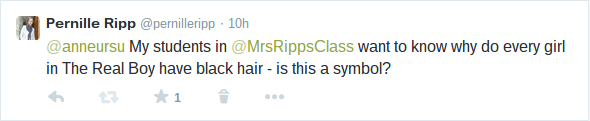
We are doing our final book clubs right now and a group of girls had picked Anne Ursu’s The Real Boy as their choice, something that made me quite happy because for some reason students had not yet gravitated toward this amazing read.  When it was time for me to check in with the girls, they immediately told me just how well their book club was going, how deep their conversations were, and all of the things they were speculating about.  It was clear that this book had made some new fans.  As they walked away, I mentioned that the author, Anne Ursu, is on Twitter and would they like to tweet her?

One minute passed and the girls told me what to tweet (we do have a class account but no one was logged into it at the time).  Here is what they said

Pernille Ripp (pernilleripp) on Twitter.clipular


I pressed send and the girls went back to their group.

3 minutes passed, I looked up from what I was doing and this caught my eye

Twitter - pernilleripp- @anneursu They say, that makes ....clipular

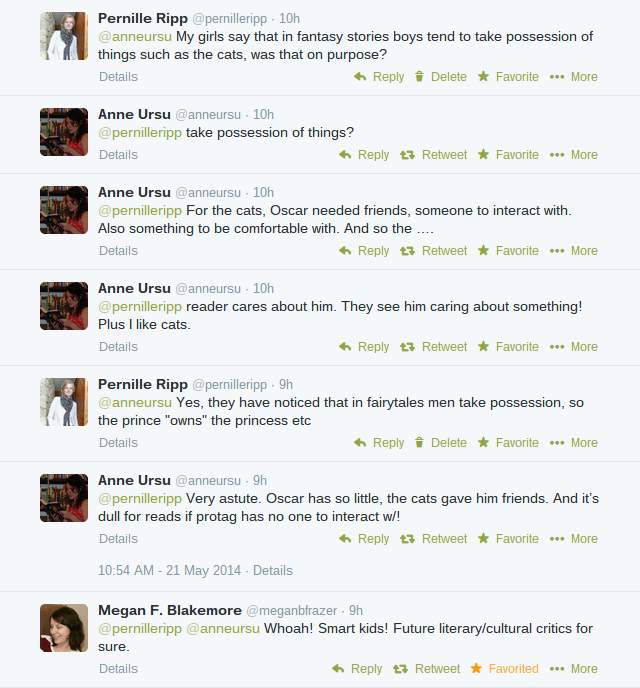
3 minutes!  And the author of their new favorite book had taken the time to reply to them.  The girls lit up and immediately started to discuss Mrs. Ursu’s reply and what that must mean.  This quickly spiraled into another questions and then another and what ensued was a deep literary discussion fueled by Anne’s answers and my students questions.  For 30 minutes, Anne Ursu took the time to answer them, ask them questions herself, and even having her own thinking pushed.  30 minutes!

As I stood back and let it unfold, I kept thinking how this is exactly why we are connected.  Not to just show off our learning as if the world is our audience but to interact with people that matter discussing things that matter.  That same morning I had written about engaging our strongest readers, and here my girls were pursuing ideas and theories grounded in a text much like I had discussed.  In the end, my girls asked this, officially blowing my mind…

Twitter - pernilleripp- @anneursu They say, that makes ....clipular (1)

Do I need any further assessment that these kids get what it means to think beyond the text, to make connections, to infer, to look for commonality between texts?  Thanks to Anne Ursu and her willingness to connect, my students just applied everything we have discussed within our own four walls.

So when people ask whether being connected is needed, I have a hard time not saying yes.  Sure, we can teach just fine without, in fact, we can be great teachers without being connected, but our students will miss out on amazing opportunities to connect with others.  They will miss out on great discussions waiting to happen, on opportunities to expands other people’s minds in the process.  These girls, my 5th graders, they made someone else think today, and that is invaluable.

I am a passionate (female) 5th grade teacher in Wisconsin, USA, proud techy geek, and mass consumer of incredible books. Creator of the Global Read Aloud Project, Co-founder of EdCamp MadWI, and believer in all children. I have no awards or accolades except for the lightbulbs that go off in my students’ heads every day.  First book “Passionate Learners – Giving Our Classrooms Back to Our Students Starting Today” can be purchased now from Powerful Learning Press.   Follow me on Twitter @PernilleRipp.


Reading, students

How to Engage Your Strongest Readers

image from etsy

This summer, I was lucky enough to be inn the presence of Mary Ehrenworth at Teachers College as she gave us strategies for how to support our strongest readers.  Inspired by her words and knowing that I would have readers that were well beyond their years, I decided to put her words into action.  But what did it look like in the classroom?

I met with them frequently.  All kids had one to one with me at least every other week depending on what we were doing.  This meant I knew what every kid was reading and working on.  I also met with them in small groups or in partner ships.  They pushed each other’s thinking just as much as they pushed mine.

We revisited ideas.  Too often their initial ideas were good, but not deep thinking.  In the past I would have been happy with that but I wanted more from these kids.  If they wrote something down, I would ask them to think deeper about it, add more thoughts, and clarify what they meant.  They learned to push themselves further than their initial thoughts.

We brought writing into reading more.  Students would jot more thoughts down as they read since I was not worried about the quantity of books they were consuming, so if they decided to sit and think while reading that was celebrated rather than frowned upon.

Their reading goals were catered to their thinking. My strongest readers don’t need to just work on vocabulary, connections,or the standard comprehension strategies but really need to have their thinking pushed.  Things we discussed in our books were:

  • How would the characters react if placed in a different book such as putting Katniss in the Divergent series?
  • Gender roles in their books for example: why are strong female characters in science fiction still obsessed with love?
  • How would a character change if they were of the opposite sex?
  • How would characters react to each other if they met outside of a book?
  • What social issues were in the book?
  • How did characters develop throughout an entire series?
  • What was the author trying to tell us with the decisions the characters make?
  • Similarities and differences in genres as a whole, but not just within the genre but also with the time frame that it was written.  So how is science fiction written now different from science fiction written in the 1980’s?
  • How trends in literature show up in other media such television, movies, comics etc.
  • And finally, what the role models are now that we are creating for younger children?

If you had told me at the beginning of the year that I would have these deep conversations with 5th graders, 5th graders!, I would have thought you were joking.  But these kids, with their insatiable thirst for books, even if they read slowly, they were ready for these conversations and thoughts.  They brought things to the table that I had not thought of.  They pushed me in my thinking, even if I had never read the book they were discussing.

Mary Ehrenworth was right; our strongest readers need us just as much as our developing readers. They need to be pushed and challenged, they need to be handed books that will inspire them.  They need to discuss and think with each other and continue to push themselves.  I am so glad I listened, I am so glad I pushed myself.

I am a passionate (female) 5th grade teacher in Wisconsin, USA, proud techy geek, and mass consumer of incredible books. Creator of the Global Read Aloud Project, Co-founder of EdCamp MadWI, and believer in all children. I have no awards or accolades except for the lightbulbs that go off in my students’ heads every day.  First book “Passionate Learners – Giving Our Classrooms Back to Our Students Starting Today” can be purchased now from Powerful Learning Press.   Follow me on Twitter @PernilleRipp.


global read aloud, projects

Top 10 Reasons You Should Join the Global Read Aloud #GRA14

Besides the babies we already have at our house, I have another baby; The Global Read Aloud.  The premise is simple; we pick a book to read aloud to our students during a set 6-week period and during that time we try to make as many global connections as possible.  Each teacher decides how much time they would like to dedicate and how involved they would like to be.  Some people choose to connect with just one class, while others go for as many as possible.  The scope and depth of the project is up to you.  In the past we have used Twitter, Skype, Edmodo, our wiki, email, regular mail, Kidblog, and any other tools we can think of to make these connections.  Teachers get a community of other educators to do a global project with, hopefully inspiring them to continue these connections through the year. 

So why should you join, well, let me count the ways:

  1. It is free.  There is nothing to buy besides the book, there is nothing you have to pay to be a part of it, and for free you get access to educators all over the world.
  2. It brings the world in.  Every year, educators who participate in it cannot believe how many connections they make, whether just in the US or around the world.  Having a common project provides you with a platform to start collaborating with others that you can then use the rest of the school year.
  3. You decide.  This project is great because of its simplicity, I don’t tell you how to connect or what tools to use, just which book you should be discussing.  Different teachers have different time to dedicate so this fits in with any curriculum anywhere.
  4. Students get it.  The reason I keep doing this is because my students cannot wait to hear what others think of the book we are reading.  They cannot wait to connect, they cannot wait to share, they cannot wait to reach out and learn with others.
  5. It is only 6 weeks.  We keep it short because we know how busy we all get.  6 weeks is just the right amount of time to discuss, elaborate and dissect a great book without getting overwhelmed by all of the to do’s.
  6. There is a book for your level.  Last year we expanded into two separate books, one for younger grades and one for upper grades.  This year we took it a step further and now span K through 12.  Now you truly get to pick which book you feel the most comfortable with for your students.  There is even a French version of the project for those who would rather do it in French.
  7. It provides a way to introduce tech tools.  I use the project to introduce students to Skype, KidBlog, Edmodo, Animoto and other tools.  This way I am not trying to reinvent the wheel but get to use the tools in a meaningful way with my students for their intended purposes.
  8. You get a voice.  I invite others to make it their own and share their ideas.  This is not just “my” project, it is for everyone to make their own.  I love all of the sharing and great ideas that come from being part of this project, it really sets me up for great collaboration and idea creation for the the rest of the year.
  9. You don’t have to be a techie to do it.  Sometimes technology is really overwhelming and the great thing with this project is that you don’t have to use a lot of it if you don’t want to.  You can email one other class, or even use regular mail to share observations and discussions.  However, if you are feeling adventurous, this is a great project to get your tech feet wet because there is a whole group of participants that would love to help you!
  10. It’s fun!  The biggest reason for why you should join, it is a great project!  Many teachers have embraced this project and made it their own, using it receive grants and propel their own teaching. The students love it, the books are always thought provoking and who doesn’t love a great read aloud.  So why not take something you probably already do and make it even better.
I could keep going, but I hope some of these reasons have at least sparked your curiosity.  So to get more information head over to the Global Read Aloud blog.  To sign up go right here.
I am a passionate (female) 5th grade teacher in Wisconsin, USA, proud techy geek, and mass consumer of incredible books. Creator of the Global Read Aloud Project, Co-founder of EdCamp MadWI, and believer in all children. I have no awards or accolades except for the lightbulbs that go off in my students’ heads every day.  First book “Passionate Learners – Giving Our Classrooms Back to Our Students Starting Today” can be purchased now from Powerful Learning Press.   Follow me on Twitter @PernilleRipp.