Be the change, being a teacher, Literacy, Reading, students choice, students teach me

How Do You Reach Your Vulnerable Readers?

This morning I was asked what we do for our most vulnerable readers to help them be successful.  As I took a moment to ponder this question, I realized a big thing;  what we do for the most vulnerable is also what we do for all of our readers.

We have fidelity to our students, not to our programs.

I work in a district that believes in fidelity to the students and not to the program.  Think about that for a second.  Oregon School District believes in staying true to what the children need and not what an outside purchased program, no matter how research-based it is, tells us what to do.  We use components from incredible programs, but they do not dictate our decisions; our students do.

We place them with amazing teachers.

We give them the best teachers we have to work on interventions.  These teachers know their research and use best practices.  They are given longer books, they have choice, they do meaningful work.  We make sure they work on stamina in books, not chopped up passages to just check their skills.

And we do not put them in front of computer programs.  We need our students to read, to think, to work through a text and then come out on the other side with a deeper understanding.  We need face-to-face interactions to gauge what they really know, not what a computer may think.  There is no replacement for a qualified teacher and so every child deserves one, especially those who are not where we would hope they would be.

We have them surrounded by books. 

We have a beautiful school library, staffed by a fully certified librarian, and we also promote classroom libraries.  As Neumann researched, having a classroom library can increase reading up to 60% and so we believe in the power of great books within their reach at all times.  As one student told me Friday, “Mrs. Ripp, I love that we have great books right here, I never have to go far to find my next read.”

We are also mindful of the books we surround them with.  Inspired by the work of Dr. Simms Bishop, Chad Everett, Nerdy Book Club, and so many other passionate advocates for better library experiences, we think of how our library shapes our students’ identities.  Can they see themselves?  Can they see others?  Who is represented, how are they represented, and who is not?  All of this pushes us forward as we purchase more and better books.

We are careful with our language. 

I flinch a little whenever I hear the term “struggling readers.”  As Donalyn Miller has taught me, there is little hope in that term.  How about vulnerable?  How about careful?  How about developing?  How about just readers?  Our language promotes a growth mindset so we have to be aware of what our language does to shape their self-image.  How do we speak about our readers when they are around or not around?

We cultivate patience.

It is really hard to not lose hope when you have implemented best practices (choice, time, books, and a reading community) and then see little results.  And yet, sometimes we are working against years of a negative reading identity.  We are working on catching up years of stalled reading experiences.  We are working against unseen forces that derail us any chance they get.  So we must be patient.  Patient with the child who is trying.  Patient as the teacher hoping for results.  I have said it before and will say it again; sometimes we are just the tourniquet that stops the growth of the hatred of reading or the negative reading experiences, not the teacher that will see the actual seeds of change grow and bloom.

We balance our purchasing decisions.

While we may be going one to one with Chromebooks, my principal will also tell you that she always has money to purchase books.  Our literacy coach asks us if we want more books because if we do then she will get us some.  This speaks volumes because if a district is spending money on technology without spending money on books there is a serious imbalance in priorities.   And if that is the case, a conversation needs to be started about what is more important?

So when I think of what we do for our vulnerable readers, I once again see the thread that runs through our entire school community; every child a reader, every single day.  Every child deserves the best chance.  Every child deserves the best teachers.  The best experiences.  The best, period.

If you like what you read here, consider reading my newest book, Passionate Readers – The Art of Reaching and Engaging Every Child, out August 2017.  This book focuses on the five keys we can implement into any reading community to strengthen student reading experiences, even within the 45 minute English block.  If you are looking for solutions and ideas for how to re-engage all of your students consider reading my very first book  Passionate Learners – How to Engage and Empower Your Students.      Also, if you are wondering where I will be in the coming year or would like to have me speak, please see this page.
Be the change, being a teacher, being me

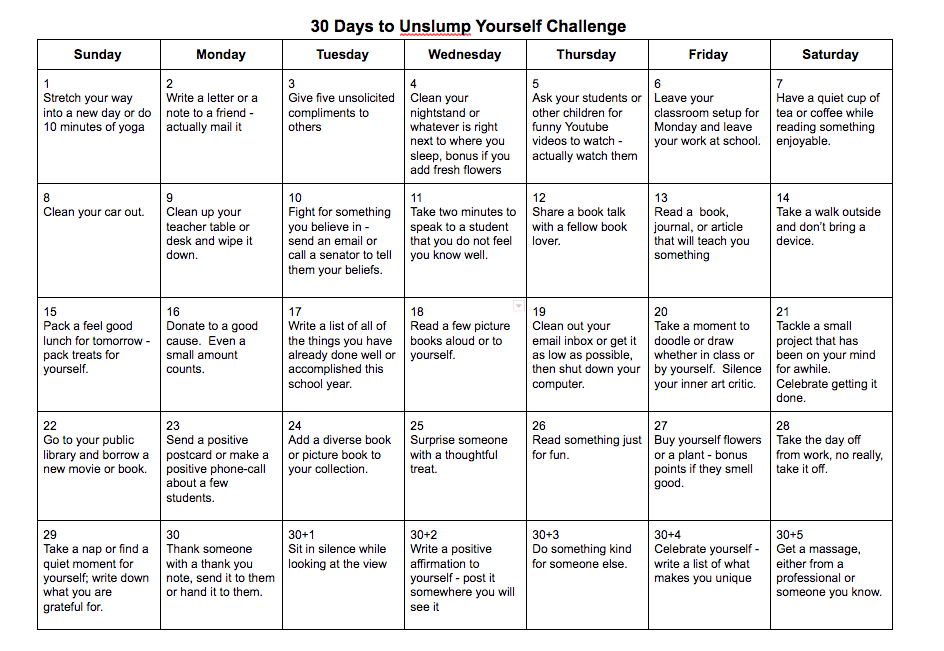
The 30 Day Unslump Yourself Challenge

If you are like me, January brings excitement, positivity but also exhaustion.  This quiet month is one where I sometimes find my energy running low, my creativity running out, and rather than take the time to take care of myself I barrel on as if that will do the trick.  So this year, I realized I needed to challenge myself.  Challenge me to take better care of myself.  Challenge me to slow down.  Challenge me to focus more on meaningful interactions, rather than hurried conversations.  And yet I know that as soon as I say I will do it, I just don’t.  Such is life.  Such is so many of our realities.

So I created a 30-day challenge to unslump myself.  To remember to take care of me.  You are more than welcome to join me or create your own.  My challenge starts on Monday.  I cannot wait.  To see the challenge document, go here.

4884095594397696.png

If you like what you read here, consider reading my newest book, Passionate Readers – The Art of Reaching and Engaging Every Child, out August 2017.  This book focuses on the five keys we can implement into any reading community to strengthen student reading experiences, even within the 45 minute English block.  If you are looking for solutions and ideas for how to re-engage all of your students consider reading my very first book  Passionate Learners – How to Engage and Empower Your Students.      Also, if you are wondering where I will be in the coming year or would like to have me speak, please see this page.

Be the change, being a teacher, classroom setup, our classroom

On Flexible Seating

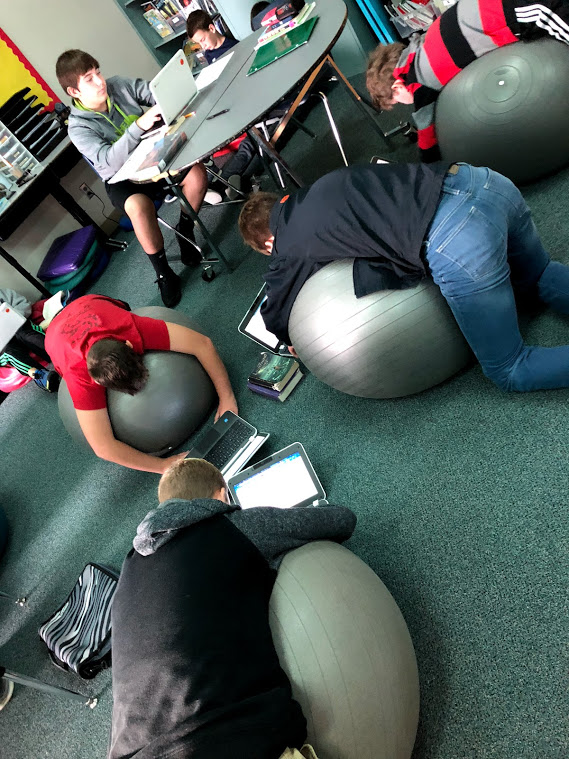
Our classroom, room 235D, is an open door classroom.  Anyone is allowed in to see us learn together at any time.  Our classroom is nothing fancy.  We have tables covered in whiteboard paper, that has seen better days.  We have chairs.  We have yoga balls.  We have ratty old beanbags that are definitely on their last leg.  A few pillows of varying sizes.  And we have books, many, many books.

That’s what you might see, but if you stayed awhile, you may notice something else; freedom.  Shared control.  Freedom to sit where we would like.  Freedom to choose who we work with.  Freedom to move the furniture around.  A sense of shared control over our shared space so that we all can feel comfortable together.  It is nothing much but is ours and you would think that the students would realize just how unfancy it is.  And yet, every year when I ask my students how I could change our classroom, the answers are similar, “It’s fine, Mrs. Ripp. Perhaps a few more pillows. We like it the way it is…”

While I have a milelong wish list of furniture I wish we could get, I find comfort in their answer.  The room is working for us, as well as it can.  The control that they have over what the room looks like is working for them.  The flexible seating that has been a part of our learning for years, works for us.

And I see it spread across the globe; the push for more innovative seating.  For yoga balls and wiggle chairs, pillows, and getting rid of desks.  On Pinterest I drool over classrooms I will never be able to recreate, and yet, I wonder; how often does the furniture actually match the teaching?  How often does the furniture match the educational philosophy that needs to be in place for this to truly be flexible?

Because the reality is that while many districts are gladly spending money on new furniture in order to promote innovation, the educational philosophy in many of those same districts is not changing. The students are still sitting through a scripted curriculum, where teachers have limited choice in how to teach and the students are expected to learn through the same process.

This is the problem in education; we so gladly throw money at new educational initiatives that look great, but then do little to think about our thinking.  And yet, our educational philosophy is what really determines the experience that everyone has within our schools, not the fancy new chairs.  Buying new furniture is easy, changing the way we educate is not, and then we wonder why the furniture ends up being used in the exact same way as the furniture was before.

So I wonder; what good is flexible seating if we don’t also have flexible thinking?

One of the central questions of our year together is for my students to explore how they learn best.  This includes the room manipulation and where in the classroom they need to be to access the learning.  They cannot do this if I am constantly telling them where to sit, how to sit, and also with whom to sit by.  There has to be room for experimentation, bad decisions, and reflection on what works best for them.

So before we invest more of our already limited funds into newfangled furniture, let’s look at what flexible seating should really encompass, here are a few questions to help.

Can the kids move the furniture?

Flexible seating should be flexible both in function but also in where it is used.  If students need to explore how they learn best then deciding where to sit is just as important, if not more so, than what to sit on.   Do they need to move tables into a corner so they can think or will being in the middle of the classroom work better for them?  Will they learn best sitting on the floor in the front or pacing in the back?  Where in the classroom can they access the learning best?

IMG_2461.jpg

Do they always need permission?

When permission is tied into flexible seating, we often tend to say “no” to the same kids; the kids who may have made poor decisions in the past.  And while there certainly can be different guidelines at times for some kids, they need to, at some point, go back to having the same blanket permission as everyone else.  Schools are meant to be safe places for kids to experiment with learning, to try new things, to learn about who they are and what they need.  If we constantly limit that for some kids, think of what will happen to their self-advocacy and also their sense of belonging.

Is it choice for all or just for some?

Are kids earning their way into the flexible seating or is it an automatic yes to all?  While there are times I have doubt about some of the choices my students are making, I will tell them to prove it to me.  If they do, then great, if they don’t, then we discuss further.  We have to be careful that flexible seating choices do not become one more way to segregate the kids.  After all, it is often some of my most challenging learners that benefit the most from having a different way to work in the classroom, but we won’t know that if they don’t get a chance to choose.

IMG_1714.jpg

Does it encourage new ways of working?

I have seen beautiful classrooms with lots of flexible seating where students work through traditional lessons; teacher-centered, and one process for all.  Where is the innovation in that?  One of the things I love the most is how my students move around the classroom and try new configurations when needed.  Not at all times by any means, but when they need to.  They know they have the tools at hand to move their group onto the floor or a table in the team area.  They know they can make the furniture support their learning rather than work around its limitation. They know to use each other as writing peers, reading partners, or project collaborators because they know that with their choices in seating also comes the choice in who to work with most of the time.  They think about how to work, rather than always look to me to make all of the decisions, thus growing their independence and once again their knowledge of how they learn best.

IMG_1810.jpg

Is there choice throughout?

Flexible seating should truly just be the outward indicator of the choice-driven learning that should be happening.  We operate under the five tenets of choice at all times, meaning that I try to give my students as much control and power over how they learn, what they learn, who they learn it with, and how they are assessed.  This is what matters most to me.  Not the yoga balls, not the pillows, not how they can move things around, but that the students feel like they have a shared power and responsibility for what happens in our classroom.  It is a work in progress every single year, yet, at the end of the year, I am always amazed at how far we have come.

So as a new year begins, it is time for us to really reflect on the educational innovation we are pursuing.  If we are looking at adding more flexible seating to our schools, are we also having the educational discussions that need to go with it?  Are we asking ourselves how this will change the way we teach?  The way our students learn?  Are we asking ourselves how this will be better?  Or is it just an outward show of supposed innovation that does not really change the educational experience our students have?

The choice is ours; it is not enough to have great new furniture if we don’t also have new ideas.

PS:  If you are wondering what the research says, here are a few great articles to get you started.  One that discusses the need for our classrooms to match the type of learning experiences we would like to have, so once more focusing on intentionality within our environment.  And another that is a conglomeration of research that discusses the need for students to feel empowered within our classrooms.  And here is another that while lengthy discusses how the way we have students sit can help them learn deeper depending on the activity they are engaged in.

If you like what you read here, consider reading my newest book, Passionate Readers – The Art of Reaching and Engaging Every Child, out August 2017.  This book focuses on the five keys we can implement into any reading community to strengthen student reading experiences, even within the 45 minute English block.  If you are looking for solutions and ideas for how to re-engage all of your students consider reading my very first book  Passionate Learners – How to Engage and Empower Your Students.      Also, if you are wondering where I will be in the coming year or would like to have me speak, please see this page.


Be the change, being a teacher, Student dreams

He Was an Angry Child, You Know

He was an angry child, you know.

The clenched fists.  The stare that could take you down.  The raised voice with the yells of unfairness.

“It wasn’t me…” traveled down the hall, always emanating from our classroom.

He was the angry child.

The kicked-back chairs and the tossed desk told his story loudly.

The playground fights, the raised fists told it as well.

So did the suspensions.

The missed assignments.

The checklist and the endless meetings.

He was an angry child, or so they said.

At least, that is all you would see if that was all you noticed.

If you didn’t look further or take the time, you would have missed everything else that he was.

Because did you know, he was a dancer?  That he could play ball with the best of them?

That he could hold a tiny baby and surround it with love, thanking you for the chance to say hello.

That he was funny, his smile would light up the room, his jokes would crack us all up, even when I tried to teach.

That he liked to read when he found the right book.

That while his life was far from easy, he still had love?  He wanted to give love.

It would have been so easy to only see the angry.  After all, how often do we only see a child for their loudest quality?  How often do we so easily dismiss everything else they are as we try to fix their problem, as we try to fix them?  How often does their story reach us before they do and already we have prepared everything we think we need without knowing if they need it.  We get stuck in our thought patterns and only see the flaws, the areas of growth, and not everything else that makes them the person they are.

How easily we compartmentalize children to only be one story, while we speak of growth mindset and embracing differences.  To only have one facet and let that become the only thing we see in every interaction, in every discussion?  Do we ever stop to consider how the narrative we dictate becomes the story that unfolds?  Do we ever wonder if the children we teach can see the labels we have for them?  (I think they do). And while some may fight with everything they have to not be who we think they are, others may simply shrug their shoulders and accept the destiny we have had a part in designing and become the kid that they think we see.

It would have been so easy to only see the angry.  To only discuss the fights.  To only share the bad, the areas needed for growth.  But we didn’t.  We couldn’t.  Because he deserved more than what he had gotten before.

Because sure, he was an angry child, but he grew up to be a college student.  A football player on a scholarship, telling you he is going to be a PE teacher some day.  One who checks in once in a while, showing of his GPA (3.36 baby!) that may have just made you cry.  Who may not be at the end of his journey just yet but has come so far already.

He was an angry child, you know, but he was also a child who needed more love than he had gotten before.  More understanding than I had ever given before.  More patience than I thought possible.  And he grew up and he becomes something more.  Not because of us, but despite us at times.

So what do you see when you see that child?  Who do you think they will become?

If you like what you read here, consider reading my newest book, Passionate Readers – The Art of Reaching and Engaging Every Child, out August 2017.  This book focuses on the five keys we can implement into any reading community to strengthen student reading experiences, even within the 45 minute English block.  If you are looking for solutions and ideas for how to re-engage all of your students consider reading my very first book  Passionate Learners – How to Engage and Empower Your Students.      Also, if you are wondering where I will be in the coming year or would like to have me speak, please see this page.


Be the change, being a teacher

Excuse Me While I “Just” Go Innovate

It has been building for a while.  This idea that teachers need to “just” innovate more.  That we need to break the system, try a new idea every day.  That we need to just do more.  Just do it better.  Just be more.

But that little word “just” has such a huge implication.

It tells me that what I am doing is not already innovative.

That what I am doing is not enough.

That I am not good enough, nor enough for the very kids I teach.

That if I only would “just” be a better teacher then perhaps all kids would run into my classroom with a smile on their face and beg me not to send them home.

But I teach real live children who have friendships, and emotions, and families, and lives to live and so no, I don’t get offended when they don’t run into my classroom, I look for the small acknowledgments that what we do matters, rather than the big empty promises of a smile that may or not be plastered on for my benefit.

And the thing is, I do innovate.  Educators and administrators do every single day.  When we see a child not getting what they are meant to learn, I am innovating on the spot trying to problem solve a situation with a child I may or may not know very well and come up with a solution so that this child can feel like what we are doing at this very moment matters to them.

And I am innovating when I lesson plan and I pull my own resources, my own expertise, my tried-and-true, and find those from others and I take into account the story of every single child I teach, 100 and counting, and I try to create lessons that they will have power over, that they will be invested in, that they will remember.  And then I repeat it for the next day.

And I am innovating when a child tells me their truth, that school is not for them and I ask them what I can do to be a better teacher, to make this a place they want to come to.

And I am innovating when I sit with colleagues and we problem-solve and we ask each other how we can reach every child and make sure every child has a chance of success.

And I am innovating when I speak to those at home and ask how I can be more for their child.

But that doesn’t count as innovative in many “experts” eyes.  I am not flipping my classroom, or doing blended learning, or even bringing in new technology that is sure to blow my student’s minds.

My classroom has tables, and ratty bean bags, and yoga balls that deflate from too many wild bounces.  My classroom has books, not digital ones, but the ones with paper that allow children to pass them on to each other when they know they need to share their experience with someone else who will get it.

My classroom has Chromebooks and we use them to bring the stories of others in.  We use them to bring our stories out.  We use them to make sense of the world that sometimes seems so senseless.

Every day we try to make count.  Every day, we hope these kids entrusted to us will have a great experience, will learn something, will be something more than when they came.  We innovate every day, but you don’t see it if you don’t look for it.

And yet we are told as teachers over and over to do more.  To be more.  Because the more that we are doing is not enough.  If we “just” embraced innovation and took a risk.  Finally tried something new. Then, maybe then, all kids would finally love school.

It is a race none of us can win, and yet we keep on running, hoping that someday we will have it figured out.  And so we innovate quietly before we go to sleep, when we wake up in the middle of the night, when we drive to work when we take our lunch break.

So I ask those who tell us these things who are no longer in the classroom.  And I don’t mean just out of touch administrators because I would say that the administrators that I know innovate every single day on their feet long after I get to go home, but anyone who has forgotten what it means to be a teacher.  What it means to juggle hundreds of things every single day, well knowing that the very future of this country lies within our hands.

Come teach.

Come be in our classroom and innovate alongside us.  Not for a day, anyone can make it a day in 7th Grade English.  Come for a week, a month.  Come tell me how to be more and then tell me what I no longer need to do, because it has been a while since that has happened.

Come be with us.  Show us what innovation can look like but stop using the word “just.”  Just implies easy, as if I don’t want to be more.  Just implies that it is something I am choosing not to do.

Teaching is an art, we can hope to do it well by the time we retire.  It is a permanent pursuit of innovation that many would not be able to do.  Perhaps that is why so many choose to leave.  Some to teach others their best ideas, others to tell us what to do without remembering what it means to actually do it.  I, for one, am staying, are you?

If you like what you read here, consider reading my newest book, Passionate Readers – The Art of Reaching and Engaging Every Child, out August 2017.  This book focuses on the five keys we can implement into any reading community to strengthen student reading experiences, even within the 45 minute English block.  If you are looking for solutions and ideas for how to re-engage all of your students consider reading my very first book  Passionate Learners – How to Engage and Empower Your Students.      Also, if you are wondering where I will be in the coming year or would like to have me speak, please see this page.


Be the change, being a teacher, students teach me

As I Plan My Lesson

It has been four days since I stood in my classroom and surveyed the books.  Four days since I got the papers ready.  Four days since I sharpened the pencils and then shut the door, ready to take a break.  My brain is now thinking of how in one day I go back.  rejuvenated, refreshed, excited, and yet…

Am I really ready to be the teacher that these kids so wholeheartedly need?

I keep seeing the ideas shared.  The quippy lines.  The hopes and dreams that we so eagerly pass on as reminders to one another.  The mantras, the quotes and even the blog posts that tell us how we should be teaching.  With urgency, with passion, with creativity.

We should see each child.

We should strive for more.

We should make it relevant.

We should make it challenging.

We should make it real-world learning, whatever that means.

And yet…

We say we want the students to talk, but are we quiet long enough to hear them?

We say we want innovative classrooms, but are we embracing new ideas, unafraid of change?

We say we want hands-on learning, but are we providing opportunities for that or are we stumped for how to do it?

We say we want kids to explore, but are we giving them the time to veer off our path?

We say we want choice, but are we giving it?

We share the ideas that others have and tell ourselves that they are right.  That we can do education better, but then fall into our same patterns as we shut our doors and get to teaching.  We nod our heads in agreement with all the pretty statements but then cannot find the time, the courage, or the know how to change.

So as I prepare for this Monday, I ask myself, is this everything you hoped it would be or could it be better?  And if so, how?

Perhaps I need to ask myself the following, and perhaps you should too:

  • How is there choice involved?
  • How are their voices heard?
  • How can they move around?
  • How can it be relevant to them?
  • How can it matter?
  • How can it be fun?
  • How will this help them grow?

And then I can plan my lesson.

If you like what you read here, consider reading my newest book, Passionate Readers – The Art of Reaching and Engaging Every Child, out August 2017.  This book focuses on the five keys we can implement into any reading community to strengthen student reading experiences, even within the 45 minute English block.  If you are looking for solutions and ideas for how to re-engage all of your students consider reading my very first book  Passionate Learners – How to Engage and Empower Your Students.      Also, if you are wondering where I will be in the coming year or would like to have me speak, please see this page.