Be the change

Take One and Pass It On

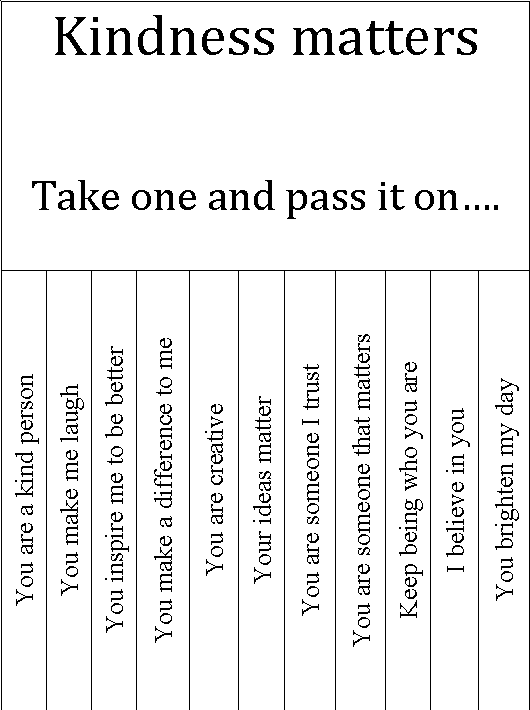
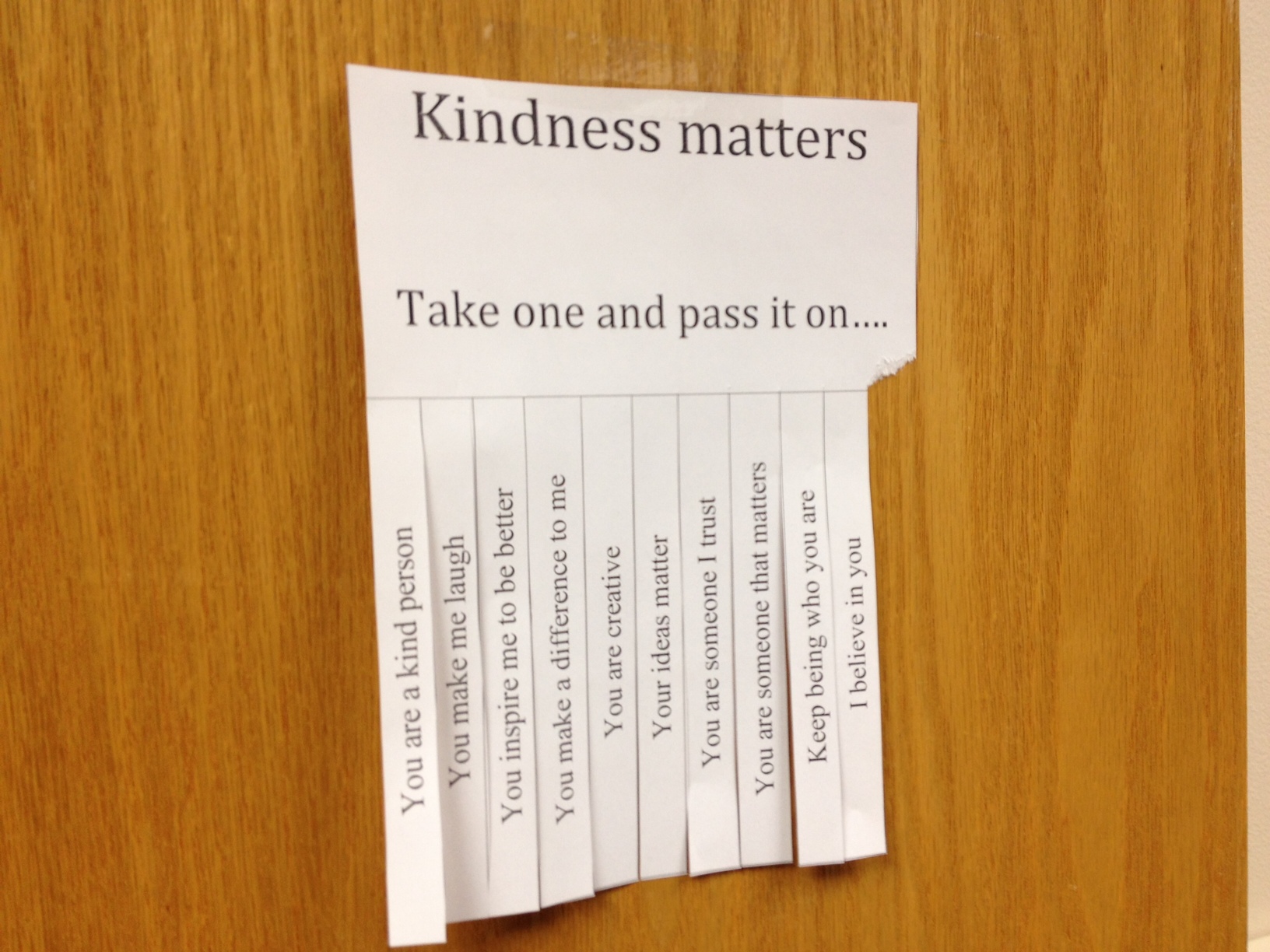
In the staff bathroom at my school something like this hung on the wall.  I should have taken a picture but I was too caught up in it to think that far ahead.  It kind of looked like this except a couple of strips had already been ripped off.  So I followed the direction, ripped it off, and passed it on.  Perhaps these should be plastered all over our schoolskindness matters

Go ahead, print it off, cut along the lines and hang it up. Start a movement of kindness.

Hanging on my classroom door, I had to replace it today because they were all gone.

To print it, go here

I am a passionate teacher in Oregon, Wisconsin, USA,  who has taught 4th, 5th, and 7th grade.  Proud techy geek, and mass consumer of incredible books. Creator of the Global Read Aloud Project, Co-founder of EdCamp MadWI, and believer in all children. I have no awards or accolades except for the lightbulbs that go off in my students’ heads every day.  First book “Passionate Learners – Giving Our Classrooms Back to Our Students” can be purchased now from Powerful Learning Press.   Second book“Empowered Schools, Empowered Students – Creating Connected and Invested Learners” is out now from Corwin Press.  Follow me on Twitter @PernilleRipp.

aha moment, Be the change, being a teacher, change, inspiration

You Don’t Have to Throw Everything Out to Be Innovative

Innovation-should-not-be

I almost felt guilty walking to the cabinet.  I almost felt as if I would get busted, as if someone would burst through the door wagging their finger and raising an eyebrow.  Touting me as a phony because am I not “one of those” educators that are supposed to be innovative?  One of those that is constantly trying something new and crazy?  One of those that tells everyone to just take a chance and make a change?  Well I am (sometimes), but I am also human.  And on this day I went to the cabinet to fetch an old lesson, something I knew would work, something that I could use again.  Something that I would probably tweak to fit my new students, but not majorly overhaul, and honestly I felt relieved.

We often confuse great teaching with constant innovation.  We think that to reach all of our students in the best way possible, we must constantly change.  we must never rest.  We must never reuse.  Yet, we forget that we are dealing with children that crave routine.  Children that yes can be creative and curious but at the same time also need some predictability.  Children that can get exhausted when we are constantly trying new things and asking them to discard the old to embrace the new.

And let’s not forget about ourselves.  The job we have is demanding, and we must constantly search for new solutions, yet we forget to give ourselves a break.  There is nothing wrong with using something that has worked before, as long as we make it better each time we use it.  There is nothing wrong with trying something we have tried before.  There is nothing wrong with pulling out old lessons.  Innovation should not be confused with discarding every thing we have tried.  There is beauty in the old, in the tried.  There is beauty when a teacher has experience.  Allow yourself that moment.

So do embrace the old when it works.  Fly the flag of your past lessons that have soared.  Don’t get stuck, but allow yourself to rest in familiarity as well.  Great things come from ideas we have tried on before.  Don’t think you have to constantly change to be a change-maker.

I am a passionate teacher in Oregon, Wisconsin, USA,  who has taught 4th, 5th, and 7th grade.  Proud techy geek, and mass consumer of incredible books. Creator of the Global Read Aloud Project, Co-founder of EdCamp MadWI, and believer in all children. I have no awards or accolades except for the lightbulbs that go off in my students’ heads every day.  First book “Passionate Learners – Giving Our Classrooms Back to Our Students” can be purchased now from Powerful Learning Press.   Second book“Empowered Schools, Empowered Students – Creating Connected and Invested Learners” is out now from Corwin Press.  Follow me on Twitter @PernilleRipp.

Be the change, Passion, student choice, student voice

6 Changes Toward Personalized Learning

Say personalized learning to most people and it conjures up classrooms where every child is doing their own thing and the teacher is furiously trying to maintain order and overview in an otherwise rule-free classroom.  Yet, this is not exactly what it is.    Instead, personalized learning to me means student voice and choice, where student input is used to create a personalized learning path that allows students room to explore their passions while exposing them to new things.  Sounds great but where do you even begin on this path?  Or even better, what are you already doing that would count as a step toward personalized learning?

Change the way they sit.  I ask my students to sit wherever they want as long as they can work.  Only once in awhile do I have to interfere as to their seating choice and I have much happier students.  Why?  Because they got to have a say in their classroom environment, they were given control.

Change the way they work.  I ask my students to discover how they work best; do they like to hand-write things, type, dictate?  Are they kids that love to write papers rather than make a movie?  How do they want to read?  How do they want to think?  If students are to discover how they work best we have to give them choice and room for exploration.  This doesn’t mean that every single thing has to be open for anything, but simply providing choice in some things is a step in the right direction.

Change the knowledge they have.  One push-back against personalized learning has been that students don’t necessarily know what they need to know, and I agree.  That is why personalized learning also has to include exposing students to various topics, such as the materials we have to cover due to standards.  However, there are many ways to expose students to these topics, so don’t do the same thing over and over; change it up and allow for student ideas in the way material is covered.

Change the expectations for all.  We tend to teach the way we learn best but that is not always the way our students learn best.  So rather than plan by yourself, plan with your students.  Their ideas are often much better than ours anyway.  This also allows us to move out of our comfort zone rather than use the same type of format, or go with just your own thinking.  So ask the students HOW they would like to learn something and then heed their advice.  You don’t have to go with every single idea but try a few of them at least.

Change the timeline.  I used to think all students had to gain mastery of something at the same time because I had taught it to them all at the same time, until I had my twins.  Kids, even born at roughly the same time from the same mother, do not learn things at the same time so why do we expect our students to?  My students will now show me mastery of the standards when they feel they are ready within the quarter.  Sure, it will require a more lucid timeline but it really doesn’t add more work to me, all I need is a more flexible mindset.

Change the conversation.  I used to be the queen of all answers and solutions.  If a student had a problem, I fixed it.  If a student needed help, I helped them.  I used to think that was one of my main components of being a teacher; the helper/fixer/teacher role.  Now I know that students need support so they can help themselves and figure things out themselves and my language reflects that.  Rather than giving an answer, I ask a question back.  Rather than affirming an answer, I ask them to explain it.  I ask for their input, I ask them to reflect, I ask them to provide solutions and to teach others what they know.  This classroom is no longer about what I need them to do or know, but what they need to do or know, and that carries power.  So change the way you speak, include the students in the conversation, and stick with it.

Starting a journey toward personalized learning can be a terrifying endeavor, but have faith; every step you take toward giving your classroom back to your students matter.  Every idea you have that gives the students more power matters.  We have to create environments where students are passionate learners, that want to take control of their learning journeys.  I wrote my first book on how I did my journey, hoping to inspire others, and still my journey continues.  I am not done changing the way I teach because every year I have new students to grow with.  It is not just the students that need to be exposed to personalized learning, it is us the adults as well.
Be the change, reflection, Student-centered, writing

But We Hate to Write

image from etsy

“It’s just…”His eyes dart away and he stops talking.

I sit there quietly, waiting for him to finish his sentence.  I can tell he is down, I can tell he is unsure.

“It’s just…” he begins again after a long pause, “It’s just that I really hate writing, I’m sorry.”  And he gives me that look that only a child can give you, that “please don’t hate me” look that cuts straight through me.

A million thoughts fly through my head, mostly surprise.  I would never have guessed, not this kid, not him, he is too good of a student.  And yet, he waits, so I ask the only thing I can think of, “Well, when did that start?”

I don’t think I hated writing as a child.  It was something I did gladly, often delving into long stories filled with tragedy and drama as I worked through my own quiet life.  I remember all of the essays I had to write and how I had to wait until I was inspired or the deadline had passed and a teacher was asking me to hand it in before I wrote.  But hated it?  Nah, more inconvenienced than anything else.

But this child, with his courageous statement, is not alone.  More and more often I hear it from my students; “We hate writing.. We hate being told what to write.  We hate having to come up with something when we are not inspired.”  And I know I cannot be alone .

So what do we do as the teachers of the future writers?  How do we bring back the passion into our writing curriculum, much like we aim for in our reading?  How do we show these kids that writing is not a chore, not something simply to get through to get to the next thing, but the way for them to have a voice.  The way for them to make a difference from where they are right now?

We start with blogging.  By providing them with a platform for putting their voice into the world where they can see their words are being read, and their words carry weight.  Where others can comment and start a conversation.  We then add choice, authentic purpose, and declare our own passion for writing.  We show how writing makes a difference to us in our lives.  How writing matters and should be held sacred, much like we hold our reading sacred.

But then what?  Where do we go from there?  How do we convince our students that writing does actually matter?  That being a good writer is actually something worth their time and not just something they have to do because their teacher told them to.  Or something forced to fit into an already pre-determined box of thought.   How do we help them un-hate writing again or is it too late?


I am a passionate  teacher in Wisconsin, USA,  who has taught 4, 5th, and 7th grade.  Proud techy geek, and mass consumer of incredible books. Creator of the Global Read Aloud Project, Co-founder of EdCamp MadWI, and believer in all children. I have no awards or accolades except for the lightbulbs that go off in my students’ heads every day.  First book “Passionate Learners – Giving Our Classrooms Back to Our Students” can be purchased now from Powerful Learning Press.   Second book“Empowered Schools, Empowered Students – Creating Connected and Invested Learners” is out now from Corwin Press.  Follow me on Twitter @PernilleRipp.


Be the change, Reading, reflection, Student-centered

How Many Readers Have I Hurt?

image from etsy

Every year I share the story of my husband and how he hated reading for most of his life with my students.  I used to share it because it was unfathomable to me; how can anyone hate reading?  But in the past few years, I share it so the students know that hating reading and feeling like a bad reader is not a box that should define them.

Yesterday, as I told the story to my 7th graders, head nods all around as I explained how my husband would rather ride his bike than read a book.  He knew he was a slow and bad reader, so why even bother when the world has so much else to offer?   I asked the students; why is reading hard?  Why do we think we are bad readers?  One boy raised his hand and said, “I was told I couldn’t read a book because it wasn’t at my level…”  More head nods, and I cringed a little, pretty sure I have told students something similar at some point.  But still I asked them, “What else has happened to you?”

One shared the story of being told to read other genres to break out of their preference, another of the five finger rule and how it was enforced.  A girl told us of how easy books were not allowed, only the ones deemed “Just right.”  Stories of forced books, worksheet packets, and reading logs arose and my mortification grew because I know I have said and done all of those things.  But these kids were telling me how harmful it had been, not helpful as I had thought every time I said it.

I wonder how often our sage reading advice hurts rather than helps?  I wonder how often our great intentions damage what we are trying to build?  I know that students need guidance when it comes to growing as readers, but are levels, forced books, and “just right” the way to do it?  In our helpfulness are we instead creating reading boxes that our students cannot break free from?   I told my students that I would never define them by their level and that the books they choose to read need to be just right for them.  Just right at this time in their life.  Just right for what they want to do.  That can mean many things and it can change through time.

I end with the story of how my husband realized at the age of 35 that he was not a bad reader.  He was a slow reader, yes, but that did not make him bad.  He realized that had he had more choice, more books, something else in his younger age who knows what would have happened.  The past is out of his hands but the future he controls.  So as he slowly makes his way through books, he is becoming a reader.  I tell my students that they have control of the label they give themselves and to not let that label hinder them.  We have all been “bad” readers at some point, we chose what to do with that label.  It is my job to help them with that, not give them more boxes to hold them back.

I am a passionate  teacher in Wisconsin, USA,  who has taught 4, 5th, and 7th grade.  Proud techy geek, and mass consumer of incredible books. Creator of the Global Read Aloud Project, Co-founder of EdCamp MadWI, and believer in all children. I have no awards or accolades except for the lightbulbs that go off in my students’ heads every day.  First book “Passionate Learners – Giving Our Classrooms Back to Our Students” can be purchased now from Powerful Learning Press.   Second book“Empowered Schools, Empowered Students – Creating Connected and Invested Learners” is out now from Corwin Press.  Follow me on Twitter @PernilleRipp.


Be the change, being a teacher, being me, reflection, Student-centered, students

Are We Having Honest Conversations with Kids?

image from icanread

The groan could have been heard for miles it seemed.  The 7th grader in front of me looked at me with that look only kids can give you when you have said something that they hate.

“Post-its?  I hate post-its, why do we have to use post-its?”

I bent down and said “Why?” took the few minutes to discuss and then knew I had to change what I was about to teach.

It was my first day of readers workshop with the students and I was pumped, I couldn’t wait to get them started on their journey to think deeper about their books, have better conversations, and boost their writing.  And yet, already by the first hour, I had run into a boulder of disapproval.

In the past, I would have had a conversation with the student as well, but it would have centered on explaining why this was good for them, why they had to do it, and how they just had to trust me.  This time though, I knew it wouldn’t be enough, that my role right now is not to force habits because I said so but rather create discussion and find habits that work for us.  So I listened and we discussed and I realized that the student brought up points that I think of myself as I read through some of my lessons and it was time for me to admit it.

Being a teacher is sometimes like being an enforcer.  We tell children what to do because we know best, we know the end point, and so we know the building blocks that they need to get there.  We have discussions, we offer choice, but how often do we listen to what the students are telling us and admitting our own doubts or thoughts?  How often do we admit our own adult habits and how they fly in the face of what we are teaching and then create a new path forward because we know the students might be right?  How often do we listen when students tell us how they feel and then actually act upon it even if it means changing the way we teach?

We have to have honest conversations with our students.  We have to be able to admit that sometimes the ideas we first had are not the ideas that are best suited for the children in front of us.  That we as adults have developed habits that fly in the face of what we are teaching and yet we still manage to be deep thinkers.  We have to admit that sometimes our lessons are not “real life” or even do-able for all of us.  We have to admit that not everyone has the same path forward to whatever goal we may have set.

I speak to my students about developing as independent thinkers, yet I expect them to conform to all of the same rules in our classroom.  I am not sure how to go forward, but I know something has to give.  We may know what is best for most, but I need to know what is best for each.  And that will take a lot of honest conversations.

I am a passionate  teacher in Wisconsin, USA,  who has taught 4, 5th, and 7th grade.  Proud techy geek, and mass consumer of incredible books. Creator of the Global Read Aloud Project, Co-founder of EdCamp MadWI, and believer in all children. I have no awards or accolades except for the lightbulbs that go off in my students’ heads every day.  First book “Passionate Learners – Giving Our Classrooms Back to Our Students” can be purchased now from Powerful Learning Press.   Second book“Empowered Schools, Empowered Students – Creating Connected and Invested Learners” is out now from Corwin Press.  Follow me on Twitter @PernilleRipp.