Be the change, being me, Student-centered

The Connected Educator Series – First Four Drop Today

via: Corwin.com/connectededucators

Thank you so much to Mark Barnes for writing this post highlighting the incredible series I get to be a part of with my next book “Empowered Schools, Empowered Students.”

Ask any of the thousands of teachers who regularly use Twitter, Pinterest, or Facebook about connected education, and you may get an earful about using digital tools as a means to connect with educators and students worldwide.

But if you ask teachers who have never used a social network, blog, or mobile device for learning in their classrooms to discuss connected education, you are likely to be met with blank stares, furrowed eyebrows and shrugged shoulders.

Enter Corwin Press and the Connected Educators Series.

In an effort to connect all teachers, EdWeek author and Corwin editor Peter DeWitt enlisted the help of his professional learning network (PLN) in order to launch a series of books on digital learning, digital leadership, mobile learning, digital citizenship, and everything else that is connected education.

Peter DeWitt, Connected Educators Series Editor”It is our hope and intent to meet you where you are in your digital journey, and elevate you as educators to the next level.

Corwin’s Connected Educators Series features short books, about 70 pages, in both paperback and electronic formats, aimed at helping educators improve classroom practice and educational leadership in the digital world, something that has been sorely missing in the education book world.

The first books in the series will be published in August and September.

[su_heading size=”28″]Corwin Connected Educators Series[/su_heading]

The Relevant Educator: How Connectedness Empowers Learning, by Tom Whitby and Steven Anderson: Two of the profession’s most connected educators explain how to effectively use social media to build a professional learning network.

Flipped Leadership Doesn’t Mean Reinventing the Wheel, by Peter DeWitt: If we can flip the classroom, why can’t we flip faculty meetings and other kinds of communication with parents and teachers? According to DeWitt, we can.

Connected Educator Series
Connected Educators Series

The Edcamp Model: Powering Up Professional Learning, by The Edcamp Foundation: Professional development has never been so simple than when teachers create it. The Edcamp model connects educators to PD like never before.

Teaching the iStudent: A Quick Guide to Using Mobile Devices and Social Media in the K-12 Classroom, by Mark Barnes: Knowledge is in the palm of learners’ hands, making them iStudents. This book helps teachers understand how to maximize this incredible power.

The Corwin Connected Educators series is your key to unlocking the greatest resource available to all educators: other educators.

Connected Leadership: It’s Just a Click Away, by Spike Cook: In the 21st-century, it’s critical that principals create a transparent school for all stakeholders. Principal Cook shows school leaders how to author blogs, PLNs and more, in order to open up a digital window to your school for parents and community.

All Hands on Deck: Tools for Connecting Educators, Parents, and Communities, by Brad Currie: The connected educator doesn’t just connect with students and colleagues. She connects with parents and community, using 21st-century tools. Currie shows readers how this is done.

Empowered Schools, Empowered Students: Creating Connected and Invested Learners, by Pernille Ripp: Connecting also means empowering. Ripp shares a variety of methods for teachers and school leaders to empower colleagues and students to help each other build a strong learning community.

The Power of Branding: Telling Your School’s Story, by Tony Sinanis and Joseph Sanfelippo: Connected educators must teach students about digital citizenship, and what better way to teach this lesson, according to administrators Sinanis and Sanfelippo, than by showing students how to brand their own schools?

These eight books are the first in Corwin’s ongoing Connected Educators Series. Several more are currently in production and scheduled for publication in early 2015.

For updates, author biographies and other valuable information, visit the Corwin Connected Educators Series website here.

You can order Any books in the Connected Educators Series here. Let us know what you think and what you’d like to see next.

Be the change, being a teacher, being me, building community, making a difference, new year, principals

Dear Administrators, Please Don’t Forget About the Little Things

Dear Administrators,

I know you are excited.  I see it on Twitter, I hear it on Voxer, and in the conversations I am lucky enough to be a part of.  School is starting and another year is about to begin.  The big ideas are ready, the new initiatives, the dreams, hopes, wishes that come bundled with the start of a new school year.  There is so much potential surrounding you.  So much to do.  And so little time to waste.

But before you get too far in your dreams, think small first, please.  Before you roll out all of the new initiatives, the changes that you know will make everything so much better for everyone, yourself included, make me a promise first; promise to take care of the little things as soon as possible.

Yes, I know it is not fun or exciting to think about those things that you promise teachers that you will do, like approving a form, emailing a parent, looking up that long lost order.  But those little things?  They make a big difference to us teachers.  Those little things that you may not think deserves your limited time right now, those are the ones we need you to also take care of because those things add up to a whole lot of stress for us when left undone.  In fact, some of those little things may be stopping us from fulfilling our big dreams, hopes, and wishes.  

An amazing school doesn’t just come from dreams.  It is built upon a foundation of trust, of accountability, of feeling respected.  And all three of those are built on getting the management side of your job done for those who need it.  There are certain things that we teachers can only ask you to do, we don’t mean to burden you, we don’t mean to add more tasks to your already busy day, but there are some things we are not allowed to do or we are not capable of doing.  There are some things we need you for to make our jobs easier.

So this year, please do dream big.  Please do work for change.  Get excited about the big things.  But don’t forget the little things, those boring to-do tasks that don’t seem pressing.  To you they may be able to wait, but to me, it matters so much that you got them done.  That I can trust you to get them done.  That I know that even the small things deserve attention in the journey we are on.  

Thank you,

Pernille

PS: Shannon or Jason, if you read this, you do this.  Thank you from the bottom of my very excited heart.

I am a passionate  teacher in Wisconsin, USA,  who has taught 4, 5th, and 7th grade.  Proud techy geek, and mass consumer of incredible books. Creator of the Global Read Aloud Project, Co-founder of EdCamp MadWI, and believer in all children. I have no awards or accolades except for the lightbulbs that go off in my students’ heads every day.  First book “Passionate Learners – Giving Our Classrooms Back to Our Students” can be purchased now from Powerful Learning Press.   Second book“Empowered Schools, Empowered Students – Creating Connected and Invested Learners” can be pre-ordered from Corwin Press now.  Follow me on Twitter @PernilleRipp.

Be the change, being a teacher, new year, student choice, Student-centered, voice

Some Myths About Student Choice and Voice

If you ever listen to me speak, whether in a podcast, at a conference, or just over tea here in Wisconsin, chances are at some point I will mention student voice.  And then, if we continue discussing teaching, student choice will also pop up.  I can’t help it.  It is what I fervently believe in.  It is what I live for in the classroom.  Yet, sometimes when I bring it up, I get strange looks, like “Is she insane?” type of looks.  Or just confused expressions, nonchalant shrugs, or even indifference.  Sometimes though I get excitement, then confusion, then questions.  Those are my favorite types of moment.

So what are some of the most common myths about student voice and choice?

That it is hard.  Giving students a voice is not hard.  Asking them for their opinion is not hard.  Implementing it is.  Listening to it without judgment is.  But asking the first question, not hard, not even brave.  Acting on what they tell you, now that takes courage.

That is a mess.  Sure, students working on different things can be messy, but it is far from a mess. A mess would indicate no direction, no instructions, no real purpose.  Messy can indicate a variety of things; creativity in progress, exploration at hand, failure and triumph all at the same time.

That it is utopian.  Offering students a choice in what they are doing, even if it is a small one, is not an unrealistic expectations for students to have.  After all, as adults (which I believe children will be some day) we are given choices all of the time.  Sure, certain things are determined by things outside of our control, but so many things can be handed over to students to decide.  We just have to look for them.

That it stands in the way of learning.  Often choice is seen as a hindrance to cover what we need to cover, yet, in my experience the opposite is true.  Giving students choices and a voice in the world will help you cover more curriculum.  You can have students unpack the standards with you and come up with ways to cover multiple ones in projects.  Plus student engagement inevitably goes up when they are engaged in the learning progress.

That it will breed negativity.  Often the assumption is that if you give students a voice all they will do is complain, but that is simply not true.  Sure, there will be complaints, but there will also be constructive criticism, braistorming, ideas, questions, and hope.  We will not know what we get without asking first.

That it is the answer to everything.  I love student choice and voice, but there is more than this to creating a successful learning journey.  You can add it, but it won’t fix everything.  To do that you have to figure out whether you would want to be a student in your own classroom and then start fixing what you wouldn’t like.  Student choice and voice are just parts of the solution.

I am a passionate  teacher in Wisconsin, USA,  who has taught 4, 5th, and 7th grade.  Proud techy geek, and mass consumer of incredible books. Creator of the Global Read Aloud Project, Co-founder of EdCamp MadWI, and believer in all children. I have no awards or accolades except for the lightbulbs that go off in my students’ heads every day.  First book “Passionate Learners – Giving Our Classrooms Back to Our Students” can be purchased now from Powerful Learning Press.   Second book“Empowered Schools, Empowered Students – Creating Connected and Invested Learners” can be pre-ordered from Corwin Press now.  Follow me on Twitter @PernilleRipp.

Be the change, classroom management, new year, Student-centered

How to Make Your Anti-Rewards Philosophy Fit in A Pro-Rewards/PBIS School

image from icanread

4 years ago I decided that rewards in its most basic sense of trinkets, special events, and things to earn had no place in my classroom.  I threw it all out, decided to go rewards free and then held my breath.  3 years ago my former school adopted PBIS.  And I was in a dilemma.  Questions like what do you do when you are anti-rewards but part of a school that has a school-wide reward system?  What do you do when you are seemingly the only person like this?  How do you follow the expectations and rules without betraying your own philosophy? surrounded my brain.  Turns out I am not the only one in this situation.  In fact, this is one of the most common emails I get from people who have read my book “Passionate Learners” or this blog; how do you fit into a school that does rewards when you don’t believe in it yourself?

It would be easy to say that you stand your ground.  That you refuse to give them.  That you tell everyone how wrong they are and that you will never, ever participate.  But let’s be real.  If I had done that it would have been put in my file as being a non-team player.  I also would have looked like a jerk.  And nobody wants to look like a jerk.  So instead there is a few things you can do if you find yourself in this situation.

You can participate like everyone else.  I did this my first year.  I followed all of the expectations, didn’t ask any questions (for a while any way) and made sure I gave it a chance.  I did not want to judge something that so many people loved before I had fully tried it.  What I discovered helped me shape how I worked with the expectations in my own classroom.

I discovered that PBIS, or similar all school “management philosophies” works on noticing the positive.  That I could stand behind.  It also works on common expectations and common language.  That I also believe in.  So those parts were fine with me.  What I didn’t like so much was the handing out of rewards to earn something materialistic, the singling out of certain students, and the exclusion of others.  I had a hard time being okay with handing a student a ticket for walking properly in the hallway, following normal rules, and pretty much just doing what was expected.  And yet I had to work with it, not against it and thus make it work.  So, some ideas to work with this are:

  • Create your own “awards”– rather than trading tickets in for things, my students could show them to me and get a thumbs up/wohoo/high five etc.  This may sound totally ridiculous but my students work on being noticed for their great behavior and so I worked on noticing those.  Often we get too busy with teaching that we don’t see or say when kids are being great, a few seconds here or there for positive call outs go a long way.  So when students were awesome, I told them that.  When students weren’t so awesome, I also told them that.  They would rather have words from me than a ticket.  However, if you have to hand out tickets for students to earn things, see if they can earn time with you, earn time to read more, earn time to read a picture book etc.  That way you are still following school rules but getting rid of the trinkets.
  • Have class parties.  My students never earned these in the traditional sense, I would surprise them with a special afternoon when they had worked really hard.  Parents knew and would help behind the scenes, but the students most of the time did not know it was coming.  They never acted in a certain way to get something and no one ever lost the privilige to take part.
  • Have students pick students to be recognized.  I was put in the uncomfortable position or picking two kids to honor at an assembly.  Uncomfortable because I really had a lot more than two that could have been honored.  So instead of picking, I let the students vote.  That way they were recognizing their peers, which meant more in the long run.
  • Have them set their own rules.  Yes, we were a PBIS school with PBIS rules, but I also wanted students to set their own expectations for behavior within our class.  I wanted them to decide how they would get the most out of school by deciding what their learning environment should look like and feel like.  This was not to replace what the school had decided but to supplement it.  Students made rules that worked for them in their language and then modified/fine-tuned throughout the year.
  • Plant a seed.  It is okay to start a conversation on how PBIS or other all-school reward/award philosophies can be changed to fit your school and all kids better.  You don’t have to come out with guns blazing, you can bring up small questions and points, thus planting the seed of change.  You can discuss how you would rather not reward students with trinkets for what they are supposed to do, and then offer alternatives.  You can discuss how you work with it in your class.  You can also have students discuss it.  When I asked my students whether they thought the tickets made a difference, some of them laughed.  They did not care much about them and saw them as silly since it seemed random as to whether they got them and the prizes associated with them were not very good (gotta love 5th graders’ honesty).
  • Band together.  Find people who also question some of the philosophies and discuss it with them, this is not to form a terror group of “we are right, you are wrong” but rather to not be alone in presenting your views.  If more than one person is questioning certain parts, a better conversation can be had with differing viewpoints.
  • Make it work for you.  I think we can take even some of the strictest systems and make them work for us by starting thoughtful conversations with those in charge, by asking for small tweaks and changes and explaining why.  Don’t try to ridicule the system because parts of it does work, but find ways to work with it without making yourself sick.  There are always battles to pick and fight, but compromise goes a long way as well.  Yes, in a perfect world, we would not have to change our own philosophies to fit our school’s, but we work in buildings with many needs.  What works for us may not work for others and if we model that belief we can create a space where we all fit.

I know I am not the only one in this boat, so what has worked for you?

I am a passionate  teacher in Wisconsin, USA,  who has taught 4, 5th, and 7th grade.  Proud techy geek, and mass consumer of incredible books. Creator of the Global Read Aloud Project, Co-founder of EdCamp MadWI, and believer in all children. I have no awards or accolades except for the lightbulbs that go off in my students’ heads every day.  First book “Passionate Learners – Giving Our Classrooms Back to Our Students” can be purchased now from Powerful Learning Press.   Second book“Empowered Schools, Empowered Students – Creating Connected and Invested Learners” can be pre-ordered from Corwin Press now.  Follow me on Twitter @PernilleRipp.


Be the change, being a teacher, being me, new year

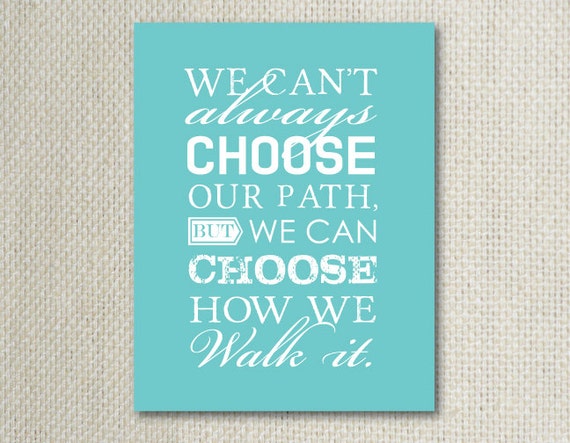
What We Can Choose

image from etsy

We get so caught up in our big things.  The units we have to teach.  The conferences we need to do.  The to-do list that always grows with our next big project.  We lie awake at night wondering about our direction, whether students are invested?  Whether what we do matters?  And yet, the big things are not always the things that matter the most.  We may think they do, but really, the little things have a lot of power.  There are choices we make every day that seem so small, yet make such a big difference.

We can choose to look at a child when they speak to us.  That matters.

We can choose to withhold judgment as an answer is given.  That matters.

We can choose to do something we promised we would, even if it is so small we think the other person may forget about it.  This matters.

We can choose to smile when someone greets us.

We can choose to stop by, say hello, even if we are busy.

We can choose to be interested, to slough away our tiredness, and instead remember why we do this job.

That matters.

We can choose to remember names.  To ask about a weekend.  To find a book.  To lend a pencil.  We can choose to take time for talking.

We may be busy.  We may always have the next big thing waiting for us, pressing down on us, urging us to move faster and further.  Yet.

We can choose to slow down in small moments.

We can choose to savor the time.

We can choose to tell a story.  To laugh out loud.  To show our humanness.  We can choose to share our mistakes.

We can choose to unveil our dreams, our fears, and in turn create a community.  This matters.

We may dream big, but we should think small.  Everything matters, especially the things we think matter very little.

That’s what we can choose.

I am a passionate  teacher in Wisconsin, USA,  who has taught 4, 5th, and 7th grade.  Proud techy geek, and mass consumer of incredible books. Creator of the Global Read Aloud Project, Co-founder of EdCamp MadWI, and believer in all children. I have no awards or accolades except for the lightbulbs that go off in my students’ heads every day.  First book “Passionate Learners – Giving Our Classrooms Back to Our Students” can be purchased now from Powerful Learning Press.   Second book“Empowered Schools, Empowered Students – Creating Connected and Invested Learners” can be pre-ordered from Corwin Press now.  Follow me on Twitter @PernilleRipp.

Be the change, being me, building community, new year, Student-centered

May I Speak to You Privately?

image from icanread

“Hey Pernille, can I speak to you in my office?”  My new principal asked me today.  Immediately my heart dropped; what had I done?  Had I screwed up already?  Were they regretting their decision to hire me?

I followed her in, sat down, took a deep breath and waited for the inevitable.  I must have screwed up somehow, why else would she want to speak to me privately?  And then she surprised me.  It wasn’t to yell or reprimand, nor was it to point out my rookie mistakes.  It was to connect, to ask questions, to ask how she could help.  To further welcome me and discuss the year ahead.  I stayed for almost 30 minutes, inwardly amazed at the moment.  So thankful that this is the kind of person I get to work for and with.  That this is the community I get to represent.

As I left I couldn’t help but cringe at my initial reaction.  My assumptions had gotten the better of me.  Yet, I realized that those assumptions are based upon my experience, that asking to speak privately with someone has a negative connotation.  That being asked to step into an office is usually not positive.

So think of how our students feel when we do the same to them? When we ask them to stay back for a moment? To come in during recess?  To hang on?  Wait up?  Don’t go?  Do they assume we have something positive to share or something negative?  I can tell you right now, that I have missed so many opportunities to use this moment for praise.  I have reserved the private moment for corrections, reprimands, careful questions of concern.  I have almost never used it for good. Have you?

This year that will change.  I want to reclaim the power of the private moment and change the assumption.  I want students to not automatically assume that staying behind means something bad.  That waiting for a moment does not signify trouble.  Sure, there will be times where a private moment is needed to discuss decisions or actions, but there should be more of celebration.  There should be more positive surprises.

So just as I tell students what I notice on post-it notes, I will look for the moment to praise privately.  I will look for that small sliver of time where I get to speak one to one to someone and tell them what I see, how proud I am, how I am here to help.  I hope they leave feeling relieved like I did and then proud.  I hope they will see that I care.

I am a passionate  teacher in Wisconsin, USA,  who has taught 4, 5th, and 7th grade.  Proud techy geek, and mass consumer of incredible books. Creator of the Global Read Aloud Project, Co-founder of EdCamp MadWI, and believer in all children. I have no awards or accolades except for the lightbulbs that go off in my students’ heads every day.  First book “Passionate Learners – Giving Our Classrooms Back to Our Students” can be purchased now from Powerful Learning Press.   Second book“Empowered Schools, Empowered Students – Creating Connected and Invested Learners” can be pre-ordered from Corwin Press now.  Follow me on Twitter @PernilleRipp.