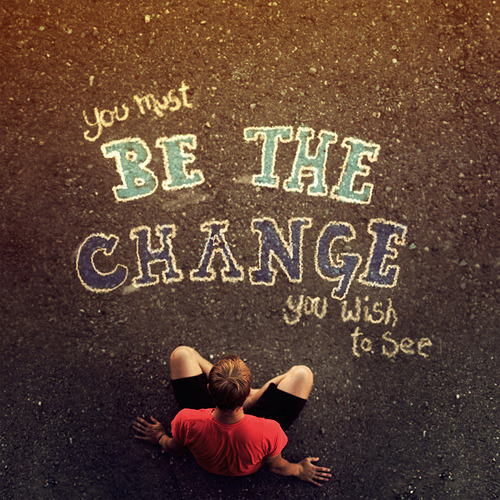
Be the change, being a teacher, choices

Find Your Change

image from Case&Co

I write a lot about change, after all, in education how can you not?  Change does appear to be the constant every year and this year is no different.  However, the change I love to focus on is the personal change; the one where we know that something has to be different for us to keep on going.  The change that tells us that we will burn out in teaching if we don’t act now.  So the one question I seem to get the most is; how do you change?

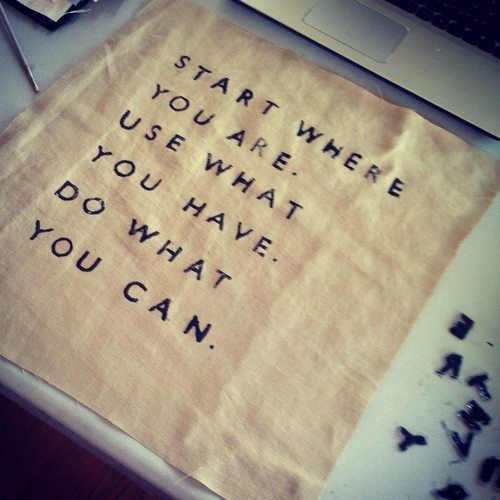
The answer for me is; start where you are.  Take stock of what it is that makes you tick and what makes you stop.  What burns you out and what do you have power over?  There are many things that wear my soul down that I cannot control so I try to focus on those that I can; homework, grades, punishment, ways I present information, community, and so on.  And then I focus in on a few that I need to change right now.  I do not marry an idea, I date i,t and year after year it may get transformed – the change may change, and I am at peace with that.

I also don’t buy into a lot of programs.  I already have enough to memorize with the curriculum I have to teach so I look for natural changes; those that speak to me, that I know are authentic to me, nor purchased and packaged in a sleek form.  I have tried to implement many programs in my classroom, Tribes anyone, only to watch them disappear because I don’t remember what the main components are.  So my change is my program and therefore not prescriptive, it works for me in that moment, in that year, and I believe those are the best types of changes.

So this year, as I sit on maternity leave and wait for the calendar to show November 5th, I think of changes I may implement this year.  There are many I can think of but none that I know for sure, after all, how can I know what to change when I don’t know what will work with this amazing group of students?  And yet, the need for change is there, I can’t wait to blog about it.

Be the change, being a teacher, choices

We Make Kids Hate School

image from icanread

I think it is time I take responsibility for the damage I can do.  Most definitely for the damage I have done to those kids that came to me loving school who  left my room changed.  Those kids that thought they were good at math until my long-winded lectures and explanations confused more than clarified, and in the end they did not know whether to ask for help or just pretend that they got it.  I changed my teaching because of the damage I had done.  I still change my teaching hoping that the students I teach will not leave my room hating school, but loving it instead, seeing it as the ultimate learning challenge to be embraced and celebrated.  Not scorned, survived, or floated through.

So how do we make children hate school so much?  I teach 5th grade and by that time certain subjects have already become hated for most kids.  Math tops the list but social studies comes in a close second.  Most love recess (which so doesn’t count), art, reading (not often writing) and science.  PE is up there and as is music for the girls.  But math and social studies, yikes.  I think of how I used to teach math; lecturing at the students with hardly any time to actually apply.  I thought they could go home and “practice” on their own time.  Often we had so much to get through that questions were not always answered thoroughly and discussion was certainly discouraged; can’t you see we have a lot to do here? Social studies belonged to the textbook, to spice things up we would share the reading aloud of the text and I would try to catch students not paying attention so I could point out that they were not paying attention.  Nothing beats a good old fashioned public embarrassment routine.  By the time I was done with them in 4th grade they knew how to follow along in a textbook and fill out worksheets really well.  Too bad the incredibly fascinating history we had just read about got buried in the disgust.

So what is so different now?  Well, I don’t talk as much.  That’s huge.  In math I prepare just what is important, then showcase it, and we discuss, answer questions, and practice as we go.  Time is given to finish pages in class and I never feel I have to assign it all if need be.  If a students asks one of those questions that are just too hard to miss out on, we explore it and deal with the time constraint later. We pull out manipulatives and whiteboards whenever we can.  We work together when desired and we move around when it makes sense.  I stress that not all concepts are meant to be conquered that day and that the most important thing is growth; no longer rote memorization but application and deeper meaning.  We discuss the similarities between concepts and how they are connected; I hope students see the red thread that runs through our year and why things are presented in this order.

Social studies starts much the same way; I don’t talk as much!  And I no longer fool myself into believing that reading round robin style counts as interaction.  Instead, the massive text book is used as a spring board for discussion.  We find the key concepts and then we set off through projects to explore them.  Students have choice in how they explore and often in what they explore within a topic.  History is brought up to the now as we discuss the parallels we can see between the past and the present.  Student questions are invited and we debate whether we would have proceeded the same way or anything else that needs to be debated.  Student voice is as important as my own and so is their understanding of why we are where we are now in the world, how we got there, and that doesn’t come through rote memorization either.

So while not every kid that leaves my room falls back in love with school – sometimes the damage takes years to undo – I try to put them back on the path.  I take responsibility for my own actions as a teacher and realize the damage I can do.  I go to school every day with the mission for kids to love learning and to show my own curiosity and be a rolemodel for loving school.  I go to school knowing that I can be the difference between love and hate and between further success in school or not.  I hope everyone takes that responsibility.

advice, Be the change, being a teacher, education reform, new year

Who Is to Blame? Who Cares…

image from icanread

In the ever expanding debate on the state of education, it seems a lot of blame is passed around.  Teachers blame parents, parents blame teachers, public schools blame society, charter schools blame public schools, and politicians, well they seem to blame everybody.  Not a day goes by without another blaring headline of one side versus the other and frankly I am sick of it.  I know there is blame to be passed, I know there is blame to be had, but in the end, who really cares?

Blame doesn’t do us any good.  Blame doesn’t fix the problem.  Yes, I can lament the fact that not all of my students have the same socioeconomic background, the same level of parent commitment, heck, I can get upset about their varying degrees of pre-school involvement, but at the end of my teaching day, none of it matters.  What matters is what I do now.  What matters is how I work with the students, with all of their background, and how we keep them successful from there.  Blame is great to discuss, it can get us all riled up, it can get us more invested in the debate, but really it takes our focus off of where it should be – what we can do in education with the students we have.

So this year, I am going to try to step out of the blame game.  Yes, I know there are many ills in our public schools and society in general.  Yes, I know poverty is a major factor in many students’ lives.  Yes, I know that I cannot control what happens outside of school or what happened before they became my students but I can control the now.  I can play a part in what happens starting September 4th and for a whole school year within the walls of our classroom.  I can focus on the students as I have them, rather than the blame I would like to assign.  I am going to take my energy off of blaming and place it back with my students.  I will continue to work and fight for change.  I will continue to be a voice in the debate.  But I will not continue to just pass the blame and do nothing.  Are you with me?

Be the change, change, classroom expectations, guest blog

Flying Above the Radar

With the arrival of our twins, I asked for guest bloggers and was super excited to share this post with all of you by Kaitlyn Gentry…

Too often in education, and in life, people aim to fly under the radar. No one wants to fail, but appearing overtly successful makes a lot of people uncomfortable. It is like a cultural regression towards the mean. Occasionally people fly high and norms are challenged, but aren’t those are statistical anomalies, ones that can be corrected with a wider data sample or retests? Why would a tiny point continue to appear above the radar, outside of that regular curve?

            My previous year was a successful one: students grew, parents were happy, and I emerged from my first year as a third grade teacher unscathed. But that is what happens when you fly below the radar. Soon thoughts began creeping in…Why had the year gone so smoothly? It must have been those sticker charts and earned recess minutes, those warnings of “this is impacting your conduct grade”, the “If I were taking this test, I’d be paying close attention to the chart of page 52.” The carefully calculated control I wielded over my group of eighteen boys had allowed for effortless success; except when it didn’t. Those small failures: students no longer caring to earn extra recess because they saw through the ploy, boys ignoring the conduct grade pleas, memorization of the chart on page 52, without understanding the chart. These were easily explained away: these are the strategies that everyone uses, the boys are ready for summer, the required chart on page 52 is actually pretty boring.
Enter the outlier.
I realized I was wrong. Those excuses were just that, excuses, and I began to see that I wasn’t alone in my thinking. There was a cluster appearing outside of the curve…a conversation was growing about the amount of control exerted upon our students, about the threats of grades, homework, lost recess, and the more subtle “positive reinforcement” of earning stickers or treats to memorize, regurgitate, and perform in lock-step fashion. I realized that in order to make my next year a true success it was not going to be smooth, within the curve, or below the radar.
This year was messy: filled with conversations about citizenship, having a voice, effort, reflection, process over product, and growth over grades. Instead of discussing their monthly grades, each student wrote a reflection paper, covering areas of growth and difficulty in every subject, which we reviewed together. These reflections also went home at the front of their folder, to be reviewed with parents, before grades were discussed if they chose to do so. Instead of removing or adding recess time for talking in the hallways, we discussed the impact of showing respect for the other classes in session. Writing assignments were no longer assigned a letter, instead I wrote to each student on their papers, citing strengths and areas for improvement. My students did not simply “aim for an A,” but sought to improve their writing mechanics, structure, creativity, or detail. Not only did this allow my students to understand specific and measurable goals, but it also helped them take responsibility for their growth. They were not relying on me to “hand down” their grade, they were able to improve by focusing on specific skills.  I eliminated many of the multiple choice tests and created projects which gave the students choices to experience authentic learning opportunities. They were no longer memorizing empty facts about the medieval time period; instead they were investigating the history of medieval warfare to design a realistic video game and “teaser video.” I stopped assigning stickers for books read or neatness. Instead, I learned about what my students liked to read, and why. We discussed beautiful artwork and made connnections between finished art and final papers, with students remarking that craftsmanship is present in both. It was eye-opening to realize how I devalued both of these areas by simply assigning stickers for completion, insteading of encouraging a conversation to occur. I was at times very uncomfortable, and so were my students, but our existence above the radar was making a real impact. Conversations were starting in classrooms nearby, students were responding, and growth was happening. Could I view this year as more of a success?  
Enter the point under the radar.
It was one sentence on a final student survey: “I look like I know what I am doing in compositions, but sometimes I do not; next year look for the boys who don’t stand out.” I had missed one…A tiny, small voice, hidden below the radar. In all of my efforts to reach each student, to listen to them, to support their individual growth, I had overlooked at least one. He was reaching out now, but it was too late, the final desk cleaned, the last locker emptied.
However, his message will help me not regress towards the mean, because the mean is created by those who have already deemed their methods as successful, instead of striving for more. I will not count this year as a “success” because I missed at least one, there is much more to be done, and next year I will continue to be an outlier, to work beyond the curve to reach each student, even those hidden safely below the radar.
Bio of Kaitlyn Gentry:
I am entering into my fifth year of teaching, and my third year with my third grade boys at Calvert School in Baltimore, Maryland. I attended Calvert, and I feel fortunate to be able to give back to such a wonderful community where I am encouraged to explore, take risks, make mistakes, and to grow alongside my students everyday. I have loved establishing a PLN through twitter (@mk8g) this year and write about my ever evolving pedagogy on my classroom blog (http://ninthageboys9-1.blogspot.com/) to teach my students not to just be “consumers,” but “producers” as well!
Be the change

We Cannot All Be the Best

Be the example!  Set the bar high so others will rise to it!  We want to be a beacon school!  How often do we hear all of these statements in education.  Be the best teacher you can be…Be the one others want to emulate…Be the best school…the best team…the best everything.  And yet, we cannot all be the best. The whole notion of the term “best” automatically excludes most of us.

So instead of striving to be THE best, how about we strive to be better?  To change things?  To inspire others?  To motivate? To set grand examples while still learning from others?  The truth is if we were all beacon schools no one would be able to see us from the glare.  So shine bright yes, but that doesn’t mean you have to shine the brightest because then all you do is blind others.  

alfie kohn, assessment, Be the change, being a teacher, change, choices, grades, homework

Change Doesn’t Have to be All or Nothing

I remember the first orientation day when I had to face parents and explain to them that their child would probably not have much homework in my classroom.  I remember the fear that almost made me choke on my words, the way I had to remind myself to look up, the way I held my breath waiting for a reaction.  Then I added that instead of letter grades students would get feedback and we would set goals, grades would only show up on trimester report cards and no where else.  By now I was breaking into a cold sweat, my stomach churning, hands were clammy.  Somebody had to react, and then…nothing.  No raised hands, no sour faces, just a quiet wait for what else I had to share. 

Big changes for sure coming from this sophomore teacher.  Big changes that I felt had been necessary for me to be a better teacher and to provide a better education for the students.  Big changes that I had decided to do all at once.  And yet, you don’t have to.  Even though I speak passionately about how throwing out grades or limiting homework has been the best decision I have ever made, that is exactly it; it was my decision.  Something that I knew I had to do to restore my sanity, my passion for teaching.  And yet, that doesn’t mean it is going to work for you.  Perhaps my ideas are too extreme, or just do not fit with your educational philosophy and that is perfectly fine.  But maybe, just maybe, you would be willing to try it for just one little assignment?

Perhaps you are curious but just not ready to go all out.  Perhaps the idea of limiting homework overall sounds insane but maybe it could be tried for a unit?  Perhaps rather than a letter grade, for one project, feedback could be given or students could assess themselves?  Perhaps just trying something different one time will work better for you?  Perhaps, you might like it, perhaps you wont, but perhaps one time will change your mind?

As a first year teacher, if someone had told me to limit homework, or to get rid of grades, I would have rolled my eyes and not listened.  I would have thought them radical, extreme, or totally clueless.  I was not ready for that type of teaching.  I was not ready to take my teaching in that direction.  That direction had to come from within me, the timing had to be right, as did the purpose.   And that is ok.  It is ok to not embrace what Alfie Kohn says.  It is ok to have faith in whatever one believes is the way to teach, there is room for us all in education.  But perhaps, we should all try something else, just once, and then see if that change is meant for us or not.