assessment, assumptions, Be the change, being a teacher, education reform, No grades, student voice

What My Students Told Me – Students Take on Grades

I thought teaching 7th graders would mean that they had a cool distance to school.  That they knew that the grades we give reflect the work they do.  That a report card is not meant as a slap in the face, but rather a tool to be used as they grow toward their goal.  I thought that moving from letter grades to standards based meant students would get it better, would embrace the chance to see what they needed to focus on and then work harder to master their deficits.  Yet again what I thought has proven to not be so, so when I asked my students their thoughts on grades so that I could add their voice to the re-publication of Passionate Learners, I had to take a moment to digest what they told me.  It wasn’t what they said about whether teachers should grade or not, it was how they reacted to the grades they were given.

Once again, I am the mouthpiece for my students, they asked that I please share this with the world in the hope that it will inspire change.  In the hope that it will inspire discussion, that we will take their thoughts and use them to push our own.  So what my students wish teachers knew about grades is simple, yet significant.  I hope it makes you think.

That they feel they have little to no control over what grade they get.  Even in a standards-based grading district, where I ask them to show me mastery with deconstructed standards using rubrics we have created together, they still feel that they have little control over how they are assessed, and more importantly what that assessment means to them.  Now imagine how students feel when they haven’t created the rubric, self-assessed, or deconstructed the standards.  They don’t understand the rubrics we give, they don’t understand at times what they should know to be labeled proficient.  They don’t understand the number they are given.  They crave feedback and conversation, rather than a number or letter.  They crave classrooms that relish growth, failure, and attempts at learning.

That grades means they are done.  The minute we grade something, they are done with it.  It is the signal they need to move on, no matter that I teach in a district that allows and encourages re-takes for everything.  If we want them to continue working on something then we should give feedback but no scores.

That grades sometimes become the one thing that their parents look at, nothing else.  The minute a grade is placed on something that is all their parents can focus on.  Their parents don’t always care about the effort, they don’t always care about the growth, just what the final result is.  The conversations then centers around reaching the “3” or the “4,” to get that A, rather than what they learned, how they liked it, and what they are working on next.

That a grade tells them whether they are smart or not.  We may say that grades are in their control and that they don’t reflect how smart they are, but they are not listening.  If you get good grades, you must be smart, if you don’t well then you are dumb.  Grades are leading them to a fixed mindset, rather than the growth mindset we are all hoping for.

That publishing honor rolls or GPA’s mean that their private learning is now public.  We may see releasing these names as a way to celebrate their learning, but many of my students says it just creates a divide.  And it’s not the students who are not on honor roll that said this to me, no, over and over it was the students that made it.  They didn’t see their accomplishments as anyone else’s business.

That grades are for the future, not for the now.  So many of my students reported that grades mattered because they want to go to college, and while at first I found this to be great (they care about the future!) I soon realized that this is so far from the purpose of what school should be.  Students should keep an eye on the future, yes, but they should also keep an e eye on the now.  They should be focused on the learning journey they are currently on and be excited to see their own growth and how it will help them right now, not 6 years from now.

Once again, my students are pushing me to change the way I asses in the classroom.  While I strive to give them meaningful feedback, I have slipped from my ways.  That’s what happens when you teach more than 100 students.  Yet, the numbers I am so carefully doling out are not helping them grow, so I am not doing my job as their teacher.  My students are making me a better teacher, imagine if we asked all of our students what grades means to them?

I am a passionate teacher in Oregon, Wisconsin, USA but originally from Denmark,  who has taught 4th, 5th, and 7th grade.  Proud techy geek, and mass consumer of incredible books. Creator of the Global Read Aloud Project, Co-founder of EdCamp MadWI, and believer in all children. I have no awards or accolades except for the lightbulbs that go off in my students’ heads every day.  The second edition of my first book “Passionate Learners – Giving Our Classrooms Back to Our Students” will be published by Routledge in the fall.   Second book“Empowered Schools, Empowered Students – Creating Connected and Invested Learners” is out now from Corwin Press.  Join our Passionate Learners community on Facebook and follow me on Twitter @PernilleRipp.

aha moment, Be the change, being a teacher, being me, Passion, Personalized Learning, student voice

What Story Are You Telling?

My students told me to stand proud.  To make sure I made eye contact.  To speak up and smile.  Maybe play music and crack a joke.  To do all of the things I ask them to do every time they speak.  “Tell them what we tell you…we need to change school, no joke”

I stand today, privileged to speak to other educators about the way we do education, about the things we may want to change.  I stand today ready to carry my students’ words out into the world.  I stand today, nervous and with butterflies in my stomach, knowing that those things my students tell me day after day now have an audience to be passed on to.  I don’t want to let them down.

Yet, I am not alone.  All of us that write, all of us that speak, all of us that go out and discuss education whether globally or locally, we carry the words of our students with us.  We carry the awesome responsibility that comes with being in classrooms or schools every day.  We carry the knowledge of what may work work and what definitely doesn’t.  We carry the words students give us so that they have a voice.  We carry the stories of our students and what they do every day.  We carry their words when they can’t.

So before we speak of THAT kid that drove us crazy.  Before we speak of THAT class that just wouldn’t listen.  Before we speak about THAT school that didn’t work; remember that we choose what the narrative of education is.  Remember that within our words we carry all of their words, all of their thoughts, all of their hopes.  We just have to decide what we share with the world.  We decide what story is told about education; one of frustration or one of change.  The choice is always ours.

I am a passionate teacher in Oregon, Wisconsin, USA but originally from Denmark,  who has taught 4th, 5th, and 7th grade.  Proud techy geek, and mass consumer of incredible books. Creator of the Global Read Aloud Project, Co-founder of EdCamp MadWI, and believer in all children. I have no awards or accolades except for the lightbulbs that go off in my students’ heads every day.  The second edition of my first book “Passionate Learners – Giving Our Classrooms Back to Our Students” will be published by Routledge in the fall.   Second book“Empowered Schools, Empowered Students – Creating Connected and Invested Learners” is out now from Corwin Press.  Join our Passionate Learners community on Facebook and follow me on Twitter @PernilleRipp.
aha moment, assumptions, authentic learning, Be the change, being a teacher, education reform

What I Need to Change

I was going to write about all of the things we have been doing to try to break down the barriers to poetry in class.  All of the eye rolls I have been seeing, the grunts and groans.  The many “Roses are red…” poems I have sen in the last few days as I ask them to write me a poem, any poem, just write something.  I was going to write about how many of my students hate poetry because of all of the rules we have forced upon them in our pursuit of helpfulness and understanding.  I was going to write about how my students are slowly inching further away from a disinterest or total hate to a small interest or even like when it comes to listening to poetry.  Writing it is an entirely different battle.

But I decided that this was bigger than that.  This moment, in our classrooms, is bigger than that.

It is not that my students are the only ones that hate poetry.  In fact, some of them do, some of them don’t.

It is not that my students are the only ones who hate writing.  Hate reading.  Hate book clubs.  Hate English.  Some of them do, some of them don’t.

It is not that my students are finally expressing their hatred not to be mean or out of spite, but so we can do something about it.

It is not that my students are different from most students.

It is more that I have had the same conversations every year.

It is more that every kid has something they hate about school because of choices I have made, choices we have made, when we decided to teach a certain way.

It is more that student curiosity seems to have been drowned out by our carefully planned lessons.

That inquiry and critical thinking have been buried by the pursuit of the one right answer.

That we have taught students that school is black and white while life is multicolored.

That we tell them to sit still so much that they forget their own voice.

That we make all of the choices for them and then get frustrated when they cannot create on their own.

That is what I need to write about because that is what I have discussed with my students.  That is what teaching poetry has revealed so far.  That is what I need to change.

Who knew poetry would be the place my students found their voice.

I am a passionate teacher in Oregon, Wisconsin, USA but originally from Denmark,  who has taught 4th, 5th, and 7th grade.  Proud techy geek, and mass consumer of incredible books. Creator of the Global Read Aloud Project, Co-founder of EdCamp MadWI, and believer in all children. I have no awards or accolades except for the lightbulbs that go off in my students’ heads every day.  The second edition of my first book “Passionate Learners – Giving Our Classrooms Back to Our Students” will be published by Routledge in the fall.   Second book“Empowered Schools, Empowered Students – Creating Connected and Invested Learners” is out now from Corwin Press.  Join our Passionate Learners community on Facebook and follow me on Twitter @PernilleRipp.

being a teacher, education reform, MIEExpert15, no homework, student voice, students choice

Before You Assign That Homework – What Students Wish You Knew

FullSizeRender

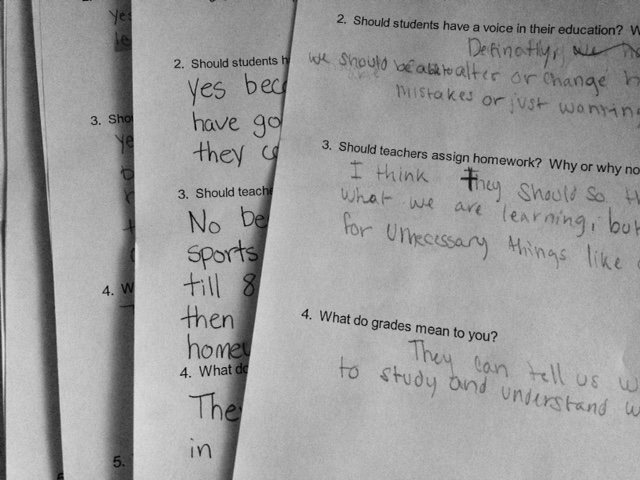
“Should teachers assign homework?” was the question I asked my students today.  I thought I knew the answer, a resounding no I was sure, and yet, once again my 7th graders surprised me.

While some pleaded for no more homework, many said they understood the purpose of it, that it was a necessary component of school and then wrote a paragraph asking for change.  Asking for their thoughts to be considered.  Asking for teachers to think before they assign.  So what my students wish teachers knew before homework is assigned is now written here for the world to see.

They wish teachers knew just how busy they are.  That we ask them to live balanced lives that involve sports, family, friends, and sleeping, yet assign hours of work that pushes their bedtime later and later.  They cannot fit everything in, even though they try.

They wish teachers knew just how stressed they are.  That they feel like our expectations are through the roof at all times, but sometimes they are bound to mess up, and can we make that okay as well?  Can it be okay to forget once in a while or to not get it all right?

They wish teachers knew that they don’t always need the practice.  That homework should be for those kids that don’t quite get it, not assume a need for everyone, and that those that really don’t get it won’t get it after they do the homework.  That they need help in school instead.

They wish teachers knew how much we all assign.  That we spoke to one another more so that we see that our class may not assign a lot but when you add each class together, it is now hours of work, not just a little bit of time.

They wish teachers knew that they have worked really hard in school and wish they could have a break.  That homework on some days is okay but it doesn’t need to be every day. Nor does it need to be over the holidays.  That tehy get we have a lot to cover but can they promise us to work hard in school in exchange for time off from school?

Finally, they wish teachers actually did their own homework.  That they tried the assignments so they could see how difficult or confusing they may be.  That they worked through it with kids, not in a pretend way, but really, and then shared their own learning with students.  That teachers truly felt what it means to live the life of a student, along with the pressure of homework,  to understand why homework continues to be a problem for some.

Once again, my students thoughts push my own thinking.  I quit assigning homework years ago but still run into my old ways once in a while; there always seems to be so much to cover, so much to do.  Now, I only assign reading every night, but even that adds up with everything else.  So I wonder; if we all asked our students, what would they say about homework?  And what would we do about it?  How would their answers change education?

I am a passionate teacher in Oregon, Wisconsin, USA but originally from Denmark,  who has taught 4th, 5th, and 7th grade.  Proud techy geek, and mass consumer of incredible books. Creator of the Global Read Aloud Project, Co-founder of EdCamp MadWI, and believer in all children. I have no awards or accolades except for the lightbulbs that go off in my students’ heads every day.  The second edition of my first book “Passionate Learners – Giving Our Classrooms Back to Our Students” will be published by Routledge in the fall.   Second book“Empowered Schools, Empowered Students – Creating Connected and Invested Learners” is out now from Corwin Press.  Join our Passionate Learners community on Facebook and follow me on Twitter @PernilleRipp.

aha moment, being a teacher, books, Passion

Got a Minute? One Sure Fire Way to Get Students to Read

For the past 3 years I have avidly shared my reading life.  Students always know the book I am reading, they know the titles I am excited about it, I have shown them pictures of my ever growing TBR (to be read) pile at my house and every week I am lucky enough to bring in new books for my students.  I place them on the shelves, the ledges, the window sill.  I place them on their desks and I place them into their hands.  And yet, something was definitely missing.  Students were reading sure, I see them with the books in their hands, but for some reason my excitement was not carrying over.  Those books I had loved that were given 5 stars on my “Read” poster were still staring at me from the shelves.  Enter Nancy Atwell and her idea that is so simple, yet I had forgotten to do, the idea that has changed the way my students are finding books, the idea that has taken 1 minute to implement in every class.  Yup a minute.

Got a minute?  Do a book talk.  Seriously.  Grab a book and plan one right now.  

For a little more than a week, I have started every class with a book talk.  A one minute recap of why a book was amazing and deserves to be read.  Sometimes I have expanded it to 4 minutes as I have read the first few pages of a book when I don’t feel the back page gave it enough selling power.  Then I have put it down where the students can see it and then started to teach class.  Easy to prep, easy to do, doesn’t take much time out of our precious 45 minutes.

The result has been palpable.  Almost every single book I have book talked has left the room.  Almost every book has found a new reader right after the talk.  That is why I talk up a different book to each class, so they all get a chance at something amazing.

The best part though is that a book talk doesn’t just end with the one reader that gets the book.  Once a child loves a book, they pass on that love to another friend,  and that friend passes it on.  A whole chain of book love going on all because you took one minute to talk up a book.  I should have done this from the start.  Thank you Nancy Atwell for reminding me.

I am a passionate teacher in Oregon, Wisconsin, USA but originally from Denmark,  who has taught 4th, 5th, and 7th grade.  Proud techy geek, and mass consumer of incredible books. Creator of the Global Read Aloud Project, Co-founder of EdCamp MadWI, and believer in all children. I have no awards or accolades except for the lightbulbs that go off in my students’ heads every day.  First book “Passionate Learners – Giving Our Classrooms Back to Our Students” can be purchased now.   Second book“Empowered Schools, Empowered Students – Creating Connected and Invested Learners” is out now from Corwin Press.  Join our Passionate Learners community on Facebook and follow me on Twitter @PernilleRipp.

aha moment, being a teacher, education reform, Passion, student voice

Want More Student Understanding? Try This.

I don’t know when my classroom first got so quiet, but I remember the moment when I realized that it shouldn’t always be.  I remember looking around at the students, some working through the task at a steady pace, others with their hand up waiting for me, and some staring into space completely lost.  There were no words spoken.  My shushes and teacher looks had effectively taken care of that.  So those kids with their hand up waited until I could get to them while I tried to get those who stared into space started.  The time wasted for all was significant; not much had been gained by the silence other than compliance and loss of learning time, but at least they were silent.

It seems an epidemic of silence has been harming our schools for many years.  That we long for silent hallways, which also mean quiet classrooms, as we tour schools.  That we often equate silence with good learning and noise with bad.  Teachers are evaluated on how quickly they can get students to settle in and listen, not how quickly they can get them talking.  

I knew then that this was not the type of classroom I wanted to be a part of; one where students were so well-trained in being quiet that they didn’t even dare advocate for themselves anymore.  Where students waited patiently at a time when they should have been figuring out how to access the information they needed without the teacher.  The quiet, the shushes, yes they still had a place but it could not be for everything.  It should not be the golden standard with which we held our learning too.

So I changed the way I taught, in fact, it was quite easy to do.  I started to plan for when they students should speak.  Rather than plan for silent engagement at all times, I plan for discussion, for deeper learning to occur because more than one person (IE the teacher) has shared their thoughts, doubts, or wonderment.  When I teach, I seek out moments for students to talk.  They turn and talk or discuss with their groups before we discuss as a whole group.  Even before an assessment, I ask the students to discuss for a few minutes to help them sort through their thoughts, to gain confidence in their beliefs, and to get mentally started with the task ahead.  I can still assess their thinking just fine, in fact, I think theirs has gotten stronger simply by allowing them a few more minutes to process in a different way.

I am not saying that all noise, all the time, is what we should strive for but there should be more.  Students should leave every single classroom having used their voice to further the learning.  Students should feel that their voice mattered, that they were heard, that those questions they carried, those ideas they had were brought into the world and at the very least touched upon.

So as you plan ahead for the week today, ask yourself; when are the students speaking?  When are they a part of the teaching going on?  My students will discuss every single class, every single day this week, much like they have in the weeks past. They will grow their listening skills by speaking.  They will grow their ideas by sharing them.

Our classrooms should not be judged on how quiet they are but instead on the type of noise they create.  Please allow the students to speak, teach them how to use their voices for good, for learning.  Let our classrooms be about the students speaking and not just their listening.

I am a passionate teacher in Oregon, Wisconsin, USA but originally from Denmark,  who has taught 4th, 5th, and 7th grade.  Proud techy geek, and mass consumer of incredible books. Creator of the Global Read Aloud Project, Co-founder of EdCamp MadWI, and believer in all children. I have no awards or accolades except for the lightbulbs that go off in my students’ heads every day.  First book “Passionate Learners – Giving Our Classrooms Back to Our Students” can be purchased now.   Second book“Empowered Schools, Empowered Students – Creating Connected and Invested Learners” is out now from Corwin Press.  Join our Passionate Learners community on Facebook and follow me on Twitter @PernilleRipp.