being a teacher, Literacy, Reading, Reading Identity

I Don’t Read

White, Black,  Free Image

“I don’t read” has been a refrain heard loudly in our classroom for the last three weeks.  Several students have informed me that reading is not something they do.  Not something we can get them to do.  And they have been right.  For the past three weeks, these few kids have stood by their words, proven them to be true and we have pondered what the solution may be.

I bet those students are in your room as well.

So what have we done, when children loudly claim this identity of children who will not even pick up a book?  Who will not even open a book? Who will not even book shop?  Who will not even give it a try?

We start with what we have a lot of; patience.

I think of the kids who come to us declaring loudly how much they hate to read and how many negative reading experiences they must have had to get to that point.  How many times they must have felt defeated in the face of a book and now have found a way to protect themselves.  When you refuse it is much easier to not get hurt. When you refuse it is not to anger the teacher, but o shield yourself from more embarrassment, more harm, more hurt.  How every moment we do not force them to but instead offer them an opportunity for enticement is one more moment of negative counteracted by a moment of positive.  Of how we tread lightly, offering up multiple opportunities to read every single day, but never shaming, never demanding.

Instead treating their refusal as the gift that it is; a view into the minds of a child who feels like the act of reading is not something that is safe for them.

So we treat it with care.  With gentleness as we whisper our repeated question; how can we help?  And we offer them an array of enticing books, leave them at their fingertips and walk away.  Pop up books, picture books, graphic novels and other safe books placed within their reach with no judgment wrapped around them, but instead only an opportunity to try.

And we repeat that motion every day, reminding them that they should read but leaving it at that.  Pushing books toward them and holding ourselves back from rushing over there if they do, indeed pick one up to flip through the pages, instead allowing them time to sit in the moment with a book, and not a teacher that tells, “See, I told you they weren’t all bad.”

And we speak books with them.  Including them as a full-fledged reader in our classroom, sharing recommendations and not giving up despite their many shutdowns.  Despite their many refusals.  We invite them to book shop, to abandon books, to read books that matter to them even if they are not yet reading.  There is no punishment attached to not being a reader who reads actively in our room, why should there be?

And we repeat this every single day for as long as it takes.  And we smile, and we invite, and we try to help them feel safe.  To see reading as something that is not hurtful, but instead a moment of quiet in an otherwise overwhelming world of noise.

And every day as they declare that they do not read, we acknowledge their truth and then offer them a word of hope, “yet…they do not read yet.”  And that’s okay because we have a whole year to go.

If you like what you read here, consider reading my newest book, Passionate Readers – The Art of Reaching and Engaging Every Child.  This book focuses on the five keys we can implement into any reading community to strengthen student reading experiences, even within the 45 minute English block.  If you are looking for solutions and ideas for how to re-engage all of your students consider reading my very first book  Passionate Learners – How to Engage and Empower Your Students.      Also, if you are wondering where I will be in the coming year or would like to have me speak, please see this page.


being a teacher, being me

On Death Threats and the Life I Lead…

Black,  Free Image

Note:  There is offensive language in this post, not from me, but I wanted to warn you before you read it.

I was cooking dinner today when my phone went off.  Three new emails waited for me.  In between cooking dinner, catching up with my husband, and watching the kids have a water fight, I checked my email because I was waiting for an important one.

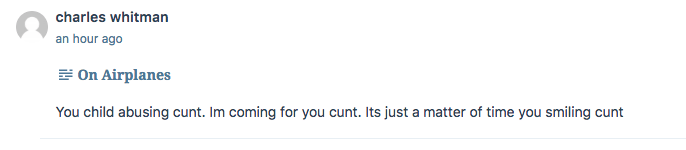
Two were comments on my blog, nothing unusual in that until I read them.  The first one said

6129818614366208.png

The next one said

4732758648422400.png

I showed my husband, Brandon, and tried to shrug it off.  After all, these aren’t the first vile comments I have received and they probably won’t be the last but he stopped me.  “What do you mean you have gotten comments like this before?  You haven’t told me that?!”

I guess in this day and age you just get used to it.  I see it happen all of the time, especially to women, and even more to women of color.  It seems to the price you pay to be public in a way, to being online.  Nestled in between all of the learning, the connections, and the book recommendations is your daily slice of hatred.   You have people who praise you, people who disagree with you, some in angry ways.  And then you have death threats against your family and yourself.

I blocked the commenter, deleted the comments after taking screenshots of everything. And yet, Brandon wouldn’t let it go.  “You should report it, just in case…” Sure it’s probably nothing, but still…And it was that “Just in case…” that made me do that very thing.

Because sure it is probably some kid somewhere having some fun.

Because sure it is probably some troll not caring who they wrote to or what they really said.

Because sure it is probably someone who just wanted to get a reaction and saw an easy way to do so.

But still, that small little thought is there; what if it’s not?

What if it’s not…

What if someone does want to hurt my children or me and I did nothing but shrug it off?

So I write this post to say it’s not okay.

It’s not okay for us to be a society where threats towards us and our families are so commonplace that we barely register when they happen.

Where language like what was posted to me is deleted rather than reported.

Where threats and the use of vulgar language are so common that we even hear people in power use them as if it is no big deal.

Where trolls and kids and whoever wants to hide behind their computers get to mess up your sense of security because who really cares how others feel, they were just joking anyway…

And because it happens so much we don’t even do anything about it.

It is a big deal.  And we have to remember that…

When kids say things in our classrooms that are not okay.

When people leave comments online that are not okay.

When those in power say things that are not okay.

We have to speak up, reclaim the conversations, and shift the power back.

So tonight, after I hung up with the police and they told me I did the right thing, while I didn’t feel much safer, I did feel right.  Like somehow me tracking that ISP.  Me documenting.  My writing and sharing let me reclaim a little piece of the power that someone tried to take away from me.  Because guess what?  I’m not done writing.


being a teacher, Reading

What’s In Our Reader’s Notebook

A frequent question I get while speaking to other educators is what does your reader’s notebook look like?  I usually don’t have a good answer because much like for many others it is a work in progress, every single year.  This year, however, it feels a little more solid as the year gets underway and we use the tools we have used previously with a few small tweaks added as we need them.

So what can you find in a student’s reader’s notebook this year?  In order, you will find…

Our To-Be-Read List

This is the very first page, hand-drawn by students, and used every single time we bookshop or have book talks.  Part of my check-in conferences means I peak at their to-be-read lists as well to say what they have on dock for their reading experiences.  All the list says is the title, author, and genre which just means where they can find the book. This is on page 1, 2, 3, and 4.

Our Who Are You as a Reader Quarter 1 Survey

This simple survey gets glued to page 5 as a way for me to see where they start the year as far as the relationship with reading.  As we re-take the survey throughout the year, the will be glued in after it (I screwed this up and did not leave pages for this so this year the rest will be glued in on the back pages).

Our Reading Challenge for the Year

On page 6 and 7 you will find our reading challenge documents as well as their personal reading goals for the year.  This is what we confer about for their first reading check-in.

Reading Rate Tracker

Inspired by Penny Kittle, we do a reading rate tracker once in a while to see how many pages a student should be reading every week or so if we ask them to read at least two hours outside of class.  This is glued in on page 8.  This helps us with the reading data we gather in class as students study their habits, set goals, and also increase their reading.

Books I have Finished

On page 9, we have another hand-written page simply titled “Books I have finished.”  This is where students write down any titles they finish.

Reading Response Pages

Then we have the rest of pages for reading response and anything else we need.  We did not want to tab out sections beforehand because we always get the section needs incorrect, which my smart colleague, Reidun reminded me of.  Instead, we plan on tabbing as we need to. I will say though that we do not write a lot of reading responses.  These are one of the top reasons students report hating to read, so we are very picky about when and what we have them write about to discuss their reading in their notebooks.

So there you have it.  Nothing too fancy, but it works for us for now.  We will add sections as we need them.


being a teacher, new year

At the End of the First Week

There is nothing like the first week of school tired, it seems.  Well, perhaps it’s only contender is the first week with a new baby tired.  We drag ourselves home, hoping that dinner has somehow magically arrived, that our house is not a mess, that our own kids are doing well because honestly, all we can think of is when we will get to go to bed.

While I love the first week of school, I always seem to forget how exhausting it is.  How the excitement quickly morphs into an overwhelming sense of “there is so much to do…” How the only kids we can compare these new kids to are the ones we just had, and those kids had it all figured out…

So as I drove home yesterday, overwhelmed by this long list of what I needed to do this weekend in order to simply teach my 90 minutes on Monday, feeling like maybe I was not that great of a teacher after all, I remembered a few truths shared by others, experienced by me, every single year…

They don’t know us yet.

They don’t know our routines even if we have spent all week teaching them.

They don’t know our expectations and so they are trying to figure that out and sometimes we are not as crystal clear as we think we are.

They are just as overwhelmed at times as we are.  Starting school is a whole lot of new and for some, it is a whole lot of negative.  We might not see that yet, but that doesn’t mean the emotions aren’t there.

It’s okay to slow down.  Your best-laid plans were based on fictitious children and now that the real children are here, our job is to make our plans fit the kids, not the other way around.

You are not a bad teacher if you haven’t reached every kid yet.  If you are still forgetting names even though you just knew them.  If you thought the lesson would be amazing when you planned it and it turned out to be mediocre instead.  You are not a bad teacher even if you feel like one.

So last night, as my kids played and got their boundless energy out (where do they get it from?), I did a simple thing; sent notes of appreciation home.  As I looked at my class lists, I remembered once again all of the great moments we did have in class, all of the kind behaviors, the kids who tried, the kids who smiled, the kids who didn’t think my crazy ideas were totally stupid.

The times when it did click.  When it did work, rather than the times where I had to repeat, reteach, restate.

As I sent each note home, the excitement that had been hidden by exhaustion came back; the promise of an amazing year, the hopes that I have so carefully stoked all summer.  These kids are awesome, we are the lucky ones who get to teach them.

Perhaps, like me,  you need to be reminded as well?

I cannot wait for Monday.


Be the change, being a teacher, Literacy, Passion, Reading, Reading Identity, student choice, Student dreams, student driven, Student Engagement, student voice

The Rights of Our Readers

Today was the second day of school.  the second day of trying to get to know these incredible kids that have been gifted to us.  The second day of trying to establish the seeds for the habits that will carry us through the year, hopefully leading us to a year where they leave feeling like this year was worth their time, that this year made a difference.

Today was the day of one of our big fundamental lessons; when reading is trash or magic.  I shared my past reading mistakes in teaching, we shared when reading sucks or when it is lit (student choice of words).  As the post-its crowded the whiteboard, the questions and statements inevitable came.  Will we have to read books you choose for us?  Will we have to write every time we read?  Will we have to do post-it notes?  All things that in the past, I would have answered yes to but now the answers are different.  You always choose your books, even in book clubs, you will have plenty of choices.  You will not always write after you read, sometimes you will, and because of the work of teachers before me, you will be better at it than ever before.  And post-its?  Sometimes, when it makes sense, but not every time and not at home.  Only here because at home I just want you to work on your relationship with reading, the skills teaching that will happen in class.

As we finished our conversation we merged into what their reading rights are this year.  the things that I will not take away.  The rights they have as individuals on a reading journey.  This is not my idea, nor something new, but once again the work of others who have paved the way for my better understanding of what developing student reading identity really looks like.  As we discussed what rights they would have and what they meant, I wrote an anchor chart, a reminder that will hang all year so we don’t forget just what we can do together.  What choices we may have.  As we went down the list, the relief was palpable, the excitement grew.  Even some of the kids who had not so gently told me how much they hated reading right away, looked less scared, less set in stone as we talked about what this year would like.

And so this is where we stand tonight…  Our very first anchor chart to remind us of what it means to be a reader that is honored within our community.  What it means to be a reader that already has a reading identity, that we will continue to develop together, honoring everyone wherever they are on their journey, rather than forcing our well-intended decisions down over the top of kids.  Perhaps, once again, this year kids will develop a better relationship with reading, will grow as readers, will grow as human beings.  What more could we hope for when it comes to teaching?

If you like what you read here, consider reading my newest book, Passionate Readers – The Art of Reaching and Engaging Every Child.  This book focuses on the five keys we can implement into any reading community to strengthen student reading experiences, even within the 45 minute English block.  If you are looking for solutions and ideas for how to re-engage all of your students consider reading my very first book  Passionate Learners – How to Engage and Empower Your Students.      Also, if you are wondering where I will be in the coming year or would like to have me speak, please see this page.
Be the change, being a teacher, Reading, Reading Identity

After Accelerated Reader

One of the questions, I am asked the most often is, “What do you do if you don’t have Accelerated Reader?” Or insert whatever computer program here.  It is a question filled with emotion, after all, change is hard, and for some kids, AR and programs like it seem to work.  For some teachers, it works.  And yet, it doesn’t work for all, it is expensive, and in my opinion, it is not worthy of the precious time we have with students every day.

Last night, as I sat surrounded by incredible passionate educators and leaders in the Imperial Valley in California, I was asked that question again, and here is how I answered it.

Giving up AR can be scary.  After all, it is a program that seems to tell us things we need to know; has this child read the book?  Have they understood it?  It is a program that allows us to chart progress, to reward growth.  To have an understanding of the complex process that is often hidden from view.  And yet, how much of AR is actually a true view?  How often are kids able to take the test without fully reading the book?  How often do they fail the test despite having read the book?  How often do we end up policing the testing, the book choice, the kids without actually doing meaningful work?

Our job as teachers is not to police reading, it is to support the love of reading.  There is a huge difference.

So we start by looking at the components already in place.  Every child deserves a classroom library, a school library staffed with a certified librarian.  Every child deserves a teacher who read children’s literature, who is knowledgeable and excited about reading.  Every child deserves time to read a self-selected book in a supportive reading environment.  Every child deserves to do meaningful work once they finish these books, building a reading community one book, one conversation, one connection at a time.

If we hold these components as rights, then the only thing AR really fulfills is the check off when it comes to whether a book has been read.  When we remove that, we must find other ways to see whether children are reading and whether they understand what they have read.

In my own classrooms, we have different methods to see whether kids are reading.  I have gone into more details about this here and also in Passionate Readers, but the first component is to simply kid watch.  How are they picking up books?  Are they picking up the same book day after day?  Are they making progress in the book?  We use Penny Kittle’s page tracker to help us see the page kids are on in class.  That way if a child is on the same page day after day, I know a conversation is waiting to happen.  Perhaps the book is boring, perhaps they don’t understand it, perhaps something is happening outside of class that is affecting them in class.  Either way, that small sheet of paper allows me to see if they are making progress.  I don’t need it as a reading log, I need it so that kids can take control over their own reading habits and see whether they are making true progress as they challenge themselves.  That way they have tangible data when we reflect at the end of every quarter.

We also set meaningful goals.  I recently wrote about what that looks like at the beginning of the year, but it is these goals that I discuss with kids.  While some may be quantity based, others are based on habit.  You may notice that so much of what we do is conversation based.  Not having a computer to tell me these things forces me to speak more to students, for them to actually reflect on their lives as readers, this is always a great thing.

When students finish a book, they often do what we adults do.  They recommend it.  They put it back on the shelf.  They hand it to someone to read it as well.  Sometimes they write about it in a reading response, but not often, because I have found that it is often all of the things we have kids do with their reading that actually makes them dislike reading.  This year, I will also have them do reading ladders, an idea created by Teri Lesene, explained here, so that students can ponder whether they are challenging themselves or simply reading at the same rung.  They also keep a list of books they have read, finished, or abandoned in their notebook and at any point, I can ask to see that.  This list is something we update in class so that the kids that forget also have a chance to do it.  For kids who are motivated by competition, I try to make it an internal one.   Can they beat last year’s numbers of books or some other goal?  I do not believe that reading should be rewarded with a prize because it tells kids that reading itself is not worthy of their time.  That it is something they are being bribed to do because it has no value on its own.  Reading is its own reward.

And finally, when it comes to the assessment of skills, I don’t need a test on a book to tell me whether they comprehend it.  I can either discuss the book with them even if I haven’t read it or I can use a common text, such as a short story, read aloud, or picture book to assess their skills of reading.  After all, all of the independent reading we do is for practice, for building the love, it is not to be graded, the skills we are developing are what we need to grade and that can happen with any text that we know together.

Getting rid of any component that has been a cornerstone of instruction is scary, it takes work, and it takes a change in practice.  But it is worth it for our students and the reading experiences they deserve.  I would recommend anyone who is looking to get rid of a computer program to really speak about the experiences that need to replace it.  How will that look on a day-to-day basis and also how it will help the students.

Teaching is hard work, it is easy to see how we can be persuaded to place children in front of computers to help us out.  To see the short-term gains sometimes from these programs.  And yet, what about the long-term?  At what point do children, and adults for that matter, need to internalize what reading really is?  A discovery of self?  A discovery of the world?  A transport into more understanding, more empathy, more imagination?  Removing AR is a process, but one that is worthy of our time, because kids deserve rich reading experiences at every level, and computers, no matter how well-tested their programs are, cannot provide the same meaningful interaction as we get from a conversation, real assessment, and building a community of readers.

To see more thoughts on AR please see Jen Robinson’s posts which showcase other work on it.  Donalyn Miller’s post on it and do take the time to read Stephen Krashen’s discussion of the research that AR uses as a selling point.
